














Register

Perfect the Pattern

Gemini Sparkle

Key Takeaways:

  • Flying a precise and predictable airport traffic pattern is crucial for safety, efficiency, and reducing risks for all pilots.
  • A good pattern begins with entering the downwind at pattern altitude and a 45-degree angle, maintaining consistent distance from the runway using visual references and adjusting for crosswinds.
  • Key maneuvers include beginning descent abeam the runway approach end, turning base when the runway is at a 45-degree angle behind you, and executing a shallow, early base-to-final turn to avoid overshooting, adding power if low.
  • On final approach, maintain centerline alignment using crabbing or side-slipping, and exit the runway promptly after landing to complete the pattern.
See a mistake? Contact us.

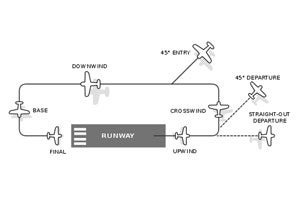
The traffic pattern around an airport keeps the flight paths of airplanes in the vicinity predictable. By following the same track, it is easier for pilots to see other airplanes approaching to land. But the safety and efficiency of the traffic flow is dependent on the pilots in the pattern. It can become quite frustrating to do pattern work around an airport with pilots who extend their downwind legs on each circuit, delaying each lap unnecessarily and increasing the risk for others as they’re forced to fly further from the runway than necessary. Therefore, you should learn to fly and stick to flying a perfect pattern.

A good pattern begins as you approach the airport. Make sure you descend to the pattern altitude before you enter the downwind at a 45-degree angle. This keeps you at the same altitude as others in the pattern and makes it easier for them to see you. If you’re flying a full pattern, try to track as close to the runway heading as possible after you take off unless noise abatement procedures prohibit a straight out departure. If there is a crosswind, crab into it to maintain a straight track.


Pia Bergqvist

Pia Bergqvist joined FLYING in December 2010. A passionate aviator, Pia started flying in 1999 and quickly obtained her single- and multi-engine commercial, instrument and instructor ratings. After a decade of working in general aviation, Pia has accumulated almost 3,000 hours of flight time in nearly 40 different types of aircraft.

Ready to Sell Your Aircraft?

List your airplane on AircraftForSale.com and reach qualified buyers.

List Your Aircraft
AircraftForSale Logo | FLYING Logo
Pilot in aircraft
Sign-up for newsletters & special offers!

Get the latest stories & special offers delivered directly to your inbox.

SUBSCRIBE
