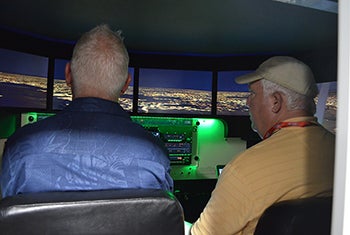


Some instructors say that flying can’t be taught in the cockpit. And while we have to fly a certain number of hours in an actual aircraft in order to earn the various levels of pilot certificates, there is some validity to this argument. In the cockpit, there are many distractions from the teaching process: traffic, ATC calls, weather, turbulence and simply flying the airplane. All that goes away in the simulator, making it an excellent tool for primary and recurrent training.
Not only are there no distractions in a simulator, but also when something happens during a training scenario in a sim you can pause the flight at any moment to discuss what may have gone wrong and why, or what was good about the most recent flight segment. You can also stop the simulator to discuss what will happen next. For example, if a student gets behind while setting up for an instrument approach, the simulation can be paused allowing the student to catch up. There is no way you can do that in an airplane with real air traffic controllers providing guidance. And best of all, no matter how badly you mess up, you, your passenger and the sim will remain unharmed.