
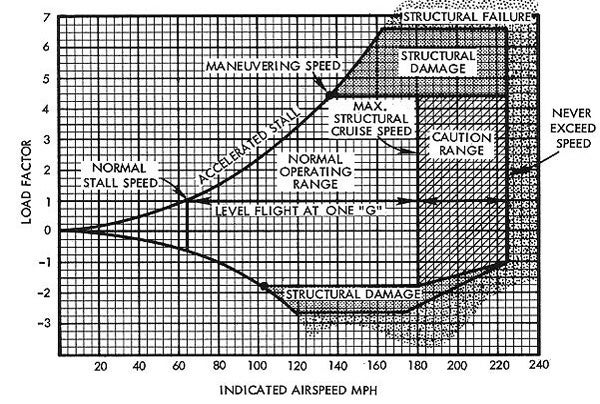


There are a lot of definitions out there for maneuvering speed (Va), including the textbook one that students deliver by rote, when asked. Unfortunately, most of the popular definitions don’t relate to the true meaning of this “life saving” speed. The best definition, albeit the shortest, is — “turbulence penetration speed” — the speed you should slow to as soon as possible when significant turbulence is encountered. But how much slower is that, really?
To understand the whole story, you need to look at a Vg Diagram — that’s the one you most likely last saw in your private pilot study materials. It’s a graph that illustrates the stall lines, the limit loads, ultimate limit loads and Vne as the “envelope” of the aircraft — and most of us have never seen an actual one for our aircraft! Va falls at the point where the ‘positive limit load’ line intersects the ‘stall’ line on the positive ‘g’ portion (upper) of the diagram. And we are told that if we are flying at that speed, the airplane stalls before it exceeds the limit, and thus can sustain no damage.