
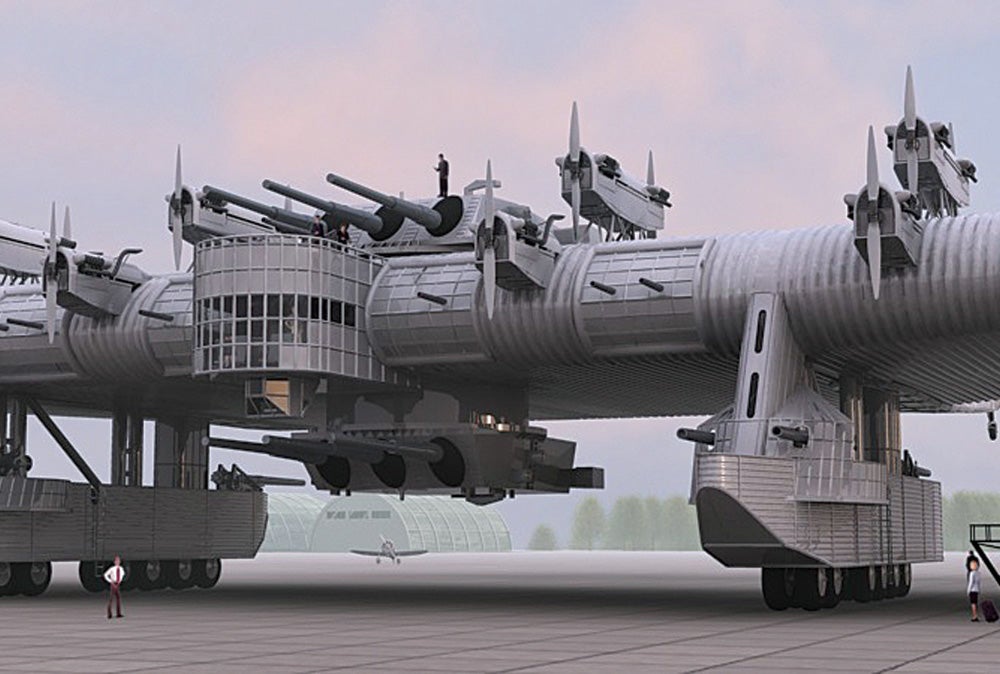


May 2010 ONE OF THE MORE persistent hoaxes drifting about on the Internet concerns an airplane called the Kalinin K-7. Built in the early 1930s, the K-7 was Russian, and big. Really big. Russian designers those days displayed a positive passion for sheer size; Igor Sikorsky’s Ilya Muromets, for example, which flew just 10 years after the Wrights’ first powered hop, had four engines and a wingspan of more than 100 feet. The British firm of Handley Page built something similar. But the K-7 dwarfed them all. Its wing was an immense ellipse with a span of 174 feet — just 20 feet shy of a 747’s — eight feet thick and 35 feet from leading to trailing edge at the center. In a civil version, 120 passengers were to be seated spanwise within the wing. Twin booms supported the smallish empennage, and six engines of 750 horsepower each stood side by side on its leading edge. One or two pusher engines — reports differ — were added when the gigantic monoplane, which was of steel construction, was found to be heavier than anticipated. Its reported all-up weight was 84,000 pounds.
The K-7’s landing gear was unusual, being carried in two pods resembling amphibious floats but about the size of motor homes. In the military version, these were equipped with machine gun turrets. They were connected to the main structure by a thicket of struts and by a couple of very large tubes that, I suppose, housed stairways for the gunners.