











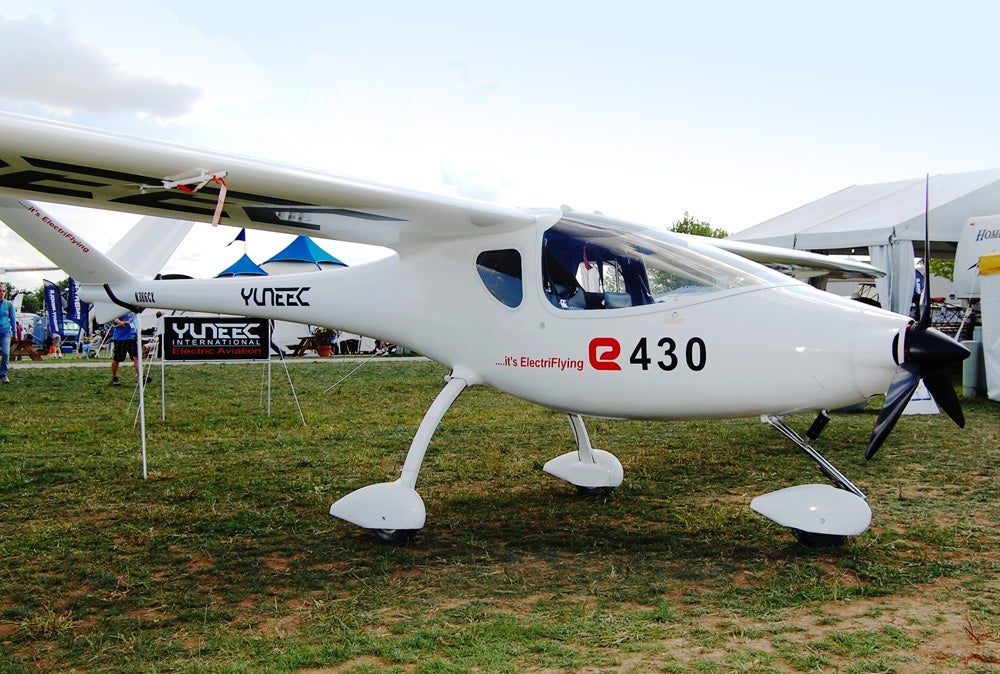
I don’t usually turn to The Economist for aviation news, but the June 12 edition had a two-page article on the emergence of alternate-power aircraft. Examples included the ’round-the-world hopeful Solar Impulse and several electric-powered aircraft, including the Chinese Yuneec e430 which made its debut at EAA AirVenture last year. While allowing that the prospect of electric flight is exciting, the author nevertheless points out that the energy density of ‘petrol’ (remember, The Economist is British) is 25 times that of the lithium-ion batteries used in the most modern electric aircraft. But even with that, the article cites Randall Fishman’s two-seat Electra-Flyer-x project, with expected endurance of two hours and cruise speed of 128 kilometers per hour (sorry, that’s 80 statute miles per hour/approximately 68 knots). Yuneec company founder Tian Yu recently completed construction of his factory outside Shanghai, and expects his two-place e430 to fly as long as three hours (at a cost of $5 per hour) and sell for $89,000 — and yes, that’s ‘batteries included.’
Electric Aircraft Generating Public Interest

Key Takeaways:
- The article highlights the emergence of alternate-power aircraft, including electric models, while noting that the energy density of petrol is significantly higher (25 times) than that of modern lithium-ion batteries.
- Despite these energy density challenges, practical electric aircraft projects are advancing, such as Randall Fishman's Electra-Flyer-x with a two-hour endurance and the Chinese Yuneec e430.
- The Yuneec e430, a two-seat electric aircraft, is expected to offer up to three hours of flight endurance at a low operating cost ($5 per hour) and sell for $89,000, including batteries.
Key takeaways sponsored by Aviator Pro | Start Your Training ->
See a mistake? Contact us.

