Close

Member Login

Logging In
Invalid username or password.
Incorrect Login. Please try again.

not a member? sign-up now!

Signing up could earn you gear and it helps to keep offensive content off of our site.

FBI, FAA Investigate Alitalia Pilot’s Report of Close Call with Drone

By Bethany Whitfield / Published: Mar 07, 2013
Rate it! or
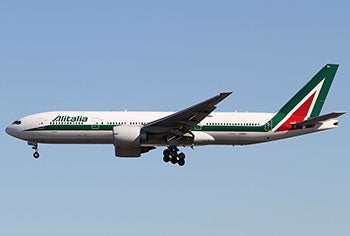
Federal investigators are looking into the unmanned aircraft sighting reported by an Alitalia pilot landing at JFK on Monday afternoon, an event that has evoked larger fears of the planned widespread integration of unmanned aerial vehicles into American airspace.
 
The 777 was on final approach to Runway 31R around 1:15 p.m. when one of the Alitalia pilots told the tower controller he saw a black drone with four propellers that was no more than 3 feet wide. According to the FAA, the craft was flying at an altitude of 1,750 feet at the time and came within 200 feet of the airliner. The Alitalia flight, which originated in Rome, landed safely without taking evasive action.
 
The event triggered FBI and FAA investigators to issue an alert on Tuesday requesting assistance in identifying the craft and its operator. Officials believe the unmanned vehicle could have been a model aircraft, which are restricted from surpassing an altitude of 400 feet agl and must stay at least three miles clear of airports, according to federal regulations.
 
The incident has drawn a new wave of national attention to the growing concerns surrounding the incorporation of drones into American airspace, a process that is to be completed by September 2015, according to legislation enacted by Congress last year. While it is difficult to pinpoint the exact number of unmanned aerial vehicles flying today, the Los Angeles Times recently reported that the FAA has issued 1,428 unmanned aerial vehicle operating permits to domestic parties since 2007. According to some estimates, American skies could see up to 30,000 drones flying by 2020.

Comments (3) Post a comment

All Comments

cconrad's picture

Thank you for calling this a "close call" rather than a "near miss".

sam2sam's picture

Drone usage promises to aid the identification, monitoring, capture, and if need be execution of terrorists and others who represent a clear and present danger to the United States.

Further, an ever-increasing number of U. S. citizens at home and abroad wish us harm, so they are included, without distinction, as potential targets.

The problem is the current rules for drone usage lack clear definitions for the operational terms “material support,” "The potential intelligence value of the individual,” and the all-inclusive phrase "Such other matters as the President considers appropriate.” It’s Catch-22 with no way out.

Under the law as currently written, any U. S. citizen who is a war protester, publicly exhibits anti-government sentiments, is a Tea Party activist, or a political opponent of a given Administration could fall (or be made to fall) under one or more ill-defined and ambiguous conditions and therefore be deemed an "enemy combatant".

If the Feds believe you are committing a “suspicious activity” or “supporting hostilities,” you can be hauled off and held indefinitely in military custody with neither legal recourse nor due process. Your Constitutional rights to free speech and personal liberties would disappear with the stroke of a hidden pen.

Cleverly invented to counter growing terrorism, drones usage offers no controls nor checks and balances to prevent them from being used for politically nefarious purposes.

Imagine what Richard Nixon would have done if he’d had such peremptory or discretionary presidential authority? Any of his antagonists, like Daniel Ellsberg, would have monitored by domestic drones... and then Ellsberg would have been picked up and held for providing “material support” to the enemy in a time of war.

There are currently no discernible safeguards to prevent a paranoid and power hungry President (think Johnson, Nixon, or Obama), or his/her national security team, from using drone technology as a threat and/or punishment to political enemies, particularly given the exigencies of war or a domestic emergency like 9/11.

For national security purposes, Americans are already subject to warrantless wiretaps of calls and emails, the warrantless GPS “tagging” of their vehicles, the domestic use of Predators or other spy-in-the-sky drones, and the Department of Homeland Security’s monitoring of all our behavior through “data fusion centers.”

http://www.wired.com/threatlevel/2012/03/ff_nsadatacenter/

Given this toxic mashup of losses of privacy, if the road to hell is paved with good intentions, then domestic drones are a superhighway to an Orwellian panoptic gulag.

America’s promise has always been the power of the many to rule, instead of the one. Ungoverned drone usage, particularly domestically, gives power to the one.

Domestic drone usage is ill-conceived, elitist, and end-runs our inherent Constitutional protections.

Here are two (2) different videos that anchor my points:

http://www.youtube.com/watch?v=ssoOASanKao

http://vimeo.com/59689349

Flywyrless's picture

While I understand the concern over privacy, I would be more inclined to worry about airspace rights. The Alitalia flight to New York is a case in point. Drones are easy to buy, build and fly. For around €550 DJI (http://www.dji-innovations.com) offers a simple drone with complete a way-point navigation software that you can load onto your tablet and fly. Whereas earlier multicopters required the ability to fly a radio-controlled aircraft, todays RC drones can be "piloted" by anyone. At the simple push of a button, the aircraft reaches altitudes that put commercial aircraft in danger.

Yes, it is true that drones have the added ability of carrying cameras and can be used to spy on people. But let's be realistic, one's privacy can be much more easily (and cheaply) violated by CCTV, wireless cameras and wire taps. Technology has pushed our ability to observe anyone at anytime and never be detected. Camera lenses have been reduced to a fraction of a millimeter and hidden in the head of a philips screw, the center of a Levi's jeans fly button, even within the single line of a bar code. Security companies offer ordinary household smoke detectors with cameras hidden in the barcode of the sticker on the side. They are literally impossible to spot.

The debate over drones is simply a growing pain. Much like genetic engineering, science has jumped ahead of legislation, the media has sensationalized the story and politicians are scrambling to catch up (and/or look opportunistically at the hype to leverage their candidacy for 2016). Because of the advantages and cost savings they offer, drones are here to stay. It is only a matter of time until we as a population accept them and settle down to worry and debate about the next big issue.

Top Rated

Your Comment
CAPTCHA
This question is for testing whether you are a human visitor and to prevent automated spam submissions.
All submitted comments are subject to the license terms set forth in our Privacy Policy and Terms of Use