Register

Archer Plans Electric Air Taxi Operations at GA Facilities in Texas

Commercial passenger service won’t begin immediately, but the company is beginning to lay the groundwork.

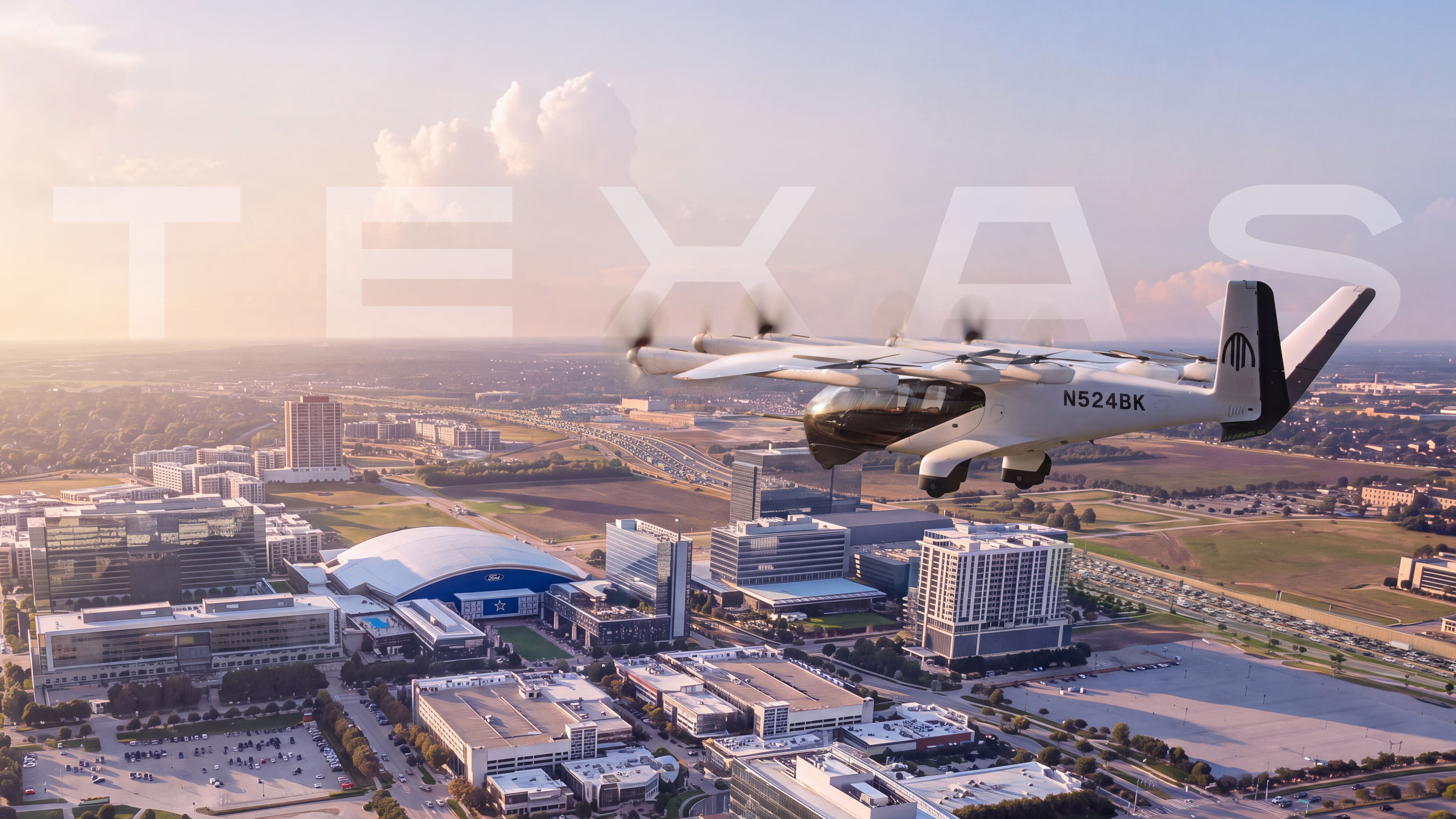
Rendering of Archer Midnight electric air taxi flying over Dallas Texas
A digital rendering shows Archer’s Midnight electric air taxi flying past the headquarters of the NFL’s Dallas Cowboys within Frisco Station, a planned node in its Texas network. [Credit: Archer Aviation]

Users of certain general aviation facilities in Texas will soon catch a glimpse of electric vertical takeoff and landing air taxi demonstrations, with commercial passenger service to one day follow.

Archer Aviation, which is pursuing FAA certification of its four-passenger Midnight eVTOL air taxi, on Friday shared maps for planned networks covering Dallas-Fort Worth, Houston, and Austin. The networks include FBO locations and other GA facilities across the three cities.

Eventually, Midnight will use vertiports—heliports designed to accommodate eVTOL aircraft—for its operations. But the aircraft is also designed to take off conventionally from a runway, and Archer plans to bring it to Texas for demonstration flights ahead of expanded VTOL testing and certification.

The company plans to install electric aircraft chargers across the Texas Triangle to support its planned participation under a federal pilot program designed to gather operational data on the novel aircraft.

“Our planned networks will make the benefits of electric air taxis real for Texans—trading hours in traffic for minutes in the air, while connecting the biggest airports, business districts, and sporting hubs in ways that America’s largest megaregion needs to grow,” said Archer founder and CEO Adam Goldstein in a news release.

The all-electric Midnight is intended to provide quiet, zero-emission, 10-20-minute flights, with a maximum range of 100 miles and speed up to 150 mph. It comprises 12 propellers, half of which support only vertical takeoff and landing. The other six are tilt propellers designed to enable the aircraft’s transition from vertical to wingborne flight.

Midnight will be piloted at launch, but Archer is working toward future uncrewed operations. It recently acquired autonomous eVTOL developer Wisk Aero from Boeing and is developing Zee, an AI foundation model designed to provide copilot assistance and handle ATC communications, among other capabilities.

Air Taxis at GA Facilities

Maps shared by Archer detail exactly where the company plans to demonstrate and later operate Midnight.

Dallas-Fort Worth

The Dallas-Fort Worth network would comprise:

  • DFW Corporate Aviation at Dallas Fort Worth International Airport (KDFW)
  • Signature Aviation and Atlantic Aviation terminals at Dallas Love Field (KDAL)
  • Atlantic’s location at Addison Airport (KADS)
  • Arlington Air Center at Arlington Municipal Airport (KGKY)
  • Modern Aviation’s FBO at Fort Worth Meacham International Airport (KFTW)
  • Alliance Aviation Services at Perot Field Fort Worth Alliance Airport (KAFW)
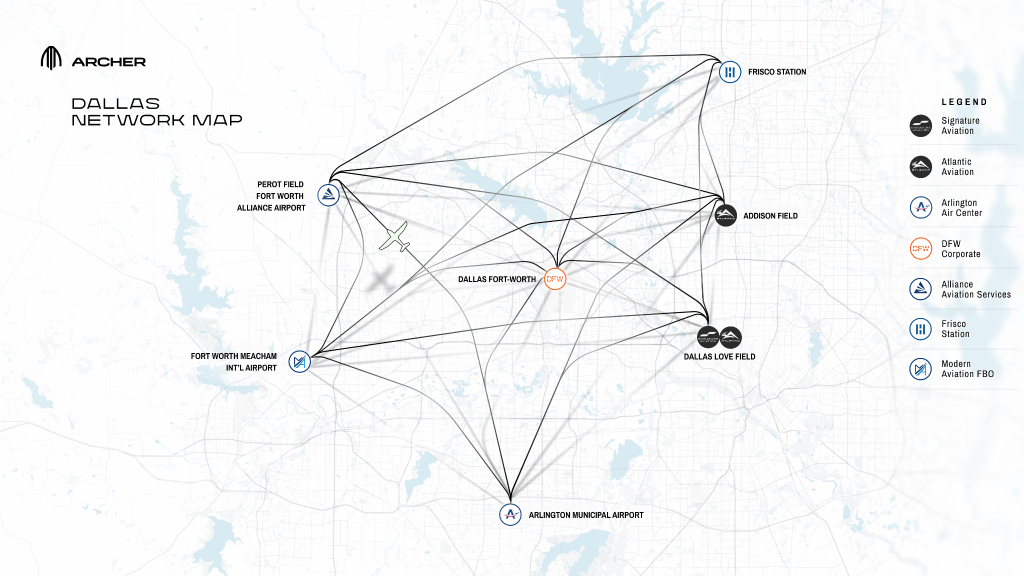
Archer planned Dallas-Fort Worth air taxi network map
Archer’s planned Dallas-Fort Worth network [Credit: Archer Aviation]

Travelers would be able to fly from those sites to locations such as the 242-acre Frisco Station business hub, which also surrounds residential communities, hotels, and the headquarters of the NFL’s Dallas Cowboys. The company is partnering with real estate developer Hillwood, which is part of the joint venture that owns Frisco Station.

Transport to sporting events is one of Archer’s key focuses. The company in 2024 said it was in discussions with the Los Angeles Rams on potentially exclusive vertiports near SoFi Stadium in Inglewood.

Houston

Archer also plans to fly Midnight out of Signature’s terminals at George Bush Intercontinental Airport (KIAH) and William P. Hobby Airport (KHOU), as well as GlobalSelect at Sugar Land Regional Airport (KSGR). Its subsidiary Wisk in 2024 announced partnerships with the city of Sugar Land and Houston Airports, the city’s department of aviation, to explore bringing operations to these three airports.
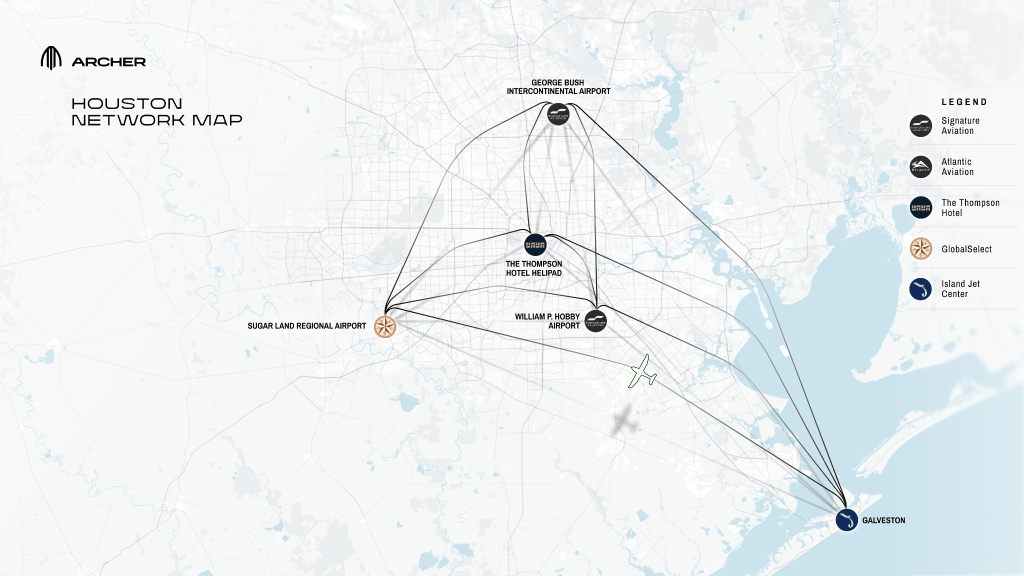
Archer planned Houston air taxi network map
Archer’s planned Houston network [Credit: Archer Aviation]

The Houston network would connect to downtown Houston’s Thompson Hotel Helipad. It would also link to the Island Jet Center in Galveston, offering access to beaches.

Archer’s customer and investor United Airlines uses George Bush International as its primary Texas hub. The carrier in 2021 placed a conditional order for up to 200 Midnight aircraft and in 2022 made a $10 million predelivery payment for 100 of those aircraft.

Austin

The smallest of the three networks, Archer’s map of Houston includes Signature’s Austin-Bergstrom International Airport (KAUS) location and the Henriksen Jet Center at Austin Executive Airport (KEDC).
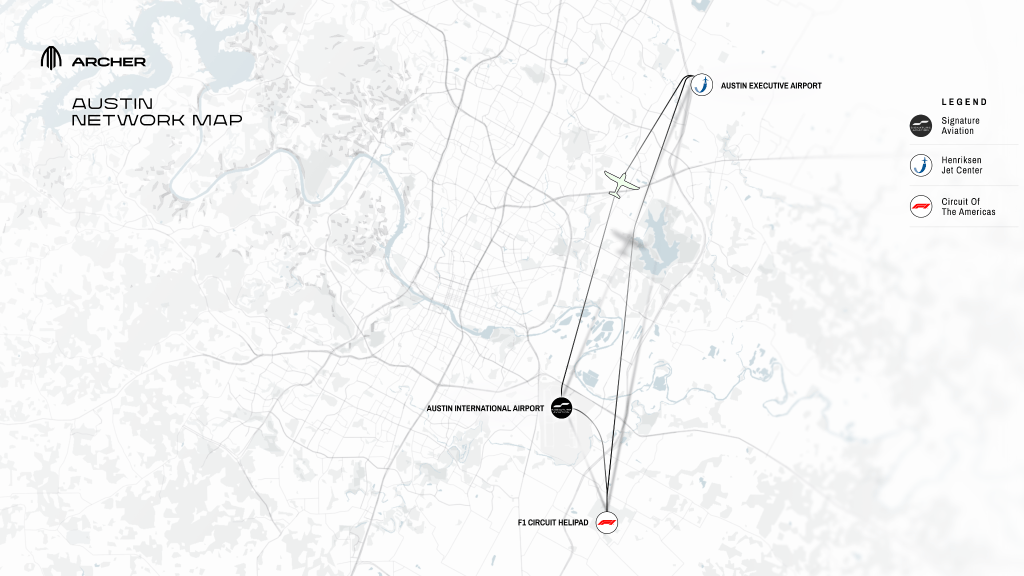
Archer planned Austin air taxi network map
Archer’s planned Austin network [Credit: Archer Aviation]

The network would offer transport between Austin-Bergstrom and Austin Executive Airport to the helipad at the Circuit of The Americas, providing access to Formula 1 auto racing events.

Midnight will be on display Friday and over the weekend at the Formula 1 United States Grand Prix, though it will not fly there.

Not Just Texas

Texas is the fifth market for which Archer has provided maps of its planned networks, joining the San Francisco Bay Area, New York City, South Florida, and Los Angeles. In LA, the company owns the lease to Hawthorne Municipal Airport (KHHR) and has announced plans to build a vertiport in the downtown area.

Vertiport infrastructure at GA locations in the other markets could soon follow. Outside Texas, the manufacturer is partnering with Signature, Atlantic, Modern Aviation, Clay Lacy Aviation, and Skyports, as well as regional partners that operate one or a handful of sites.

The networks will be powered by chargers purchased from competitor Beta Technologies. Through a joint effort, the companies plan to install 250 systems across Texas, New York, California, and Florida.

When Will Midnight Arrive?

Archer is preparing for operational activities under the FAA’s eVTOL Integration Pilot Program (eIPP) in the coming months. It is part of projects led by the Texas Department of Transportation, Florida Department of Transportation, and Port Authority of New York and New Jersey.

The company in recent weeks conducted demonstration flights at airports in northern California and plans to bring Midnight to LA next, followed by Texas and Florida. Planespotters in those states could be the first to witness the air taxi transition from vertical to wingborne flight, which Archer in March said it was “on track” for later this year.

Routine commercial passenger service will take a bit longer to materialize. Though Midnight is designed for both vertical and conventional runway takeoffs, Archer has yet to demonstrate a crewed transition, which will be key in its certification efforts.

However, the company is ramping up testing. Per FlightAware, its preproduction prototype flew 16 times between October 13 and 18, making at least one sortie per day. Its production-representive, VTOL-capable test aircraft flew twice on Tuesday according to FlightRadar24.

Archer stopped providing a firm certification timeline after repeatedly pushing back the milestone. But with plans to fly at the Los Angeles Olympic Games, it will likely seek to complete the certification process by 2028.


Jack Daleo

Jack is a staff writer covering advanced air mobility, including everything from drones to unmanned aircraft systems to space travel—and a whole lot more. He spent close to two years reporting on drone delivery for FreightWaves, covering the biggest news and developments in the space and connecting with industry executives and experts. Jack is also a basketball aficionado, a frequent traveler and a lover of all things logistics.

Tillamook Air Museum Set to Reopen as Roof Repairs Progress

Historic WWII hangar in Oregon to welcome back visitors less than a year after suffering severe storm damage.

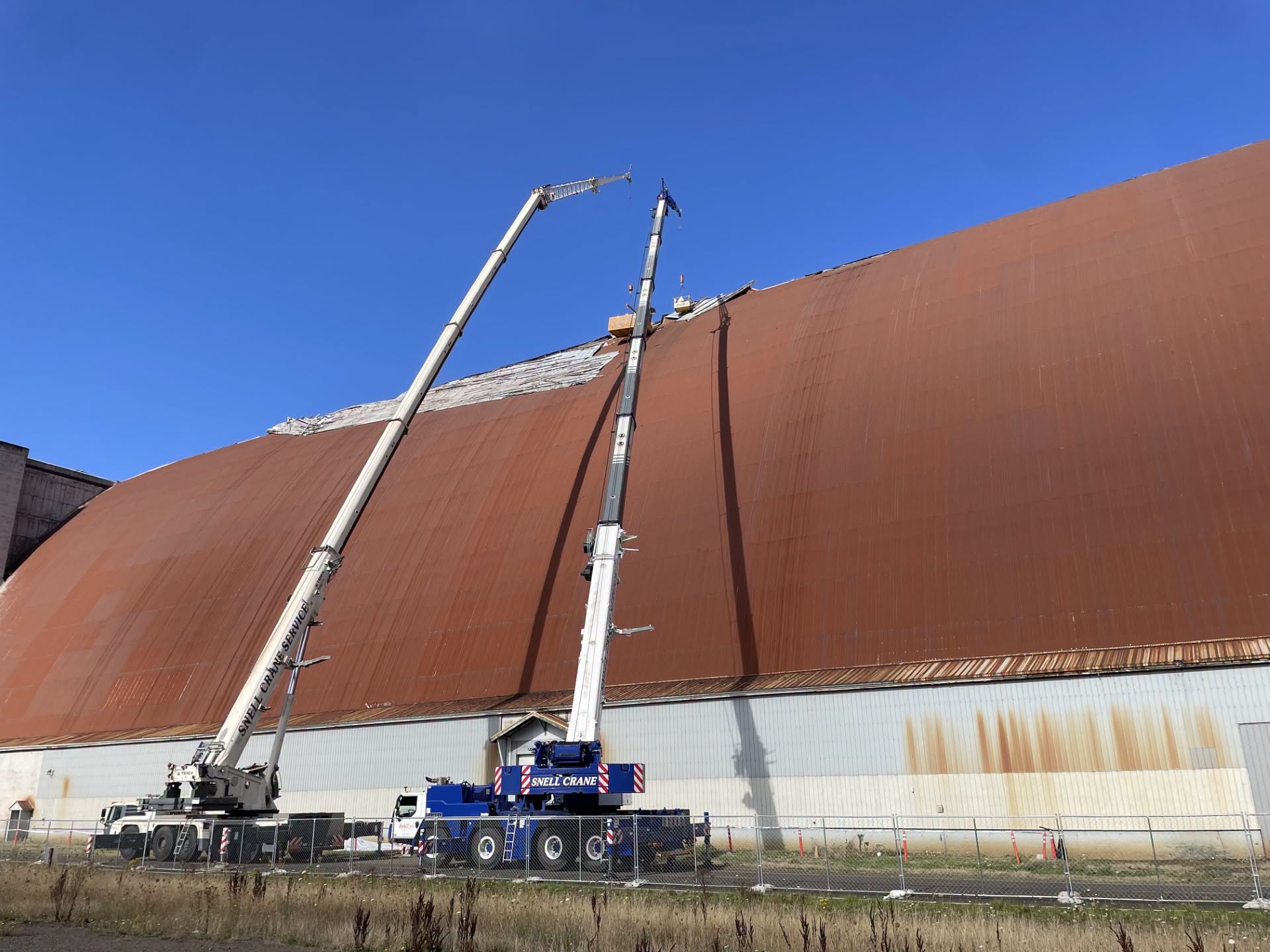
Tillamook Air Museum in Oregon is set to reopen on October 29, as roof repairs to Hangar B continue. [Credit: Tillamook Air Museum Facebook page]

Less than a year after a fierce windstorm ripped a colossal 180-by-30-foot hole through its historic roof, Oregon’s Tillamook Air Museum is set to stage a triumphant comeback, reopening its doors to the public at 10 a.m. PDT on October 29.

The weather damage wrought on December 18, 2025, was both severe and hard to reach as the World War II wooden hangar is 192 feet tall, and the hole was at the apex of the roof. 

Hangar B has been home to the museum since 1994. There were questions about how and if the Port of Tillamook Bay, which owns the property, would be able to make repairs since the cost and logistics of reaching the damage made the project particularly challenging.  

Immediately following the storm, volunteers moved aircraft and other artifacts inside the museum to protect them from the elements. Tarps were deployed to protect the artifacts while museum, state, and local officials discussed the facility’s future.

For a time it seemed the museum would not reopen as the cost of repairs were more than the Port of Tillamook Bay could handle.

In August the nonprofit Vintage Aviation Museum (VAM) out of Spanish Fork, Utah, signed a land lease and future sale agreement with the port. The VAM took ownership of the hangar and museum and with the support of volunteers and the nonprofit group Friends of Tillamook Hangar (FOTAM) repairs became a possibility.

About the Building

Hangar B was built during World War II when the U.S. Navy used the coastal airport as a blimp base. The blimps, known as K-ships, flew submarine patrols off the West Coast. 

Earlier in October, two mobile cranes from Snell Crane Service in Olympia, Washington, arrived on sight to make repairs to the roof while volunteers helped clean the aircraft and exhibits inside the hangar to prepare it for reopening.

“All of our exhibits are back in place, and we are ready to welcome visitors on October 29,” said Christian Gurling, museum director and curator. “An incredible amount of work has gone into preparing for this reopening, and we look forward to sharing the museum with our community again.”

The museum is able to be open while repairs are being made to the 1,072-foot-long hangar.

“Fortunately, we did not need to redesign the museum layout or relocate exhibits to accommodate the repairs,” Gurling said. “The roof opening is at the south end of the hangar, while the museum operates at the north end, well away from the affected area. The repair area has been fenced off for safety and will remain closed while the work is underway. The roof flap, the large area of the roof that has been hanging from the hangar, was completed October 21.”

The milestone represents a significant step forward for the facility’s long-term preservation and historical mission.

“It’s an incredible feeling, but more than anything, it’s an enormous responsibility,” said Sean O’Brien, president of the Vintage Aviation Museum. “Hangar B isn’t just an old building. It’s a living piece of American history and a testament to the men and women who served our country during World War II. Buildings like this are irreplaceable, and once they’re gone, they’re gone forever. We recognized that we had a rare opportunity to step in and ensure that this remarkable structure would not only survive but thrive for generations to come.

“For us, this isn’t simply about saving a building or operating an aviation museum. It’s about honoring the past, preserving history, and creating something truly special for future generations to experience. We’re incredibly proud to be part of that effort, and in many ways, we’re just getting started.”

The museum operates with a combination of paid staff and volunteers, with all expected to be on hand for the grand reopening.

Meg Godlewski

Meg Godlewski has been an aviation journalist for more than 24 years and a CFI for more than 20 years. If she is not flying or teaching aviation, she is writing about it. Meg is a founding member of the Pilot Proficiency Center at EAA AirVenture and excels at the application of simulation technology to flatten the learning curve. Follow Meg on Twitter @2Lewski.

This 1984 Piper PA-60-700P Aerostar Is a Rare, Famously Fast  ‘AircraftForSale’ Top Pick

Known as one of the fastest piston twins ever built, the pressurized, turbocharged version boosts speed by flying high.

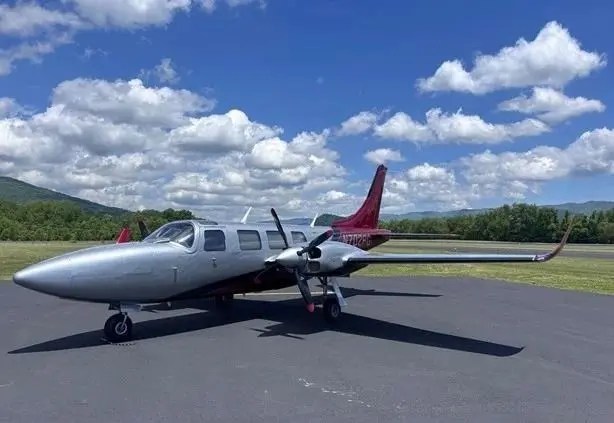
1984 Piper PA-60-700P Aerostar [Credit: Scott MacDonald Aircraft Sales]

Each day, the team at Aircraft For Sale picks an airplane that catches our attention because it is unique, represents a good deal, or has other interesting qualities. You can read Aircraft For Sale: Today’s Top Pick at FLYINGMag.com daily.

Today’s Top Pick is a 1984 Piper PA-60-700P Aerostar.

Pilots opt into light piston twins for a range of reasons. The common thread is that they all want more of something, such as climb performance, load-carrying capacity, or safety through redundancy. But let’s be completely clear—the big attraction is raw speed.

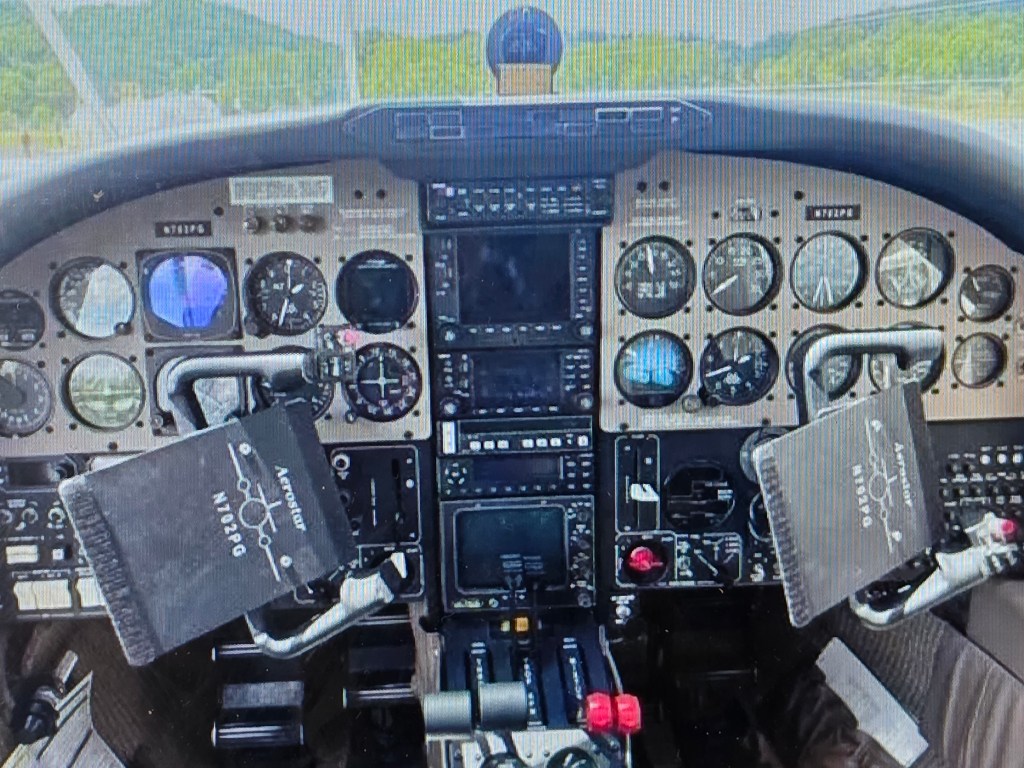
The Aerostar’s panel includes updated GPS nav/coms. [Credit: Scott MacDonald Aircraft Sales]

Not all twins are especially fast. Indeed, high-performance singles often make a better case for rapid, time-saving travel while utilitarian twins like the Piper PA-23 Aztec and Beechcraft Travel Air focus more on other advantages of having two engines. For many buyers, though, the best argument for a light twin is expressed in knots.

When we talk about fast twins, the Cessna 310 and Beechcraft Baron typically start the conversation. These longtime rivals are fast enough for many pilots, and souped-up versions, such as the Jack Riley-modified Rocket and Turbostream 310s, offered big performance increases.

But for aviators bent on getting the most out of a pair of piston engines, the Aerostar is the answer.

Designed by engineering whiz Ted Smith, who also brought us the Aero Commander light twins and A-20 Havoc and A-26 Invader bombers of World War II, the Aerostar was built for speed from the beginning and only got faster with time—and horsepower. The model evolved from naturally aspirated, unpressurized beginnings through a number of high-flying, turbocharged, and pressurized versions.

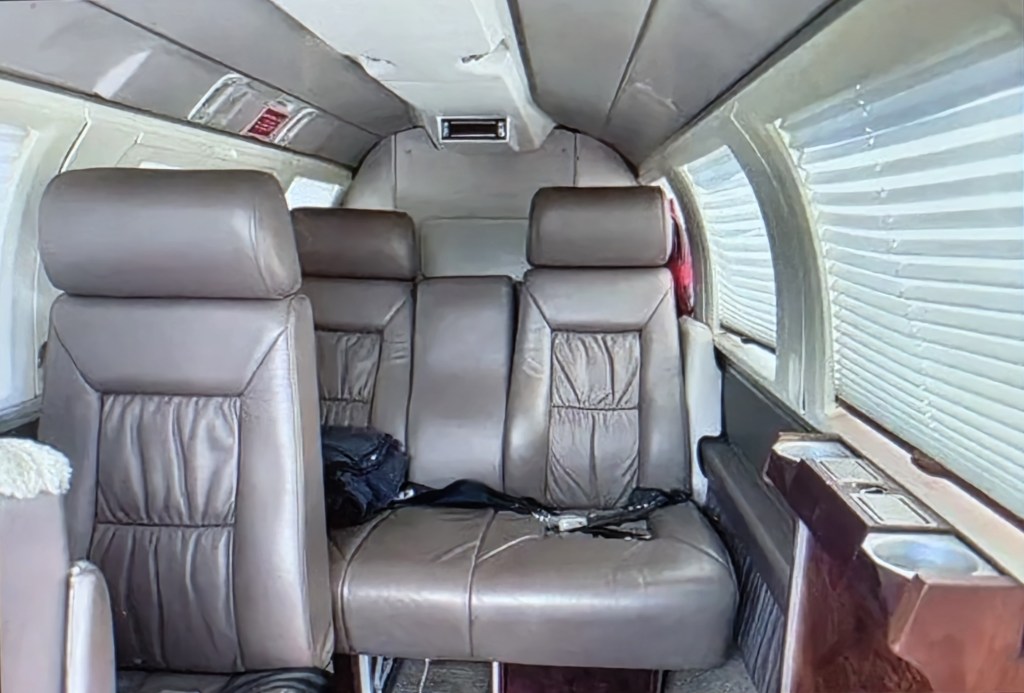
This Aerostar has a comfortable, pressurized cabin. [Credit: Scott MacDonald Aircraft Sales]

The aircraft for sale today is among the latest Aerostars, built during the last year of production after Piper acquired the design. Many consider it the ultimate iteration of this desirable machine. With seven seats and many upgrades to the cockpit and cabin, it would make a fantastic family and business transport.   

This 1984 Aerostar has 3,249 hours on the airframe, 892 hours since top overhaul, 1,766 hours since new on its 350 hp, counter-rotating Lycoming TIO-540-U2A engines, and 98 hours since overhaul on its four-blade, composite MT propellers.

The panel includes Garmin GNS 530 and GNS 430 WAAS GPS/nav/coms, GDL 69A, remote datalink receiver, GMA 347 audio panel, GTX 345 with ADS-B In and Out, King DME, Bendix KWX 56 weather radar, King KFC 150 autopilot, Hoskins CFS 2000A digital fuel monitoring system, and Gemini 1200 dual engine monitor.

Additional equipment includes full ice protection, air conditioning, engine synchrophaser, enhanced cabin air ducts, and heavy-duty brakes.

Pilots who want to cover more ground in significantly less time during cross-country trips, and those who have always believed that doubling the number of engines on an airplane should also double its cruising speed, should take a serious look at this 1984 Piper PA-60-700P Aerostar, which is available for $387,000 on AircraftForSale.

If you’re interested in financing, you can do so with FLYING Finance. Use our airplane loan calculator to calculate your estimated monthly payments. Or, to speak with an aviation finance specialist, visit flyingfinance.com.

Jonathan Welsh

Jonathan Welsh is Lead Editor of Aviation Consumer and a private pilot who worked as a reporter, editor and columnist with the Wall Street Journal for 21 years, mostly covering the auto industry. His passion for aviation began in childhood with balsa-wood gliders his aunt would buy for him at the corner store. Follow Jonathan on Twitter @JonathanWelsh4

Bombardier Plans $270M U.S. Expansion After ‘Deal’ With Trump

President implies American officials working with his administration helped orchestrate business jet manufacturer’s fresh investment.

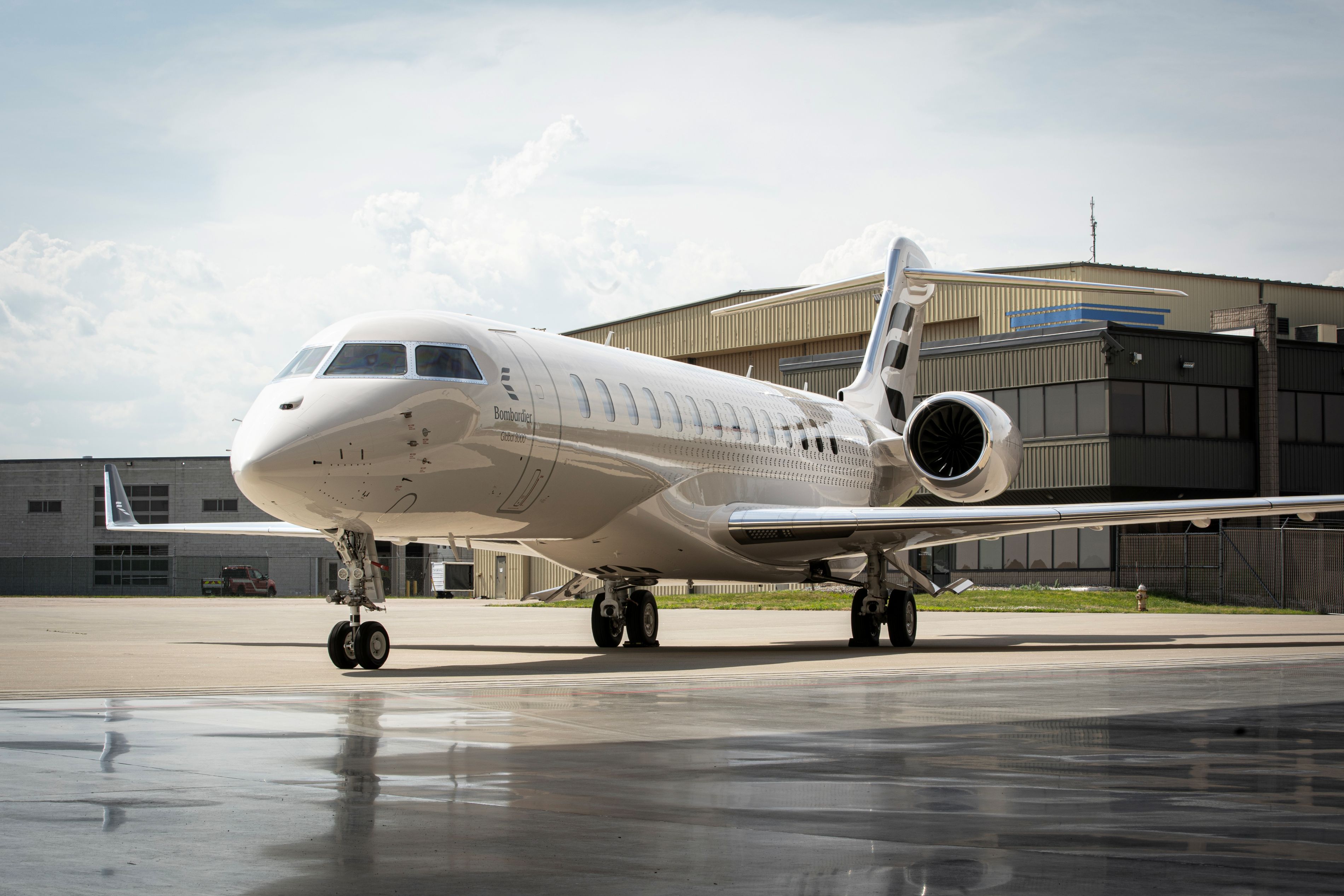
Bombardier Global 8000 business jet at service center
Investment follows President Trump’s threats to decertify and ban U.S. sales of Bombardier business jets such as the Global 8000 (above). [Credit: Bombardier]

Bombardier plans to invest at least $270 million in an American expansion following what President Donald Trump described as a “deal” orchestrated by U.S. officials working with his administration.

In a post on his social media platform Truth Social on Thursday night, Trump wrote that the business jet manufacturer’s $270 million investment will create thousands of American jobs in Wichita, Kansas, home to the company’s U.S. headquarters, as well as Texas and Indiana. The president implied that the move came about because of the efforts of Republican Senator Roger Marshall of Kansas and Texas Attorney General Ken Paxton.

“Senator Marshall, together with Attorney General Ken Paxton of Texas, has done an incredible job in getting this deal done,” Trump wrote. “They are strong fighters for American workers.”

Bombardier in a news release Friday confirmed the investment, calling the $270 million the “initial” or “first phase” of a planned expansion.

The move follows Trump’s threats against the manufacturer in January and September, which he appeared to walk back this week. The president on Monday said he would “take good care” of Bombardier after previously vowing to decertify the Canadian manufacturer’s aircraft and shut it out of the U.S. market.

“Based on our constructive conversations with the U.S. administration, we see a bright path forward for our highly skilled aerospace workers as well as a positive environment for Bombardier to continue pursuing direct investments to grow our American footprint,” said Eric Martel, president and CEO of Bombardier, in the company’s news release.

A spokesperson for Bombardier told FLYING the company could not comment more on the nature of the discussions beyond what is stated in the release, referring to Martel’s remarks.

Bombardier’s U.S. Expansion

Bombardier said it intends to hire 800 American workers in Kansas, Texas, Indiana, and Connecticut during the first phase of its expansion.

The manufacturer said it is “actively recruiting” for 500 of those positions and plans to create 300 additional jobs by “significantly” enhancing its U.S. footprint with infrastructure investments. It said Texas will account for 150 of the 300 new roles, describing the state as the “next pillar of expansion” and specifically highlighting Dallas.

“This new wave of expansion and hiring reflects our long-term confidence in this market and our employees in America,” Martel said.

Bombardier is in the middle of what a spokesperson described to FLYING in September as a large-scale American expansion.

That includes a recent $50 million investment to expand site capabilities and train new aviation personnel in Wichita, where it inaugurated a new North American Learning Center last week. The city is also home to Bombardier’s defense division and a major service and flight test center.

The manufacturer also plans to open a new service center at Fort Wayne International Airport (KFWA) in Indiana in November. The approximately 64,500-square-foot facility, announced in late 2025, will house up to six aircraft and offer scheduled and unscheduled maintenance, modifications, avionics installations, and AOG support, it said.

Citing a study conducted on its behalf, Bombardier said its U.S. activities in 2025 supported 27,200 American jobs and that the figure is expected to surpass 33,000 “based on current hiring and expansion plans.”

The manufacturer said it invested $2.8 billion in its U.S. supply chain in 2025, which it said in September comprises roughly 2,800 American companies across 47 states. Its overall direct employment presence covers more than 20 states.

Bombardier vs. Trump

Trump on Monday seemed to reverse his stance on Bombardier, saying that he “always viewed them as a Canadian company” but had learned of its sizable U.S. presence.

“We’re not hurting them if they’re in Kansas,” the president said. “So we’ll take care of those people and the jobs.”

Less than two months prior, amid broader U.S.-Canada trade disputes involving cross-tariffs, Trump demanded that Bombardier cease sales in the U.S. unless it moved more manufacturing stateside.

The president’s ire toward the Canadian manufacturer dates to January, when he threatened to decertify its jets operating in the U.S. and slap Canadian-built aircraft with a 50 percent tariff. It is unclear whether Trump could unilaterally decertify the airplanes, as the FAA certification process hinges on airworthiness and safety rather than political or economic interest.

Regardless, neither threat materialized, and Canada certified several Gulfstream models soon after Trump’s January remarks. The president had argued that Canadian regulators were unfairly delaying the certification of American-made Gulfstream jets.

Jack Daleo

Jack is a staff writer covering advanced air mobility, including everything from drones to unmanned aircraft systems to space travel—and a whole lot more. He spent close to two years reporting on drone delivery for FreightWaves, covering the biggest news and developments in the space and connecting with industry executives and experts. Jack is also a basketball aficionado, a frequent traveler and a lover of all things logistics.

FAA Weighs Restoring Citation Single-Pilot Operations

Administrator Bryan Bedford voices support for exploring alternatives to legacy exemptions, which the agency rescinded in September.

Citation model 550 jet
The FAA banned single-pilot operations and rescinded exemptions for certain legacy Citation jets, such as the model 550, in September. [Credit: Shutterstock]

The FAA is reportedly open to exploring ways to restore single-pilot operations in legacy Cessna Citation models after the agency halted them in September and rescinded exemptions.

“We believe that there’s some compelling data that might provide a path to allowing single-pilot operations with some training, with an STC,” Kristie Greco Johnson, senior vice president of government affairs for the National Business Aviation Association, told FAA Administrator Bryan Bedford at the group’s Business Aviation Convention & Exhibition (NBAA-BACE) in Las Vegas.

A supplemental type certificate (STC) authorizes a major modification or repair to an already type-certified aircraft. Bedford replied that the STC approach is worthy of further examination.

According to digital news outlet AeroTime, he also defended the FAA’s decision to withdraw the exemptions, which cited safety concerns and a 2024 review that “revealed widespread noncompliance with the exemptions.”

“In order to achieve any exemption, the FAA asks one question: Can we find an alternative that will give us an equivalent level of safety?” Bedford said. “If we can’t get to at least an equivalent level of safety, we shouldn’t be entertaining it.”

Neither Bedford nor the FAA has announced a timeline for restoring single-pilot privileges. But the administrator’s remarks indicate that it is a possibility.

Potential Work-Around

Exemptions have historically been a tool the FAA uses to permit single-pilot operations with certain aircraft certified for two pilots. Temporary or conditional waivers can be issued if the operator completes specialized training programs and logbook endorsements.

The agency began granting single-pilot exemptions for Citation aircraft in 1984, many of them to training providers under 14 CFR Parts 61, 141, and 142.

However, the FAA in September said the exemptions pose a safety oversight issue, as a pilot exercising relief granted to a training provider may be unaware of when it expires. The agency also found that some non-exemption holders were offering training under another entity’s exemption.

The use of an STC to enable single-pilot operations is rare but would not be impossible. The certificate holder would need to prove that a single pilot could handle the total workload typically assigned to two pilots during all phases of flight. This could be achieved through additional pilot training and aircraft modifications or upgrades, proposals that Bedford said he would consider.

At the same time, the STC process could place a prohibitive burden on manufacturers and training providers that would need to pay for the modifications, perhaps including cockpit automation, and additional training. Already Transport Canada has taken that route, including for Citation aircraft.

“In order to permit single-pilot operation of the Cessna Models 500, 550, S550, 552 and 560, the FAA has chosen to grant exemptions to operating rules rather than revise the certification basis,” the regulator wrote in a 1997 airworthiness notice. “Transport Canada has chosen to grant the airworthiness certification for single-pilot operation through the Supplemental Type Approval process with operational and licensing requirements being addressed in accordance with existing regulations.”

Why the FAA Banned Citation Single-Pilot Operations

On September 29, the FAA said it would rescind and cease issuing single-pilot exemptions and immediately require two-pilot operations for the following aircraft originally certified for two-pilot crews under Part 25:

  • Citation and Citation I (Model 500)
  • Citation II (Model 550)
  • Citation S/II (Model S550)
  • Navy T-47A (Model 552)
  • Citation V and Citation Ultra (Model 560)
  • Bravo (Model 550)
  • Encore (Model 560)
  • Encore+ (Model 560)

The decision caused confusion among operators and industry associations, as many of these aircraft since the 1980s have regularly operated with a single pilot. AeroTime reported that about 1,250 U.S.-registered Citation models are covered by the policy. The change does not impact single-pilot operations of Citation jets certified as single-pilot aircraft.

The NBAA was among stakeholders to question the FAA’s decision. It issued a joint statement with the Citation Jet Pilots (CJP) association, which submitted a Freedom of Information Act request to examine the data the agency used in its analysis of single-pilot Citation incidents.

The FAA in its notice said it found the accident rate for Part 25 CE-500 aircraft operated by a single pilot to be twice that of Part 23 CE-500, 510, and 525 aircraft flown with a single pilot.

The Aircraft Owners and Pilots Association also decried the FAA’s decision. AOPA said that its Air Safety Institute (ASI) was working to duplicate the results and conclusions the FAA reached.

In a letter to Bedford, David Boulter, AOPA’s vice president of regulatory affairs, called the agency’s decision “all or nothing” and said it “makes no sense to punish compliant and safe operators with this order.” Boulter asked the FAA to “immediately halt” the total denial of exemptions and rescind them only for operators who do not meet required standards.

The FAA said it revoked single-pilot exemptions for 13 out of 14 Part 61 exemption holders that it investigated due to various noncompliance issues.

“Any deficiencies in operations under this exemption should have been identified and corrected long before such drastic action, without industry collaboration, was taken,” Boulter concluded.

The rule change followed high-profile crashes involving Citation aircraft, one of which killed former NASCAR driver Greg Biffle and six others. The retired airline pilot involved in that incident—which the FAA cited—flew without a qualified copilot despite lacking a single-pilot exemption. Still, the FAA cited it in its decision.

National Transportation Safety Board investigations of the accidents cited by the FAA remain open and have not determined probable cause.

Jack Daleo

Jack is a staff writer covering advanced air mobility, including everything from drones to unmanned aircraft systems to space travel—and a whole lot more. He spent close to two years reporting on drone delivery for FreightWaves, covering the biggest news and developments in the space and connecting with industry executives and experts. Jack is also a basketball aficionado, a frequent traveler and a lover of all things logistics.

Meeting Aviation Where It Happens

Future of FLYING is not print or digital—it is both.

FLYING Magazine is honoring its rich print legacy while evolving to meet the aviation community’s digital future. [Credit: Jim Koepnick]

Aviation does not happen in one place anymore.

It happens at Oshkosh, where thousands of people gather around flight lines, forums, aircraft displays, and evening conversations that stretch well past sunset. I know I had plenty of these at Camp Scholler. It happens in hangars and flight schools, at maintenance shops and on the ramp, in owner groups, text threads, YouTube videos, newsletters, and in between legs of a cross-country flight.

For nearly a century, FLYING has been part of that aviation conversation. The magazine has documented the evolution of flight in real time, from the early days of general aviation to the aircraft, technology, training, and ownership questions shaping the industry today.

This Article First Appeared in FLYING Magazine

If you're not already a subscriber, what are you waiting for? Subscribe today to get the issue as soon as it is released in either Print or Digital formats.

Subscribe Now

That responsibility has not changed. But the way people engage with aviation has.

This September issue is digital only, and I understand that any change in format can raise questions. FLYING has a deep print legacy, and we take that seriously. Print is not going away entirely. In fact, print remains one of the clearest expressions of what makes this brand special—thoughtful storytelling, strong photography, and long-form aviation coverage that deserves time and attention. This continues to be the case even as print and postage costs continue to skyrocket. 

But being good stewards of a legacy brand does not mean preserving it in amber. It means making sure it remains relevant, useful, and accessible to the community it serves.

A digital-only issue gives us room to do that in a different way. It allows us to reach readers faster, share stories more broadly, and present aviation coverage in formats that fit how people consume information today. It also opens the door for us to invest in other parts of the publication. Some readers still want to sit down with a printed issue. Others are reading between meetings, in the FBO, at the airport, from a tablet during downtime. Many do both.

Members of the Firecrown Media Aviation Division team 
pose for a photo at EAA AirVenture 2026. [Credit: Firecrown Staff]
Members of the Firecrown Media Aviation Division team pose for a photo at EAA AirVenture 2026. [Credit: Firecrown Staff]

Our job is not to force the audience into one habit. Our job is to meet aviation where it happens.

That mindset was clear again this summer at EAA AirVenture. Oshkosh is a powerful reminder that aviation is not just an industry or a hobby. It is a community that moves, gathers, debates, learns, and evolves. The energy there is immediate. The conversations are current. The questions are practical. What is next for aircraft ownership? How will new technology shape training? What does affordability look like? Where are the next pilots coming from?

Those are not once-a-month questions. They are ongoing conversations.

As FLYING approaches its 100th anniversary, we are thinking a lot about what the next century of this brand should look like. The answer is not choosing between tradition and innovation. It is honoring both.

A digital-only issue is one part of that work. It gives us another way to serve readers, test new ideas, and keep FLYING connected to the aviation community in real time.

The format may evolve. The mission does not. We are here to tell aviation’s stories with accuracy, curiosity, and respect for the people who live them. Whether those stories reach you in print, online, in your inbox, or on your phone at the airport, the goal is the same.

Meet the community where it is. Then keep flying forward. 


This column first appeared in the September Issue 974 of the FLYING print edition.

Ryan Ewing

Ryan is Group President of Firecrown Media’s Aviation Group, overseeing a portfolio that includes FLYING, AirlineGeeks, AVweb, Plane + Pilot, KITPLANES, and AircraftForSale.com. He founded AirlineGeeks.com in February 2013 and has more than a decade of experience across aviation media, airport operations, airline workforce planning, and Part 135 regulatory compliance. His experience ranges from time behind the yoke of a Cessna 172 to interviewing aviation industry executives. Ryan holds a B.S. in Air Transportation Management and an MBA from Arizona State University and is an adjunct instructor at Embry-Riddle Aeronautical University.

Trump Reverses Course on Bombardier Threats

President previously threatened to decertify company’s jets and ban sales to U.S. customers amid trade tensions with Canada.

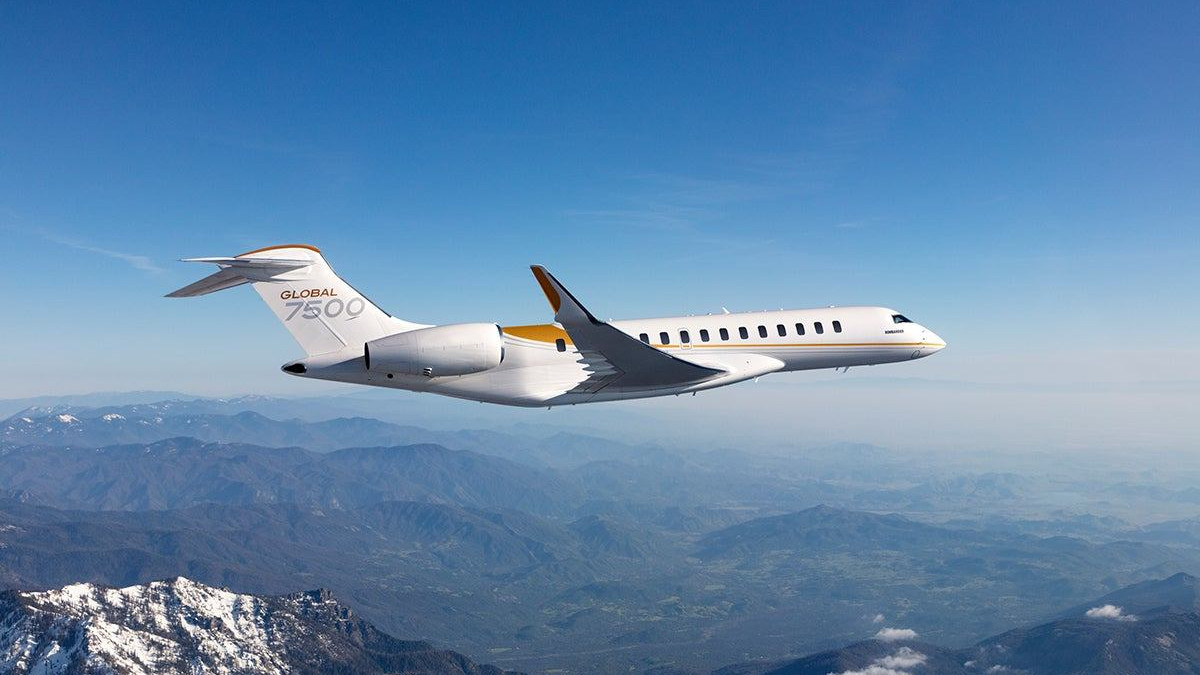
Bombardier Global 7500 business jet in flight
Bombardier relies on roughly 2,800 suppliers across 47 U.S. states to produce business jets such as the Global 7500. [Credit: Bombardier]

In a seeming reversal, President Donald Trump said he intends to “take good care” of Bombardier, the Canadian business jet manufacturer that he threatened with aircraft decertification and a ban on U.S. sales earlier this year.

Trump made the remark to KWCH-TV in Wichita, Kansas, ahead of a midterm campaign rally in nearby Park City. During his speech at the rally, Reuters reported that Trump said he would help a “certain air company get themselves straightened away,” referring to Bombardier.

“I’ll be helping them because I always viewed them as a Canadian company,” the president said. “But now I find out they have a presence here, and we’re not hurting them if they’re in Kansas. So we’ll take care of those people and the jobs.”

Speaking to KWCH, Trump explicitly credited a phone call from Republican Senator Roger Marshall—one of several Kansas lawmakers to push back against his previous threats—with swaying his opinion.

Though it handles final assembly of its Challenger and Global families in Canada, Bombardier employs some 1,500 people in Wichita, which is home to its U.S. headquarters, defense division, and a major service and flight test center. The manufacturer recently invested $50 million to expand site capabilities and train new aviation personnel. It employs about 3,500 people across the U.S., including in Texas, California, and Florida.

The company is in the middle of what a spokesperson described to FLYING in September as a large-scale American expansion.

Canada’s CBC reported that more than half of Bombardier’s revenue comes from American customers, and more than half of the value of its Global 7500 derives from American parts.

Trump vs. Bombardier

Trump’s remarks, though not firm evidence that the president intends to drop his threats, will be viewed as promising by Bombardier and its customers. Less than two months ago, the president vowed to shut the Canadian manufacturer out of the U.S. market unless it shifted more manufacturing stateside.

Trump first targeted Bombardier in January, threatening to decertify its aircraft operating in the U.S. and slap Canadian-built aircraft with a 50 percent tariff. He accused Canadian authorities of unfairly delaying the certification of U.S.-manufactured Gulfstream jets, specifically the G500, G600, G700, and G800. The president singled out Bombardier’s Global Express aircraft for revocation.

It is unclear if Trump could do so unilaterally, as the certification process hinges on airworthiness and safety rather than political or economic interest. Bombardier expressed concern that the situation could cause a major impact on air traffic and the flying public if not quickly resolved.

Regardless, neither threat materialized, and Canada certified several Gulfstream models soon after Trump’s January remarks.

Tensions flared again in September amid broader U.S.-Canada trade disputes involving cross-tariffs. Trump posted on Truth Social demanding that Bombardier cease sales in the U.S., claiming Canada was treating the U.S. like a “piggybank.”

Bombardier countered by highlighting that its supply chain comprises approximately 2,800 American companies across 47 states. Again, it is unclear how Trump could prevent Bombardier sales and deliveries to U.S. customers, since the jets have been approved by the FAA.

In September, the administration banned certain Canadian products from import but took no action against Bombardier.

An analyst cited by CBC said Trump’s threat did not have a “tangible impact” on demand for Bombardier jets among American customers over the past six weeks. Another said that blocking sales would “undoubtedly” cause revenue and job losses for American parts producers and be “massively disruptive” to American operators awaiting deliveries.

Jack Daleo

Jack is a staff writer covering advanced air mobility, including everything from drones to unmanned aircraft systems to space travel—and a whole lot more. He spent close to two years reporting on drone delivery for FreightWaves, covering the biggest news and developments in the space and connecting with industry executives and experts. Jack is also a basketball aficionado, a frequent traveler and a lover of all things logistics.

This 1964 Piper PA-24-250 Comanche Is a Fast, Graceful ‘AircraftForSale’ Top Pick

Company’s first in-house-developed, all-metal, high-performance plane made an immediate impression with pilots.

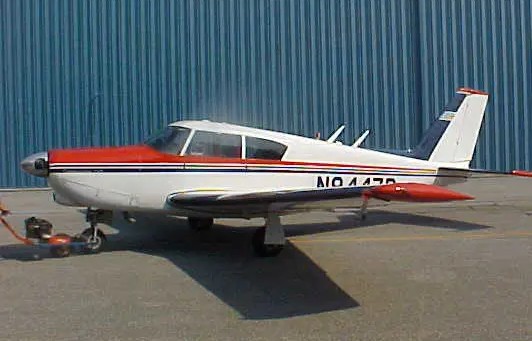
1964 Piper PA-24-250 Comanche [Credit: Tom Henry]

Each day, the team at Aircraft For Sale picks an airplane that catches our attention because it is unique, represents a good deal, or has other interesting qualities. You can read Aircraft For Sale: Today’s Top Pick at FLYINGMag.com daily.

Today’s Top Pick is a 1964 Piper PA-24-250 Comanche.

When Beechcraft rolled out the striking, speedy, V-tail Bonanza in 1947, it shook up the general aviation industry, which had been turning out an assortment of slow, mostly high-wing airplanes with steel-tube frames and fabric covering. Many still had wooden wing spars.

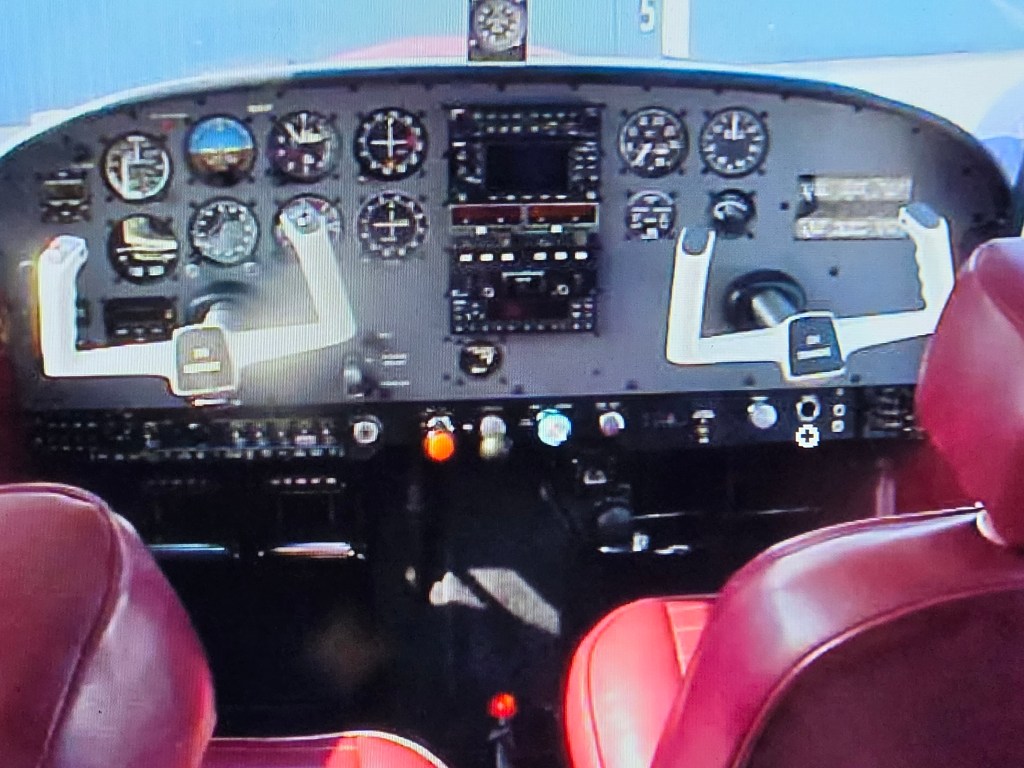
 This Comanche has a custom panel with GPS. [Credit: Tom Henry]

For rival manufacturer Piper, the message was clear. The company, based in Lock Haven, Pennsylvania, and famous for selling nearly 20,000 J-3 Cubs, needed to catch up with the developing trend toward higher-performance, low-wing aircraft with all-metal, semi-monocoque construction, retractable landing gear, and a lot more power than the company’s earlier aircraft.

The result was the PA-24-180 Comanche, with a 180 hp Lycoming O-360.

While sleek and modern, the initial Comanche lacked the power needed to truly compete with the Bonanza. Piper soon upgraded the airplane with a 250 hp Lycoming O-540, which turned out to be an ideal powerplant for the new, aerodynamic airframe. The Comanche was a hit with pilots, who enjoyed its speed, smooth handling, and comfort on long cross-country flights.

Piper built more than 4,800 PA-24s in its Lock Haven factory before a flood wrecked the facility and much of the tooling needed to manufacture the complex model. The company decided to end production of the PA-24 and focus on its simpler, less-expensive Arrow for the retractable market.

The Arrow was built at the company’s Vero Beach, Florida, plant, where Piper eventually consolidated its operations. Today the former Lock Haven factory houses the Piper Aviation Museum, which is absolutely amazing but also a sad reminder of the Comanche’s demise.

Neat red upholstery enhances the Piper’s mid-century style. [Credit: Tom Henry]

The aircraft for sale today harks back to the good times when Comanche sales were brisk and general aviation was growing in the U.S. Even after more than 60 years, this classic four-seater remains competitive in the market for personal aircraft, especially for buyers who care about history and style in addition to performance and practicality.

This airplane, with an updated panel and classic 1960s interior offers a nice combination of the past and present.

This 1964 Comanche has 5,305 hours on the airframe and five hours since overhaul on its 250 hp Lycoming O-540 engine. Its panel features updates including a Garmin GNS 430 WAAS GPS/nav/com, GTX 345 transponder, and Flight Stream 250. The cabin features shoulder belts and quarter-inch tinted glass.

Pilots looking for an attractive, economical, high-performance four-seater with vintage appeal and modern performance should consider this 1964 Piper PA-24-250 Comanche, which is available for $148,500 on AircraftForSale.

If you’re interested in financing, you can do so with FLYING Finance. Use our airplane loan calculator to calculate your estimated monthly payments. Or, to speak with an aviation finance specialist, visit flyingfinance.com.

Jonathan Welsh

Jonathan Welsh is Lead Editor of Aviation Consumer and a private pilot who worked as a reporter, editor and columnist with the Wall Street Journal for 21 years, mostly covering the auto industry. His passion for aviation began in childhood with balsa-wood gliders his aunt would buy for him at the corner store. Follow Jonathan on Twitter @JonathanWelsh4

Autonomous Cessna Flies in New Mexico Under Federal Program

Modified 208B Grand Caravan begins demonstrations at Albuquerque International Sunport under federal program.

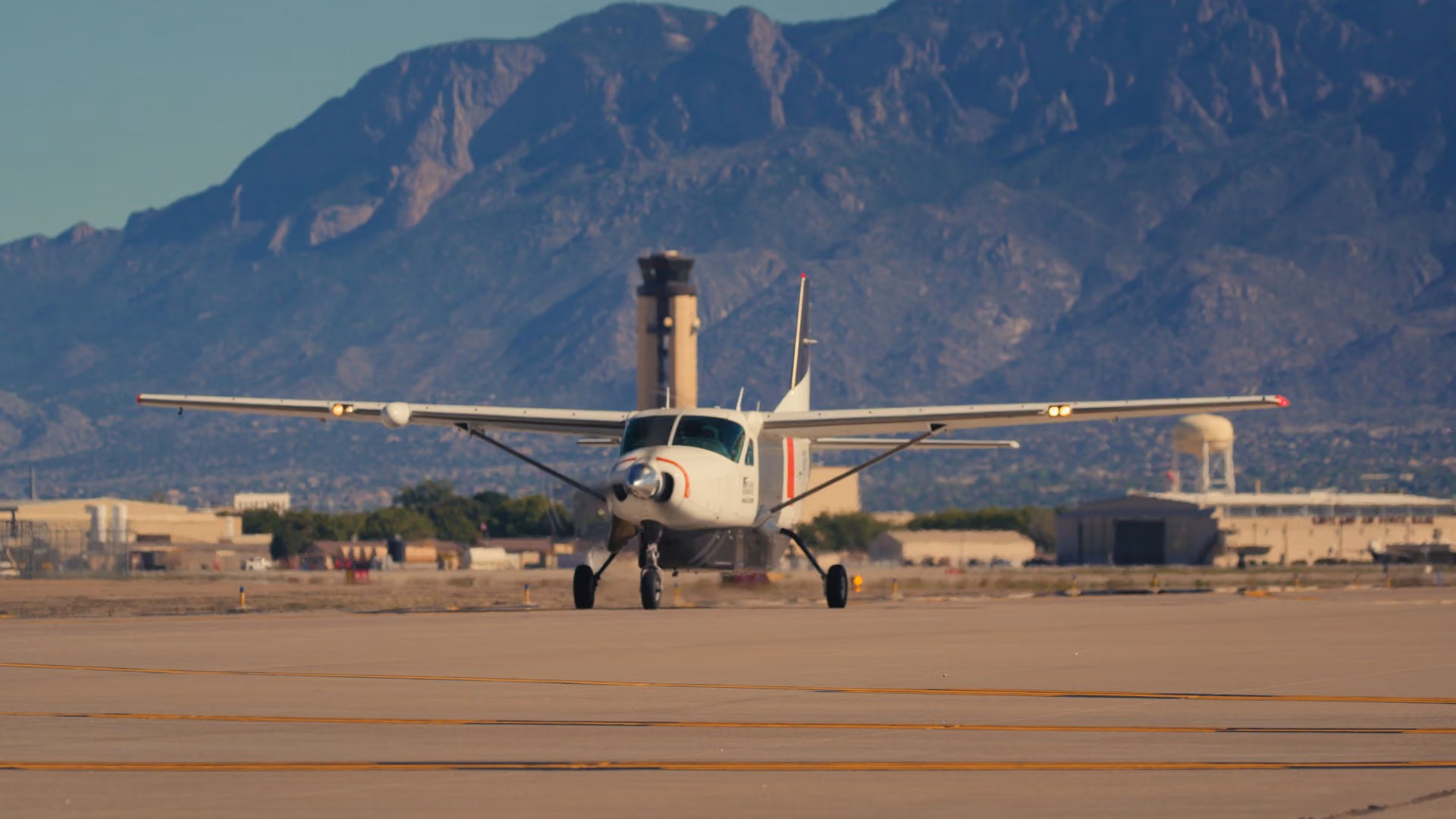
Reliable Robotics autonomous Cessna 208B Grand Caravan on the runway at Albuquerque International Sunport in New Mexico
A Cessna 208B Grand Caravan equipped with Reliable Robotics’ gate-to-gate automation system has begun activities under a federal program designed to collect data on the technology. [Credit: Reliable Robotics]

At Albuquerque International Sunport (KABQ), an autonomous Cessna 208B Grand Caravan has begun operating under a federal program designed to generate data on novel advanced air mobility aircraft.

The AAM activities began at the Sunport, New Mexico’s largest commercial airport that handles  joint-use military and civilian traffic within Class C airspace. But they will soon expand to other airports in the region as general aviation and business aviation locations become a testing ground for future aviation technology.

“By putting the Sunport to work as a testing ground for the future of aviation, we’re helping bring new industries to New Mexico, strengthen our regional economy, and show what’s possible when we embrace innovation,” said Albuquerque Mayor Tim Keller in a news release from Reliable Robotics, which owns and operates the Caravan.

The flights, which according to the FAA took place last week, were not Reliable’s first at an airport. In April, the company completed data collection flights in and around the terminal area of Hollister Municipal Airport (KCVH) in California to help the FAA develop certification standards for large uncrewed aircraft systems (UAS). Reliable also has a partnership with NASA that will allow it to conduct operational demonstration flights with the C-208 at and near airports across the U.S.

The company’s chief competitor, Merlin Labs, is also flying autonomously at U.S. airports. Merlin, which also conducts testing with the Caravan, made an autonomous landing at this year’s EAA AirVenture in Oshkosh, Wisconsin, in June, and it recently selected Rhode Island’s North Central State Airport (KSFZ) as its new flight test hub.

However, Reliable’s flights in Albuquerque were among the first autonomous flights under the federal eVTOL Integration Pilot Program (eIPP), which includes activities using not only electric vertical takeoff and landing but also autonomous and remotely piloted aircraft. Another company, Elroy Air, recently conducted uncrewed autonomous operations in Louisiana.

The demonstrations, which are underway across the U.S., are intended to generate data for the FAA to help the agency create rules and guidance for the safe integration of the novel aircraft. Reliable said it plans to collect operational data throughout the program across increasingly complex operations.

The company’s activities in New Mexico are part of the only city-led eIPP project. There are eight in total, with most led by state transportation departments. A handful will include autonomous operations.

“We take seriously our responsibility to help inform the safe integration of these emerging technologies into the National Airspace System by providing the data and insights the FAA needs to develop appropriate policies and requirements for this evolving industry,” said Manny Manriquez, the city of Albuquerque’s director of aviation.

How It Works

Reliable conducted a two-day flight campaign with the Caravan, equipped with its Reliable Autonomy System (RAS).

The RAS is intended to address the most common causes of aviation accidents, such as controlled flight into terrain (CFIT) and loss of control in flight (LOC-I). The aircraft-agnostic platform is designed for gate-to-gate automated operations using existing aviation infrastructure and certified aircraft.

The RAS also includes Reliable’s detect and avoid (DAA) system, which uses the company’s radar systems and the FAA’s Advanced Collision Avoidance System X (ACAS X) technology to automatically mitigate traffic conflicts.

Reliable said the Caravan had an onboard safety pilot but performed auto-taxi, auto-takeoff, and auto-landing operations. It was supervised by a remote pilot at the company’s California headquarters more than 700 miles away. Humans communicated with air traffic control. Merlin’s autonomy system, by contrast, does not require a human pilot for communication and is instead designed to use natural language processing algorithms.

Reliable has an FAA-accepted certification plan and means of compliance for continuous autopilot engagement. It is working toward certifying the RAS for U.S. operations using the Caravan, with the goal of enabling reduced-crew operations for customers.

The technology also supports military applications. Reliable has contracts with several branches of the military including the U.S. Air Force, which plans to deploy it operationally on real-world missions in the Indo-Pacific.

Next Steps for Autonomous Aircraft

According to the FAA, the City of Albuquerque Aviation Department and other eIPP participants are planning additional test flights throughout the rest of the year. Many of those activities will take place at GA and business aviation airports.

“We’re taking into account many variables, including traffic patterns, point-to-point visual flight rules (VFR) routes, controlled class B airspace with standard instrument departure and arrival procedures, and more,” said Sunil Chatani, eIPP team lead within the FAA’s Office of Advanced Air Mobility Technologies, in October blog post.

“The data we’re collecting can only improve operations for both air carriers and general aviation,” Chatani added. “Then, as these technologies become more advanced and regulatory pathways become standard, general aviation will incorporate them into a variety of beneficial use cases.”

The eIPP began in July and is expected to last three years. The city of Albuquerque-led project is focused on testing autonomy for regional air cargo operations, including deliveries to small, rural markets that lack aerial connectivity.

Reliable plans to conduct precertification commercial operations under the program. They will take the form of regional air cargo services operated by the company’s Part 135 subsidiary, Reliable Airlines. Albuquerque International Sunport is only the start as the aim is to fly cargo from the Sunport to Santa Fe Regional Airport (KSAF) in New Mexico and Durango-La Plata County Airport (KDRO) in Colorado.

New Mexico is the sixth location to launch under the eIPP, which is also underway in Texas, Utah, North Carolina, and other states across the eastern U.S. led by the Pennsylvania Department of Transportation and Port Authority of New York and New Jersey.

In addition to Reliable and Elroy, eVTOL air taxi manufacturer Joby Aviation has also begun autonomous eIPP operations. Joby in September completed what it said was the first fully autonomous, coast-to-coast journey across the U.S., also using a modified Caravan.

Wisk Aero, which Boeing sold to Joby competitor Archer Aviation this year, is also part of the eIPP. It plans to evaluate autonomous flight operations on real routes in Texas airspace, though the company has indicated that those may come later in the program.

Jack Daleo

Jack is a staff writer covering advanced air mobility, including everything from drones to unmanned aircraft systems to space travel—and a whole lot more. He spent close to two years reporting on drone delivery for FreightWaves, covering the biggest news and developments in the space and connecting with industry executives and experts. Jack is also a basketball aficionado, a frequent traveler and a lover of all things logistics.

First Fully Outfitted G400 Takes Flight

Test aircraft flew from Dallas Love Field, while an experimental G400 test article set a new city pair speed record.

Gulfstream G400 large cabin jet in flight
Gulfstream’s large-cabin G400 jet will fill a niche between the G280 and G500/G600. [Credit: Gulfstream Aviation]

Gulfstream has announced the first fully outfitted test aircraft in its next-generation G400 program completed its maiden flight, moving the large-cabin jet closer to certification.

The manufacturer Monday said the test article took off from Dallas Love Field (KDAL) in Texas and flew for about 2 hours and 46 minutes, reaching an altitude of 48,000 feet. The model is dedicated to evaluating cabin systems at altitude as well as testing functionality and comfort in flight. It flew in an 11-passenger configuration over two-and-a-half living areas.

Aviation Week reported that the fully outfitted jet is the fourth and final model to join the G400 test fleet, according to Mark Burns, president of Gulfstream.

“The aircraft continues to perform exceptionally well as we advance through the rigorous certification program,” Burns said in a news release.

Still, Burns, speaking this week at the National Business Aviation Association Business Aviation Convention & Exhibition (NBAA-BACE) in Las Vegas, declined to predict when the G400 will be certified, according to Aviation Week. It was officially announced alongside the ultra-long range G800 in 2021, and Gulfstream at the time anticipated first deliveries in 2025.

These days, delays in aircraft certification programs are not uncommon. Dassault, for example, recently delayed certification of its Falcon 10X from 2027 to ’28 or ’29.

The first G400 test article flew in August 2024. According to Gulfstream, test aircraft have now completed high-altitude testing in Telluride, Colorado, cold-weather testing in Iqaluit, Canada, and “other validation efforts.”

The manufacturer also said Monday that one of its three experimental G400 test aircraft set a new city pair speed record between Miami and Las Vegas as it travelled to NBAA-BACE. It completed the flight in 4 hours and 8 minutes at an average speed of Mach 0.89, using a blend of sustainable aviation fuel (SAF), Gulfstream said. The aircraft and cabin mock-up are on display at NBAA-BACE alongside the G700, G800, G500, G600, and a new G300 mock-up.

The first G300 flew in December. Burns said a “second airplane will fly here very soon,” according to Aviation Week. A third G300 test article is in production by licensee Israel Aerospace Industries.

According to Aviation International News, Burns said Gulfstream’s production rate in 2026 will be about 160 jets. But it soon aims to reach at least 200 aircraft annually, which would be a company record.

What to Know About the G400

Gulfstream in 2021 billed the new G400 as the industry’s first new large-cabin aircraft in more than a decade. It is not a replacement for any model on the company’s roster. Rather, it will sit in the sweet spot between the super-midsize G280—slated to be replaced by the G300—and the large-cabin G500/G600. Reported list price is around $34.5 million.

The G400’s aerodynamic clean-wing design and Pratt & Whitney PW812GA engines are designed to reduce fuel burn, emissions, and noise. It also features Gulfstream’s advanced high-speed wing and swept winglets, introduced on the G500/G600, to boost efficiency.

At its long-range cruise speed of Mach 0.85, the jet is designed to fly up to 4,200 nm, enabling nonstop trips from New York to Geneva, Switzerland, or Miami to São Paulo. At its high-speed cruise of Mach 0.88, range decreases slightly to 3,950 nm. The jet’s top speed will be Mach 0.90, and it will cruise up to 51,000 feet.

Like the G800, the G400 will come equipped with Gulfstream’s Symmetry Flight Deck, which includes electronically linked active control sidesticks and 10 touchscreen displays. It will also include a Predictive Landing Performance System (PLPS) designed to give pilots advanced warning of potential runway excursions using real-time data.

For passengers, the G400 will offer what Gulfstream says is the largest cabin and lowest cabin altitude (3,255 feet at 41,000 feet) in its class. It will have seating options for up to nine, 11, or 12 passengers, sleeping up to five. The jet will offer the same cabin width as the G500/G600, with cabin height of 6 feet 2 inches and interior length more than 42 feet. Other cabin features include an air purification system and 10 panoramic oval windows.

Jack Daleo

Jack is a staff writer covering advanced air mobility, including everything from drones to unmanned aircraft systems to space travel—and a whole lot more. He spent close to two years reporting on drone delivery for FreightWaves, covering the biggest news and developments in the space and connecting with industry executives and experts. Jack is also a basketball aficionado, a frequent traveler and a lover of all things logistics.
Pilot in aircraft
Sign-up for newsletters & special offers!

Get the latest stories & special offers delivered directly to your inbox.

SUBSCRIBE