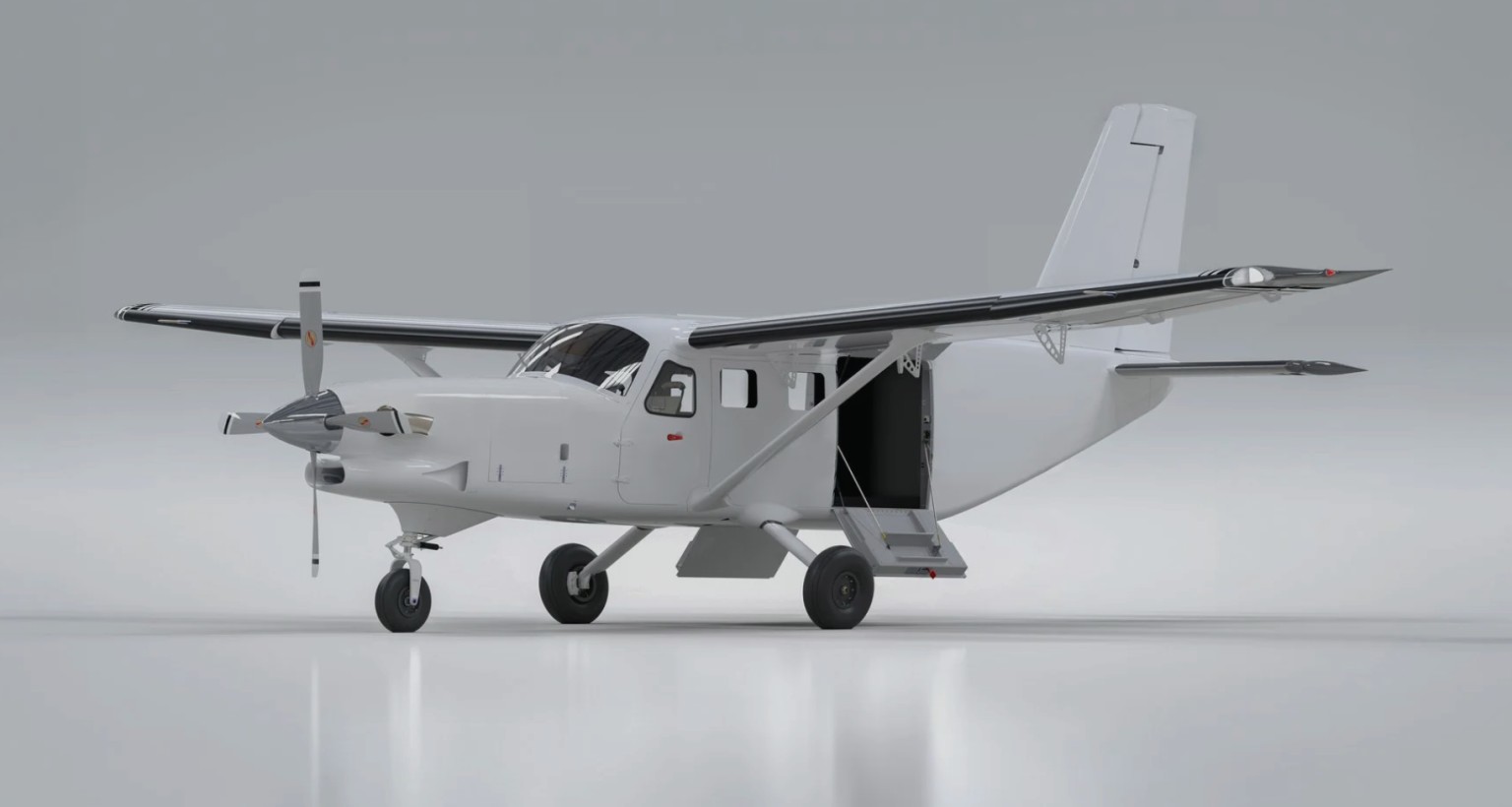
The Reach AC-6 is being developed as an efficient utility aircraft for the GA market. [Credit: Reach Aviation]
A founder of companies that have developed popular amateur-built and turboprop aircraft is setting off on a new mission to develop a highly capable utility aircraft for the general aviation market.
Tom Hamilton has spent five decades designing aircraft, according to his biography on the website of his latest venture, Reach Aviation.
Hamilton previously founded Stoddard Hamilton Aircraft, the originator of the Glasair and Glastar series kits, which it delivered until its 2012 sale to a Chinese company. The firm now does business under the name Glasair Aviation USA but has faced challenges due to the COVID-19 pandemic and its shifting of production from Washington state to China.
Hamilton founded Quest Aircraft in 1999, which developed the Kodiak turboprop series. The program was taken over by Daher in 2019 after the French manufacturer acquired Quest.
Between those two ventures, Hamilton in the 1980s founded Aerocet, a developer of composite floats and amphibious wheels.
Now, under Reach, Hamilton has set his sights on a short takeoff and landing (STOL) airplane that would allow GA operators to access hard-to-reach places. The firm’s AC-6 is being developed for missionary aviation organizations, emergency medical aid, fire overwatch, private owners, and small commercial operators who fly in demanding conditions, including short or rough strips, backcountry bases, and variable climates.
According to Reach’s website, the AC-6 is intended to bridge a gap between aging, decades-old piston platforms such as the de Havilland Beaver, Cessna 206, Pilatus PC-6, and Helio Courier and their more expensive, turbine-powered contemporaries like the Kodiak. The airplanes will be easy to maintain and understand while offering high uptime, low cost, and dependable performance, the company says.
More Utility for GA Operators
According to Reach’s site, the firm is partnering with Ascent Engine Technologies—which according to its page on the Wisconsin Economic Development Corporation’s website will produce a lightweight, efficient, diesel engine family for commercial and military customers—to make the AC-6 the launch platform for Ascent’s 12-cylinder diesel engine.
The engine is designed for up to 650 hp and a sharp reduction in fuel burn, enabling a 170-knot cruise speed and range of 1,340 nm with 45 minutes of reserves for the AC-6. Plane + Pilotreported that the engine and specifications are for a variant called the AC-6D.
An initial AC-6T variant, Plane + Pilot reported, will instead use a 750-shaft-hp Pratt & Whitney PT6A-34 turboprop. For the AC-6T, Reach is targeting range up to 800 nm with 45 minutes of reserves.
Plane + Pilot said further that the initial variant will have double-slotted flaps with 48 degrees of deployment that enable a 56-knot stall speed, as well as a 49-inch wide cabin and structural attachment points for floats. The avionics suite will include dual Garmin G500 TXi displays, GTN 750 and 650 navigators, a GI 275 standby instrument, and a GFC 500 autopilot.
According to Reach’s site, the AC-6 will require just 987 feet for takeoff and 1,098 feet for landing to clear 50-foot obstacles. Those specifications would appear to be for the AC-6D, as Plane + Pilot reported that the AC-6T will instead be designed for takeoff and landing distances of 750 feet and 700 feet, respectively.
The company’s website lists a bevy of additional features without specifying which AC-6 variant they are intended for.
According to Reach, the AC-6 will seat eight or nine passengers and have a useful load up to 2,700 pounds, though Plane + Pilot said the latter is targeted at up to 3,000 pounds. Forty two-inch cargo doors on either side and eight feet of usable cabin space are intended to make the airplane easily adaptable to a variety of missions, from passenger to cargo and medevac. Per Plane + Pilot, it will also have an optional additional door and external cargo pod.
Reach said that rather than aluminum, the AC-6 will use a rigid steel tube frame designed for FAA-standard repairs, as well as a high-lift wing. Removable composite panels will provide quick access to critical structures and systems to reduce maintenance time. Also removable will be the windshield, which would improve access to the instrument panel, eliminate common floatplane failure modes, and be replaced in as little as eight minutes, the company said.
Plane + Pilot reported the list price for the initial AC-6T variant at $2.25 million. It said that Reach has not yet announced a first flight date, certification timeline, or anticipated deliveries. Given Hamilton’s pedigree, though, the project may be one to watch.
Jack is a staff writer covering advanced air mobility, including everything from drones to unmanned aircraft systems to space travel—and a whole lot more. He spent close to two years reporting on drone delivery for FreightWaves, covering the biggest news and developments in the space and connecting with industry executives and experts. Jack is also a basketball aficionado, a frequent traveler and a lover of all things logistics.
Pilots love many things about the Beechcraft Baron 58, from its smooth handling, roomy cabin, and useful load to its celebrated build quality. But what really makes the Baron special is its power. After all, it is based on the company’s single-engine Bonanza, but adds a second engine for good measure.
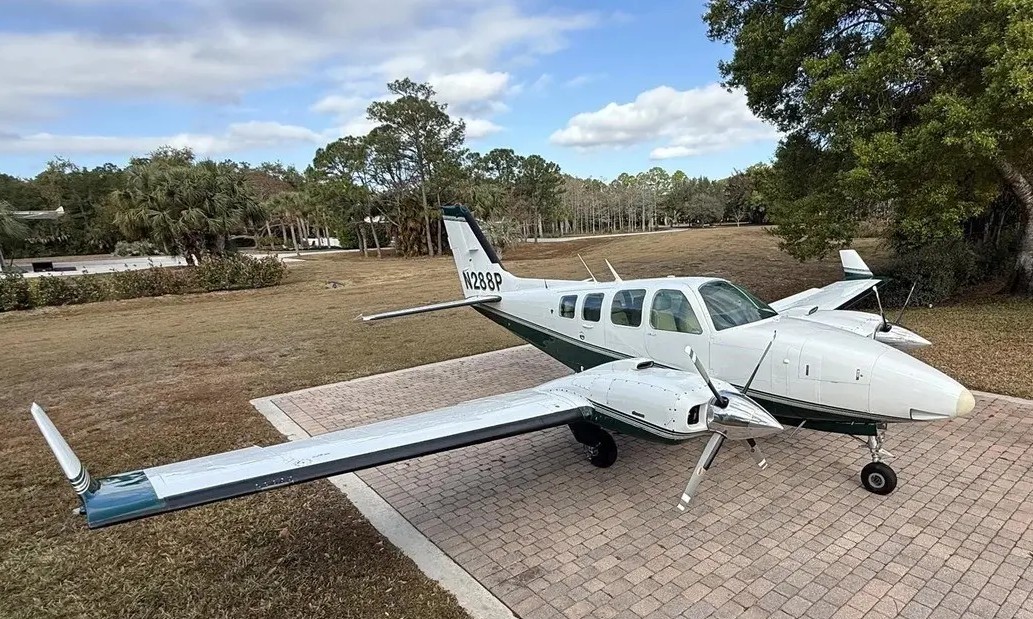
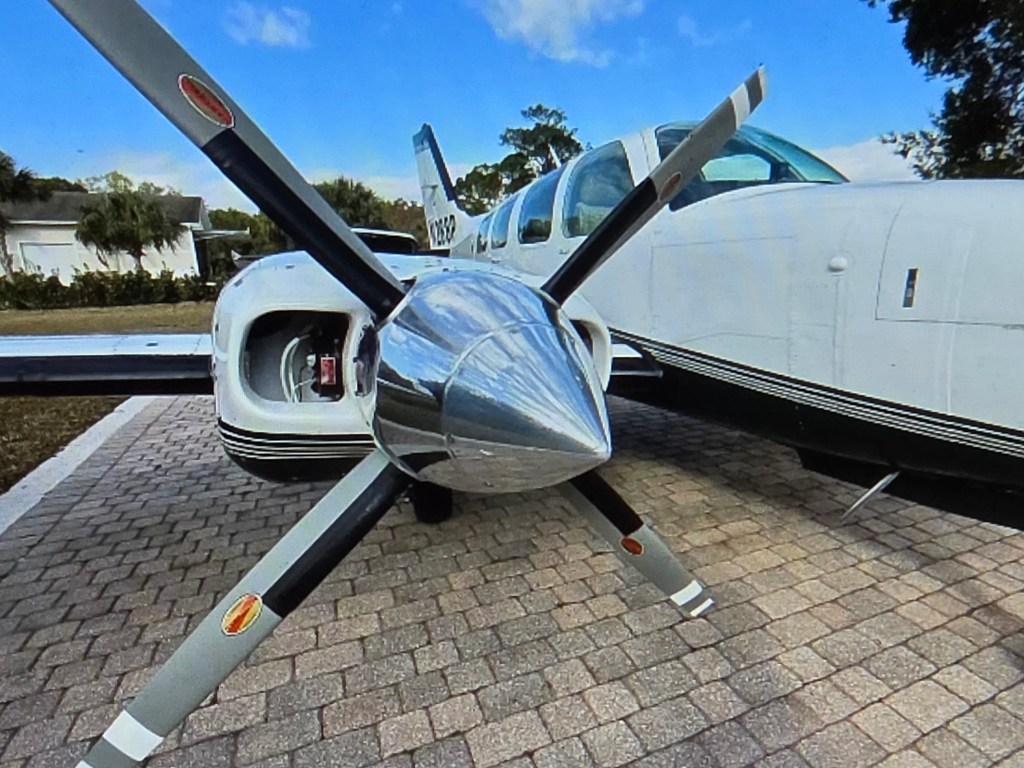
This Baron has been upgraded with larger engines and four-blade propellers. [Credit: Scott MacDonald Aircraft Sales]
The result is an aircraft that can continue the mission if an engine fails, at least long enough to reach a suitable diversion airport.
Redundancy is a beautiful thing in an emergency, but the real joy comes from having two engines that are working perfectly and delivering what my father used to call an excess of power. I prefer to call it power to spare.
Like cash in your pocket, the acceleration on the runway, rapid climb, and speedy cruise from a pair of big-bore Continental engines give pilots a degree of confidence that a piston single cannot quite match This is especially so when crossing mountain ranges, open water, and other inhospitable territory.
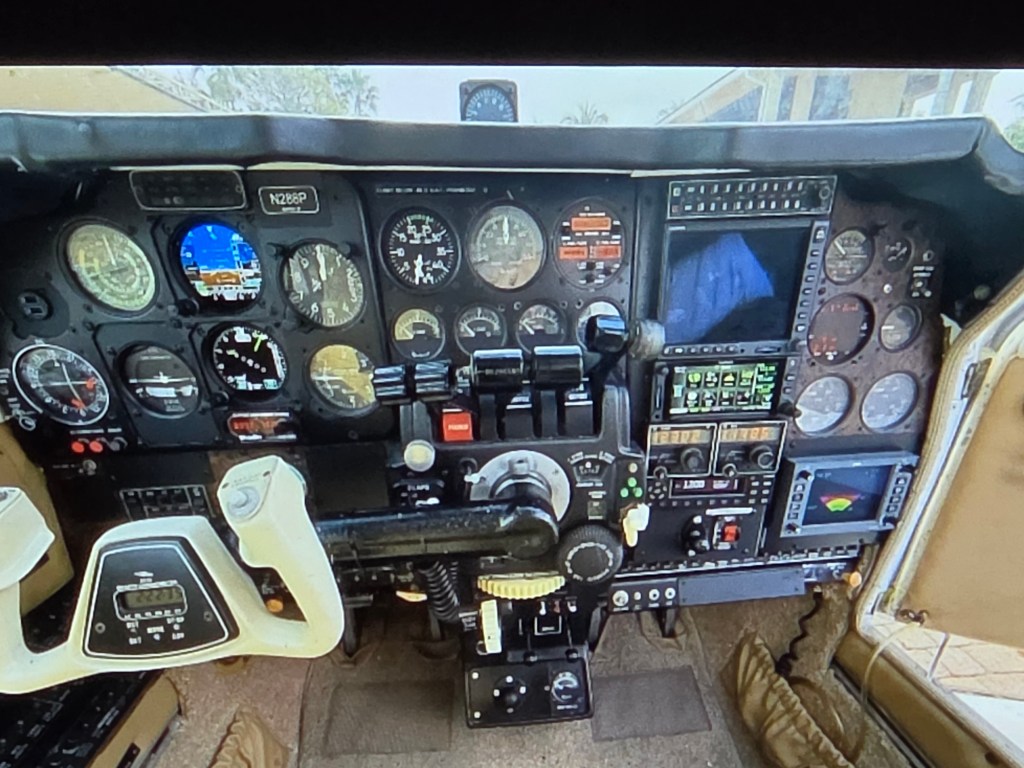
The Baron’s panel has several updates to ease the cockpit workload. [Credit: Scott MacDonald Aircraft Sales]
The aircraft for sale today has received the impressive Colemill Foxstar engine upgrade, which exchanged its original 285 hp IO-520 engines for 300 hp IO-550s The conversion provides even more power to spare, and, I would argue, more joy when pushing the throttles forward and counting the seconds before the Baron breaks ground and speeds skyward with authority.
This 1980 Beechcraft Baron B58 has 4,771 hours on the airframe, zero hours since overhaul on its 300 hp Continental IO-550-C engines, and zero hours since overhaul on its heated Hartzell four-blade propellers.
The engines and propellers are part of the airplane’s Colemill Foxstar modification package, which includes winglets and is designed to improve overall performance. The aircraft is also equipped with GAMI fuel injectors and 166-gallon fuel tanks.
The panel includes dual Garmin GI 275 with artificial horizon and HSI, GTN 650xi touchscreen GPS.nav/com with WAAS,GTX 345 transponder with ADS-B In and Out, GMX 200 color MFD, Bendix color radar, Collins 351 nav/com, King KMA 24 audio panel, Shadin AMS 2000 altitude management system, King KFC 200 autopilot, backup artificial horizon, JPI EDM 760 engine monitor, and intercom.
Additional equipment includes full surface deicing, electric trim, and Shadin fuel flow indicator.
Pilots who wish to step up to a light piston twin with thoughtful, performance-enhancing modifications and a spacious cabin should consider this 1980 Beechcraft Baron 58, which is available for $449,000 on AircraftForSale.
If you’re interested in financing, you can do so with FLYING Finance. Use our airplane loan calculator to calculate your estimated monthly payments. Or, to speak with an aviation finance specialist, visit flyingfinance.com.
Jonathan Welsh is Lead Editor of Aviation Consumer and a private pilot who worked as a reporter, editor and columnist with the Wall Street Journal for 21 years, mostly covering the auto industry. His passion for aviation began in childhood with balsa-wood gliders his aunt would buy for him at the corner store. Follow Jonathan on Twitter @JonathanWelsh4
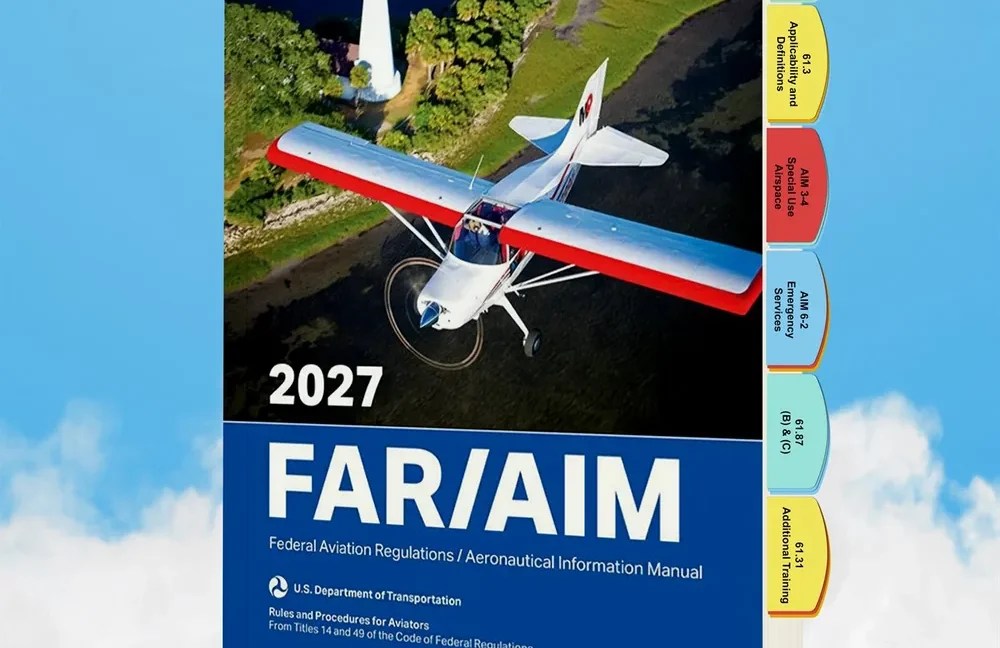
Learn to sift through reams of information in the FAR/AIM to determine what is pertinent and what is not. [Credit: ASA]
Before I taught my first private pilot ground school I was warned to keep the paper copy of the Federal Aviation Regulations/Aeronautical Information Manual (FAR/AIM) out of sight until everyone who had signed up for the class had paid the $400 tuition and purchased the $395 ground school kit that was essentially a cloth flight bag containing an E6-B, plotter, the Airplane Flying Handbook, the Pilot’s Handbook of Aeronautical Knowledge, and the FAR/AIM.
Once all of them had paid the bags were handed out, and they were allowed to open them. Why was there such production? According to the chief ground instructor, there was something about the size of the FAR/AIM—it was over 2 inches thick with relatively small print and instilled panic in the students.
The sheer volume of information in the pages still puts fear into the hearts of many aspiring aviators, some of whom somewhat timidly ask, “How much of this do we have to know?” which is occassionally followed by, “What if we don’t like to read?”
The FAR/AIM is a reference tool, not something to be memorized. In paper form it’s large and heavy, which may be why so many face-to-face ground schools now use digital editions of it that can be downloaded for free from the FAA website or obtained for a price as PDFs from aviation apps or publishers such as ASA (Aviation Supplies & Academics).
While the digital version of the FAR/AIM is much easier to carry, update, and search (type in a term and swipe versus thumbing through physical pages), there are some people who do better with the tactile experience of holding a book in their hands for learning to take place.
I am one of those pilots who obtains a hard copy of the book, in addition to having the latest digital edition accessible on my tablet. This time of year I secure an updated hard copy version of the book and spend part of a day going through the new edition, adding tabs made from repurposed business cards from a now defunct flight school.
By now I know what I will be frequently referencing, for example, cFAR 61.87: Solo requirements for student pilots.
When I get my hands on the hard copy, I spend the better part of an afternoon reading the summary of major FAR changes since the last FAR/AIM was published, then I put tabs on the book so I can find important and frequently referenced regulations and information quickly. The latter is often done as a ground lesson with a client. A big part of being an instructor is modeling good habits, and when the CFI puts in the effort to tab the book, the client is more likely to respect the importance of knowing where to look up the information.
I know there are companies that sell pre-tabbed versions of the book, but I prefer doing the work myself. It is something I look forward to in the same way I do watching the annual television broadcast of The Wizard of Oz. Just as I have fond memories of the movie (it was a family event), I have warm recollections of learning to tab the FAR/AIM and discussions in ground school about which FARs a private, instrument, and commercial pilot must know.
Don’t neglect the AIM part of the book. Chapter 4 (Air Traffic Control) and Chapter 5 (Traffic Procedures) are a must-read for fledgling pilots.
Chapter 7, which covers meteorology, is a favorite. I have lost count of how many times I have referred to the PIREP (pilot report) script printed there or how many times I have printed out section 7-1-7 (Categorical Outlook) and given it to the flight school dispatcher who was not a pilot but knew how to listen to the automated weather.
When a customer called and asked if the weather was flyable, the dispatcher pulled up the ATIS/AWOS on the computer, hit the “decode” button then compared it to the definitions in 7-1-7. It cut down on the number of students who made the trip out to the airport after being told “it looks pretty good” only to discover that the ceiling was below VFR.
Buried Under Info
In the 1980s when someone would share too much information (usually of a personal nature), the accepted response was “TMI,” or too much information. It was slang for “I don’t need to know this.”
Aviation has a different version of this. We have so many options for information now, especially when accessing a weather briefing with an app such as ForeFlight, Garmin Pilot, Aviation Weather.com, etc. that you often find yourself facing pages and pages not necessarily pertinent to your mission METARS and TAFs.
Too much information buries the fledgling and not-so-fledgling pilot, and in worst cases, can make the pilot reluctant to put in more than a perfunctory effort to gather more than perfunctory information before a flight.
As a student pilot you don’t know what you don’t know, or what’s important to know before a flight. This is a perfect time to have a ground session with your CFI to help you get a grasp on what is pertinent to the average mission.
This is particularly true when the briefing contains multiple pages of NOTAMs (Notices to Airmen) about things that really don’t factor into your mission—for example, canceled NOTAMs about taxiway closures or runway weight limitations that don’t affect your mighty Cessna 172. Going over the information with your CFI is a great way to determine what information is critical to the mission, what is nice to have, and what you can ignore.
If you run across an acronym you’ve never seen before, Appendix 3 of the AIM can help you decode it. Most of the time.
The exception was the day “ROSNOT” appeared in the remarks section of the weather report from a remote nontowered airport in Northern California. At the time, weather was reported by the airport manager or someone designated by them, often a retired military pilot.
Unable to find ROSNOT in the AIM and with the graybeards at the airport coming up blank, two handfuls of quarters were dumped into the pay phone (yes, this was that long ago) to call the airport manager who had filed the report. ROSNOT stood for “Rattlesnake On Step. No Observation Taken.”
Meg Godlewski has been an aviation journalist for more than 24 years and a CFI for more than 20 years. If she is not flying or teaching aviation, she is writing about it. Meg is a founding member of the Pilot Proficiency Center at EAA AirVenture and excels at the application of simulation technology to flatten the learning curve. Follow Meg on Twitter @2Lewski.
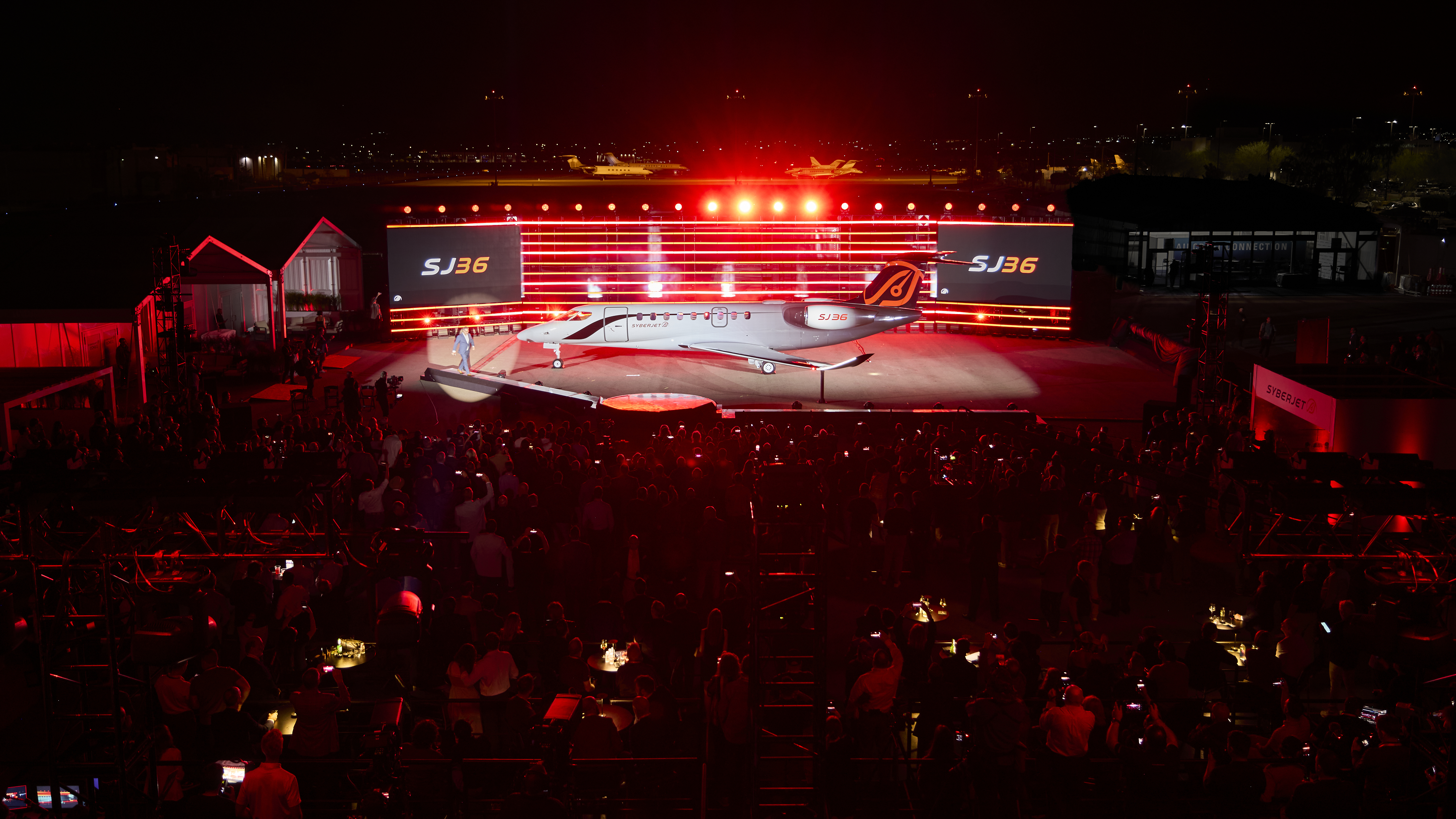
SJ36 mock-up on display in Las Vegas [Credit: SyberJet]
SyberJet has received letters of intent for more than 50 SJ36 aircraft following the model’s unveiling last week in Henderson, Nevada.
The LOIs are nonbinding expressions of interests that can eventually result in a firm purchase agreement. SyberJet said the letters came from across the business aviation sector, including charter operators, corporate flight departments, and private owners. Several sought to reserve multiple aircraft.
The SJ36 has seating for eight passengers and is designed to be the fastest and farthest-flying light jet ever built, with projected maximum speed of Mach 0.88 and a range of up to 3,000 nautical miles and a 49,000-foot ceiling.
A mock-up of the aircraft was displayed to the public ahead of the NBAA Business Aviation Convention & Exhibition (NBAA-BACE).
Deliveries of the SJ36 are expected to begin in 2032.
Meg Godlewski has been an aviation journalist for more than 24 years and a CFI for more than 20 years. If she is not flying or teaching aviation, she is writing about it. Meg is a founding member of the Pilot Proficiency Center at EAA AirVenture and excels at the application of simulation technology to flatten the learning curve. Follow Meg on Twitter @2Lewski.
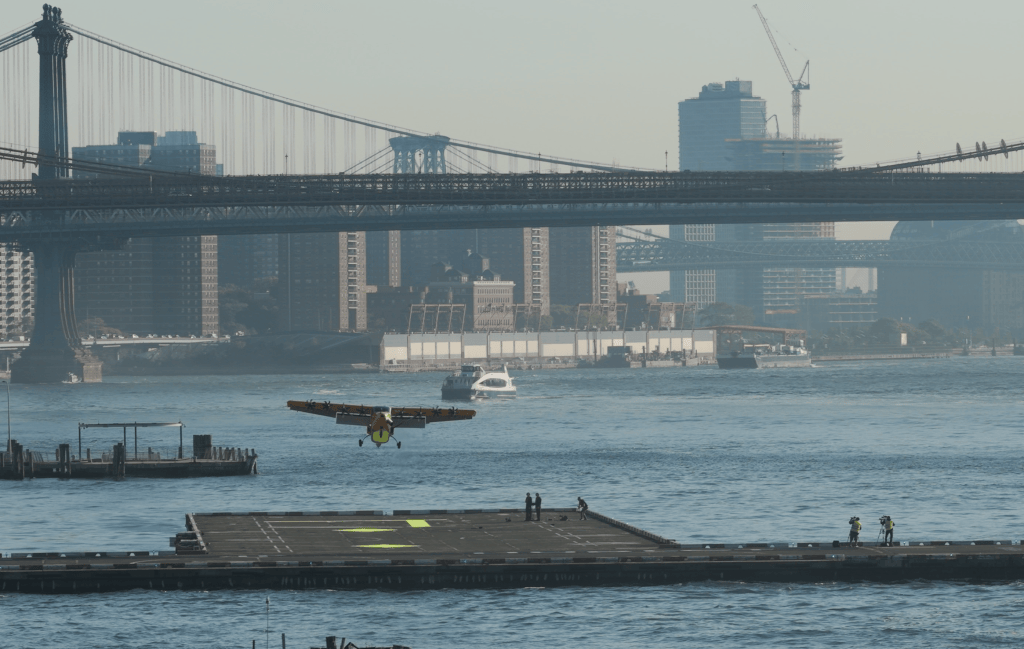
Electra test pilot Cody Allee conducted a series of takeoffs, landings, and low-speed maneuvers at the Downtown Skyport in Manhattan using the company’s fixed-wing EL2 demonstrator. [Credit: Jack Daleo]
Downtown Manhattan’s piers and barges were not designed to accommodate airplanes. They are the domain of helicopters, whose vertical capabilities counteract the limited space.
But according to Electra CEO Marc Allen, Monday morning marked the “first time that a fixed-wing airplane has landed” at Manhattan’s Downtown Skyport (KJRB).
Electra test pilot Cody Allee demonstrated two takeoffs and landings at the heliport using the company’s EL2 demonstrator, and he even wowed a crowd of about 100 spectators with a few low-speed maneuvers.
Allen said the event was the first time the manufacturer has shown the EL2’s capabilities publicly in such an environment—“right at the doorstep of the country’s greatest city.”
The EL2 lands at the Downtown Skyport in Manhattan. [Video credit: Jack Daleo]
“[The Downtown Skyport] is trafficked every single day by helicopters that come in the dozens,” Allen told the crowd. “What we’re doing is demonstrating what it looks like when regional mobility can be opened up to the entire world with the affordability of a fixed-wing airplane.”
Allen said the Downtown Skyport provides a landing area about 300 feet long. But J.P. Stewart, Electra’s senior vice president of product development, estimated that Allee used just 100 feet for takeoff and landing. The demonstrator was also remarkably quiet, its noise signature barely perceptible amid New York City’s soundscape.
Though it is only a prototype, Allee told FLYING that the EL2 is unlike any aircraft he has flown, offering a unique blend of maneuverability and safety.
Pilot’s Perspective
With the Statue of Liberty behind him, Allee flew toward the Downtown Skyport from the southwest then entered left traffic for landing. He went around once to avoid overflying ferry traffic, then landed. Green diamonds on either end of the barge guided the test pilot’s alignment, and a small “L” marked the desired touchdown zone.
After taxiing to the other end of the barge for some quick checkouts, Allee took off on a southwest heading. He did a lap around Governors Island before making a few tight turns over the barge at about 40 knots.
Stewart said the EL2 uses a wing identical to the Cessna 172’s “from the wing box forward,” modified with some reinforcements, motor mounts, and a new flap and aileron. Allee said that in terms of handling, the demonstrator flies just like the 172, despite being 600-700 pounds over the Skyhawk’s gross weight.
The EL2 uses a highly modified Cessna 172 wing. [Credit: Jack Daleo]
“The wild part is that now, you can fly it at really high angles of attack and get it very slow,” he said.
When maneuvering at low speed like he did Monday, Allee said he typically does about 40 knots indicated airspeed at a 20-degree angle of attack. The 172 will stall at an 18-degree AOA, but Allee has flown the EL2 at a 40-degree AOA with no stall buffet.
Test pilot Cody Allee maneuvers the EL2 at a leisurely 40 knots. [Video credit: Jack Daleo]
“If I were to pull the power off, we’d stall instantly,” he said. “But with the power on, I’m at 40, 45 knots doing 20 alpha, and it just makes the speed—and thus the turn radius—really, really tight.”
Conventional wisdom will tell you to fly with the rudders while doing stalls because “you feel like you’re on the head of a pin, waiting to fall off on a wing one way or the other,” Allee said. But with the EL2, “you don’t have to worry about that.” Both the demonstrator and EL9 are designed with blown-lift aerodynamics, redirecting airflows over the wing.
“I’ve got full control because you’re blowing air over [the wing],” Allee said. “So the wing doesn’t stall. [The airflow] doesn’t separate. It doesn’t change your control inputs even when I’m down to 25 knots.”
The test pilot said he can use the ailerons to keep the wing level and that the airplane is “perfectly happy” at a 35-degree AOA doing 25 knots.
“By blowing the wing, it sees what the propellers give it, not what the free stream is doing,” he said. “Basically, you make your own lift. You’ve got a collective that allows you to add power in a helicopter, essentially lift. The throttle does the same thing in this airplane.”
The demonstrator is also remarkably resilient. Its small jet engine converts jet-A or sustainable aviation fuel (SAF) to electricity to power eight motors, with the combination of two batteries and a conventional turbine providing power. Monday’s demonstration used all three power sources, but the airplane can take off using only one.
“Any one of them I can lose, and it doesn’t change the power available, and it really doesn’t change the handling qualities at all,” Allee said. “If I lose one of the sources of power, all eight motors still run.”
The EL2 demonstrates ultra short takeoff capability, using only a fraction of the barge. [Video credit: Jack Daleo]
He said that since the architecture provides differential thrust, it lacks a minimum control speed. The EL2 can continue to fly straight even if a motor is turned off.
“Even though it’s a multiengine airplane…I have started my takeoff roll with an outboard motor turned off,” Allee said. “So if I lose a motor, if I just put normal intuitive control inputs in, the airplane has enough authority basically to compensate. If I lost an engine in a [Beechcraft] Baron, it’s gonna be a lot of work. I’m not nearly as scared of losing a motor on this as I am on my Baron.”
Expanding the Envelope
As impressive as the EL2 is, it is only a glimpse of what Electra is building. The airplane was “built to be a technology demonstrator” to validate blown-lift aerodynamics, flight controls, and system management, Stewart said.
Electra originally planned to land at the Downtown Skyport on Friday. But winds were estimated at 12 knots gusting up to 22, “which was likely to create a bunch of eddies,” Stewart said. The company set a 5-knot gust limit for the demonstration for safety reasons, forcing them to move it to Monday.
“We actually had to set narrower limitations for this test airplane…in the spirit of doing things right and safe,” Stewart said.
But Electra’s “real product,” the clean-sheet EL9 Ultra Short, will face fewer limitations in order to “operate consistently in all weather, on all days, from a variety of different environments,” Stewart said. Electra aims to begin EL9 flight testing in 2027 and achieve certification by 2029.
The larger airplane will have capacity for two crew and nine passengers, flying over 1,000 miles at about 175 knots. But the “magic is that it will do that in the same takeoff distances as the EL2,” Stewart said.
He said the EL2 required certain design compromises due to its Skyhawk-derived wing. However, it will give Electra the “understanding” to “confidently design” the EL9’s clean-sheet wing, which he said will be a “big, full-span, slotted flap.”
Stewart predicted the production model will double the demonstrator’s lift coefficient and have a 15-knot crosswind component, making it perfectly suited to flying in Friday’s windier conditions. It will also be capable of flying IFR and into known icing conditions.
Like the EL2, the EL9 is designed to use hybrid-electric propulsion and blown-lift aerodynamics to enable operations with only 150 feet of ground roll. Those features are intended to unlock what Electra describes as access points that will not be limited to dedicated airfields.
“You might go to a conventional airport and use a runway,” said Stewart. “You might use an ultra short access point at a conventional runway, one of the parking lots, or remote parts of the terminal. You might go to a mall with an ultra short access point.”
Allen added that the larger EL9 will beat the range and payload of a helicopter at a fraction of the operating cost.
“This is an airplane that gives the operational performance of a helicopter,” he said. “So it’s access like a helicopter, but it is the efficiency, the payload, the range, the cost affordability of a fixed-wing airplane.”
Lower Manhattan’s Downtown Skyport could be one of many future access points for Electra’s EL9. [Credit: Electra]
Put together, those advantages are intended to enable what Electra terms “direct aviation,” or flying passengers directly from where they are to where they want to go for business, leisure, and other purposes. As a potential access point, the Downtown Skyport could enable time savings of about 3 hours and 45 minutes for trips to Boston, 3 hours and 30 minutes to Washington, D.C., and 45 minutes to Philadelphia.
Electra said Monday that it is partnered with more than 60 airline operators that intend to operate regional direct aviation routes.
The EL9’s runway independent capabilities could also support defense missions, including distributed operations and logistics. Electra is working with Lockheed Martin’s secretive Skunk Works unit and also has contracts with the U.S. Army and Air Force with those operations in mind.
Jack is a staff writer covering advanced air mobility, including everything from drones to unmanned aircraft systems to space travel—and a whole lot more. He spent close to two years reporting on drone delivery for FreightWaves, covering the biggest news and developments in the space and connecting with industry executives and experts. Jack is also a basketball aficionado, a frequent traveler and a lover of all things logistics.
Allworth Airline Advisors can help pilots make the most of year-end tax planning opportunities. [Credit: Allworth Airline Advisors]
Every pilot knows that overlooking a checklist item can create complications down the line, often when there are fewer options to address them.
Tax planning works much the same way.
Strategies that can make a meaningful difference in your tax bill, such as funding an account, harvesting a loss, or timing a charitable gift, often have a December 31 deadline. After that, certain opportunities may no longer be available for the current tax year.
That’s why financial advisers generally recommend starting your year-end planning in November rather than mid-December. Custodians need time to process contributions, and fund paperwork doesn’t happen overnight.
Between your demanding schedule and complex compensation structure, a few strategic decisions made now could help reduce your 2026 tax liability while supporting your broader financial goals.
Here’s where to start.
Make Education Savings Work Harder
If you’re balancing education funding with long-term wealth planning, a 529 college savings plan can offer a tax-efficient way to support both priorities. Contributions grow tax-free when used for qualified education expenses, and making larger contributions upfront can be an effective strategy if you have the financial flexibility to do so.
For example, rather than contributing the annual gift tax exclusion amount of $19,000 each year, you can elect to front-load up to five years of that exclusion at once ($95,000 per contributor, or $190,000 for a married couple). This approach can potentially move a substantial sum out of your taxable estate in a single transaction while funding your child’s education down the road.
It’s also worth revisiting the Child Tax Credit and dependent care benefits, even if your income has historically phased them out. Thresholds and partial-credit calculations can change, and a strategy that didn’t apply a year or two ago may be worth a second look before the calendar turns.
Look Beyond Your Airline Retirement Plan
If you’ve built income streams beyond your airline paycheck, such as a charter operation, consulting work, rental property business, or another venture run as a sole proprietor or small business, you may have additional tax-planning opportunities. Self-employment income opens retirement planning tools that a W-2 paycheck alone doesn’t.
A Solo 401(k) or SEP-IRA may allow you to defer a significant portion of that outside income, depending on your eligibility and existing retirement plan contributions. For 2026, the standard elective deferral limit sits at $24,500, with an additional $8,000 catch-up contribution available to those 50 and older, and a combined employer-and-employee plan limit of $72,000.
When coordinated with your existing airline-sponsored retirement plan, these options may create additional opportunities for tax-efficient retirement savings.
A high-deductible health plan opens a similar opportunity through a Health Savings Account (HSA). These contributions are tax-deductible going in, grow tax-free, and come out tax-free for qualified medical expenses. It’s a triple benefit you won’t find in many other places.
The 2026 HSA limits are $4,400 for individual coverage and $8,750 for family coverage, with an additional $1,000 available to those 55 and older. If you can afford to pay current medical costs out of pocket and let your HSA balance grow, an HSA can also serve as a valuable resource for healthcare expenses in retirement.
Find Opportunities Inside Your Portfolio
Over the course of your aviation career, you may have accumulated significant holdings in a single stock, whether through equity compensation or long-term investments. These concentrated positions can create both opportunity and risk, making year-end an ideal time to evaluate your portfolio’s diversification, tax efficiency, and alignment with your long-term goals.
One strategy worth considering to address overconcentration is tax-loss harvesting, which involves selling investments at a loss to offset capital gains and potentially reduce your tax bill. There’s no annual limit on how much you can offset in capital gains, and if your losses end up exceeding your gains, you can generally deduct up to $3,000 of the remaining losses against your ordinary income each year. Any unused losses can be carried forward to future tax years.
To count against this year’s taxes, eligible transactions generally must be completed before December 31. (As a note, be mindful of the wash-sale rule that can disallow a loss if you purchase the same or a substantially identical security within 30 days before or after the sale.)
For additional tax-loss harvesting opportunities, direct indexing may be worth exploring. By holding individual stocks rather than a single index fund, you can potentially harvest losses across multiple positions while maintaining broad market exposure.
Give Generously, Plan Strategically
If charitable giving is part of your financial strategy, changes to federal tax rules make it especially important to revisit your approach in 2026.
Under the new rules, itemizing taxpayers generally face a 0.5 percent adjusted gross income (AGI) floor before charitable deductions apply, and the tax benefit of itemized deductions is limited for those in the highest tax bracket.
In practical terms, the same gift may provide a different tax benefit than it did in previous years, making strategies such as “bunching” multiple years of charitable contributions into a single tax year worth considering before December 31.
Additionally, gifting appreciated stock directly, rather than cash, remains one of the more tax-efficient ways to give. Depending on your circumstances, you may be able to avoid capital gains tax on the appreciation while receiving a deduction based on the stock’s fair market value, subject to applicable limitations.
Other considerations include donor-advised funds (DAFs), which allow you to make a contribution now, potentially capture the deduction this year, then decide which charities receive the money over time. A Qualified Charitable Distribution (QCD) made directly from an IRA can also support your charitable goals while satisfying all or part of a required minimum distribution (RMD), if applicable, once you’re 70½ or older.
Stay Ahead of Retirement Tax Deadlines
For airline pilots, retirement comes with a deadline most professionals don’t face—mandatory retirement at age 65. This predetermined transition period from airline compensation to retirement income creates a new set of tax-planning opportunities and challenges, particularly if you’ve accumulated substantial retirement savings.
Required minimum distributions (RMDs), which generally begin at age 73 or 75 depending on your birth year, are an important year-end consideration. If you’re subject to RMDs, ensuring you’ve withdrawn the required amount by December 31 can help you avoid costly penalties while managing your annual tax liability. While certain first-time distributions may qualify for an extended deadline, reviewing your requirements before year-end can help you avoid unnecessary surprises.
Importantly, the years between mandatory retirement and the start of RMDs typically create a strategic Roth conversion window. While you’ll pay taxes on the amount converted, this strategy can help reduce future RMDs and provide a source of tax-free retirement income. Because conversions must generally be completed by December 31 to count toward the current tax year, it’s worth evaluating this opportunity before the window closes.
Coordinating these decisions with your airline retirement benefits, Social Security, and other income sources can help you manage future tax exposure while maintaining greater financial flexibility throughout retirement.
Bringing It Together
Your financial priorities will evolve throughout your flying career. Whether you’re balancing a growing family’s needs or approaching retirement with a concentrated investment portfolio and charitable giving goals, your tax strategy should evolve alongside them.
What stays constant is that many year-end planning opportunities disappear once the calendar turns. Taking a proactive approach now can help you make the most of those opportunities while keeping your long-term financial goals in focus.
That’s where Allworth Airline Advisors can help. Our airline-specialized advisors understand the complexities of your airline’s compensation package, retirement benefits, and the financial decisions that come with your career. Backed by an in-house team of specialists across investments, tax planning, estate planning, and retirement strategies, we provide tailored guidance to help you coordinate these moving parts into a comprehensive financial strategy aligned with your long-term goals.
To learn how Allworth Airline Advisors can help you make the most of your year-end planning opportunities, call 800-321-9123 or visit AllworthAirline.com.
Matt Herr develops sponsored content for clients at Firecrown Media. He is a gearhead and motoring enthusiast with experience in tech, freight and manufacturing. He spends his free time hiking with his wife, son and German shepherds, or reading and writing hobby pieces.
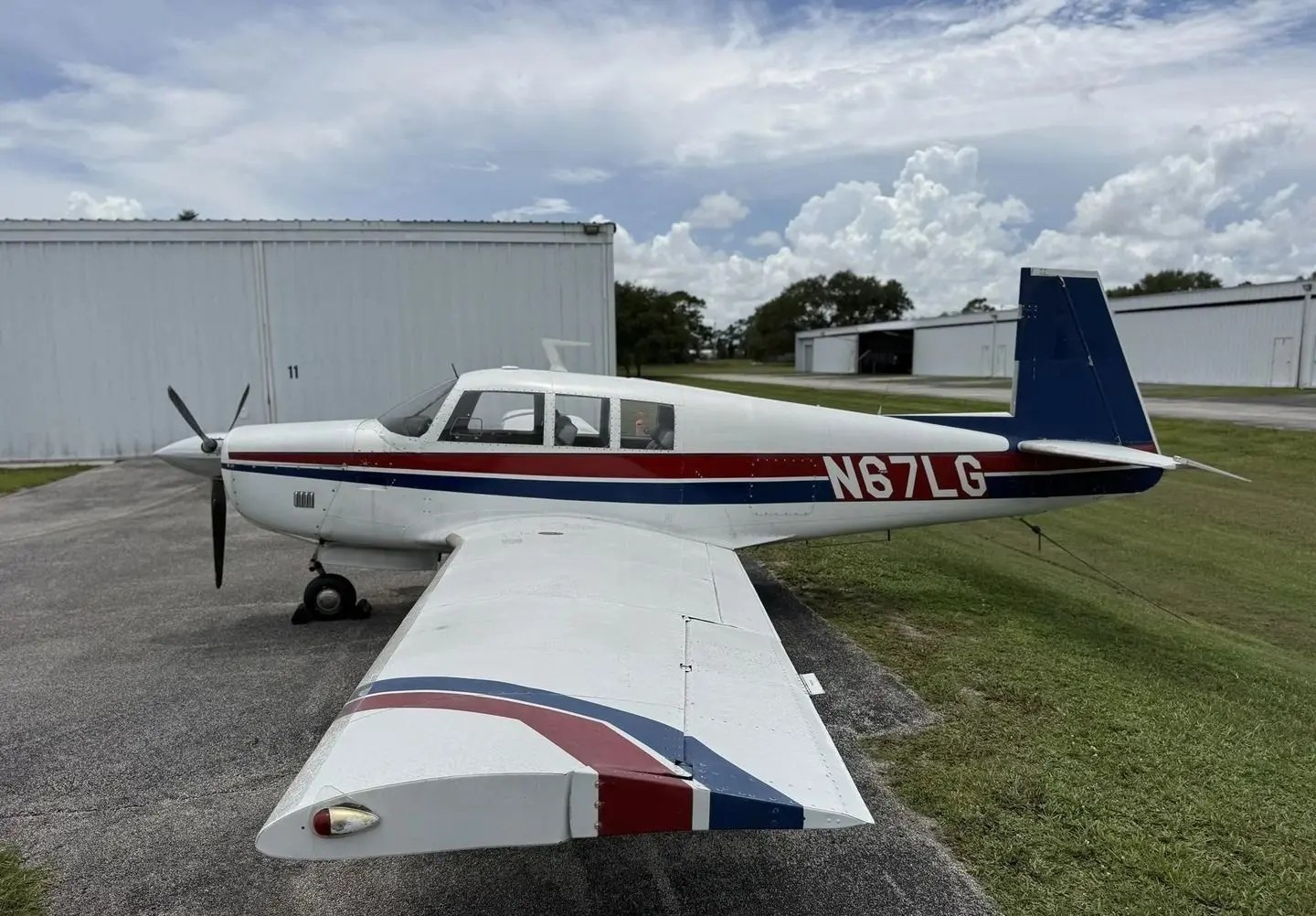
Mooney test-flew its first M20 in 1953 and began selling the type in ’55. Early models had partial wooden construction, including wing spars and tail surfaces, and were equipped with 150 hp Lycoming O-320 engines.
First of the ‘mid-body’ Mooneys, the F model has a larger, airy cabin. [Credit: Scott MacDonald Aircraft Sales]
Their ability to cruise at 140 to 150 ktas on such modest power made a big impression. Soon the company switched to an all-metal structure and the 180 hp Lycoming O-360, which allowed the M20 to match and even surpass the performance of more powerful competing models.
The aircraft for sale today reflects Mooney’s steady improvement of the M20 that would continue through decades of production. A highlight of the M20F is its stretched fuselage, which is 10 inches longer than for earlier versions, which became known as short-body Mooneys. The stretch gave rear-seat passengers more legroom for improved comfort.
Another selling point is the M20F’s 200 hp Lycoming IO-360, which makes it a true high-speed traveler capable of putting to shame aircraft with much higher power. The aircraft also makes owners feel pretty smart when they compare cruising speed and fuel bills with owners of “big-bore” high-performance models.
First of the ‘mid-body’ Mooneys, the F model has a larger, airy cabin. [Credit: Scott MacDonald Aircraft Sales]
A few years ago my wife and I met a couple in the Granite Air Service FBO at Lebanon Municipal Airport (KLEB) in New Hampshire. They had landed behind us in their Mooney M20J, essentially a later version of the F.
As pilots do, we began comparing notes on our trips, and it quickly became clear that while Annie, our Commander 114B, was roughly matching the Mooney’s speed, we were burning nearly 50 percent more fuel. Ouch.
I love Annie too much to trade her in for another model, but when I think about possible alternatives, several M20 models, including the excellent F, top my wish list.
This 1967 Mooney M20F has 4,098 hours on the airframe and 1,488 hours on its 200 hp Lycoming IO-360 engine and McCauley three-blade aluminum propeller.
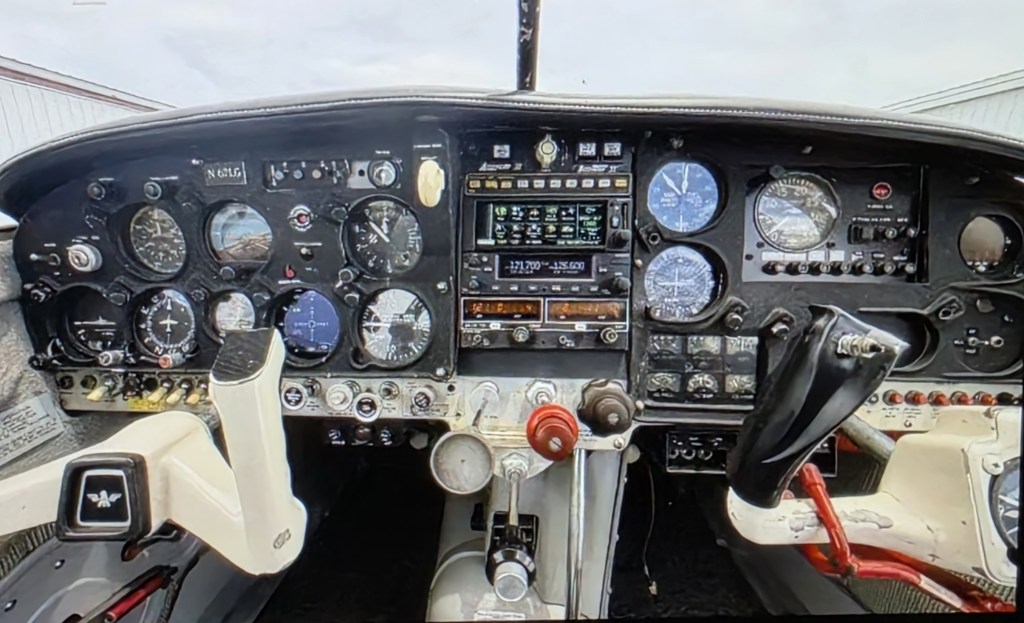
The updated panel includes a Garmin GNX 375 WAAS LPV GPS with ADS-B In and Out, Garmin GNC 255 nav/com, King KX 155 nav/com and KA 130 audio panel, Garmin GI 275, and Accutrack/Accuflite autopilot.
Pilots seeking to acquire the most performance and cross-country travel capability for their general aviation dollars should consider this 1967 Mooney M20F Executive 21, which is available for $79,900 on AircraftForSale.
If you’re interested in financing, you can do so with FLYING Finance. Use our airplane loan calculator to calculate your estimated monthly payments. Or, to speak with an aviation finance specialist, visit flyingfinance.com.
Jonathan Welsh is Lead Editor of Aviation Consumer and a private pilot who worked as a reporter, editor and columnist with the Wall Street Journal for 21 years, mostly covering the auto industry. His passion for aviation began in childhood with balsa-wood gliders his aunt would buy for him at the corner store. Follow Jonathan on Twitter @JonathanWelsh4
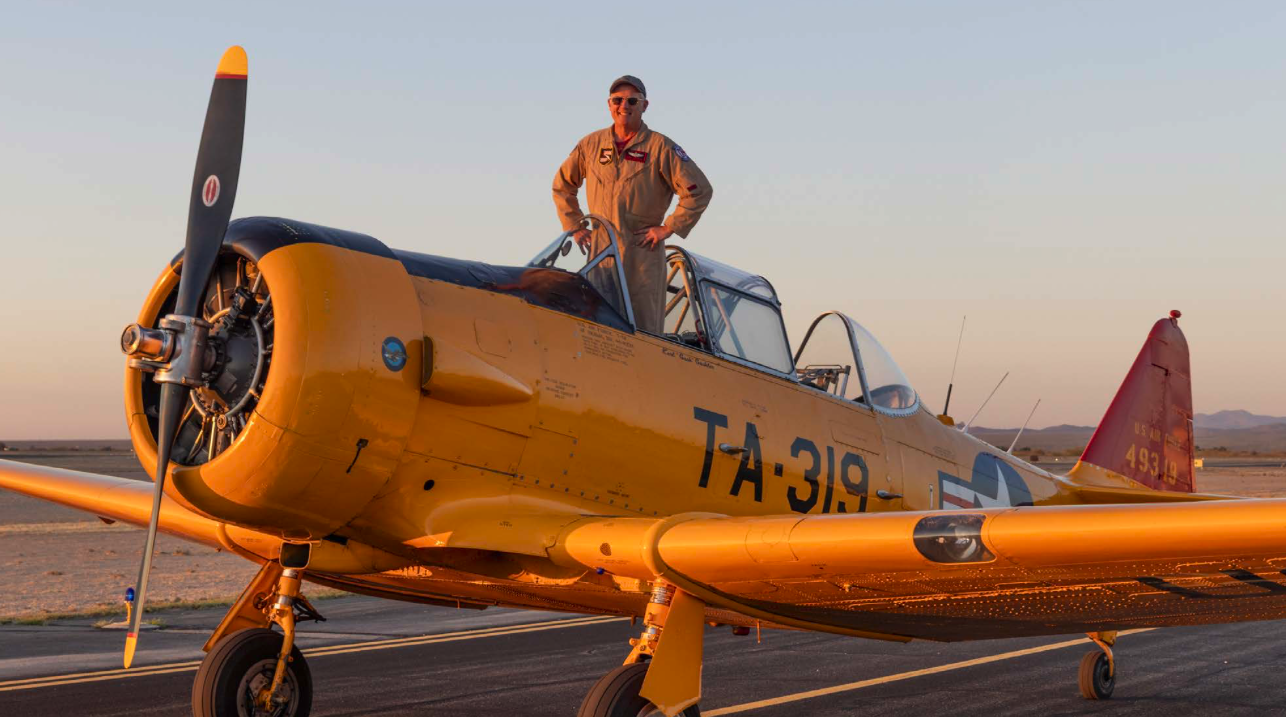
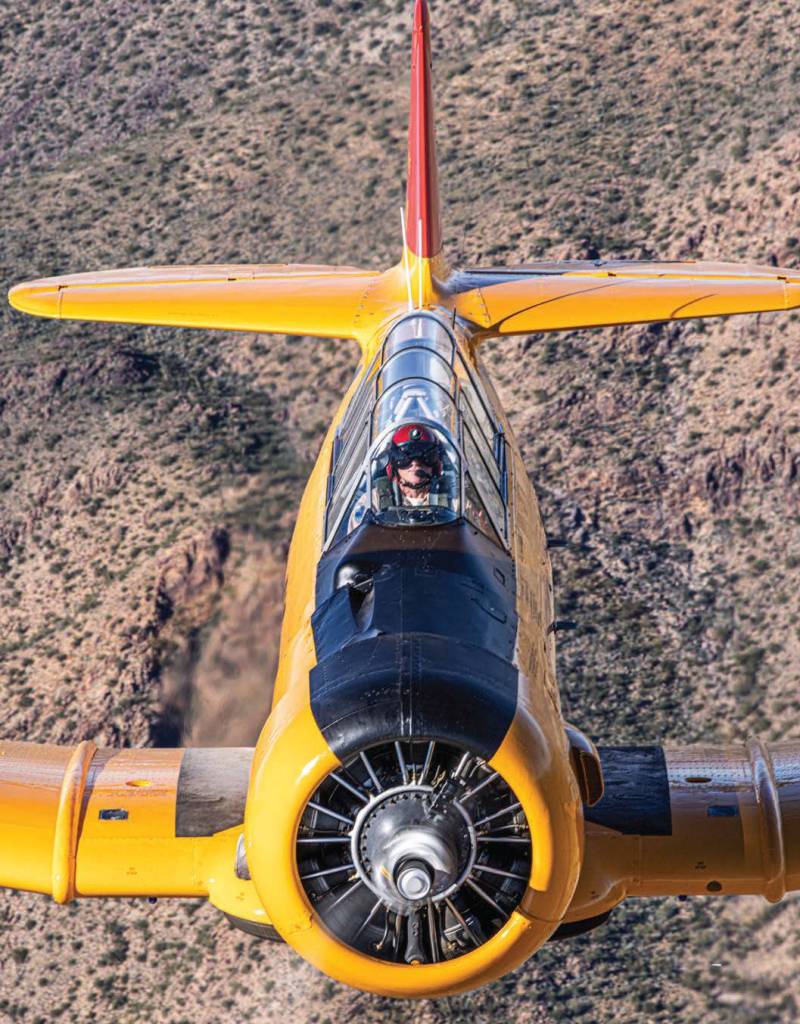
Karl Gashler poses with his T-6, a legendary airplane that trained thousands of World War II aviators for the rigors of flying fighter aircraft. [Credit: David McKay]
One snowy weekend morning in January, I was casually browsing my grandfather’s World War II logbook, accompanied by a tall mug of coffee.
Watching recently posted YouTube videos of F4U Corsairs being restored planted the seed of an idea. My basic plan was to search the internet for all known Corsair airframes either being flown or displayed in aviation museums. I collected their identification numbers and set about comparing those with the F4U Corsairs my grandfather had flown in WWII.
My hope was that I could go visit one of the surviving airframes, if any existed, and connect my family and I back to a brief moment in the past when my grandfather, at 21 years old, was training for aerial combat as a naval aviator in one of the world’s fastest airplanes.
If you're not already a subscriber, what are you waiting for? Subscribe today to get the issue as soon as it is released in either Print or Digital formats.
My grandfather died in 2020 after a long and full life. He fostered my love for aviation when I was a kid, introducing that world to me in a variety of ways, including the sponsoring of my flight training, which I began back in 1998.
He earned his Navy wings in 1944 and went all the way through his night carrier landing qualifications before being sent to Hawaii with his fighter squadron, VBF-98. The war in the Pacific ended while he was awaiting his orders to deploy, so he never saw combat, a fact he was careful to disclose when talking about his WWII experience.
After he and my grandmother raised their five children, including my father, my grandfather went back to flying in his late 60s. He got checked out in a Boeing Stearman and earned his glider rating at Van Sant Airport (9N1) in Pennsylvania and continued flying gliders well into his late 70s.
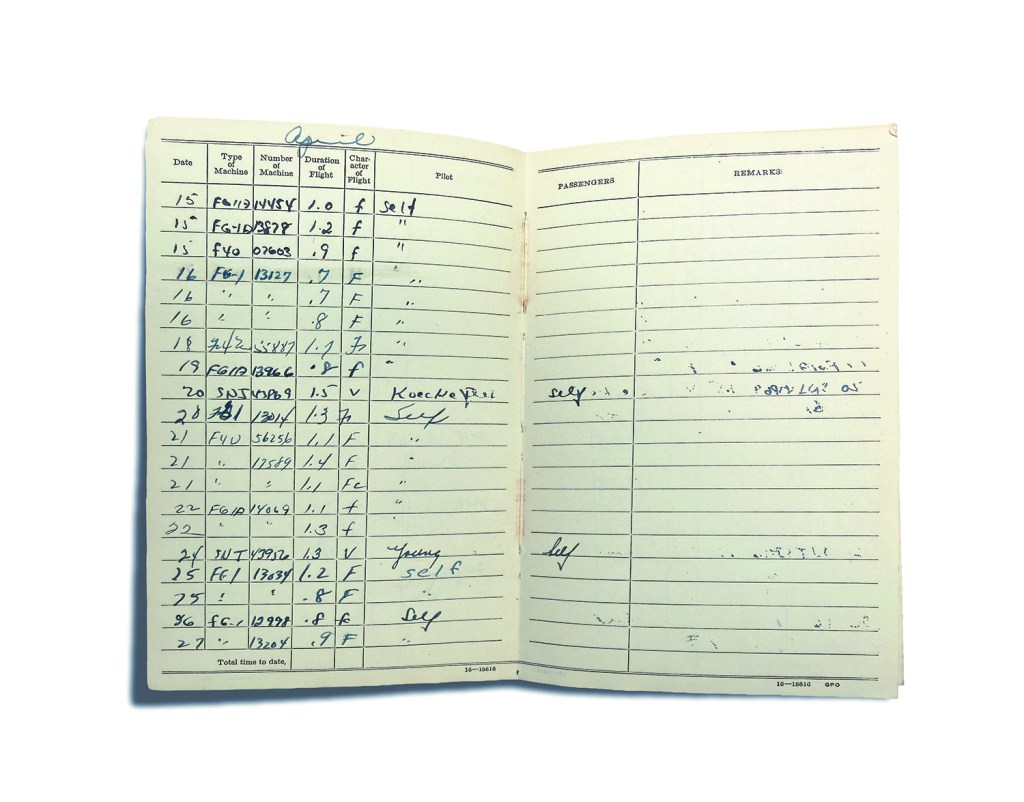
Like all WWII pilots, he flew many different types of airplanes as part of his Naval aviator training. Using his military logbook, I tracked each airplane type and the airfield he flew from as he worked his way up from the docile J-3 Cub, then into the Navy’s version of the Boeing Stearman, the N2S, and then into the branch’s version of the T-6, the SNJ. The SNJ served the role of advanced trainer flown by all airmen who were hoping to fly fighter aircraft.
Only once my grandfather passed his stage checks in the SNJ was he given the opportunity to begin training in the F4U Corsair. Most of his training in the SNJ and Corsair was at the modern-day home of Navy fighter pilots at the Pensacola Naval Air Base in Florida before deploying to Los Angeles to conduct day and night aircraft carrier qualifications from naval airfields in the area.
Over the course of my first round of research, I could not find any F4U Corsairs in existence that shared either a serial or bureau number with the Corsairs in my grandfather’s logbook. I was surprised that he rarely flew the same airplane twice, and it was easy to picture airfields full of Corsairs he and his squadron used for their training sorties.
For WWII airplane enthusiasts, it must have been a sight to behold. Since my initial search for a surviving Corsair didn’t yield any results, I rested on the idea. It had not yet occurred to me to try looking for a J-3, Stearman, or SNJ that he may have flown.
Legends Warbird Experience
Soon afterward, I began planning for my company’s attendance at the Aircraft Owners and Pilots Association’s Buckeye Air Fair outside of Phoenix. When feasible, I typically look for an aviation activity in the surrounding area of any city I need to visit for work, and I stumbled upon a warbird flying experience based out of the Phoenix Goodyear Airport (KGYR) 15 miles due west of Phoenix Sky Harbor International (KPHX).
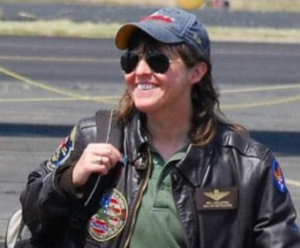
Legends Warbird Rides is owned and operated by Karl Gashler, call sign “Gash,” a former U.S. Air Force F-16 pilot who served worldwide for 21 years. After his military aviation career, Gashler became an airline captain who stayed close to general aviation and pursued his passion for warbirds. He acquired a period-correct and unique WWII-era T-6 in which he offers rides and flying experiences. Interested customers choose between a 20-minute ride, called the “Recruit” or a 40-minute ride, called the “Ace,” where the participant gets to experience a set of maneuvers that made up a typical first-day T-6 training flight for a WWII pilot.
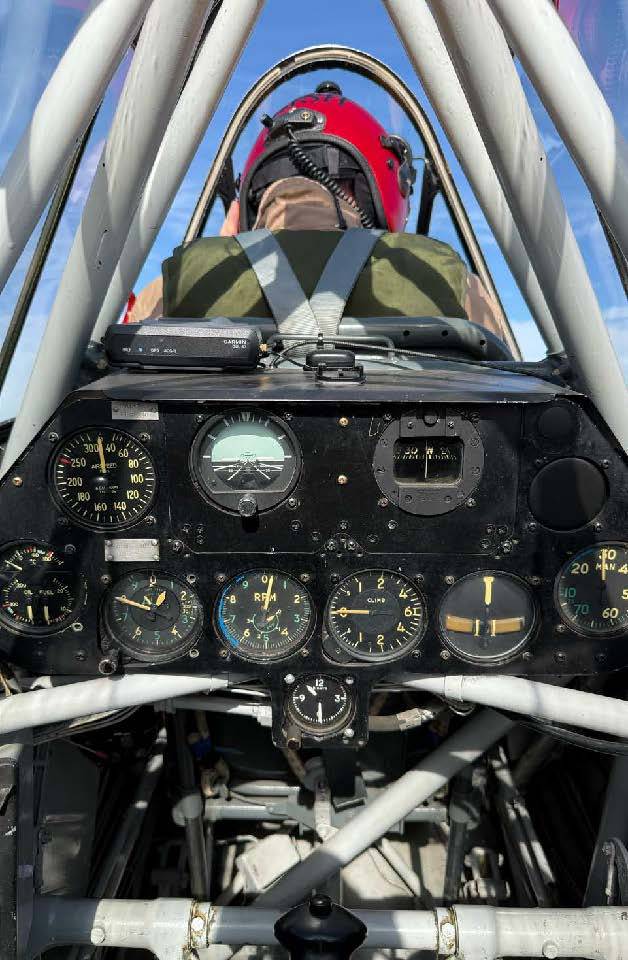
Author Sean Siff’s view in the cockpit during his ride and flight training in the T-6. [Credit: Sean Siff]
Gashler’s schedule was open the following morning, and conditions were extremely CAVU. I met him at his hangar, where he had just raised the door to begin preparing the T-6 for our flight.
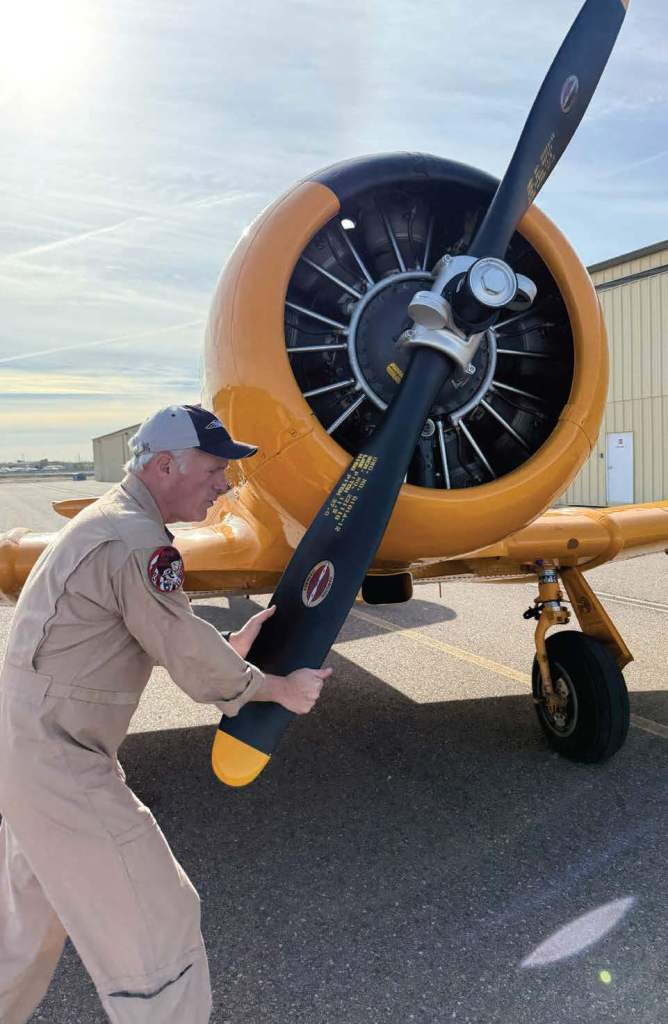
The aircraft stands tall and rather intimidating on its landing gear. At 5-foot-10, the top of my head doesn’t reach the propeller hub. Gashler talked me through the entire preflight with patience, giving me time to absorb the unique characteristics of his T-6. For example, I learned the tips of the two-bladed prop reach supersonic speed on the takeoff roll. He let me pull the propeller through, allowing me to feel the pressure and compression of the engine while the rotation checked for oil pooling in the lowest cylinders. We checked the massive stress plate that helps connect the wing roots to the fuselage. Although I was daunted by the sheer size of the T-6, checking the landing gear wasn’t much different than the Piper Arrow I had trained on. As we worked our way around the airplane, he shared interesting details about it.
Originally, this T-6 was an “F” model, delivered to the U.S. Army Air Forces in 1945. As the Army had all the airplanes it needed for training, Gashler’s T-6 was transferred to the U.S. Navy and fitted with guns and bomb racks to be used for surface attack training. At the time of transfer, it became an SNJ, and U.S. Navy pilots flew the airplane out of Pensacola Naval Air Station (NAS). It survived 12 years of training duties as a Navy SNJ until 1957 when it was flown to present-day Phoenix Goodyear Airport, then called Naval Air Field Litchfield Park, where it was parked and became part of the military surplus collection. In a remarkable coincidence, the airplane was purchased out of surplus in 1958 and made its way back to Phoenix Goodyear.
After the exterior preflight was complete, Gashler showed me how to climb into the rear seat and get strapped into the parachute, which doubled as the seat and back cushion. I paid attention to the safety briefing and how to slide back the canopy. Learning that I could do so any time, I could not wait to try opening the canopy during my flight, which would be another first.
With the preflight completed, we briefed the “Ace” flight maneuvers together. I planned to do as much of the flying as I was allowed to, eager to experience the full sequence of maneuvers that WWII fighter pilots would have needed to master in the T-6. Nicknamed the “Pilot Maker,” as an advanced trainer, the T-6 served as a bridge between the basic trainers and the high-performance fighters that pilots like my grandfather would go on to fly after completing training.
Gashler concluded the preflight briefing with some words of wisdom about flying the T-6. In his view, after training many pilots in the ways of the airplane, the fun comes from enjoying the “visceral, full-body experience that is flying a T-6,” with the goal for the pilot being to “become part of the airplane.”
Flying the T-6
With the flight sufficiently briefed, Gashler started the T-6 and handled the taxi and takeoff, allowing me to soak in the soundtrack and smell of the Pratt & Whitney radial engine. Once the airplane was cleaned up and we were departing the airspace, I was given the controls and allowed to explore, getting used to the sight picture of flying from the back seat, making coordinated inputs with the rudder, and testing the responsiveness of the flight stick in different roll-and-pitch attitudes.
Before any real maneuvers, I really wanted to get a feel for the T-6. I warmed up with some gentle turns and practiced some short climbs and descents. I noticed the T-6 built up speed and G-forces in the descents, scolding a lack of attentiveness by the pilot (me).
Karl Gashler, a former F-16 pilot and owner of Legends Warbird Rides in Arizona, performs a careful preflight inspection. [Credit: Sean Siff]
We began the WWII training profile with some steep turns. Gashler wound up the throttle and propeller, and the T-6 barely exerted itself while I attempted to hold my altitude and look through the support bars around his flight helmet as I tried to sight the horizon.
The T-6 banked cleanly without heavy effort on the stick. The steep turns were fun, and I could start to feel the size of the airplane. I noticed how it responded to my control inputs. It was rigged so well that if I closed my eyes, I would have sworn I was flying a much newer airplane. By the size of the T-6 alone, I assumed that larger control inputs would be required, but I only needed to make minute adjustments to keep it from rapidly climbing and descending.
At 3,000 feet agl, it was time for the first power-on stall. With Gashler on the throttle and my eyes fixed out into the brilliant blue desert sky, I gripped the flight stick and built a little airspeed by dipping the nose briefly below the horizon then into a smooth but rapid climb to simulate an aggressive takeoff attitude.
I immediately started gently pushing on both rudder pedals to try and gain a sense for whether I had the airplane balanced in the climb. I cheated with the briefest of glances using my peripheral vision to gauge whether I was climbing straight.
An experienced CFI, Gashler stayed silent. He wanted to create space for me to concentrate and hear and feel the airplane. But could a low-time pilot like me have a productive interaction with the T-6 in only my first 10 minutes of flight time?
I soon got my answer as the wings buffeted and exceeded their capacity to lift, and the nose of the T-6 dropped immediately as the right wing rotated under us to begin an incipient spin 180 degrees to the right in less than a second. I immediately felt the entire weight of the airplane making straight for the ground that was still a safe distance below. I had stalled the airplane without having the ball centered—and paid the price.
T-6 1, Sean 0.
The rapid descent surprised me, and Gashler and I talked about what happened. I struggled to feel the T-6’s attitude at the high angle of attack and didn’t look back at my instruments to see if I had the ball centered. Hoping I would detect the airplane’s attitude more deftly this time, I attempted power-on stall No. 2: Up we went into the stall, and the right wing cut under again, 180-degree rotation, and down we went.
T-6 2, Sean 0.
The truth was that I was too green to develop the subtle touch required, but the T-6 certainly now had my full and undivided attention.
For the next maneuver, Gashler took over and offered to demonstrate a turning accelerated stall. Letting me follow him on the controls, soon we were banking up over 60 degrees to the right and pulling into a tighter and tighter turn. The noise, vibration, and G-forces built as the airplane responded to his inputs.
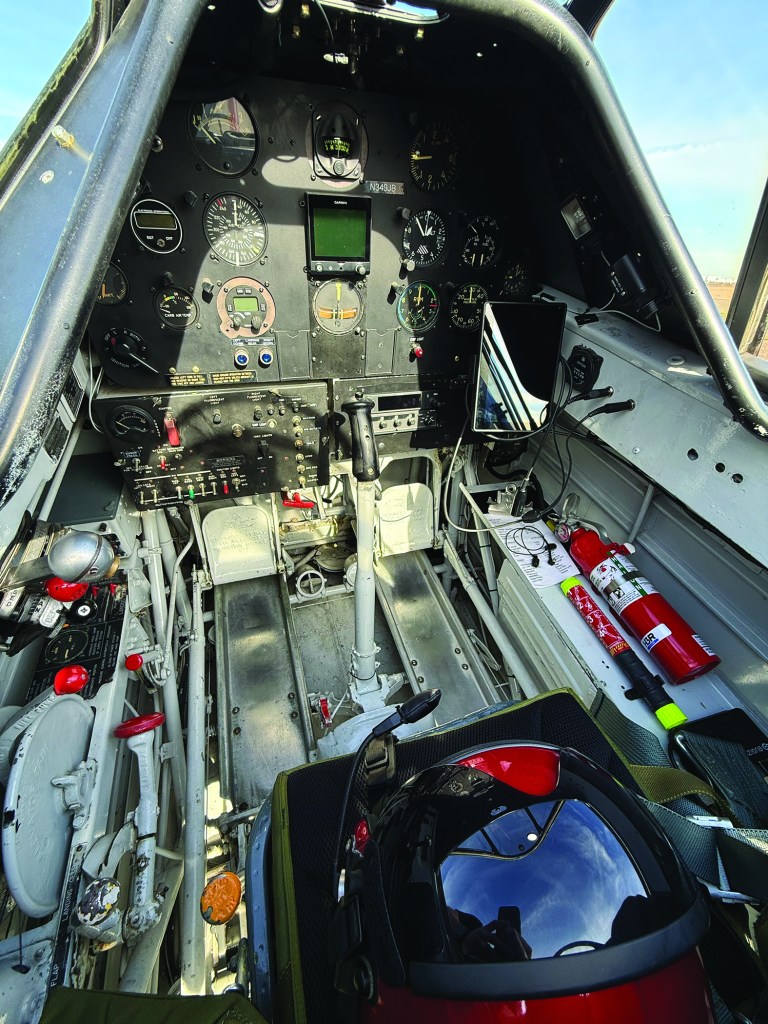
Inside the T-6 cockipit [Credit: Sean Siff]
This maneuver was another important primary aerobatic skill to be mastered by the student to demonstrate where the edges of controlled flight lay. Before I had time to fully process it, the wings stalled, and we snap-rolled to the right and were immediately pointing at the ground again.
After recovering, Gashler demonstrated a turning accelerated stall to the left. Again, the speed, noise, and G-forces built to the point where my vision began to narrow, and I experienced the bright blue day and the yellow sun begin to get darker around the edges of my vision.
The Gs loaded up as we reached the stall, and even though we were turning tightly to the left, the wing stalled, and the airplane snap-rolled to the right, surprisingly, breaking the turn in an instant as we rolled toward the ground again. Gashler recovered quickly and safely.
Needing some fresh air after the Gs we pulled, I opened the canopy, sliding it gently into the full aft position. Immediately, fresh, cool desert air from 4,000 feet barreled into my face, and I let my fingers and palms out into the air stream to direct it across my chest.
With no plexiglass in the way, I took in an unrestricted view of the sky and desert below. I followed the hills out to the edge of the horizon, perhaps 100 miles in each direction. I reflected on how my grandfather, and thousands like him, had not only flown the maneuvers in the same type of airplane but had done so at half my current age.
Gashler knew I was a little winded, so he gave me the controls, and I was free to fly the T-6 as I wished. With the canopy open, I descended toward the desert floor and followed the remnants of an old and dried-up riverbed as it wound around the hills and undulations of the terrain below.
The T-6 was a tricky dance partner, and I felt like I was stepping on her toes as I searched for the correct amounts of input to conduct even simple maneuvers, such as coordinated turns, climbs, and descents.
Author Sean Siff relives some of the intensive flight maneuvers that prepared his grandfather for WWII aerial combat. [Credit: David McKay]
Gashler shared that I was just one of many pilots new to the T-6 challenges. In fact, during WWII, T-6s just like this one were flown south from nearby Luke Field to the same airspace we were in to practice this similar set of advanced training maneuvers.
Gashler suggested we were in good company here. Even though those flights occurred many decades ago, the desert canyons we were flying over still echoed with the sound of the flights of those past generations of pilots.
We were truly reliving history in Gashler’s special T-6.
“I spent my military career flying the future [in an F-16], and now I spend my retirement making sure people don’t forget the past,” said Gashler.
I reached back over my shoulder to close the canopy as Gashler took over the controls and pointed us toward nearby Estrella Mountain, where he demonstrated how the T-6 could hug the terrain, much like he did when he flew the F-16 and needed to stay close to the peaks and canyons as a tactic to avoid enemy radar.
We had time for a few more beginner aerobatic maneuvers, so I followed Gashler on the controls for a few aileron rolls and was surprised at the T-6’s nimble handling given its relative size. Then we tried an inside loop and a Cuban-8. That was the time in the flight where my decision to not eat a sufficient breakfast had caught up with me, and the perspiration I had acquired from the mental and physical effort turned from warm to cool sweat.
Slightly disappointed in my reduced tolerance for aerobatics, I agreed with Gashler when he announced it was time to head back to the airport. The 40 minutes in the air had elapsed quickly, and it was a most satisfactory flight experience.
I relaxed for the last few minutes, taking in the scenery and many details of the cockpit, which were largely original from when it left the factory nearly 81 years ago.
After getting clearance from the tower, Gashler topped off the “Ace” experience with an overhead break into the short final. Pulling my last few Gs as we lost altitude with haste, he explained that this critical maneuver quickly gets fighters over a protected airfield “inside the wire” as well as getting lots of airplanes on the deck in the shortest possible time.
Unexpected Connection
After we taxied up to his hangar and shut down, I asked Gashler about how he got into aviation.
Gashler said his family owned and operated a dairy farm in central Wisconsin, and he spent a lot of time there looking skyward at airplanes, especially some Wisconsin Air National Guard A-10 Thunderbolt IIs. He eventually traveled to EAA AirVenture Oshkosh and found an A-10 pilot who told him how to join the Air Force and become a fighter pilot. He credits a cast of supportive adults who encouraged him to “work hard and never take ‘no’ for an answer.”
When he was 15 years old, he joined a Boy Scouts of America Aviation Explorer’s unit at his local airport, where he received his first general aviation flight and first flight lessons. That same year he and some friends were allowed to load up an early version of Microsoft Flight Simulator on their classroom’s Apple IIe computer and fly “only if their schoolwork was done.”
Author Sean Siff’s personal quest to retrace his grandfather’s World War II flight training began with a handwritten logbook, giving the author an opportunity to search for the aircraft his grandfather had flown. [Credit: Sean Siff]
One day while hanging out at the airport, a beautiful Christen Eagle pulled up and parked. A nice middle-aged man came into the FBO and offered Gashler a ride. The pilot said he was going to be practicing his full aerobatic routine and made sure that was OK. Gashler had never experienced aerobatic maneuvers before and said he greatly enjoyed the experience. After the flight, the man fueled up and left.
A friend approached Gashler and said, “Do you know who that was?”
Turns out, it was Tom Poberezny, a member of the Eagles Aerobatic Demonstration Team, and years later the president of the Experimental Aviation Association. Astonished, Gashler never forgot what that flight meant to him.
“That’s why it’s still important for kids today to get rides in airplanes,” he said.
A few weeks after I returned home from Arizona, I pulled out my phone and began looking through the photos I had taken. I saw the one I took of the U.S. Navy’s acceptance plaque that was riveted to the inside left rail of the pilot’s seat and remembered how Gashler’s T-6 became an SNJ and served as an advanced training airplane at NAS Pensacola.
The plaque specifically listed June 19, 1945, as the date of acceptance, and it struck me like a lightning bolt. In a moment, I was on my feet and hastily making my way down into the basement toward my grandfather’s WWII logbook. I had recalled from my research weeks earlier that he had been flying T-6s at Pensacola before and during his transition into the F4U Corsair.
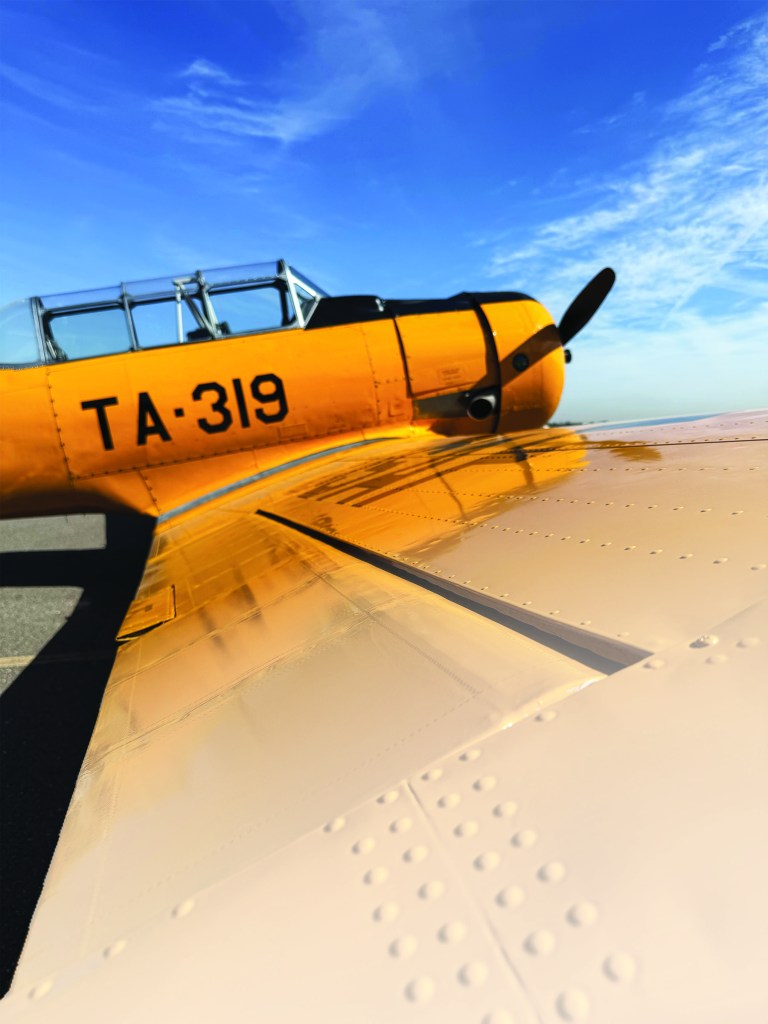
T-6 view from edge of the wing [Credit: Sean Siff]
As I found out on my own flight, the T-6/SNJ “Pilot Maker” was the ideal trainer to prepare a pilot for faster and more demanding single-engine airplanes, and I knew my grandfather had been logging hours in Pensacola’s SNJs as he prepared for his first and subsequent flights in the F4U.
Since there were no two-seat trainer F4Us, the pilot had to train, complete ground school, and taxi the F4U until the instructor was satisfied they were ready to solo. Consequently, the SNJ was the ideal airplane to prepare pilots like my grandfather for the F4U Corsair.
In the end, after reviewing the tail numbers twice and the timeline of my grandfather’s training flights, it turned out that his squadron had left Pensacola in late May 1945, and he was flying out of NAS Jacksonville, 300 miles away, on June 19, 1945, when Gashler’s T-6/SNJ was received by the Navy at Pensacola.
Separated by less than a month, my grandfather’s training at Pensacola had nearly intersected with the arrival of Gashler’s T-6/SNJ. It was a near miss, and I don’t know if I will ever be able to get closer, short of finding an airplane that my grandfather actually flew.
Even so, Gashler’s T-6 is a living history time machine that a pilot or enthusiast can fly to experience the same in-air training environment that was shaping young aviators like my grandfather as they prepared to step into even faster and more powerful fighter airplanes en route to deploying in combat zones in Europe and the Pacific.
It was exciting to get as close as I did, and knowing that my grandfather once flew the same model of SNJ as I had was extremely satisfying.
Fortunately, there are aviators like Gashler who are doing the hard work of keeping these airplanes safe and flyable for pilots and enthusiasts who want a realistic WWII experience.
“I am a temporary caretaker of this T-6,” he said. “It is a special airplane. I protect it. I take care of it, and I want it around for the next 80 years.”
This feature first appeared in the September Issue 974 of the FLYING print edition.
Sean Siff is a private pilot who has worked in marketing in the aviation industry. He’s an active flight sim user as he works to stay current in the airplane.
Business aviation demand is outpacing supply, posing challenges for stakeholders. [File photo]
The “defining question” facing the business aviation industry is “no longer who can provide an aircraft but who can secure and coordinate the capacity around it, from delivery slots, crews, hangars, and maintenance to a seamless passenger experience.”
That is according to McKinsey & Company, which earlier this week released its inaugural analysis of the state of the bizav industry. The consultancy predicted that industry leaders heading into 2027 will be those who respond the quickest to limited aircraft supply, growing infrastructure constraints, and the difficulty of scaling.
Per McKinsey, demand for private aircraft—driven by increasing wealth, particularly in the U.S. market—is outpacing supply. It said the business aviation industry is “coping” with “challenges, including the supply of new aircraft, shifts in flight patterns to smaller airports, and the need to maintain momentum in consolidation.”
The analysis draws from industry data and interviews with sector leaders such as NetJets and West Star Aviation, covering a 2019-25 time frame. According to the firm, departures have increased by 4.9 percent annually since 2019, reaching a record 3.9 million in 2025. But stakeholders are struggling to accommodate that growth.
Here’s what else McKinsey found and what the firm believes stakeholders should consider.
Why Business Aviation Demand Is Growing
According to McKinsey, the primary factor fueling demand is the 5.6 percent annual rise in the world’s ultra high net worth individual (UHNWI) population during the studied time frame.
“The transfer of wealth we have been hearing about for years suggests that around $80 trillion to $100 trillion dollars will be transferred over the next 20 years,” said Patrick Gallagher, president of NetJets Aviation.
Growth is particularly strong in North America, which McKinsey forecasts will represent a 43 percent share of the world’s UHNWIs by 2031.
Beyond increasing wealth, a decline in nonstop commercial routes for flights under 1,000 kilometers has reduced direct service, particularly for second-tier destinations, driving customers to bizav.
The industry has also absorbed demand due to geopolitical disruptions, such as the war in the Middle East. Crowded airports, inconsistent service, and lower on-time performance for commercial airlines has lessened their appeal despite rising investment in premium services, McKinsey found.
Where That Demand Is Going
The consultancy described North America’s position in the bizav world as dominant.
While utilization is up globally, North America is “by far” the industry’s largest regional market, it said. The region accounted for some 70 percent of global business flight hours in 2025 compared to 16 percent for runner-up Europe. McKinsey said it would take decades for other regions to catch up at current growth rates.
“Today, North America registers about four times the flight hours of Europe and more than ten times those of every other region,” it said.
Demand has also shifted away from corporate centers toward leisure and second-home destinations, which saw 5.4 percent growth in departures from 2019-25 versus 2.1 percent for traditional business locations. NetJets’ Gallagher highlighted Naples, Florida; Scottsdale, Arizona; Jackson Hole, Wyoming; and Bozeman, Montana, as particularly busy locations.
The way customers are flying is also shifting. Fractional ownership rose from a 14 percent share of total business jet flight hours in 2019 to a 20 percent share in 2025. During the same period, fleet size grew from 990 to 1,510. The fractional segment grew faster than managed ownership and corporate and private services models—which remain the largest segments—and charter operators, whose share of flight hours remained flat despite the emergency of more large providers.
Demand has also gone disproportionately toward very light and long-range jets, led by the Bombardier Global 7500/8000 and Gulfstream G650/700/800, compared to midsize and large-cabin models.
Rising Demand Leads to Challenges
Business aviation stakeholders are contending with a range of issues as they attempt to keep pace with demand.
For one, though fleet sizes have grown, they are aging. Aircraft, particularly midsize and large-cabin models, are remaining in service for longer stretches. McKinsey found that on average, they flew 19 percent more hours in 2025 than in 2019, which is driving higher maintenance costs.
The consultancy estimated 2025 and ’26 business jet deliveries at about 842 units, far off the peak of 1,290 in 2008, as lead times rose. It predicted a “second wave of capacity constraints” due to limited new-build rates and expensive replacements. That could prompt a shift toward fractional shares, charters, and jet card products.
These aging fleets are also seeing more unused range and capacity as travelers seek shorter, faster trips. McKinsey estimated that 65 percent of ultra-long-range flights to and from the U.S. in 2025 were less than 1,000 nm, and 27 percent were under 250 nm.
Solairus Aviation CEO Don Dreher said the firm’s jets on average fly two passengers for two hours, despite averaging capacity for 14 passengers and certified range of 14 hours. McKinsey believes the lack of utilization is a management rather than asset issue.
Another challenge is infrastructure. Leisure destinations in particular are seeing more pressure on hangar and parking space, maintenance, repair, and overhaul (MRO), and other private services. McKinsey found that landing and special event fees have not yet harmed demand, but limited ground capacity and construction and noise rules have. Gallagher said infrastructure is “by far the biggest challenge we contend with.”
The combination of limited aircraft and infrastructure is driving consolidation among operators and FBO networks, McKinsey said. West Star Aviation CEO Stephen Maiden said he expects that trend to continue.
“As the industry grows, tier-one providers and OEMs continue to invest in improved technology solutions and talent,” Maiden said. “There is pressure for other stakeholders to keep up.”
What Stakeholders Should Consider
McKinsey said “three major shifts” are affecting “every part of business aviation.” Longer planning horizons are requiring more discipline. Customer needs are shifting away from range toward speed, cabin quality, and personalization. Customers also increasingly do their research using AI rather than through brokers.
“In short, driving economies of scale and the further maturing of the industry through consolidation is the competitiveness gap that OEMs, MRO suppliers, operators, and infrastructure providers should close,” analysts concluded.
OEMs, the firm said, should increase production rates to keep up with demand, which is a seemingly obvious conclusion. But they should focus more on speed and cabin or interior retrofits than range to match shifting customer sentiment.
McKinsey described final assembly as the “lower margin half” of OEM products and encouraged them to direct more focus toward major systems and aftermarket services, such as retrofitting, to solidify customer relationships.
For operators, customers are beginning to prefer access to ownership, as evidenced by the growth among fractional providers. Rather than rapidly expanding fleets, they should better position aircraft and crews to minimize empty legs and use AI to customize offerings and spot demand, McKinsey suggested.
MRO providers are benefitting from rising demand due to aging fleets. But to capitalize, the consultancy believes addressing supply chain bottlenecks and lowering turn times will be critical. It described the latter as a “competitive differentiator rather than an operational metric.”
Organizations may also consider the importance of the customer relationship, as well as data on their installed base, in order to “move from being seen as a cost center to being the gatekeeper of fleet availability.”
Finally, FBOs and infrastructure providers should secure more long-term positions—including internationally—and optimize aircraft movement to dodge capacity constraints, McKinsey said.
“Industry experts tell us that passengers are increasingly judging the arrival, ground handling, and lounge experience against luxury hospitality rather than against other FBOs, making quality facilities and data-driven frictionless experiences all the more valuable,” it concluded.
Jack is a staff writer covering advanced air mobility, including everything from drones to unmanned aircraft systems to space travel—and a whole lot more. He spent close to two years reporting on drone delivery for FreightWaves, covering the biggest news and developments in the space and connecting with industry executives and experts. Jack is also a basketball aficionado, a frequent traveler and a lover of all things logistics.
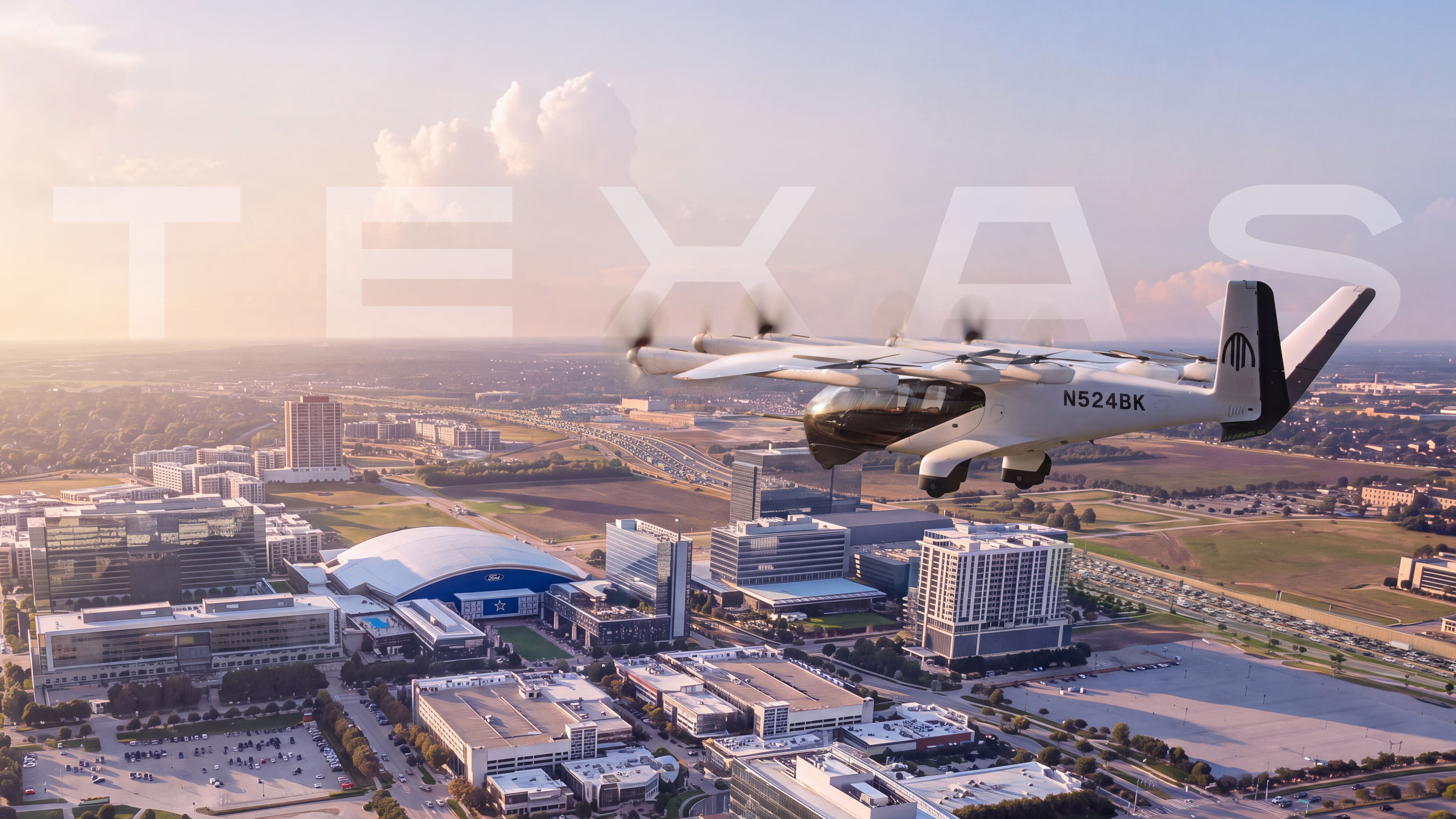
A digital rendering shows Archer’s Midnight electric air taxi flying past the headquarters of the NFL’s Dallas Cowboys within Frisco Station, a planned node in its Texas network. [Credit: Archer Aviation]
Users of certain general aviation facilities in Texas will soon catch a glimpse of electric vertical takeoff and landing air taxi demonstrations, with commercial passenger service to one day follow.
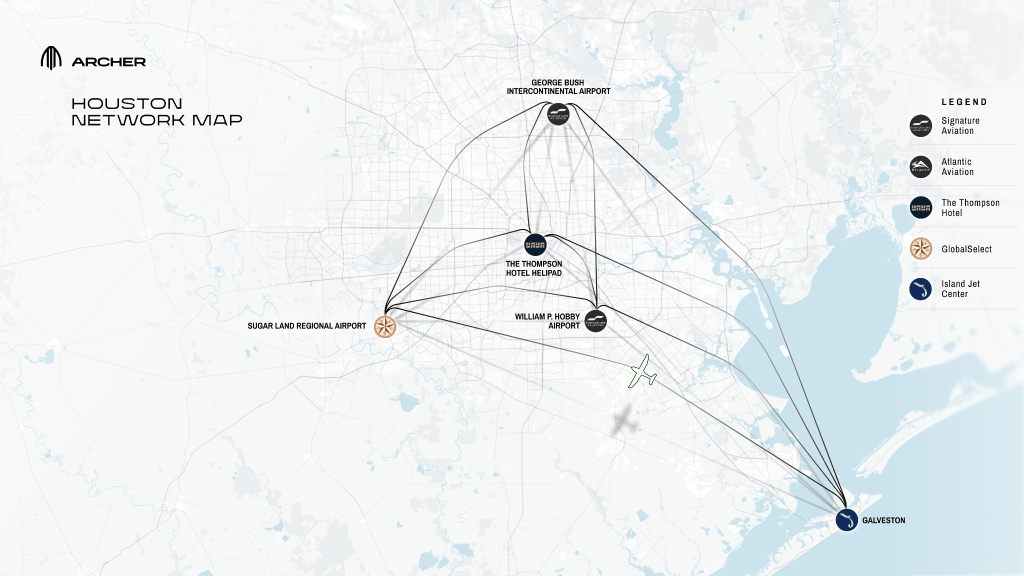
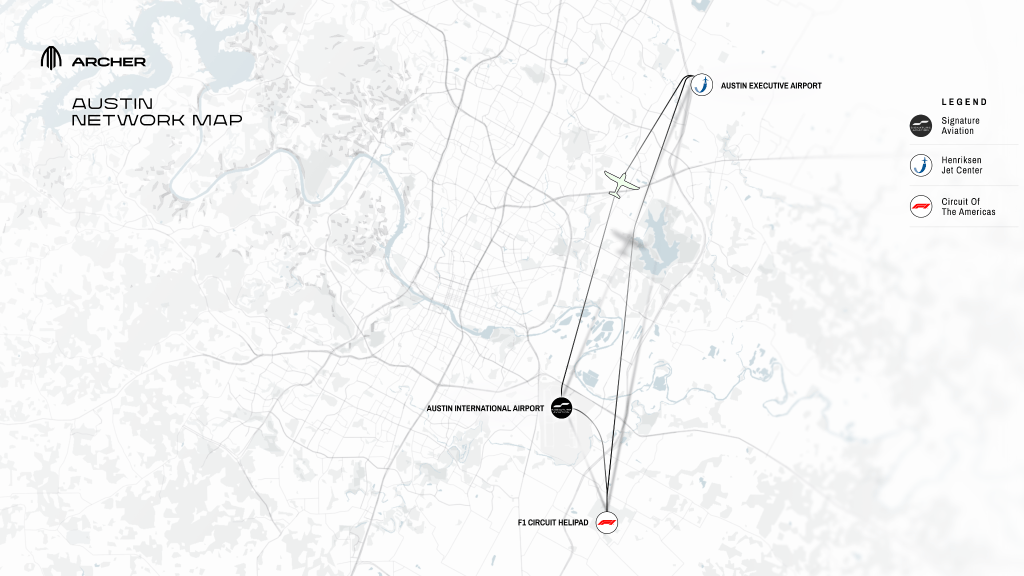
Archer Aviation, which is pursuing FAA certification of its four-passenger Midnight eVTOL air taxi, on Friday shared maps for planned networks covering Dallas-Fort Worth, Houston, and Austin. The networks include FBO locations and other GA facilities across the three cities.
Eventually, Midnight will use vertiports—heliports designed to accommodate eVTOL aircraft—for its operations. But the aircraft is also designed to take off conventionally from a runway, and Archer plans to bring it to Texas for demonstration flights ahead of expanded VTOL testing and certification.
The company plans to install electric aircraft chargers across the Texas Triangle to support its planned participation under a federal pilot program designed to gather operational data on the novel aircraft.
“Our planned networks will make the benefits of electric air taxis real for Texans—trading hours in traffic for minutes in the air, while connecting the biggest airports, business districts, and sporting hubs in ways that America’s largest megaregion needs to grow,” said Archer founder and CEO Adam Goldstein in a news release.
The all-electric Midnight is intended to provide quiet, zero-emission, 10-20-minute flights, with a maximum range of 100 miles and speed up to 150 mph. It comprises 12 propellers, half of which support only vertical takeoff and landing. The other six are tilt propellers designed to enable the aircraft’s transition from vertical to wingborne flight.
Midnight will be piloted at launch, but Archer is working toward future uncrewed operations. It recently acquired autonomous eVTOL developer Wisk Aero from Boeing and is developing Zee, an AI foundation model designed to provide copilot assistance and handle ATC communications, among other capabilities.
Air Taxis at GA Facilities
Maps shared by Archer detail exactly where the company plans to demonstrate and later operate Midnight.
Dallas-Fort Worth
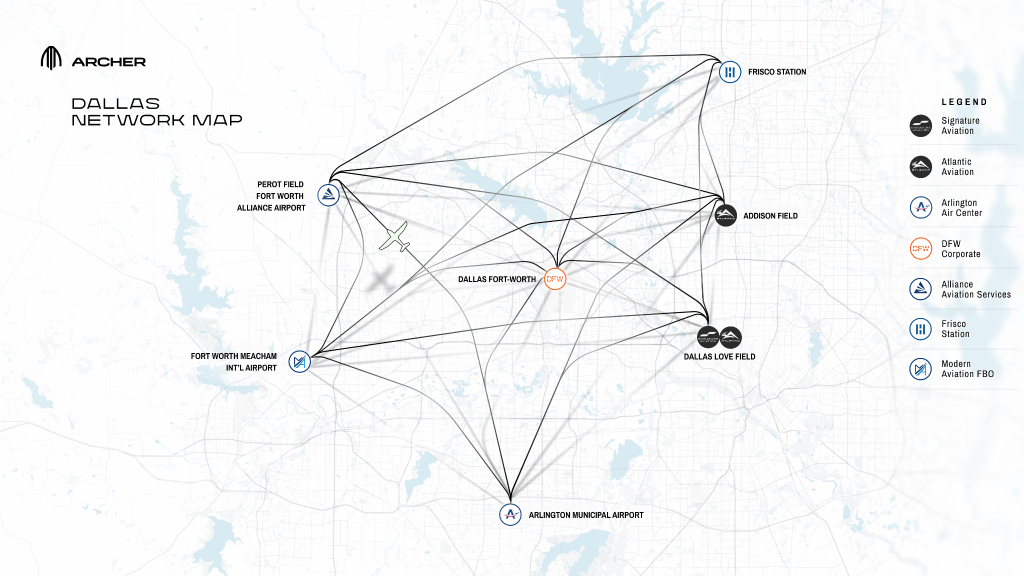
The Dallas-Fort Worth network would comprise:
DFW Corporate Aviation at Dallas Fort Worth International Airport (KDFW)
Signature Aviation and Atlantic Aviation terminals at Dallas Love Field (KDAL)
Atlantic’s location at Addison Airport (KADS)
Arlington Air Center at Arlington Municipal Airport (KGKY)
Modern Aviation’s FBO at Fort Worth Meacham International Airport (KFTW)
Alliance Aviation Services at Perot Field Fort Worth Alliance Airport (KAFW)
Travelers would be able to fly from those sites to locations such as the 242-acre Frisco Station business hub, which also surrounds residential communities, hotels, and the headquarters of the NFL’s Dallas Cowboys. The company is partnering with real estate developer Hillwood, which is part of the joint venture that owns Frisco Station.
Transport to sporting events is one of Archer’s key focuses. The company in 2024 said it was in discussions with the Los Angeles Rams on potentially exclusive vertiports near SoFi Stadium in Inglewood.
Houston
Archer also plans to fly Midnight out of Signature’s terminals at George Bush Intercontinental Airport (KIAH) and William P. Hobby Airport (KHOU), as well as GlobalSelect at Sugar Land Regional Airport (KSGR). Its subsidiary Wisk in 2024 announced partnerships with the city of Sugar Land and Houston Airports, the city’s department of aviation, to explore bringing operations to these three airports.
The Houston network would connect to downtown Houston’s Thompson Hotel Helipad. It would also link to the Island Jet Center in Galveston, offering access to beaches.
Archer’s customer and investor United Airlines uses George Bush International as its primary Texas hub. The carrier in 2021 placed a conditional order for up to 200 Midnight aircraft and in 2022 made a $10 million predelivery payment for 100 of those aircraft.
Austin
The smallest of the three networks, Archer’s map of Houston includes Signature’s Austin-Bergstrom International Airport (KAUS) location and the Henriksen Jet Center at Austin Executive Airport (KEDC).
The network would offer transport between Austin-Bergstrom and Austin Executive Airport to the helipad at the Circuit of The Americas, providing access to Formula 1 auto racing events.
Midnight will be on display Friday and over the weekend at the Formula 1 United States Grand Prix, though it will not fly there.
Not Just Texas
Texas is the fifth market for which Archer has provided maps of its planned networks, joining the San Francisco Bay Area, New York City, South Florida, and Los Angeles. In LA, the company owns the lease to Hawthorne Municipal Airport (KHHR) and has announced plans to build a vertiport in the downtown area.
Vertiport infrastructure at GA locations in the other markets could soon follow. Outside Texas, the manufacturer is partnering with Signature, Atlantic, Modern Aviation, Clay Lacy Aviation, and Skyports, as well as regional partners that operate one or a handful of sites.
The networks will be powered by chargers purchased from competitor Beta Technologies. Through a joint effort, the companies plan to install 250 systems across Texas, New York, California, and Florida.
When Will Midnight Arrive?
Archer is preparing for operational activities under the FAA’s eVTOL Integration Pilot Program (eIPP) in the coming months. It is part of projects led by the Texas Department of Transportation, Florida Department of Transportation, and Port Authority of New York and New Jersey.
The company in recent weeks conducted demonstration flights at airports in northern California and plans to bring Midnight to LA next, followed by Texas and Florida. Planespotters in those states could be the first to witness the air taxi transition from vertical to wingborne flight, which Archer in March said it was “on track” for later this year.
Routine commercial passenger service will take a bit longer to materialize. Though Midnight is designed for both vertical and conventional runway takeoffs, Archer has yet to demonstrate a crewed transition, which will be key in its certification efforts.
However, the company is ramping up testing. Per FlightAware, its preproduction prototype flew 16 times between October 13 and 18, making at least one sortie per day. Its production-representive, VTOL-capable test aircraft flew twice on Tuesday according to FlightRadar24.
Archer stopped providing a firm certification timeline after repeatedly pushing back the milestone. But with plans to fly at the Los Angeles Olympic Games, it will likely seek to complete the certification process by 2028.
Jack is a staff writer covering advanced air mobility, including everything from drones to unmanned aircraft systems to space travel—and a whole lot more. He spent close to two years reporting on drone delivery for FreightWaves, covering the biggest news and developments in the space and connecting with industry executives and experts. Jack is also a basketball aficionado, a frequent traveler and a lover of all things logistics.
Sign-up for newsletters & special offers!
Get the latest stories & special offers delivered directly to your inbox.