Register

How Long Should a Flight Lesson Be for a Student Pilot?

Shorter initial flight lessons help build endurance and maximize learning efficiency in the cockpit.

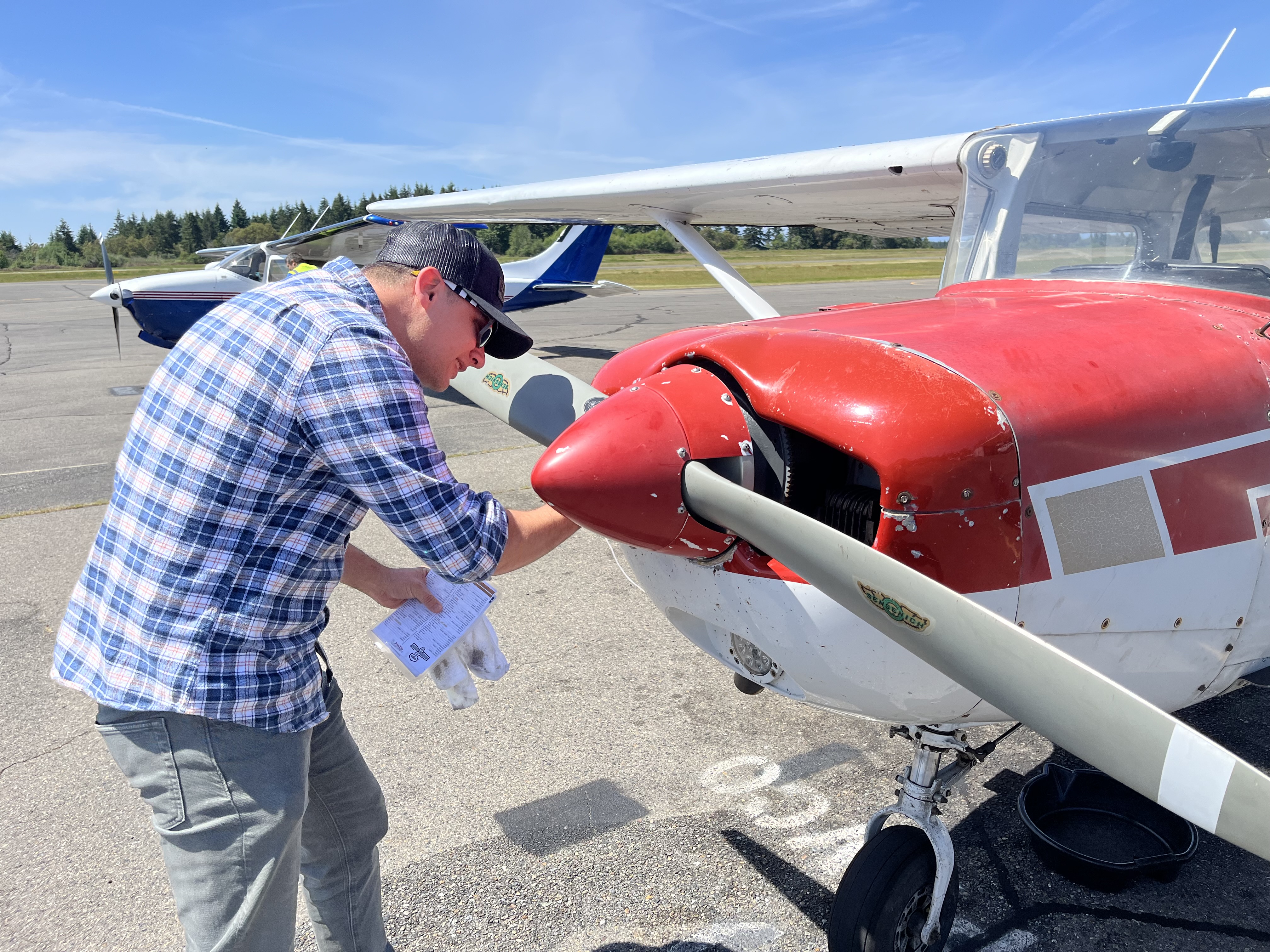
Student pilot examines the prop during preflight check. [Credit: Meg Godlewski]

Question: How long should a flight lesson be for a pre-solo student pilot? I just started flying at a Part 61 flight school, and my CFI has me on the ground for about 15 minutes at the beginning and end of each lesson, and then we’re in the air for about an hour, sometimes a bit more. That doesn’t seem like enough time to make good progress since I am only flying twice a week.

My CFI showed me the syllabus and explained that each flight we do gets a bit longer, and I have to build up my endurance to get the most out of the lessons. Is that true or is he trying to stretch the training? 

Answer: Happy to hear your CFI is using a syllabus. That is the mark of a professional instructor. While not required at a Part 61 school, it is good practice because it keeps both the learner and the CFI organized and expedites training because both the CFI and learner know what will be covered in each lesson and can plan accordingly.

Your CFI is correct that you need to physically build up your endurance in the airplane to get the most out of each lesson. Airplanes are terrible classrooms—loud, drafty, and  vibration that is fatiguing. There’s also the added bonus of the chance another “classroom” will run into you if you don’t maintain situational awareness. If you fly consistently, you will be surprised at how fast your endurance builds.

A note about the syllabus: The 1.0 hour in the air as indicated on it is the minimum amount of time recommended for that particular lesson. The lessons usually involve the instructor demonstrating a maneuver and then the learner performing it. You may learn two or three maneuvers during each lesson.

There is also review of previous tasks learned, which takes time. When the learner starts to show signs of fatigue, for example, if the CFI has to repeat instructions, a radio call is missed, their altitude is off, or they get sloppy with the checklist, it’s time to return to the airport because a tired learner is a poor learner. 

Savvy instructors will mention the signs of fatigue to the client for what they are. This helps the client determine their own fatigue level. Your endurance improves the more you fly, but it must be done incrementally. Don’t be surprised if by the time you reach week four, your flights are at least 1.1 to 1.3 hours, and each lesson ends with multiple takeoffs and landings.

Fun fact: In the early days of aviation, before pilots wore headsets, flight lessons were considerably shorter—30 minutes was common because the noise and vibration of the aircraft were physically exhausting. Then as now pilots had to build up their endurance.

I’m not a fan of CFIs who keep pre-solo learners in the air for more than an hour and a half at a stretch early in the training, because by the 1.2 mark most have hit their saturation point. When this happens, the flying becomes an hour grab for the CFI’s benefit, not the learner’s.


Ask us anything you’ve ever wanted to know about aviation. Our experts in general aviation, flight training, aircraft, avionics, and more may attempt to answer in a future article. Email your questions here.

Meg Godlewski

Meg Godlewski has been an aviation journalist for more than 24 years and a CFI for more than 20 years. If she is not flying or teaching aviation, she is writing about it. Meg is a founding member of the Pilot Proficiency Center at EAA AirVenture and excels at the application of simulation technology to flatten the learning curve. Follow Meg on Twitter @2Lewski.

Virgin Galactic Flies First Delta-Class Spaceplane, Plots Return in 2027

Company expects first commercial flight of new ‘Apeiron’ vehicle in the early second quarter of 2027.

Virgin Galactic Apeiron Delta class spaceplane
Virgin Galactic revealed the name of its first ‘Delta-class’ spaceplane, Apeiron, ahead of its delivery to the company’s operations base at Spaceport America in New Mexico. [Credit: Virgin Galactic]

Virgin Galactic, which offers high-flying commercial tours using suborbital spaceplanes, is preparing its first “Delta-class” vehicle for service in early 2027.

The company said Wednesday that the spaceplane, named Apeiron, will be delivered from its factory in Arizona to its operations base at Spaceport America (9NM9) in New Mexico. According to FlightAware, it is expected to depart Mesa Gateway Airport (KIWA) and arrive at the spaceport around 2:15 p.m. EDT. The vehicle bears the tail number N401VG.

Apeiron is not yet flying under its own power. Rather, it will be mated to VMS Eve, a Scaled Composites White Knight Two quadjet that serves as Virgin Galactic’s carrier mothership.

Flight tests are expected to begin in the months following the spaceplane’s arrival in New Mexico. First, it will undergo avionics software validation testing, as well as structural test assembly of the wing and fuselage, Virgin Galactic said Monday.

The company said it would provide more information on its third-quarter 2026 earnings call in November.

What’s in a Name?

The word “apeiron” comes from ancient Greek philosophy and is often translated as “unlimited,” “boundless,” or “infinite.”

The name was selected by a public vote comprising respondents from 83 countries across six continents. According to Virgin Galactic, “it captures what astronauts actually see from above: a view so vast that borders dissolve and the divisions we live inside fall away.”

The company in August said that Apeiron would be the name of its second Delta-class vehicle and that the first was preparing for flight testing. But it said Monday that Apeiron will be the “lead spaceship” in its next-generation fleet.

“The arrival of our lead spaceship at Spaceport America will be an enormous milestone in a years-long journey to build the world’s first human spaceship platform designed for regular commercial spaceflight,” said Virgin Galactic CEO Michael Colglazier.

Virgin Galactic Apeiron spaceplane aerial view
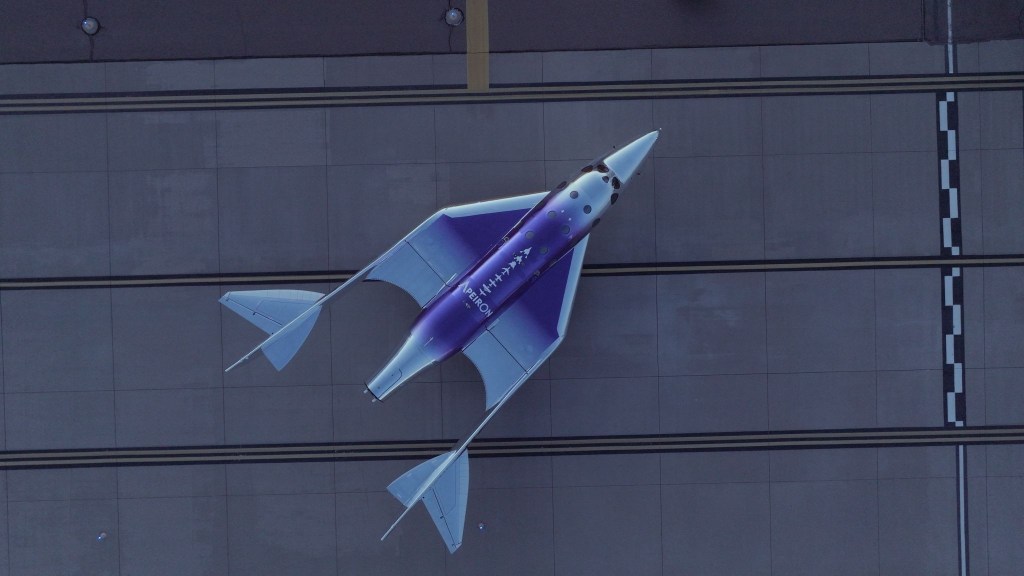
An aerial view of the Apeiron spaceplane [Credit: Virgin Galactic]

Though Virgin Galactic describes its aerial tours as spaceflights and its customers as astronauts, previous missions have not surpassed the Kármán line—the World Air Sports Federation-defined boundary of space that is commonly accepted by the international community.

Earlier trips have flown past the FAA and U.S. military-defined boundary of space at about 50 miles but fallen short of the Kármán line at about 62 miles. That means they were technically suborbital, though the FAA previously awarded astronaut wings for people who flew above 50 miles.

Virgin Galactic has not made clear whether Apeiron will pass the Kármán line. Like the company’s earlier spaceplanes, it is designed to mate with VMS Eve and take off from a runway. Eve will lift the vehicle to an altitude of about 45,000 feet before releasing it for a 60-to-90-minute suborbital tour. The spaceplane would land on the same runway used by the mothership.

Back in Action

Virgin Galactic has not flown a commercial mission since 2024. Its previous SpaceShipTwo-class vehicle, the Scaled Composites Model 339 VSS Unity, launched on its first commercial mission in June 2023 and was retired in 2024. It completed a total of seven commercial suborbital flights.

The company said Monday that Apeiron’s first mission with paying customers will fly in the early second quarter of 2027, and a second vehicle—which it said has not yet been assembled—will hit the same milestone in the late second quarter or early third quarter.

The company had previously been targeting a resumption of commercial service this year. But Colglazier said in August on the company’s second-quarter 2026 earnings call that it would be pushed to February due to delays in building the first Delta-class vehicle.

The firm said Monday that the updated timeline “reflects additional time for completing avionics software integration and validation, which uses an exhaustive testing process.” It added that more than 100 people are beginning mission preparations.

Virgin Galactic chief financial officer Doug Ahrens estimated in August that each Delta vehicle will cost about $60 million to produce. Colglazier said the plan is to charge more than $750,000 per seat.

Blue Origin, the company’s chief competitor, said in January that it would halt commercial operations with its New Shepard for at least two years. That could leave Virgin Galactic as the only commercial suborbital flight provider in 2027.

Unity vs. Apeiron

Unity returned to flight in May, conducting a handful of glider flights to train pilots for its two Delta-class vehicles. Like Unity, they will be designed to seat up to six passengers, though the former never flew with more than four passengers and two crew.

With Apeiron, Virgin Galactic aims to increase that capacity as well as the spaceplane’s cadence. It said in May that the Delta vehicles are designed for up to two weekly flights. But Ahrens in August said it hopes to fly 10 or more times per month by mid-2027. Unity achieved a peak cadence of about one flight per month in mid-late 2023.

The company earlier this month said it is “planning for around 125 flights a year, scaling to many more than that as the fleet grows.” It also announced a research agreement with the Air Force Research Laboratory to study the integration of sensor systems for space weather data collection during flight.

Jack Daleo

Jack is a staff writer covering advanced air mobility, including everything from drones to unmanned aircraft systems to space travel—and a whole lot more. He spent close to two years reporting on drone delivery for FreightWaves, covering the biggest news and developments in the space and connecting with industry executives and experts. Jack is also a basketball aficionado, a frequent traveler and a lover of all things logistics.

This 1967 Beechcraft A23-24 Musketeer Super III Is a Low-Time, Pleasantly Surprising ‘AircraftForSale’ Top Pick

Owners love well-built ‘sleeper’ that’s a bit larger and more capable than competing trainers.

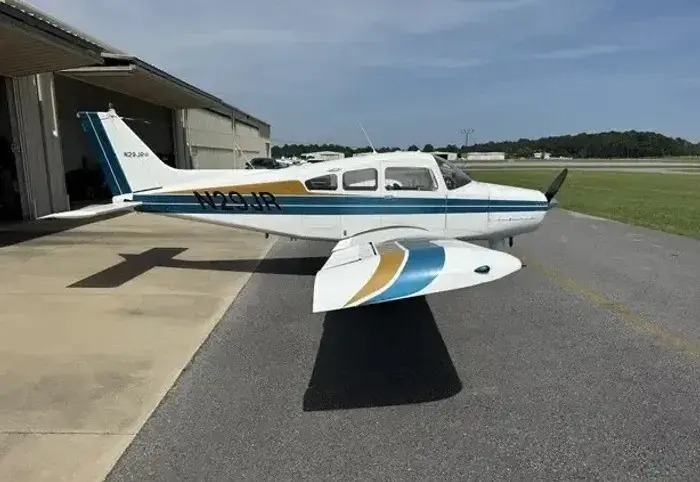
1967 Beechcraft A23-24 Musketeer SuperIII [Credit: Scott MacDonald Aircraft Sales]

Each day, the team at Aircraft For Sale picks an airplane that catches our attention because it is unique, represents a good deal, or has other interesting qualities. You can read Aircraft For Sale: Today’s Top Pick at FLYINGMag.com daily.

Today’s Top Pick is a 1967 Beechcraft A23-24 Musketeer Super III.

When pilots think of four-place airplanes that make good trainers and starter aircraft for first-time buyers, Cessna Skyhawks and Piper 172s and Piper PA-28s often come to mind.

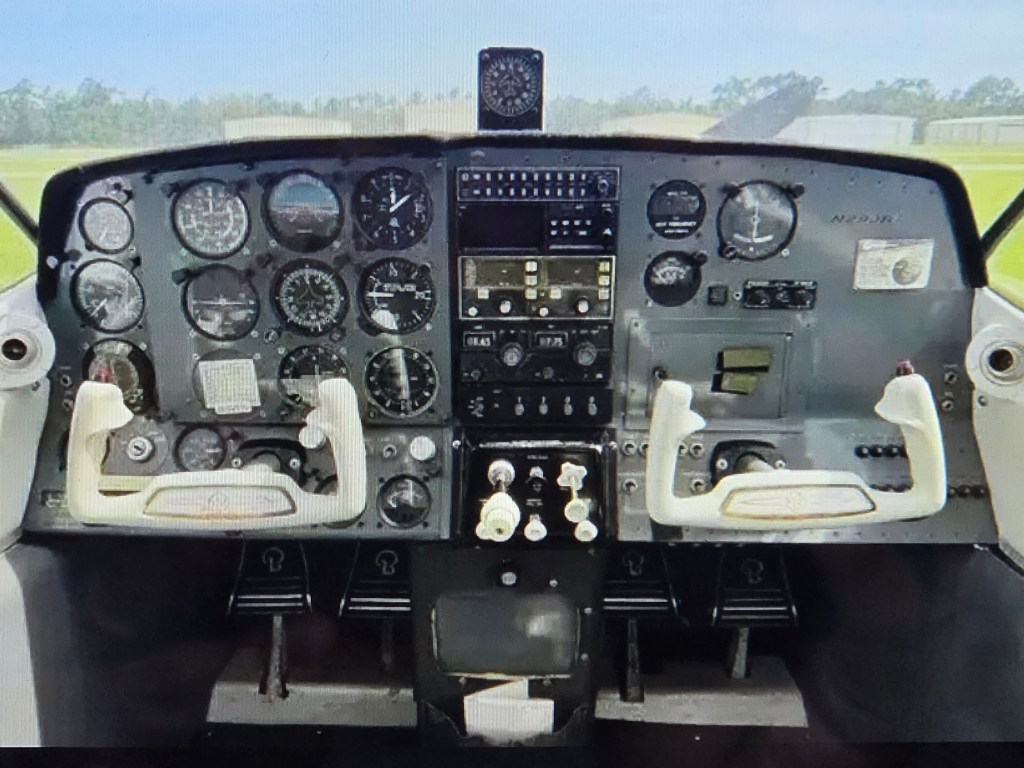
This Musketeer has a neatly laid-out panel with GPS. [Credit: Scott MacDonald Aircraft Sales]

When someone mentions Beechcraft, we tend to think about the premium, high-performance Bonanza family, not potential bargains. And that is too bad, because the company’s well-built, good-looking Musketeer series can deliver a lot for the money.

Even though the Musketeer is larger and arguably has more to offer than its Cessna and Piper rivals, it typically flies below the radar of many shoppers, mainly because relatively few are aware of the type. Beechcraft came to the basic modern four-place market a few years late and paid the price of obscurity. 

For those buyers who do their research, though, the Musketeer can be a good fit with several thoughtful features.

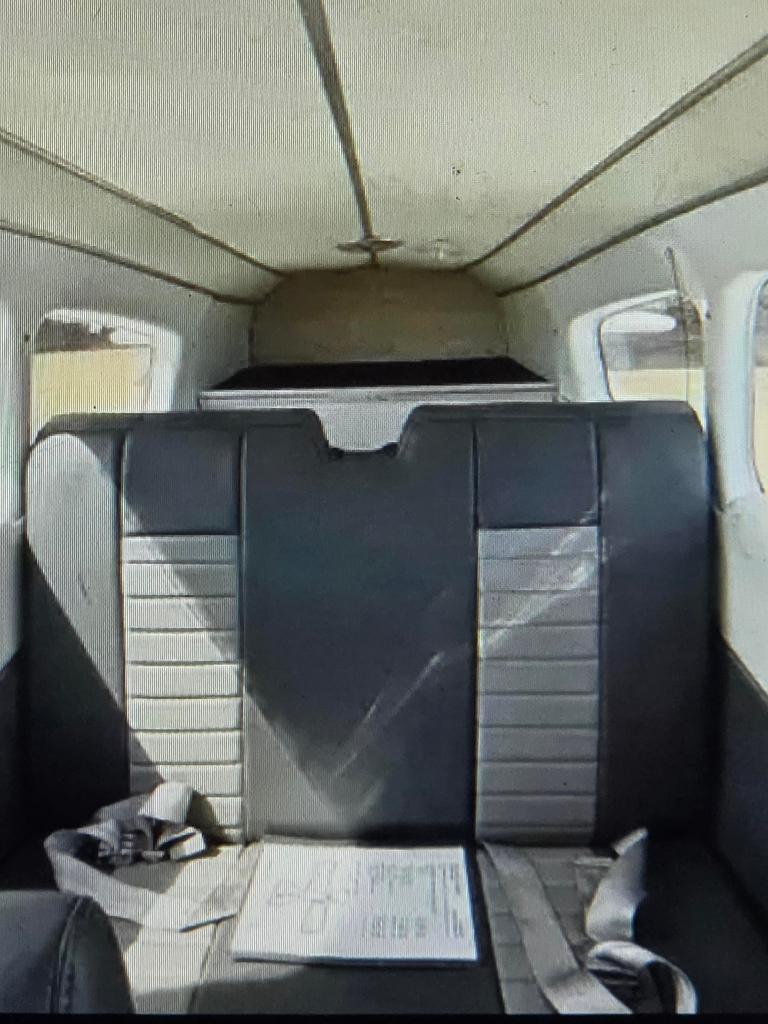
The Beechcraft’s cabin is roomier than most. [Credit: Scott MacDonald Aircraft Sales]

The aircraft for sale today is the Super III version of the Musketeer, which is equipped with the 200 hp Lycoming IO-360, which provides satisfying performance and load-carrying capacity that make it a good platform for pilots who wish to train and travel in the same aircraft.  

This 1967 Beechcraft A23-24 Musketeer Super III has 4,182 hours on the airframe, six hours since overhaul on its 200 hp Lycoming IO-360-C1C engine, and 988 hours since overhaul on its two-blade McCauley propeller. Engine TBO is 2,000 hours.

The panel includes a King KMA 24 audio panel, Apollo GX55 GPS, MAC 1700 digital nav/com with glide slope, King KX 170B nav/com, Narco AT-150 TSO transponder, PS Engineering PMA 1000 intercom, uAvionix tailBeacon for ADS-B, and vertical card compass.

Pilots looking for a basic, economical family hauler that is known for offering a bit more power and comfort, and better build quality than some competitors, should consider this 1967 Beechcraft A23-24 Musketeer Super III, which is available for $89,900 on AircraftForSale.

If you’re interested in financing, you can do so with FLYING Finance. Use our airplane loan calculator to calculate your estimated monthly payments. Or, to speak with an aviation finance specialist, visit flyingfinance.com.

Jonathan Welsh

Jonathan Welsh is Lead Editor of Aviation Consumer and a private pilot who worked as a reporter, editor and columnist with the Wall Street Journal for 21 years, mostly covering the auto industry. His passion for aviation began in childhood with balsa-wood gliders his aunt would buy for him at the corner store. Follow Jonathan on Twitter @JonathanWelsh4

FAA Proposes Criteria for Embraer E195-E2 Automated Takeoff System

Proposed special conditions cover allowable runway departure distances accounting for possible variations in rotation speed.

Embraer E195-E2 regional narrowbody jet
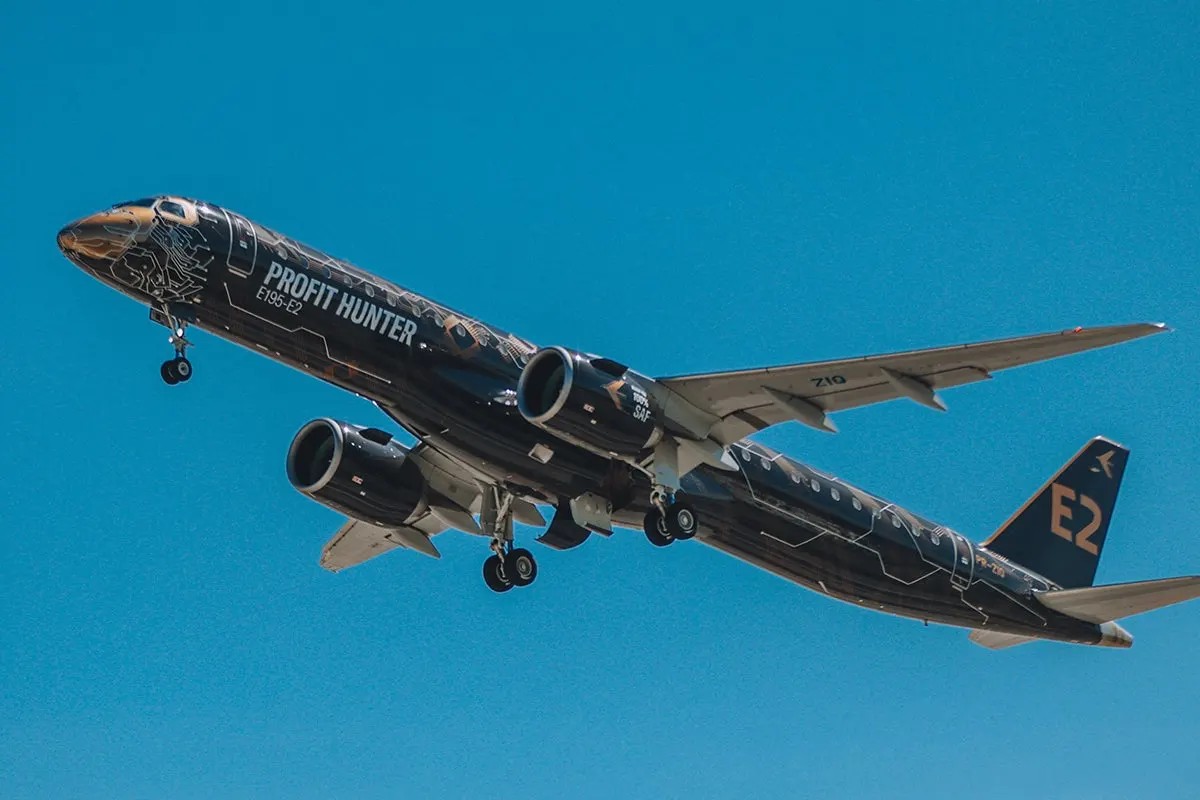
The FAA certified Embraer’s E195-E2 in 2019 and on Tuesday proposed special conditions to certify its automated takeoff system. [Credit: Embraer]

The FAA has proposed criteria for certifying a novel automated takeoff system on Embraer’s narrowbody E195-E2.

The Brazilian manufacturer in 2021 applied for a type certification modification to add the Embraer Enhanced Takeoff System (E2TS), which it bills as the first automated setup for commercial passenger jets, to the E195-E2. The regional twinjet is the largest member of Embraer’s second-generation E2 family, designed to seat up to 146 passengers. It obtained triple FAA, European Union, and Brazilian type certification in 2019.

The U.S. regulator on Tuesday proposed special conditions for the E2TS on the E195-E2. It classified the automated system as a “novel or unusual design feature” for which the transport category aircraft airworthiness standards proscribed by the type’s certification are inadequate.

The agency reasoned that because E2TS automatically controls the airplane’s pitch and bank angle without pilot input, additional requirements are necessary to establish a level of safety equivalent to existing standards.

Comments on the proposal are due by November 27. The FAA may modify the special conditions based on reasoning and data provided by commenters. The conditions would establish certification standards for the technology but would not themselves constitute approval for operational use.

What the FAA Proposes

The proposed special conditions are necessary because 14 CFR Part 25 takeoff performance requirements presuppose manual flying.

Existing regulations define rotation speed as that at which the pilot manually raises the nose wheels. According to the FAA, an automated system such as the E2TS is expected to reduce expected variations in rotation speed. But it could still be impacted by “residual” variations due to sensor inaccuracies and system tolerances.

“The current regulations do not take into consideration that the takeoff rotation is being performed by an automatic system, not a human being,” the agency wrote.

The FAA proposes that, accounting for the “maximum expected deviations” in rotation speed allowed by E2TS, E195-E2 takeoff distance with one engine out cannot surpass the corresponding published distance in the aircraft flight manual (AFM).

The maximum expected deviations could be calculated using analysis, simulation, and certification flight tests covering performance, handling quality, and other factors. But they should also reflect actual, in-service variations, which will require Embraer to comply with 14 CFR 25.101 performance requirements.

With both engines operating, takeoff distance would not be allowed to exceed the corresponding AFM distance by more than 1 percent, accounting for rotation speed deviations or in out-of-trim conditions. Unless shown to be negligent, deviations of pitch angle, pitch rate, and other factors influencing pitch rotation dynamics would also have to be accounted for.

Finally, the FAA unsurprisingly proposes that operating the E2TS cannot result in unsafe flight characteristics.

If Embraer modifies any models on its type certificate to incorporate the E2TS or amends it to add other models that use the system, those models would be subject to the same special conditions as the E195-E2.

What Embraer’s E2TS Does

Embraer developed the autoflight function to improve takeoff performance and operational safety. It could potentially allow aircraft to carry additional payload or fuel when operating from shorter runways.

The E2TS is designed to engage at the beginning of the takeoff roll, when thrust levers are advanced to the takeoff go-around (TOGA) detent. Once activated, it will perform the takeoff rotation, initial climbout, and other pitch control functions automatically without pilot intervention.

The system will also control the bank angle and augment directional control during the ground run to minimize heading deviations. Ultimately, the flight crew would be responsible for maintaining the runway centerline.

In the air, the E2TS would use sideslip—which changes based on whether one or both engines are operating—as the reference for providing control.

LATAM, South America’s largest airline group, is the intended launch operator for the automated takeoff system.

In August, Brazil’s Agência Nacional de Aviação Civil (ANAC), which has participated in the system’s development and testing, was reported to be targeting certification in October.

Jack Daleo

Jack is a staff writer covering advanced air mobility, including everything from drones to unmanned aircraft systems to space travel—and a whole lot more. He spent close to two years reporting on drone delivery for FreightWaves, covering the biggest news and developments in the space and connecting with industry executives and experts. Jack is also a basketball aficionado, a frequent traveler and a lover of all things logistics.

Next-Generation Traffic Control in the National Airspace System

NAS has accommodated crewed aircraft for decades, but how will it handle uncrewed drones?

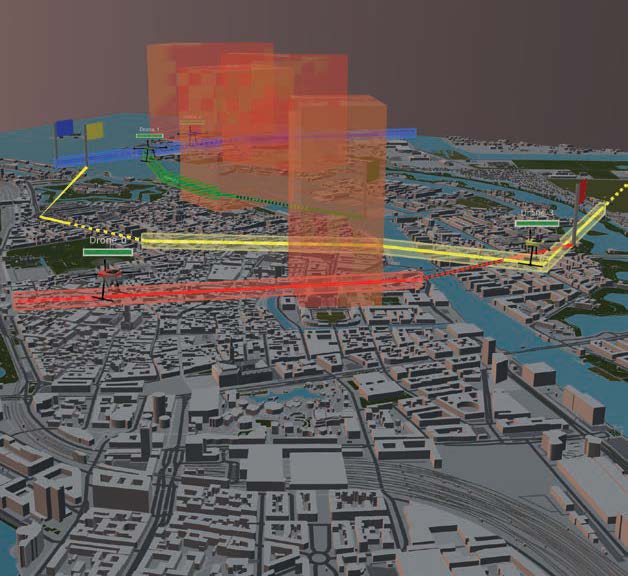
SkyPuzzler is developing digital air traffic control technology to help regulators safely manage the growing drone population. [Credit: SkyPuzzler]

In 1935, a group of U.S. airlines joined forces to establish what is considered by many to be the first standardized air traffic control system.

Nearly a century later, the ATC system is primed for a revolution prompted by the influx of small uncrewed aerial vehicles (UAVs), or drones, which are already taking on jobs from food delivery to crop spraying to policing.

“Now, we are looking at drones—hundreds, thousands of drones—and we don’t know how to handle this,” Jesper Skou, CEO and co-founder of Danish digital ATC provider SkyPuzzler, told FLYING.

This Article First Appeared in FLYING Magazine

If you're not already a subscriber, what are you waiting for? Subscribe today to get the issue as soon as it is released in either Print or Digital formats.

Subscribe Now

Skou spent about 15 years as an ATC in Denmark and Switzerland before moving into managerial air traffic management roles. He later served on the European Commission’s performance review body for the Single European Sky (SES) project, which seeks to harmonize about 30 European air navigation service providers.

Skou said aviation stakeholders in the 1930s contended with “more or less the same situation we are facing now.” ATC systems already face tremendous strain due to staffing shortages and outdated technology. As drone activity explodes, the FAA is now met with the arduous task of regulating communication between humans and aircraft that lack onboard pilots.

Complicating matters is the agency’s desire to authorize routine beyond visual line of sight (BVLOS) missions under its proposed Part 108. That means humans in charge of the airspace will need to deconflict the drones without putting eyes on them.

The FAA told FLYING that as of late July it has received no reports of fatalities or life-threatening injuries resulting from an accident involving a commercial drone.

There have, however, been reported incidents of delivery drones colliding with one another, as well as into power lines, pools, or apartment buildings. In early 2025, a civilian drone punched a fist-sized hole in an aerial firefighting aircraft, though the pilot landed with no reported injury to crewmembers.

However, the risk of more severe consequences rises as more UAVs enter the National Airspace System (NAS). Many models have exposed rotors and are heavy enough to inflict serious injury.

Simply put, the FAA and other regulators need a way to ensure drones do not cause a catastrophe. The solution, according to Skou and others, is the creation of a parallel ATC system tailored to aircraft without a pilot—“basically, a digital air traffic controller,” Skou said.

“In the U.S., it’s not the lack of ambition,” he said. “It’s not the lack of fancy drones. It’s not the lack of demand…I think it’s the lack of infrastructure.”

Regulatory Shift

In 2025, Airspace Link, a provider of uncrewed aircraft system (UAS) traffic management (UTM) services, told FLYING there were about 240 drone operators in the U.S. with BVLOS permissions. Part 108 could authorize thousands more.

The proposed rule would standardize BVLOS operations and permit commercial drone activities in controlled Class B, C, D, and E and uncontrolled Class G airspace. Pilots would not require a traditional airman certificate. Instead, they could apply for a Part 108 permit or certificate by showing compliance with FAA-approved, performance-based standards developed by industry.

In essence, Part 108 would greatly expand where drones could routinely fly. As FLYING has reported previously, groups such as the Air Line Pilots Association (ALPA) have reservations with the proposal.

“With all these new airspace users coming into the low-level airspace, it’s a huge challenge because the current air traffic control system cannot handle hundreds or thousands of unmanned aerial vehicles,” said Skou. “So we have to come up with a new solution.”

For the FAA, that remedy is UTM.

The agency envisions UTM being provided by automated data service providers (ADSPs). The FAA’s proposed Part 146 would certify ADSPs and classify them as air agencies akin to flight schools. Unlike a voice-based system, these entities would use automation and digitization to monitor for potential collisions and ensure drones follow their flight plans.

Still, UTM remains a concept that is not part of any formal FAA regulation. The agency is evaluating the framework in Dallas-Fort Worth, where several drone operators are conducting activities in shared airspace. But according to Skou, “if you really want to scale, you cannot base the [UTM] concept on the solution that they have for now.”

Beyond First-Come, First-Served

In Dallas-Fort Worth, drone operators face limitations that challenge the economic viability of their operations.

The FAA sets regulatory constraints and handles oversight. But operators are responsible for safety, coordinating activities among themselves and using visual observers or agency-approved detect and avoid (DAA) systems to manage the risk from crewed aircraft. They feed missions into a system that gives them unfettered access to a swath of airspace below 400 feet, barring other operators from flying at the same time. The model is first-come, first-served.

“That could be Google Wing saying, ‘OK, we are going to fly these missions now,’ which means that they will occupy the airspace,” Skou said.

Similar evaluations are active in 11 other U.S. states under the FAA’s UTM Operational Evaluation. The agency developed a Near-Term Approval Process that it has used to expedite the approval of 11 UTM service providers. It told FLYING that drone operators participating in the campaign have used these to conduct more than 1 million flights in 2026 alone. Some of the operators, including Zipline, Wing, DroneUp, and Flytrex, even provide their own UTM services.

European regulators have taken a different strategy. Whereas the FAA established UTM pilot programs before codifying a system, the European Union Aviation Safety Agency (EASA) since 2021 has relied on a formal regulation called U-space. The FAA’s UTM framework would permit drone operations just about anywhere. But EASA regulations require European Union member states to designate specific portions of airspace as U-space. Operators flying in those zones must be certified U-space operators, and they obtain flight data from a central, government-appointed body rather than one another. Skou contrasted U-space with the FAA’s “federated and performance-based” UTM system. However, both suffer the same shortcomings.

About 90 drone operators are conducting routine activities—from logistics to offshore inspection—at the Port of Rotterdam, Europe’s largest port near Rotterdam The Hague Airport (EHRD). To accommodate them, the port developed an airspace management system under the U-space framework, cordoning off individual operators into “closed areas or corridors,” Skou said.

As in Dallas-Fort Worth, drone operators in Rotterdam must wait for UAVs to vacate the designated airspace before lifting off.

Another issue with this predeparture deconfliction, as Skou called it, is safety. With only a handful of operators, UTM providers might be able to manage if a drone deviates from its planned path due to battery issues, weather, or avoiding another aircraft. But responding to contingencies becomes more complex with 10, 20, or 100 operators sharing the same airspace, as the FAA envisions.

That is where real-time deconfliction could help.

SkyPuzzler is integrating its drone conflict resolution platform into Thales’ UTM system. Skou said the platform monitors drone flights using data from UTM providers, feeding them into an algorithm to detect and resolve conflicts through digital notifications.

In short, it assumes the same responsibilities a human controller would, while Thales handles other UTM tasks such as approving flight plans.

“[ATCs are] saying, ‘American Airlines, turn left or turn right.’” Skou said. “We will provide the UTM system or the drone operator with a conflict resolution, which means you have to turn right, left, go up, down—whatever the solution is.”

That sort of solution is exactly what the FAA is working toward.

Proactive Safety

NASA’s In-Time Aviation Safety Management System (IASMS), covered in FLYING’s July 2025 issue, provides a blueprint of the services that Part 146 ADSPs would need to provide. IASMS is designed to go beyond real-time alerts, using continuous monitoring to flag potential hazards before they happen.

The space agency for years has helped the FAA study drones. Its efforts spurred the creation of the regulator’s Low Altitude Authorization and Notification Capability (LAANC)—a fixture of modern UAS operations. 

Now, the agency is developing the Strategic Management of Airspace, Routes, and Trajectories (SMART) platform, which is intended to predict airspace conditions months in advance. Trials of SMART are planned to begin in September.

According to Skou, the FAA is already doing at least one thing right. He prefers the American UTM model over European U-space due to its superior flexibility for drone operators. But there is more work to be done.

One challenge will be data collection. Skou said SkyPuzzler can deconflict both crewed and uncrewed aircraft, but only if their operators provide positioning data. For that reason, the platform is designed mainly for operations outside airports, he said.

The FAA could solve this by requiring Part 146 ADSPs to maintain data on both uncrewed and crewed aircraft. The agency already requires registered drones to be equipped with remote identification systems that broadcast information such as position, speed, and altitude.

But as ALPA and other pilots noted in their comments on the Part 108 proposal, installing ADS-B systems for crewed aircraft is expensive, and electronic conspicuity systems are not yet approved as alternatives. The FAA’s proposal places the burden on drones to detect and avoid crewed aircraft not broadcasting their position and restricts UAS that are incapable of doing so. 

However, as long as some aircraft are non-conspicuous, the potential for collisions with crewed aircraft remains to be addressed.


This feature first appeared in the September Issue 974 of the FLYING print edition.

Jack Daleo

Jack is a staff writer covering advanced air mobility, including everything from drones to unmanned aircraft systems to space travel—and a whole lot more. He spent close to two years reporting on drone delivery for FreightWaves, covering the biggest news and developments in the space and connecting with industry executives and experts. Jack is also a basketball aficionado, a frequent traveler and a lover of all things logistics.

What to Expect When You Are Buying an Airplane

The year-end rush for bonus depreciation and what matters all year-round.

If you are thinking about putting an airplane on the books in 2026, the calendar matters now more than it usually does [Credit: FLYING Archive]

BROUGHT TO YOU BY FLYING FINANCE

As I started writing this article in mid-October, the FLYING Finance countdown for year-end bonus depreciation sat at 77 days. I must step around the fact that Christmas is even closer and focus on a conversation I had earlier this year with the Daher TBM team in Fort Lauderdale, Florida.

As of June, the General Aviation Manufacturers Association (GAMA) shipment reports showed Daher had delivered 27 brand new TBM 980’s, not to mention nine Kodiak. According to one member of the TBM team, every single delivery he took part in was driven by one thing: bonus depreciation. 

Often coming from the sale of a business or some other liquidity event, aircraft owners are able to stave off, or at least pare back, the impact of the tax man through a timely purchase and business use of an aircraft ahead of year-end. As a banker advising clients on business exits, these purchases would complement other strategies, like using donor advised funds, to maximize the value of the transaction for the owner.

While the average loan at FLYING Finance closes in around 39 days from application to delivery, that average has two sides—the 10-day closings and the pre-approvals where buyers are still shopping.

If you are in the market for year-end, waiting may mean you need everything to go just right, and if the prebuy does not go well, any squawks needing to be completed get bumped by the maintenance shop, or there are delays scheduling ferry pilots or CFIs, your year-end tax plan may stall.  

If you are thinking about putting an airplane on the books in 2026, the calendar matters now more than it usually does. But the calendar is not the whole story, and the questions buyers ask FLYING Finance every day tell us most people are working through the same handful of decisions, deadline or not.

With hundreds of loans already closed this year, the questions we get at the outset are remarkably consistent: credit scores and loan terms, stepping up to turbine, the new MOSAIC light sport rules, older aircraft and valuation, and, increasingly as the year winds down, taxes. This article takes those questions in roughly the order people ask them, starting with the one that has a deadline attached to it.

Bonus Depreciation: Why Year-End Still Matters

The One Big Beautiful Bill Act, signed July 4, 2025, made 100 percent bonus depreciation permanent for qualifying property acquired after January 19, 2025. Before that law, bonus depreciation had been stepping down each year, twenty percent per year, phasing out from 2022. That phase out is gone and bonus depreciation at up to 100 percent is fully back.

So why does year-end still matter? Because the bonus depreciation deduction is taken in the tax year the aircraft is placed in service, not the year you sign a purchase agreement or the year you start shopping. If you want the deduction on your 2026 return to pare back profits for 2026, the airplane has to be bought, closed, delivered, and ready for business use by December 31. An airplane that closes on January 4 lands on your 2027 return instead.

There are specific aspects of the reinstated bonus depreciation that are more detailed and we cover them in more detail on our depreciation page. That said, business use must exceed 50 percent, so get that one business flight in before the ball drops. Personal flying, commuting, and entertainment flights generally do not count toward the bonus depreciation test, and you need logs to prove your business use. As pilots ourselves, our flight logs include date, entity involved if you have multiple dry leases, where to, the hours, nautical miles, passengers, and purpose. Purpose also helps answer the question around business purpose or business entertainment. 

Outside the logs and delivery date, other influencing factors that come up when we hop on calls with our customers and their tax accountants include how the aircraft is owned, whether it is leased under a dry lease or a Part 135 certificate, how grouping election is structured, and whether passive activity rules apply. Even then, states do not all follow the federal rules. Several states decouple from federal bonus depreciation, so the state-level benefit may be smaller or spread over years. All that to say, allow time to get everything structured so that you, your attorney, and your CPA are all happy and in compliance. 

If you have been on flyingfinance.com recently, you may have interacted with Amelia, our interactive tool trained for aviation. Amelia gets asked some version of “How much would I save on a $2 million turboprop at a 37 percent bracket?” often enough that I will answer the arithmetic: a full first-year deduction on $2 million at a 37 percent federal rate is worth up to $740,000 in federal tax, if every condition is met. That “if” is doing a lot of work. We finance airplanes; we do not give tax advice, and neither should anyone selling you one, so call your CPA or aviation tax attorney before you open escrow and schedule the prebuy inspection.

Working Backward From December 31

If the tax benefit is part of your reason to buy this year, the practical question is how long it takes to get from “I’m interested” to “it’s in service”. The answer is longer than most people expect, mostly because of steps that have nothing to do with the loan.

A realistic backward timeline looks like this. Closing and delivery need to happen by the middle of December, because title companies, escrow agents, and the FAA Registry slow down over the holidays and nobody wants to be wiring funds on December 30th. Before that, a pre-buy inspection typically takes one to two weeks, longer if the shop finds something that needs a decision. Before that, you need a signed purchase agreement on a specific aircraft you may still need to find. And before any of it, you should know what you can borrow so closing is a certainty.

Financing is the fastest part when started early. A pre-approval uses a soft credit pull that does not affect your score, and we typically return a decision in two business days. Once approved, your rate can be locked while you find the aircraft. A clean loan closes in 10 to 21 days. The buyers who miss year-end deadlines are almost never the ones who got pre-approved in October. They are the ones who found the perfect airplane on December 5 and started the paperwork that afternoon.

What Buyers Are Actually Asking

What rate can I get?

This is the most common question we hear, by a wide margin. As I write this, our published rates start in the mid-six percent range for jets, turboprops, and certified piston aircraft, with light sport and experimental aircraft priced somewhat higher. Interest rate spreads have been compressing this year as banks and credit unions awaited direction from the Federal Reserve.

That came as predicted, in September, when the Federal Reserve raised rates and gave indications rates could go higher. While the Fed chair and the Treasury secretary work towards a balance that will address the real sources of inflation in the services sector, we saw many lenders immediately increase rates and provide some relief to the compressed spreads. We expect interest rates will hold within about half of one percent for the near term. 

That is the backstory. The actual rate on your aircraft loan depends on the aircraft, its mission, age, TTAF and hours to TBO, the loan amount and terms, and your credit profile. FLYING Finance covers these questions up front, pilot to pilot, so you know that the rate and terms provided in your approval from FLYING Finance are not just brochure terms after a skimmed over application.

What credit score do I need?

Close behind rates on the questions we receive is credit, usually phrased as “What score do I need for the best rate?” or “What can I expect with an 800 score?” Strong credit earns better pricing, but it is not a single-number decision.

For turbine aircraft, for example, lenders generally look for scores of 700 or higher, with the best pricing above 720, a debt-to-income ratio no higher than about 46 percent, and three to six months worth of payments in bank or brokerage accounts remaining after closing. For piston aircraft the bar is more forgiving, but the same factors still matter: income, existing debt, cash reserves, and flight experience all go into the picture. An 800 score with thin reserves can price worse than a 740 with a strong balance sheet. 

We also look at what is actually factoring into the credit score. Recent late pays raise questions. A collection item from six years ago, less so. Real estate investors, particularly those on the residential side, often have lower credit scores when the investment mortgages are in their personal names. This and the debt ratios associated with those mortgages is why many AirBnB and traditional residential landlords ask the question “Should I Pay Cash for my Aircraft?“

What will my monthly payment be?

Buyers want a real number, and they should. Here is one we ran recently for a common question: a $480,000 Cirrus SR22 with 15 percent down is a $408,000 loan. At 6.22 percent over 20 years, the principal and interest payment is about $2,975 a month.

Shorten the term to 15 years and the payment rises to about $3,492, but you pay substantially less interest over the life of the loan. Scale that up to a $2 million turboprop with 15 percent down, and a $1.7 million loan at 6.36 percent over 20 years runs about $12,535 a month.

That payment is only part of owning an airplane. Insurance, hangar, annual, engine reserves, and fuel are real costs, and a lender will want to see that you can carry them.

How much do I need to put down?

For most certified aircraft including turbine aircraft with engines enrolled on a maintenance program and used under Part 91, plan on 15 percent down. For aircraft operated under Part 135, expect 20 percent or more.

The rule of thumb is that 15 percent has become standard when the aircraft has no cash flow attached to it. Once the aircraft loan payments are reliant on the aircraft generating sufficient cash flow, the risk steps up, usually with the hours, and the down payment follows. For non-recourse and light underwriting approaches like the low loan to value option we see quite a bit of for new Cirrus aircraft, 40 percent is standard. 

Light sport aircraft are typically 15 percent, and experimental amateur-built aircraft range from 15 to 25 percent depending on the build and its documentation. For instance, a Van’s or Cubcrafters, while experimental, finances similarly to a certified taildragger like an Aviat or Cessna. 

How long can I finance it?

Terms run up to 20 years for most aircraft. As most pilots know, the age of the airplane plays a smaller role than the hours on airframe and the time to overhaul. FLYING Finance regularly finances fifty and sixty year old Piper, Cessna, and Beechcraft aircraft where TTAF and the time to overhaul is reasonable.

There are certain parts that are time limited, such as the repack requirements on parachutes, or blades on helicopters, but in general, a well maintained aircraft may last and be financed generation after generation. 

There are lenders, primarily regional and large banks, in the jet market that cap the aircraft’s age plus the loan term somewhere between 23 and 30 years. This is part of the reason you cannot walk into just any bank for aircraft loan.

Larger institutions opt to stay on the newer side of the market where repayment is more readily available if the borrower needs to refinance or sell the aircraft to payoff a loan. Some of the hardest loans to secure financing for are thirty year old mid size jets being put into service for charter. The hours are high, the lending pool is small and if the charter operation is not well heeled, the direct operating costs and maintenance expense do not support a viable business model. 

Speaking of Part 135, these certificated aircraft are usually financed up to 15 years, with the up to ranging as low as five years. The age of the aircraft being chartered, the expected hours, maintenance milestones, and the cash flow considerations all come into play for this commercial underwriting. 

Can I step up to a turboprop or jet?

Questions about turbine aircraft have grown steadily all year, often from pilots who have owned a piston single for years and are ready for more speed, range or cabin. FBO operators with locations at airports across the country, real estate investors with developments in different states, and business owners working to make the most of every day, are finding time and capacity through private aviation.

The financing for stepping up into the turbine markets works much the same way, with stronger requirements on credit, liquidity and aircraft maintenance (e.g. engine programs). Insurance underwriters are often the gate here more than lenders are. If you are moving into a turboprop or light jet, talk to an aviation insurance broker early about training requirements, because type ratings and CFI hours can drive your timeline as much as the loan. For pilots who are stepping up to a turboprop or light jet, but who are not planning to fly as PIC, both financing and insurance underwriters will want to know who will be flying the aircraft as pilot in command. 

What about MOSAIC and the new light sport rules?

Interest in light sport aircraft has jumped with the FAA’s MOSAIC rule, which expands what qualifies as a light sport aircraft and what sport pilots can fly. Buyers are asking whether factory-built S-LSA under MOSAIC can be financed like certified aircraft.

In general, yes, with terms that reflect the category. Where the box has not changed is on the aircraft being known to the market. Lenders who might have to take back a plane are cognizant of the fact that unknown brands may have a very limited liquidation market, and finding comparables on brand new models, even for well known brands, is difficult right now. FLYING Finance takes a part in this, helping lenders understand which aircraft that may be EAB or LSA are gaining ground in the market, even before the used market for that model shapes up.  

Can you finance an older airplane? What is it worth?

As touched on earlier, this is largely driven by the segment (piston, turboprop, jet aircraft) and the mission. Much of the general aviation fleet is decades old, hailing back to the golden era of aviation, and a mid 1960’s Cherokee Piper or a 1970’s Cessna 182 is still highly sought after.

Because of the activity in the market for older vintages, used aircraft can often be financed very similarly to new aircraft, but the appraisal, logbooks and maintenance history carry more weight. There are risks when aircraft has been a hangar queen or spent time in South America with missing logs. Lenders may be more insistent on squawks being completed than the buyers themselves. If you find an aircraft that has damage history, like using our Aircraft History Lookup tool, the plane may still be able to be financed, but having that discussion early will save everyone time and headache. 

A 10- to 15-year-old Piper M Class, Pilatus PC-12, or Cirrus SR series may be the smoothest transactions we see, as all three are highly desirable aircraft recently beyond their maintenance milestones, and if the hours and the credit profile of the buyer match up, fifteen to twenty year financing can be secured in days. 

Can I use the airplane for a flight school or leaseback?

We hear this often from buyers who want the aircraft to help pay for itself. Leaseback arrangements can offset ownership costs and can support business-use requirements for tax purposes, but they change the insurance, the maintenance load and sometimes the loan terms more significantly than a turboprop or light jet being certificated for light charter activity.

Leasebacks for Cirrus and Diamond aircraft are more readily financed than the Grumman Tiger we closed recently, in part because a flight school is less likely to teach initial lessons in an SR20 or DA40, so the risks of a stall off rotation or a rough landing is reduced somewhat. Overall, leaseback financing is seasonal, and many lenders who may finance an aircraft for leaseback in the first half of the year, move out of that airspace by mid to late summer. 

The Market Right Now

The used piston market remains active and the turbine market that was previously a jet dominated story now has turboprops in the mix as well as year-end buying is peaking. Many jets that rolled off the production line two or three years ago are now selling for ten to fifteen percent more than the original price. Part of this is that inventory of well-equipped, low-time aircraft is still tight, below the historical average, and that means good airplanes sell quickly. This is another reason to have ownership structure and financing lined up before you start making offers. A pre-approval letter makes you a more credible buyer, and in a competitive deal where other interested parties include cash buyers, being able to show proof you can close is worth something to the seller.

What Matters All Year Around

Strip away the deadline and the advice is the same in April as it is in December. Get pre-approved before you shop, so you know your budget and can move when the right airplane appears.

Never skip the pre-buy inspection, no matter how good the logbooks look. Get an insurance quote early, especially if you are stepping up in performance (you can bind it in the days leading up to closing). Build a realistic ownership budget that goes well beyond the monthly payment. And if taxes are part of the reason you are buying, bring your tax adviser in at the beginning, not after the airplane is in the hangar.

The year-end clock is real, and for some of the more than one hundred buyers we are actively working with, it is a meaningful reason to act now. But the airplane should be the right airplane first. The tax benefit is a bonus, not the mission.

If you want to see where you stand, you can check today’s rates and get a soft-pull pre-approval at flyingfinance.com in a few minutes. Amelia is there around the clock to answer the questions above, and our team is here for the ones she cannot.

Tax information in this article is general and is not tax advice. Consult a qualified tax professional about your situation.


Tripp Thurston

As Group President and CFO of Firecrown Media and COO of Flying Finance, Tripp Thurston brings two decades of commercial banking and specialized lending experience to the FLYING audience. Having served as both a regional credit approver and a Market President, Tripp has a unique "both sides of the desk" perspective and a candid, down-to-earth style of explaining complex transactions. Based north of Atlanta in the Chattanooga area, he spends his downtime exploring the skies in different aircraft or traveling with his wife, two sons, and their husky-lab.

Retired KC-10A Starts New Life After Boneyard

Former military tanker reemerges after Air Force shuttered that fleet in 2024.

U.S. Air Force last KC-10 Extender retirement flight in 2024
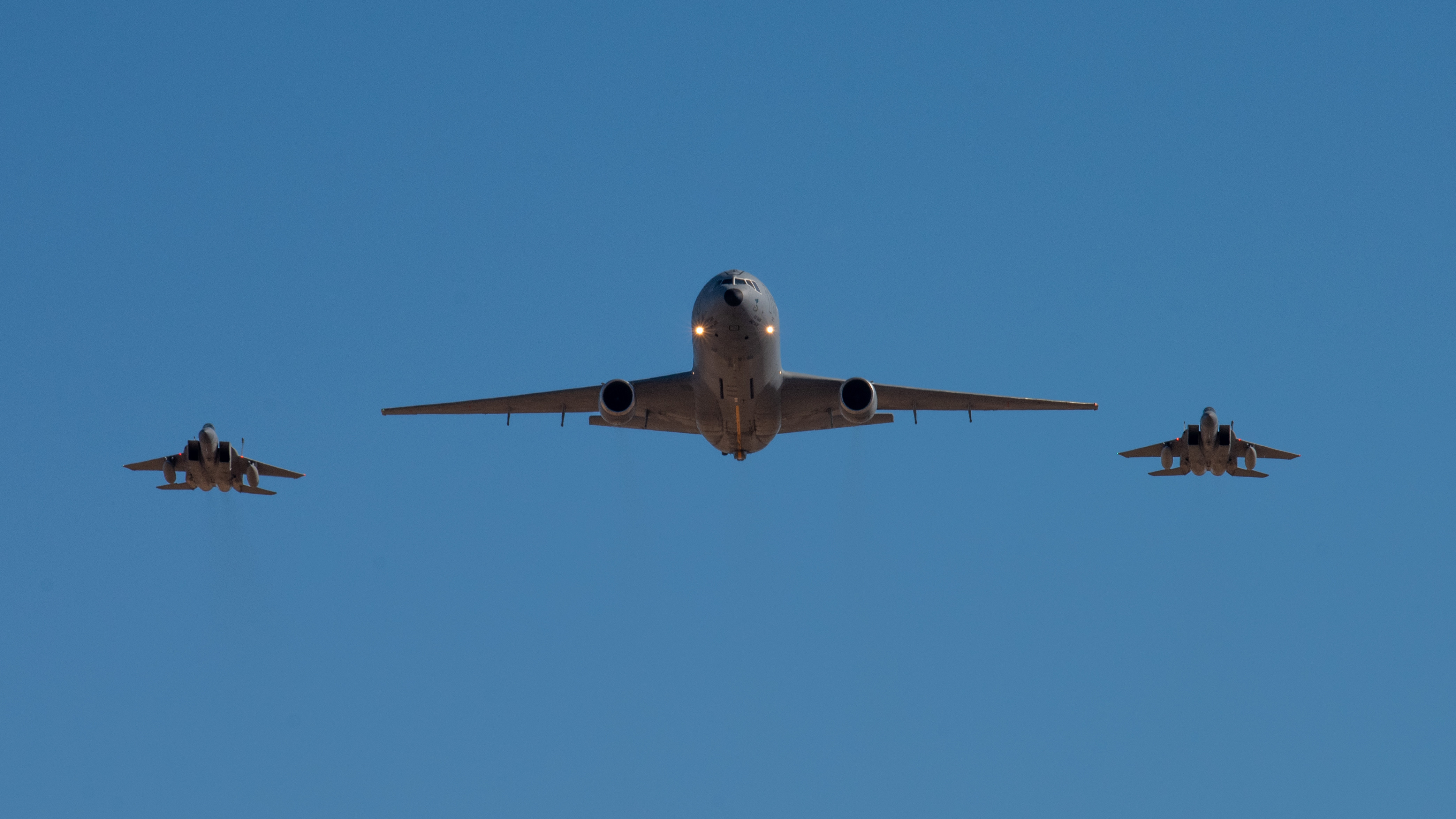
The last KC-10 Extender and two F-15E Strike Eagles fly in formation ahead of its retirement from Travis Air Force Base in California in September 2024. [Credit: U.S. Air Force/Kenneth Abbate]

A KC-10 Extender retired two years ago by the U.S. Air Force has emerged from the aircraft boneyard at Davis-Monthan Air Force Base (KDMA) in Arizona to begin a new life as a commercial tanker for contracted aerial refueling services.

Eagle-eyed planespotters first noticed the KC-10A was back in action this month. According to FlightRadar24, the model flew from its temporary retirement home at Davis-Monthan to San Antonio International Airport (KSAT) last Tuesday.

The airport is a base of operations for Omega Aerial Refueling Services, which per FAA records is the owner of the modified DC-10 airliner, a model DC-10-30F registered N82247. A certificate was issued on October 6. Images recently posted to JetPhotos show the aircraft without its original aerial refueling boom.

Who’s Flying the KC-10?

According to The War Zone, N82247 was one of several KC-10s auctioned off by the U.S. General Services Administration to Omega in 2025. The outlet reported that each of the 10 models up for auction was missing one engine for unclear reasons, and that their booms were stripped to support other models still flying.

The tankers are designed to use either booms or a probe-and-drogue system. Omega has not announced when its KC-10A will enter operational service or what modifications it may receive. But the company could potentially install new booms.

Omega offers probe-and-drogue refueling using a converted KDC-10, which unlike the Extender was not purpose-built for military use, as well as a pair of KC-707As based on the Boeing 707. It also operates Boom-equipped KDC-10s that were first certified in 2017. The fleet includes a pair of KDC-10Bs previously owned by the Royal Netherlands Air Force, which according to Omega have the “capability to potentially refuel every operative type of receiver aircraft in U.S. military inventory,” such as the B/C variants of the F-35 Lightning II.

The company’s KC-10 Extenders could soon be very busy. According to its website, it handles global deployments supporting the U.S. Navy, Marine Corps, Air Force, Air National Guard, Joint Special Operations Command, and allied aircraft. Per its most recent news release, the firm has flown more than 10,000 missions and offloaded more than 350 million pounds of fuel since 2000.

According to a news release, in November 2023, one of Omega’s boom-equipped KDC-10Bs refueled four Hawaii Air National Guard F-22 Raptors during a training mission. The company said this marked the first contracted, commercial tanker aerial refueling operation to a boom-capable, Air National Guard, and 5th generation fighter.

The same month, Omega’s KDC-10B provided what the company said was the first contracted aerial refueling support to U.S. Air Force fighters, fueling six Pacific Air Forces F-16 Fighting Falcons. Also in 2023, the company was certified to perform those services for boom-capable Navy aircraft.

Omega’s leadership includes former Navy, Marine Corps, and Air Force officers. The aircraft are flown by former Air Force aerial refueling tanker pilots and other experienced military aviators.

Omega is the only confirmed future operator of the KC-10, but it may not be for long. An October 7 request for information published by the Air Force Life Cycle Management Center seeks to identify possible operators that could restore and clear up to four KC-10s—considered excess defense articles (EDA) by the military—for delivery and return to service.

The four models would be transferred via EDA to an unidentified “partner nation in North Africa.” A contract would include a three-to-five-year sustainment package, in-country contractor logistics support, and training.

According to the Defense Security Cooperation Agency, excess equipment is offered to eligible purchasers at reduced or no cost on an “as is, where is” basis.

KC-10 Extender’s Legacy

The Extender was a workhorse for the Air Force, capable of carrying more than 356,000 pounds of fuel in its six tanks, half on the wing and half under the cargo floor. That is nearly twice the fuel capacity of the KC-135 Stratotanker and comfortably more than the KC-46A Pegasus that replaced the KC-10.

The Air Force’s Pegasus fleet has faced numerous technical, design, and manufacturing challenges in recent years. In June, the Government Accountability Office found that its KC-135s and KC-46s face sustainment concerns and that its “critical fleet has consistently fallen below availability and capability standards.”

The KC-10 derives from the three-engine DC-10, modified to add military avionics and refueling systems. It was designed for a crew of four or five to fly up to 619 mph at 42,000 feet. Range was 3,800 nm with cargo or 10,000 nm without.

The type entered service in 1981. A total of 60 were built for the Air Force to serve as advanced tanker and cargo aircraft. The Extenders could refuel fighters while simultaneously transporting up to 75 personnel and nearly 170,000 pounds of equipment on overseas, medevac, and humanitarian deployments. They could support a variety of aircraft within the same mission.

The KC-10 was operated primarily by the 305th Air Mobility Wing at Joint Base McGuire-Dix-Lakehurst (KWRI) in New Jersey and the 60th Air Mobility Wing at Travis Air Force Base (KSUU) in California, which retired the Air Force’s final model in 2024. It supported operations including Desert Shield and Desert Storm in the Persian Gulf, Allied Force in Europe, and Noble Eagle, Enduring Freedom, and Iraqi Freedom following September 11.

Jack Daleo

Jack is a staff writer covering advanced air mobility, including everything from drones to unmanned aircraft systems to space travel—and a whole lot more. He spent close to two years reporting on drone delivery for FreightWaves, covering the biggest news and developments in the space and connecting with industry executives and experts. Jack is also a basketball aficionado, a frequent traveler and a lover of all things logistics.

NTSB Cites Lack of Situational Awareness in Medevac Accident

Bell 407 tail rotor struck a rooftop surveillance camera during a night takeoff in Dallas in May.

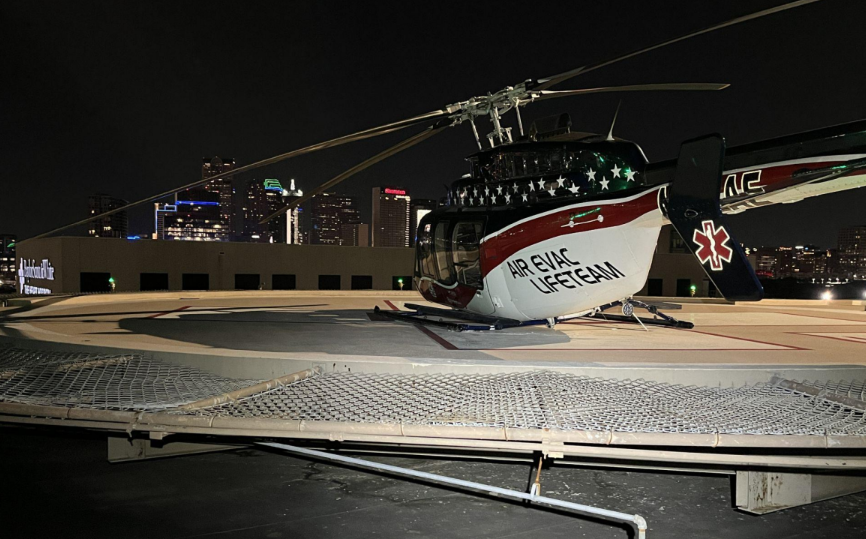
The NTSB’s final report determined that a medical helicopter sustained substantial tail rotor damage during a nighttime hospital departure when the pilot experienced unintended backward drift while attempting to establish radio contact. [Credit: NTSB]

The National Transportation Safety Board has highlighted a lack of situational awareness during a night takeoff from a rooftop helipad as a causal factor in the May 13 crash of a medevac helicopter in Dallas.

The Bell 407, flown by Air Evac Lifeteam, had a crew of three on board when the accident occurred. There were no injuries, but the tail rotor of the helicopter sustained substantial damage.

Per the NTSB final report, the pilot of the helicopter, 60, held a commercial pilot certificate and was rated for both airplanes and helicopters. The pilot’s total time was listed as 6,451 hours of which 5,219 were in a rotorcraft and 855 in the accident make and model.

The pilot reported they had dropped off a patient and were preparing to take off again. Night VMC prevailed with visibility of 10 miles and winds from the south at 3 knots.

According to the pilot, after checklists were completed and while on deck, they made a radio transmission request for departure to Dallas Love Tower to request a departure clearance as the hospital heliport is in Class B airspace. Receiving no reply, the pilot lifted off into a hover to gain more altitude and therefore better radio reception. The pilot rotated the aircraft 90 degrees into the wind, then increased the altitude to approximately 20 feet.

The pilot simultaneously heard a loud crack and felt a sudden jolt in the pedals that quickly developed into a right yaw. They applied left pedal and began a descent to the pad. After landing the aircraft was listing to the left with the engine running and rotors spinning. After a quick evaluation of the situation the pilot initiated a normal shutdown.

The post-event inspection revealed substantial damage to the tail rotor blades and left landing skid along with a security camera that had been mounted on the rooftop.

Video footage captured by a rooftop surveillance camera depicted the helicopter drifting backward as it lifted off and began a right turn. The climb, turn, and backward drift continued until the tail rotor impacted a helipad surveillance camera that ended the video footage.

The pilot reported that there were no mechanical malfunctions or failures with the helicopter that would have precluded normal operations. They also noted the accident might have been prevented by maintaining a hover of no more than 5 feet and visual reference with the helipad environment before departure to prevent unintended lateral and backward drift.

The complete final report can be found here. More crash photos are below.

Meg Godlewski

Meg Godlewski has been an aviation journalist for more than 24 years and a CFI for more than 20 years. If she is not flying or teaching aviation, she is writing about it. Meg is a founding member of the Pilot Proficiency Center at EAA AirVenture and excels at the application of simulation technology to flatten the learning curve. Follow Meg on Twitter @2Lewski.

One-G Simulation Expands Into Canada With Swiss 12 Delivery to Air Bravo

PC-12 training device brings on-site simulator access to the Ontario-based regional carrier.

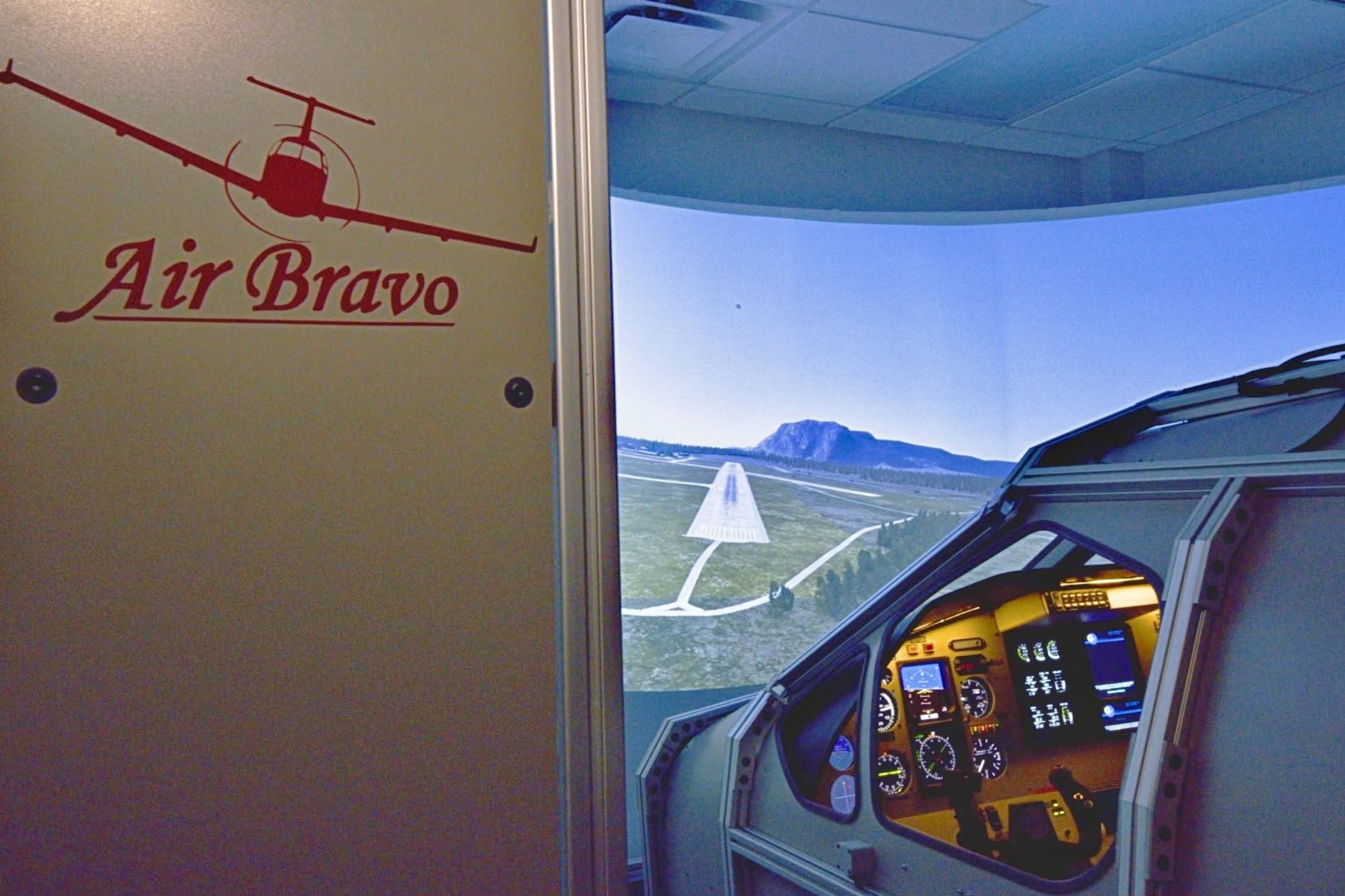
Air Bravo install of one-G Simulaton Swiss 12 AATD [Credit: one-G Simulation]

Seattle-based one-G Simulation has expanded into the Canadian market with the delivery and installation of its Swiss 12 advanced aviation training device (AATD) to Air Bravo Corp. in Thunder Bay, Ontario.

Air Bravo is a regional airline providing cargo, charter, and medevac services. The Swiss 12 is based on the Pilatus PC-12, one of the most utilized single-engine turboprops by medevac and charter companies.

According to a one-G Simulation news release, Air Bravo Corp. has also ordered a second one-G device, custom-developed around the Cessna 408 SkyCourier. Air Bravo received the first SkyCourier delivered into Canada in 2025.

Air Bravo was established in 2001 and has approximately 160 people on staff. In addition to flying, the company provides maintenance services and operates from bases at Thunder Bay Airport (CYQT), Sudbury Airport (CYSB) in Garson, Ontario, and Lake Simcoe Regional Airport (CYLS) in Ontario.

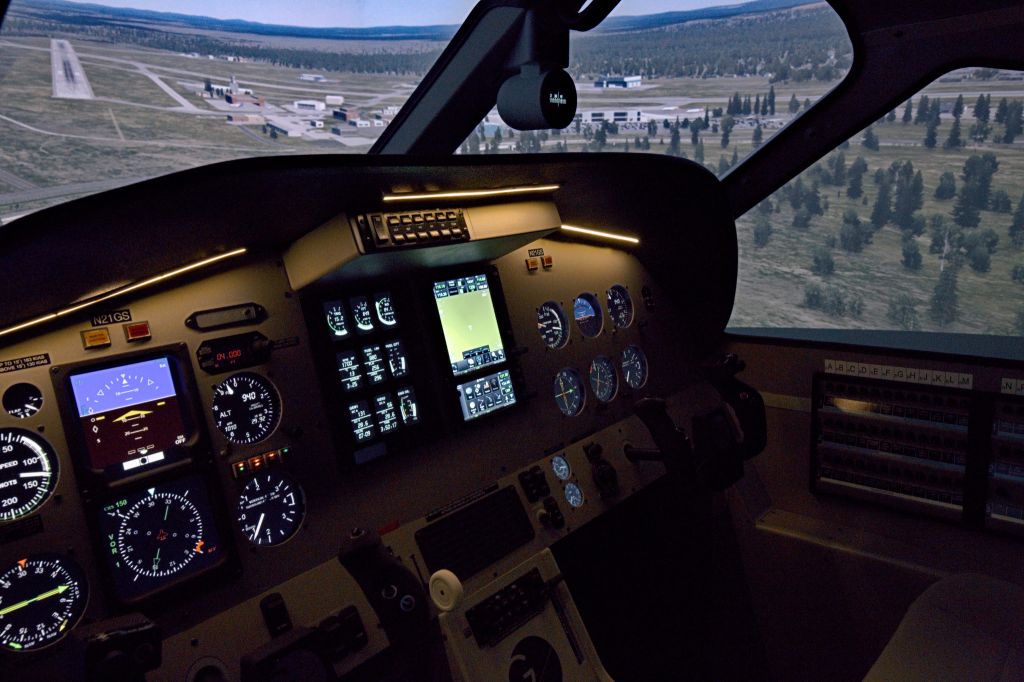
One-G officials said the Swiss 12 gives Air Bravo an on-site training platform, matched to the aircraft its pilots fly, including installed avionics. This detail provides an excellent classroom environment for pilots to learn and practice aircraft procedures and systems management, along with abnormal and emergency scenarios that are part of Air Bravo’s training requirements as well as regulatory approvals set forth by Transport Canada. 

Air Bravo install of one-G Simulaton Swiss 12 AATD [Credit: one-G Simulation]

According to one-G, the Swiss 12 received its initial FAA letter of authorization (LOA) as an AATD in 2017.

The Air Bravo device features dual aerodynamically driven force-feedback yokes, dual linked rudder pedals with toe brakes, a fully functional overhead panel, a comprehensive Crew Alerting and Warning System (CAWS) panel, and a projected curved-screen visual system. It also includes one-G’s Instructor Operator Station, which allows instructors to configure and manage flight scenarios by creating each detail down to the weather, aircraft location, and system failures.

“Having a PC-12 training device at our own facility gives our pilots an opportunity to practice aircraft-specific procedures and reinforce their proficiency closer to home,” said Rick Horwath, president of Air Bravo. “We appreciate one-G’s attention to the details of the aircraft and its responsiveness to our feedback throughout the development process.” 

Leadership at one-G Simulation also highlighted the significance of the partnership and local access to training.

“A PC-12 operator shouldn’t have to send pilots out of province for every recurrent event,” said Xylon Saltzman, founder and CEO of one-G Simulation. “Because we build the hardware and software ourselves, we could match this device to Air Bravo’s aircraft and put that training in their own hangar. We’re proud to see the Swiss 12 installed at Air Bravo and to extend one-G’s reach into Canada.”
The Swiss 12 is available for order. Turboprop operators interested in model-specific, cutting-edge training devices can contact one-G Simulation here. 

Meg Godlewski

Meg Godlewski has been an aviation journalist for more than 24 years and a CFI for more than 20 years. If she is not flying or teaching aviation, she is writing about it. Meg is a founding member of the Pilot Proficiency Center at EAA AirVenture and excels at the application of simulation technology to flatten the learning curve. Follow Meg on Twitter @2Lewski.

Kodiak Developer Launches New GA Aircraft Project

Tom Hamilton, whose companies designed the Kodiak and Glasair and Glastar series, begins a new mission with Reach Aviation.
Reach Aviation AC-6 GA utility aircraft concept image
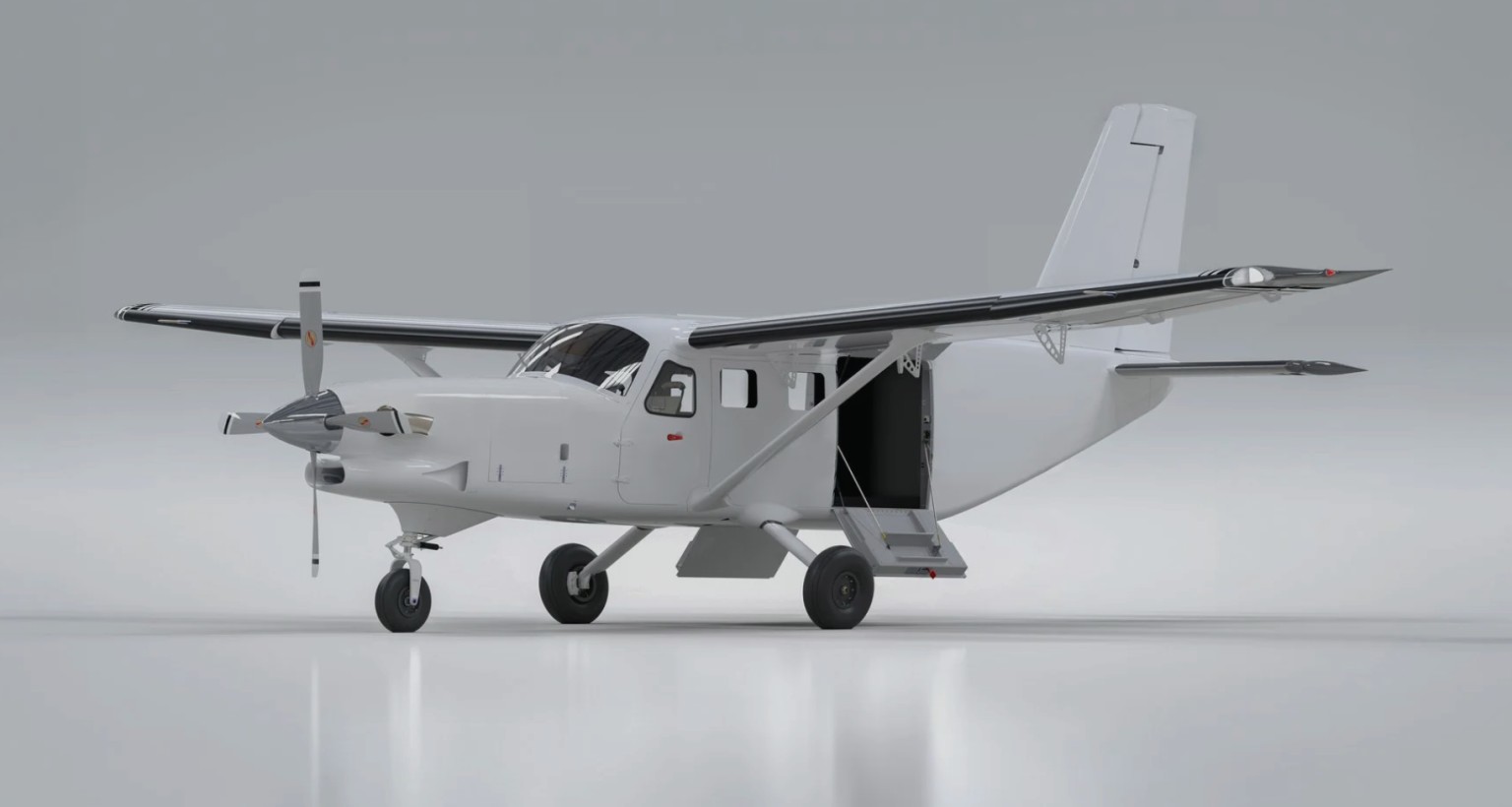
The Reach AC-6 is being developed as an efficient utility aircraft for the GA market. [Credit: Reach Aviation]

A founder of companies that have developed popular amateur-built and turboprop aircraft is setting off on a new mission to develop a highly capable utility aircraft for the general aviation market.

Tom Hamilton has spent five decades designing aircraft, according to his biography on the website of his latest venture, Reach Aviation.

Hamilton previously founded Stoddard Hamilton Aircraft, the originator of the Glasair and Glastar series kits, which it delivered until its 2012 sale to a Chinese company. The firm now does business under the name Glasair Aviation USA but has faced challenges due to the COVID-19 pandemic and its shifting of production from Washington state to China.

Hamilton founded Quest Aircraft in 1999, which developed the Kodiak turboprop series. The program was taken over by Daher in 2019 after the French manufacturer acquired Quest.

Between those two ventures, Hamilton in the 1980s founded Aerocet, a developer of composite floats and amphibious wheels.

Now, under Reach, Hamilton has set his sights on a short takeoff and landing (STOL) airplane that would allow GA operators to access hard-to-reach places. The firm’s AC-6 is being developed for missionary aviation organizations, emergency medical aid, fire overwatch, private owners, and small commercial operators who fly in demanding conditions, including short or rough strips, backcountry bases, and variable climates.

According to Reach’s website, the AC-6 is intended to bridge a gap between aging, decades-old piston platforms such as the de Havilland Beaver, Cessna 206, Pilatus PC-6, and Helio Courier and their more expensive, turbine-powered contemporaries like the Kodiak. The airplanes will be easy to maintain and understand while offering high uptime, low cost, and dependable performance, the company says.

More Utility for GA Operators

According to Reach’s site, the firm is partnering with Ascent Engine Technologies—which according to its page on the Wisconsin Economic Development Corporation’s website will produce a lightweight, efficient, diesel engine family for commercial and military customers—to make the AC-6 the launch platform for Ascent’s 12-cylinder diesel engine.

The engine is designed for up to 650 hp and a sharp reduction in fuel burn, enabling a 170-knot cruise speed and range of 1,340 nm with 45 minutes of reserves for the AC-6. Plane + Pilot reported that the engine and specifications are for a variant called the AC-6D.

An initial AC-6T variant, Plane + Pilot reported, will instead use a 750-shaft-hp Pratt & Whitney PT6A-34 turboprop. For the AC-6T, Reach is targeting range up to 800 nm with 45 minutes of reserves.

Plane + Pilot said further that the initial variant will have double-slotted flaps with 48 degrees of deployment that enable a 56-knot stall speed, as well as a 49-inch wide cabin and structural attachment points for floats. The avionics suite will include dual Garmin G500 TXi displays, GTN 750 and 650 navigators, a GI 275 standby instrument, and a GFC 500 autopilot.

According to Reach’s site, the AC-6 will require just 987 feet for takeoff and 1,098 feet for landing to clear 50-foot obstacles. Those specifications would appear to be for the AC-6D, as Plane + Pilot reported that the AC-6T will instead be designed for takeoff and landing distances of 750 feet and 700 feet, respectively.

The company’s website lists a bevy of additional features without specifying which AC-6 variant they are intended for.

According to Reach, the AC-6 will seat eight or nine passengers and have a useful load up to 2,700 pounds, though Plane + Pilot said the latter is targeted at up to 3,000 pounds. Forty two-inch cargo doors on either side and eight feet of usable cabin space are intended to make the airplane easily adaptable to a variety of missions, from passenger to cargo and medevac. Per Plane + Pilot, it will also have an optional additional door and external cargo pod.

Reach said that rather than aluminum, the AC-6 will use a rigid steel tube frame designed for FAA-standard repairs, as well as a high-lift wing. Removable composite panels will provide quick access to critical structures and systems to reduce maintenance time. Also removable will be the windshield, which would improve access to the instrument panel, eliminate common floatplane failure modes, and be replaced in as little as eight minutes, the company said.

Plane + Pilot reported the list price for the initial AC-6T variant at $2.25 million. It said that Reach has not yet announced a first flight date, certification timeline, or anticipated deliveries. Given Hamilton’s pedigree, though, the project may be one to watch.
Jack Daleo

Jack is a staff writer covering advanced air mobility, including everything from drones to unmanned aircraft systems to space travel—and a whole lot more. He spent close to two years reporting on drone delivery for FreightWaves, covering the biggest news and developments in the space and connecting with industry executives and experts. Jack is also a basketball aficionado, a frequent traveler and a lover of all things logistics.
Pilot in aircraft
Sign-up for newsletters & special offers!

Get the latest stories & special offers delivered directly to your inbox.

SUBSCRIBE