Chauncey Jones designed the T-shirt art for the semiannual Boeing Field FOD Day 2026. [Credit: King County International Airport]
We came. We walked. We looked for trash—and were happy when little or none was found. Because trash on an active runway, which is known as FOD (foreign object debris), is dangerous.
I was one of 100 civilian volunteers to turn out in Seattle on Saturday for the King County International Airport-Boeing Field (KBFI) FOD walk.
Runway inspection and FOD removal is a daily occurrence at airports. Usually it’s the airport manager or someone delegated by them driving a truck with a giant magnet hanging off the tailgate just a few centimeters above the surface. The magnet picks up screws, bolts, wires, and other pieces of metal that have come off of aircraft. The idea is to get the debris off the runway before it becomes a problem.
This FOD walk is held semiannually, according to officials from King County, and is part community outreach and part safety. As someone who was based out of KBFI for many years I can tell you that sometimes interesting items show up on the runway that shouldn’t be there, such as iPads, water bottles, fuel caps, and even wheel pants.
Volunteers gathered in the east parking lot of the Museum of Flight around 7:15 a.m. PDT. The airport supplied a continental breakfast, including coffee, because, well, this is Seattle.
The weather was cloudy and gray—again because this is Seattle.
Airport officials had arranged a NOTAM (Notice to Airmen) advising the runway would be closed from 7:30 a.m. to 8:30 a.m. Airport employee Sean Moran addressed the volunteers with a bullhorn to provide the safety briefing. Volunteers were given trash bags and grabber tools to pick up the trash. The instructions were clear—stay on the pavement and don’t wander into the grass. The wide, white side stripe marking was the boundary.
Airport employee Sean Moran delivers instruction to volunteers for the Boeing Field FOD Day 2026. [Credit: King Country International Airport]
Chartered buses would take half of the group to the south end of the runway, and the other half would go to the north end. The runway measures 10,007 feet by 200 feet, or just under 2 miles.
My group drew the south end start. We started at the displaced threshold south of the large lighted “X” that is FAA-ese to pilots signifying that the runway is closed. I explained this to a few of the volunteers who voiced concerns it was a target the pilots aimed for when they came in for a landing.
I assured them the runway was closed, and the pilots knew this because they did their homework, checking NOTAMs before the flight. Plus, the folks in the tower were keeping an eye on us and, if appropriate, would direct airplanes to the other runway still in operation if needed.
We started our journey to the north.
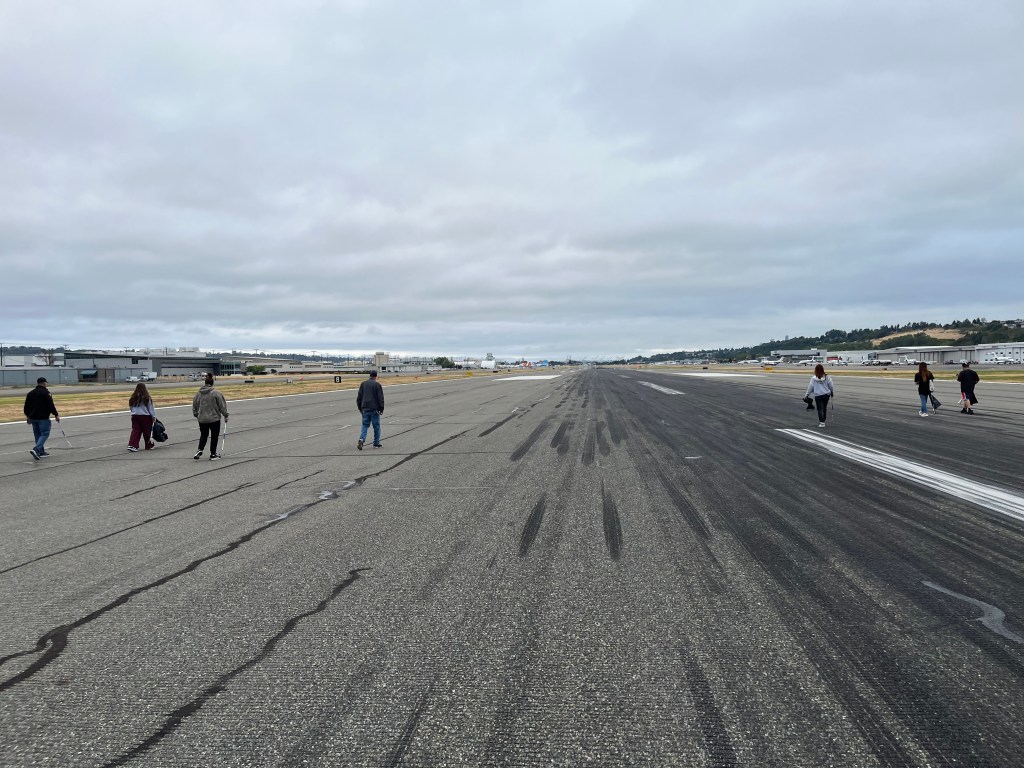
Volunteers walk the runway looking for debris on Boeing Field FOD Day 2026. [Credit: Meg Godlewski]
As a pilot, I instinctively gravitated to the centerline. For me, it was particularly fun to walk over the touchdown-zone and aiming-point markings.
I was surprised by the thickness of the layer of tire tread on the pavement. A few people picked up balls of rubber and what appeared to be tar, but that was pretty much it for FOD for the south end group. Moran, following the volunteers in his airport truck, remarked it made him happy to see the runway so clean.
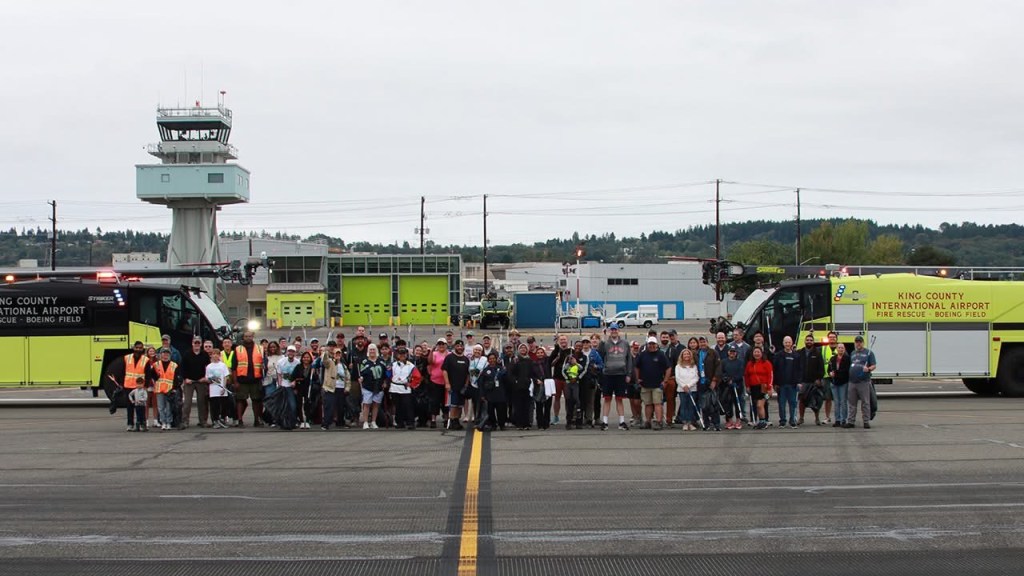
The groups met in the middle across from the control tower. We were flanked by the airport fire and rescue trucks for a group photo and water cannon salute.
Volunteers pose for a team photo after Boeing Field FOD Day 2026. [Credit: King County International Airport]
In addition to memories and photos, participants each received a commemorative T-shirt designed for the airport by Chauncy Jones, who when she is not working as an artist serves as KBFI’s flight monitoring and community outreach coordinator.
Jones took a serious issue and gave it a whimsical spin, starting with a cartoon runway scene, because there is no way the folks at KBFI would let theirs get that dirty, and adding the words “FIELD OBJECT DEBRIS.” The T-shirts were worn with pride as the Museum of Flight also gave participants free admission for the day.
Meg Godlewski has been an aviation journalist for more than 24 years and a CFI for more than 20 years. If she is not flying or teaching aviation, she is writing about it. Meg is a founding member of the Pilot Proficiency Center at EAA AirVenture and excels at the application of simulation technology to flatten the learning curve. Follow Meg on Twitter @2Lewski.
CFIs have to carefully watch their time to avoid breaking the eight hours of flight instruction per-day rule. [Credit: Pixabay]
The instructors knew we could expect a full day of flying when we walked into the flight school in the morning and found a bottle of water and a granola bar on our desks.
This was the dispatcher’s way of letting us know the schedule was booked solid with back-to-back flights all day. What inevitably followed was the verbal warning to watch the Hobbs time carefully so you did not violate cFAR §61.195—Flight Instructor limitation and qualifications (a) Hours of training: In any 24-consecutive-hour period a flight instructor may not conduct more than eight hours of flight training.
Although it may appear that a flight instructor works around the clock and is at the airport 24/7—especially when they are in a rush to build hours—there is a limit to how much of that instruction can take place in an aircraft in a 24-hour period.
When a flight school is busy, there can be a lot of juggling to make sure that no CFI overflies the eight hours. Sometimes another CFI who still has “time on their clock” is pressed into service to cover a flight, or schedules are adjusted to make sure the customers’ needs are met as well.
It is important that the person doing the scheduling knows the qualifications of each instructor so they don’t accidentally put an unqualified instructor with a client—for example, pairing an instructor who lacks a multi-engine instructor rating with a multi-engine client.
For the newly certified instructors, it can come as a surprise to learn there is an endurance building phase of being a CFI. The noise and vibration and exposure to the elements take their toll. You may remember this from your student pilot days. Those first few hours were fatiguing, and your savvy instructor carefully watched you for signs of fatigue and knew when to head back to the airport.
Many flight schools ease the freshly minted CFIs onto the schedule. You may start out doing flight reviews, or being with one or two clients at first, and balance out the rest of the time teaching a ground school or seminar. As your experience and endurance build, you pick up more clients and flight time.
‘F’ in IMSAFE
All pilots learn to run the IMSAFE checklist before a flight. It addresses the pilot’s fitness for flight focusing on illness, medication, stress, alcohol, fatigue, and emotion. You probably wouldn’t let a client fly fatigued—nor should you.
Flight instruction is much more than sitting in the cockpit. There is the preflight and postflight briefing and paperwork to keep student records up to date. You do not want to do the latter when fatigued because that’s where mistakes creep in. Fatigue takes its toll, and just like a well-trained instructor watches their clients for signs of it, you need to know your own tells as well and respect them.
Dehydration often presents as fatigue. Keep a bottle of water within reach in the cockpit. Better yet, have one for you and the client. Part of being a CFI is modeling good behavior, and the importance of staying hydrated while flying is part of that.
Nutrition is critical to maintaining energy. Focus on balanced meals or snacks if that is all time permits, along with staying properly hydrated. You can exist on energy drinks and candy bars for a short time, but it will catch up to you.
Night flights present a particular challenge because at the end of a long day we naturally want to sleep, and if you have a night flight to do, you may be fighting against the clock. It is common practice to plan night flights around the full moon and adjust the instructor schedules accordingly, or to have an instructor who comes in later in the day handle the night flights.
Fatigue doesn’t wait for the sun to go down. It seems like every flight school and a great many student pilots have a story about a CFI who fell asleep during a lesson. It can be very frightening for the student pilots.
I know, because it happened to me as a very inexperienced student pilot. My instructor was a retired airline pilot who learned to fly during World War II. He was in his 70s and very skilled. Flight instruction was a retirement job for him.
On a routine flight on a warm day he nodded off. It was late in the day, and he had been flying since sunup. We were in cruise flight in the Cessna 152 when I asked him a question, and he did not reply, causing me to look over at him. His head down on his chest, he was out cold. I repeated my question—no response, so I nudged him—again, no response. I stuck out my left wrist so the face of my watch was under his nose. I was greatly relieved when it fogged up. A few more aggressive nudges brought him around.
Multiple Job Shuffle
As most flight instructor jobs do not pay enough to live on, many CFIs have side gigs.
Be careful when working multiple jobs. If you’ve just put in a full day at (insert non-aviation job here), are you really going to have the energy, both mental and physical, to be a safe and competent pilot?
Be cautious and conservative. You owe it to yourself and your clients to bring your best to the cockpit every time so that learning can take place.
Meg Godlewski has been an aviation journalist for more than 24 years and a CFI for more than 20 years. If she is not flying or teaching aviation, she is writing about it. Meg is a founding member of the Pilot Proficiency Center at EAA AirVenture and excels at the application of simulation technology to flatten the learning curve. Follow Meg on Twitter @2Lewski.
Cirrus Vision Jet over green hills [Credit: Cirrus]
Authorities are investigating the collision of a Cirrus Vision Jet and a piece of construction equipment at Driggs-Reed Memorial Airport (KDIJ) in Idaho on Friday.
The airport is a nontowered facility with a single runway aligned 04/22 that normally measures 7,301 feet by 100 feet. However, for several weeks the airport has temporarily been operating with a shortened runway due to a construction project.
Several weeks prior to the start of the work, airport officials published advisories to pilots about the project, and on August 5 a NOTAM (Notice to Airmen) was issued with details of the partial closure.
To clarify the events leading up to the incident, Driggs deputy city administrator Doug Self issued a statement detailing the specific circumstances. “At approximately 6:30 a.m. [MDT] on Friday, August 14, 2026, a Cirrus Vision Jet airplane entered a closed section of runway at Driggs Reed-Memorial Airport and attempted takeoff through a portion of runway that was under construction,” the release read. “The pilot was able to slow the plane upon approaching the construction site but could not avert a collision with construction material.”
One passenger on board the aircraft was injured and transported to a local hospital by ambulance. Their condition has not been released.
According to Self, the city of Driggs is working with the consulting project engineer, the FAA, and the National Transportation Safety Board (NTSB) to identify what actions led to the crash.
According to preliminary information published by the FAA, the aircraft, identified as N71KD, is registered to Vision71 Technologies out of Chevy Chase, Maryland. The agency report noted the aircraft “attempted to depart from part of the runway that was under construction, hit gravel, and (the) landing gear collapsed.”
An FAA spokesperson added that it is the responsibility of the PIC to check NOTAMs before each flight.
The NOTAM, which remains in place until September 5 at 7 p.m. MDT, states: “Runway 04/22 southwest 3,451 feet closed. Declared distance: Runway 04 takeoff run available 3,850 feet takeoff distance available 3850T accelerate-stop distance available 3,850 feet landing distance available 3,850 feet. Runway 22 takeoff run available 3,850 feet takeoff distance available 3,850 feet accelerate-stop distance available 4,018 feet landing distance available 3,850 feet.”
Meg Godlewski has been an aviation journalist for more than 24 years and a CFI for more than 20 years. If she is not flying or teaching aviation, she is writing about it. Meg is a founding member of the Pilot Proficiency Center at EAA AirVenture and excels at the application of simulation technology to flatten the learning curve. Follow Meg on Twitter @2Lewski.
Uber and Zipline are the latest drone delivery partners seeking to scale operations nationwide. [Credit: Zipline]
App- and web-based delivery platforms from Walmart, Amazon, DoorDash, and now Uber are embracing small drones to slash trip times in a trend that could reshape low-altitude U.S. airspace.
Uber on Monday announced it is partnering with drone manufacturer and operator Zipline, which is also a partner of Walmart and competitor Wonder, the parent company of Grubhub. By the end of 2029, Uber and Zipline hope to achieve a cadence of 1 million daily drone deliveries, with “goals to expand far beyond that.”
The partners said the first deployments will begin this year in Dallas, Houston, and other cities where Zipline already operates, expanding as the company scales to dozens of other areas. Zipline in a news release called the move “one of the biggest steps toward expanding Zipline’s service to every home in the U.S.”
“Our goal is for millions of people to be able to order lunch, dinner, snacks, and more through the Uber Eats app and have them delivered by Zipline” in five to 10 minutes, the company said.
In a show of confidence, Uber is also making a strategic investment of an undisclosed amount in Zipline.
“We look forward to bringing this technology to more communities and making autonomous delivery part of everyday life,” said Dara Khosrowshahi, CEO of Uber, in a statement.
Zipline’s Platform 2 (P2) drones, or Zips, cruise at about 70 mph with up to 8 pounds of cargo, capable of 24-mile, one-way trips or flying within a 10-mile service radius. At the delivery location, the drones unfurl a tether to lower orders—stored within a smaller “droid”—to the ground from as high as 300 feet. Zips are designed for hub-and-spoke or dock-to-dock operations, delivering to the customer’s front yard or public locations such as a park.
Store employees load orders into a container called a Dropbox, entering a code on a keypad to unlock a secure drawer. The Zip then lowers the smaller droid into the Dropbox and secures the order autonomously.
Zipline began conducting medical drone delivery operations in Rwanda in 2016 and now serves more than 5,000 hospitals. It operates commercial on-demand and medical delivery services in Ohio, Arkansas, and Texas. The company said U.S. deliveries now make up about 70 percent of its volume.
Beyond Zipline, Uber seeks to add an aerial element to its services in partnership with Joby Aviation, with which it is exploring commercial air taxi services beginning in the Middle East.
Drone Delivery Set to Explode
For years, ambitions of drone delivery were kept afloat by venture capital flowing to small startups or side projects of companies such as Amazon and Alphabet.
The industry has since evolved from pilot programs to routine commercial services. The backing of platforms such as Uber could take it to new heights—with significant implications for low-altitude airspace.
Uber’s collaboration with Zipline pits it directly against rival DoorDash in the drone delivery business. In July, the latter revealed it is building its own delivery drone to complement the models it operates from Alphabet’s Wing, Israel’s Flytrex, and Ireland’s Manna.
DoorDash has explored U.S. drone delivery since 2024 but is now looking to bring more of those operations in-house, akin to Amazon’s Prime Air unit that builds and operates its own drones. The company is putting the full weight of its DoorDash Labs automation division into developing an end-to-end network, including a software that determines which deliveries best lend themselves to drones.
Wonder aims to add Zipline’s drone delivery service to the majority of its Texas locations by the end of next year, and it recently trialled a service in New Jersey with partner Dexa. Walmart offers drone delivery from Zipline, Wing, and Flytrex through its app and website.
According to Uber, Zipline drones make a delivery every 20 seconds on average. The company says it has delivered over 20 million items across more than 2.5 million deliveries and 140 million miles flown. Achieving one million daily deliveries by 2029, though, will require even greater scale.
Drone delivery operators represented by the Commercial Drone Alliance (CDA) and other lobbying groups are clamoring for the FAA’s finalization of Part 108, which would unlock routine operations beyond the visual line of sight (BVLOS) of humans. Instead, drones would rely on detect and avoid systems and uncrewed aircraft system (UAS) traffic management (UTM) platforms to keep operations safe.
Part 108 would enable the scale the drone industry desires. But pilots have pushed back on some of the proposal’s more permissive elements, such as the granting of right-of-way to drones over crewed aircraft in certain scenarios. The Air Line Pilots Association (ALPA) and others have expressed skepticism about the maturity of detect and avoid systems and their ability to prevent collisions.
Proposed Part 108 reportedly moved to the federal Office of Information and Regulatory Affairs (OIRA) for review last month. That means the rule could be months or even weeks away from being finalized, and companies such as Uber and Zipline could soon face fewer restrictions on fully autonomous drone delivery.
Jack is a staff writer covering advanced air mobility, including everything from drones to unmanned aircraft systems to space travel—and a whole lot more. He spent close to two years reporting on drone delivery for FreightWaves, covering the biggest news and developments in the space and connecting with industry executives and experts. Jack is also a basketball aficionado, a frequent traveler and a lover of all things logistics.
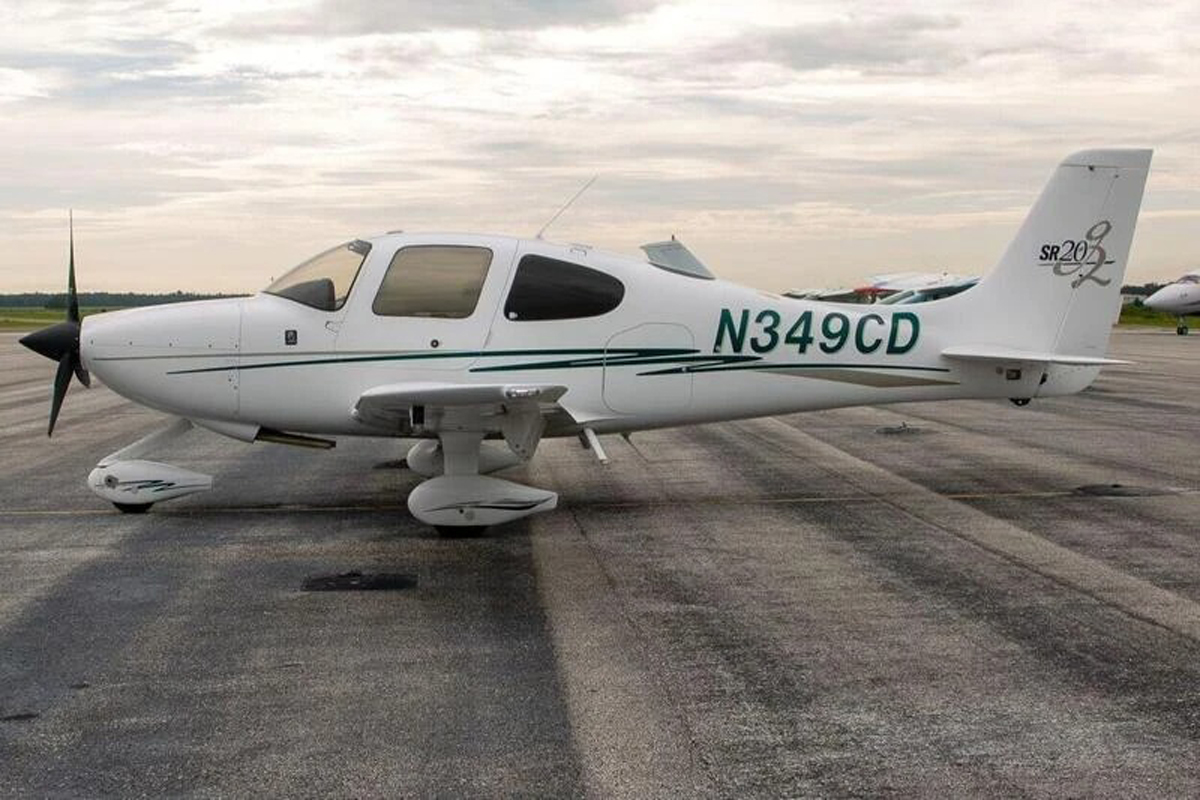
By introducing a sleek, composite airframe, advanced safety features, and simplified systems to a market hungry for innovation, the SR20 pushed general aviation into a new age. This foundational model set the stage for the wildly popular SR series, combining approachable performance with standard-setting technology like the integrated airframe parachute.
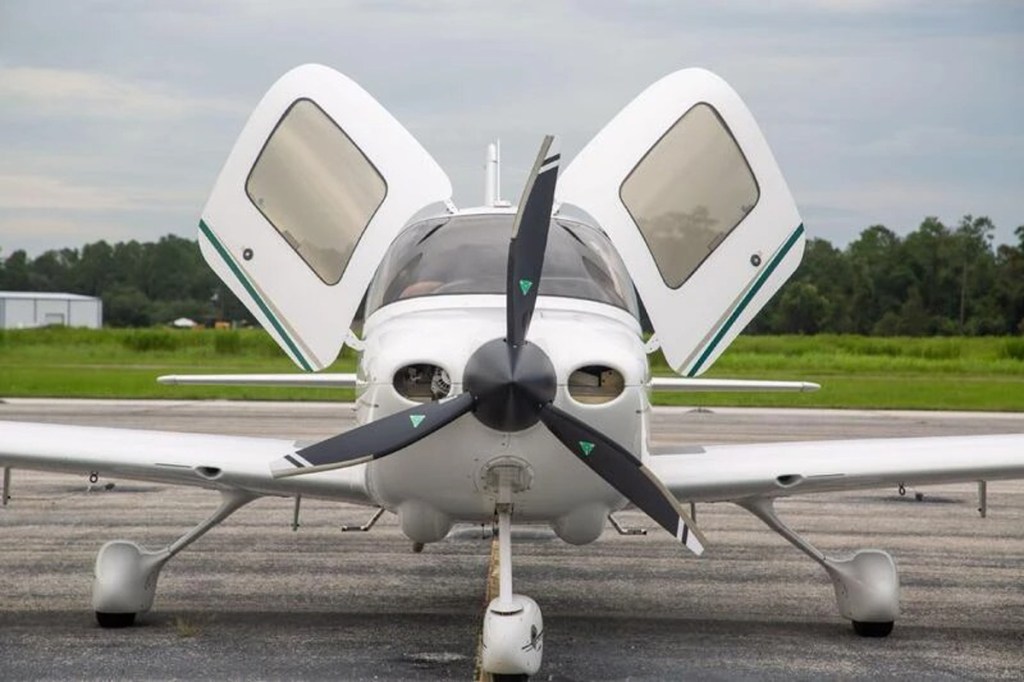
This well-equipped 2005 airframe has logged 2,640 total flight hours since new. The aircraft boasts impressive ramp presence with its white-and-green striped exterior, tinted windows, LED navigation/strobe lights, and a sleek black spinner. In terms of comfort, it stands out from the crowd thanks to a Kelly Aerospace air conditioning system installed in 2026 and a stylish custom leather interior fitted by UAC in 2018.
Providing reliable propulsion is a Continental IO-360-ES engine that underwent a top overhaul of all six cylinders in July 2023. The powerplant spins an MT three-blade composite propeller showing approximately 962 hours since its last major overhaul. Crucially for prospective Cirrus buyers, the aircraft’s signature safety feature, the CAPS parachute system, had its repack completed and is not due again until May 2034. The aircraft also comes with an added perk—Embark transition training provided by Cirrus.
The flight deck has been thoroughly enhanced to meet modern cross-country demands, featuring an Avidyne Entegra EX5000 PFD/MFD setup paired with a highly capable Avidyne Digital DFC90 autopilot.
2005 Cirrus SR20 G2 [Credit: Aerista]
Navigation and communication are handled effortlessly by dual Garmin GTN 650Xi units, while a Garmin GTX 345 transponder provides ADS-B In and Out capabilities. Additionally, a Garmin Flight Stream 510 offers seamless wireless connectivity to your devices, and an L3 Stormscope alongside XM Datalink Weather provides excellent situational awareness.
Listed at $239,900, this comprehensively updated 2005 Cirrus SR20 G2 provides an excellent entry point into the Cirrus lifestyle with the heavy lifting on maintenance and avionics upgrades already completed.
If you’re exploring ownership options, FLYING Finance can help get you airborne. Use our airplane loan calculator to estimate your monthly payments, or connect with an aviation finance expert at flyingfinance.com.
Long family trips for our sons’ far-flung sporting events, and a drawn-out move across several states to a new home combined over the past year to put me behind the wheel of the car more often than at the controls of an airplane. Still, as always, I spent much of my driving time thinking about flying. Mostly I considered how much sooner we would arrive at our destination if only we were airborne.
Flying from our old home in New Jersey to the new one in Vermont in Annie, our 1992 Commander 114B, takes less than two hours compared with at least five and a half in the car, avoiding all but the most necessary rest stops. From Vermont to Geneva, New York, to visit our younger son at school takes about an hour and 45 minutes versus seven hours driving. Vermont to Deer Isle, Maine, a favorite escape, is a shade over an hour in the airplane compared with a meandering five and a half hours behind the wheel—nearly all on backroads.
If you're not already a subscriber, what are you waiting for? Subscribe today to get the issue as soon as it is released in either Print or Digital formats.
A recent driving stint of three hours to Boston Logan International Airport (KBOS) differed in that I was not thinking about flying our Commander. Instead I was repeating a mental preflight briefing for Daher Aircraft’s TBM 980, the latest evolution of the French company’s premium turboprop single.
I was about to catch an evening flight to Florida to meet with the team at Daher Aircraft‘s U.S. headquarters and hub for distribution, maintenance, repair and overhaul (MRO) at Pompano Beach Airpark (KPMP). The next morning, I would fly the TBM 980 with Paul Salvati, a TBM instructor, mentor, ferry and support pilot with Daher Aircraft.
Considerable mental preparation lay ahead. Instead of comparing the TBM’s performance with that of the family car, I began thinking about the likely similarities and differences between it and Annie. How much faster would we reach our destinations if we flew an airplane like this?
The answer is, at least twice as fast. With a maximum cruise speed of 330 ktas, the TBM would double the Commander’s typical 150 ktas, even if I pulled the power back to a more economical setting. This slick, six-seat express could turn many of our longer flights into short hops while encouraging us to stretch our legs. Those 1,000-mile cross-country journeys would be far less daunting.
Target Market
The opportunity to fly the TBM 980 was of particular interest not simply because it is the fastest single-engine GA airplane on the market, but because I, in theory at least, represent the target market for this aircraft.
Like many owners of high-performance piston singles, I tend to think of each airplane as a collection of numbers including cruise speed, climb rate, range, useful load, and short-field performance. While I am happy that my airplane outperforms the Cessna 172s and Piper PA-28s in my former flying club’s fleet, I often gaze longingly at the many models with greater capability—the ones that routinely overtake Annie on long flights.
I occupy a segment of the “step-up” market, where middle-of-the-road private pilots shop for the next big thing—or the next better thing—that will speed their travel, impress their friends, and elevate their profile on the ramp.
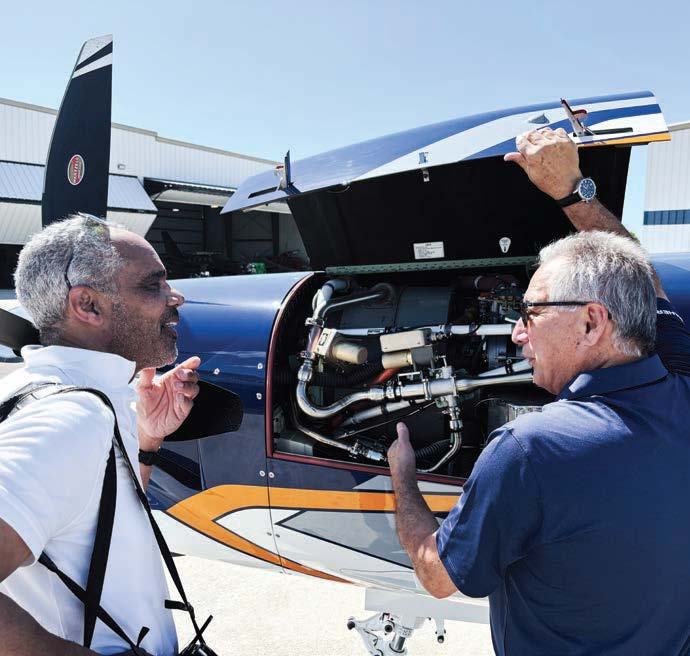
Large access hatches ease preflight inspections, as TBM instructor Paul Salvati demonstrates for the author, Jonathan Welsh. [Credit: Daher Aircraft]
Among propeller-driven aircraft, the TBM 980 sits atop the step-up staircase. Its combination of comfort, technology and hot rod performance have made it and previous TBM series models objects of desire for flying families in search of higher speeds and bigger payloads. In my case, the family threatens to outgrow our airplane.
When our two sons were skinny elementary schoolers, we flew full seats and full fuel without a second thought. Today they are strapping college students and athletes. Add our two dogs, who combine for another 100 pounds, and I find myself meticulously weighing baggage and fueling to the tabs instead of the tops.
Day Arrives
I rolled into the Daher Aircraft parking lot at Pompano Beach bright, early, and eager, a bit like a child anticipating his first airplane ride. I had flown other turbines—Cirrus SF50 Vision Jet and Cessna Caravan—but not often and not after decades of admiration.
As one would expect, the front door was locked so, unable to flag down anyone inside, I walked around to the side of the building that faced the ramp. A half-dozen colorful TBMs lined the tarmac and the hangar door was wide open, revealing more airframes in various stages of disassembly, undergoing maintenance and repair. It was the aviation equivalent of a candy store.
Soon I met demo pilot Salvati, who walked me through preflight checks. A glaring contrast, favorable to the TBM, quickly emerged. Pilots are less likely to get their hands dirty during the preflight. For example, there is a sight gauge behind a hatch in the left-side engine cowling for checking the engine oil. From there you can peek into a mirror to see that the locking lever on the oil dipstick cap is properly engaged.
Salvati likes to open the right-side cowling hatch to confirm visually that the O-ring in the dipstick cap is in fact fully seated in the filler tube for a good seal—something you cannot quite see in the mirror. Still, if the sight gauge shows oil in the proper range, you do not have to pull and wipe the dipstick.
“In newer, high-end airplanes, the preflight process tends to be cleaner than in the old days,” Salvati said jokingly.
A pilot friend who decamped to Texas a few years back used to complain about the smell of oil and avgas on his hands after preflighting his Cessna 182, and wore gloves to avoid it. He would love the TBM, which, because its fuel gauges actually work, does not require opening and probing the tanks to check the fuel level.
How times have changed. My first instructor insisted that I put my finger into the tanks of the club’s Cessna 152 to make sure the fuel was topped off. I got used to the smell of avgas and eventually learned to love it.
Easy on the Ground
Once the twin switches for battery and generator were on, getting the TBM going was more relaxing than cranking Annie’s Lycoming IO-540. Instead of switching on the electric fuel pump, waiting for the gauges to register fuel pressure and flow, and making my best guess for how long to prime the engine before hitting the starter, I simply pressed the start button.
The TBM 980’s Full Authority Digital Engine Control (FADEC) handled the timing of fuel introduction and other procedures that used to make starting a turbine engine more of an adventure. Soon the engine settled to an idle, and we were cleared to taxi to Runway 24. Wide-stance main gear and a responsive, steerable nose gear give the TBM a nicely planted feel on the taxiway. I am accustomed to applying a touch of differential braking to assist Annie’s nosewheel when initiating turns. Salvati told me I would not need to do this with the TBM. “The nosewheel steering is very positive,” he said, and he was right.
The aircraft steered more like a car and less like the light aircraft I have flown previously, all of which required constant attention and adjustment to keep them from weaving back and forth across the centerline while taxiing.
With the aircraft’s solid feel on the ground comes a sense of its weight. The TBM 980 weighs 4,782 pounds empty and has a maximum takeoff weight of 7,615—more than double the Commander. The difference in overall feel reminded me of an encounter with a Beechcraft Bonanza owner while shopping for our first high-performance piston single. The pilot told me and my wife to be aware that the Bonanza is “a lot of airplane.”
That might be true, I thought as I lined up on the runway, cleared for takeoff. But the TBM is a whole lot of airplane—a big jump for a piston pilot—and the machine let me know in a pleasant yet assertive manner.
Time to Fly
“No need to hold the brakes,” Salvati said. I eased the throttle forward to full power, as smoothly as possible. The Hartzell propeller’s five wide, composite blades bit the air, and the TBM accelerated briskly. While not quite pinned in my seat by positive G forces, I felt the motivation and urgency that 850 shaft horsepower brings to the takeoff run. Salvati advised me to hold forward pressure on the yoke for positive steering.
The TBM 980’s Pratt & Whitney PT6E-66XT engine, carried over from the TBM 960, generates far more power than I am used to, but its delivery is so smooth and quiet that the takeoff run is almost tranquil compared with the dramatic roaring, vibrating version you get in a piston aircraft.
Otherwise, the takeoff was familiar. No surprises, and just like with Annie, there was no distinct point of rotation. Around 80 ktas, the airplane began to feel light. I applied a touch of back pressure on the yoke, and we were airborne.
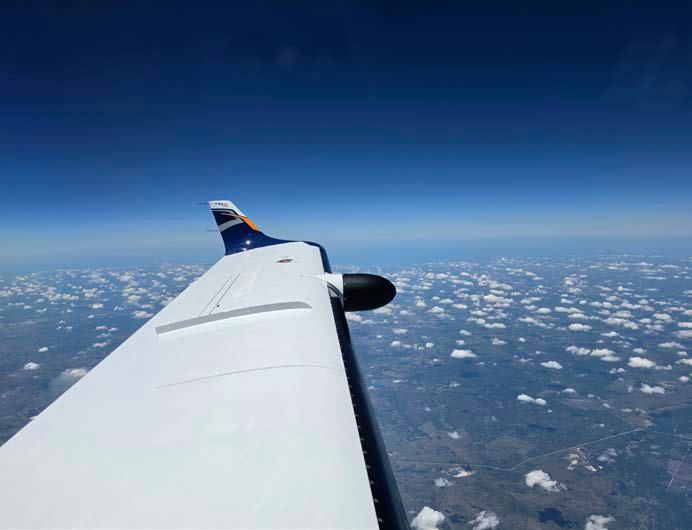
The TBM 980 provides an airline-style view from 31,000 feet. [Credit: Jonathan Welsh]
Pilots talk a lot about how some airplanes simply fly off the ground while others need to be rotated. My instructor was adamant about this notion. When my non-pilot friends hear this, they give me strange looks and ask if there really is a difference. There is, and in the end it just means that the TBM feels comfortably familiar on takeoff.
Once the gear and flaps were up and I homed in on the TBM 980’s best rate of climb speed of 124 ktas, we saw a 4,000 fpm rate, which felt amazing to this piston pilot, who is impressed when Annie delivers anything over 1,000 fpm. With its nose pointed steeply skyward, the TBM clawed its way into the clear blue of a perfect Florida flying day.
Performance like this is emblematic of the reasons why turbine singles have, in many cases, replaced the light piston twin as the standard step-up for high-performance GA pilots. I recently flew with an instructor in a Beechcraft Baron 55 which could not begin to compete with the TBM’s all-round capabilities. Sure, grabbing a fist full of throttles, pushing them forward, and hearing the roar of two big-bore piston engines while accelerating down the runway is a singular thrill, but it will not result in a 4,000 fpm climb—not even in a Riley Turbostream.
Miami Center cleared us through 10,000 feet, where we were still climbing at 2,000 fpm. Soon we were blasting through Annie’s 16,800 foot service ceiling and on to 24,000 feet at better than 1,500 fpm.
Although the climb rate naturally decreased during the ascent, it was always higher than I expected and seemed relentless. We reached the airplane’s service ceiling of 31,000 feet in less than 20 minutes. We were quite close to the book number of 18 minutes, 45 seconds, and likely could have nailed it had I followed the flight director more accurately.
Pressurization maintains a comfortable cabin altitude of 9,800 feet at FL 310 and gives passengers an airline-like experience without the cramped seating and fees for seat selection. Do I need to mention that pressurization is preferable to wearing the cannulas that came with Annie’s built-in oxygen system?
Truly Integrated Avionics
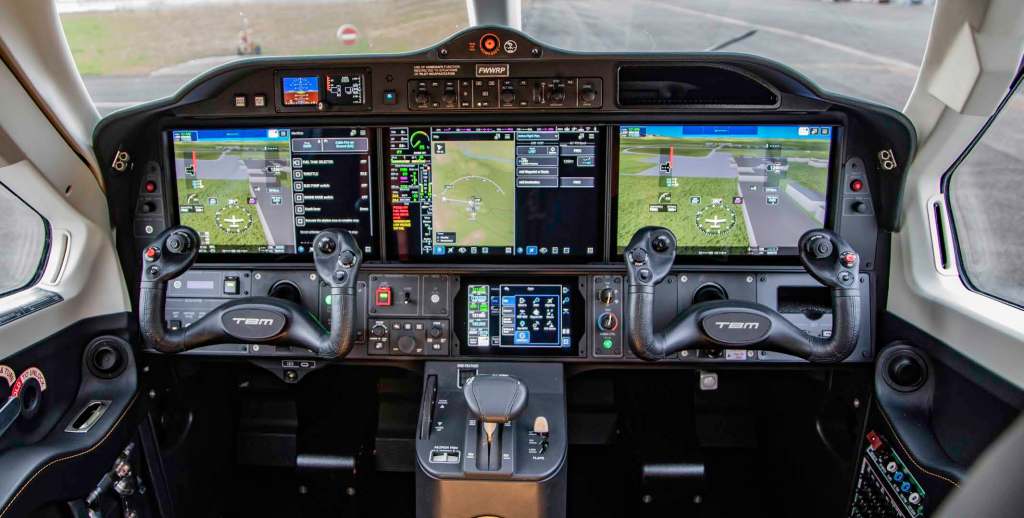
Ever since we started the engine, the airplane’s Garmin G3000 Prime avionics were working in the background, performing a sort of triage and displaying the information that we needed most during each phase of flight on the three 14-inch touchscreens.
The new flight deck is the main difference between the TBM 980 and TBM 960, and Daher Aircraft said it goes far beyond evolutionary improvement and transforms the way pilots interact with the aircraft. In general, it eliminates the menu-scrolling tradition that has vexed many pilots using modern glass panels. Pilots can also display any available information on any of the three screens. The combination of touch controls and a central joystick controller make screen manipulation easy and intuitive.
While new, comprehensive avionics packages often seem foreign and intimidating, the new Garmin suite felt familiar even at first glance. Like many pilots, I own an airplane with a diverse panel ranging from a Garmin GTN 750 and dual G5s to steam gauge-style altimeter, airspeed and vertical speed instruments, and ancient S-TEC autopilot.
Garmin G3000 Prime avionics set the TBM 980 apart. Three 14-inch screens make relevant information readily accessible. [Credit: Daher Aircraft]
Despite the contrast, though, the Prime system made sense. In many ways, the Prime avionics remind me of my home-office desktop. When I set up the new workspace late last year, I treated myself to a third screen. After years of working with two, I found three screens to be the sweet spot, mainly because they allow me to arrange and keep track of three distinct sets of information. I might have an article in progress on the middle screen, a collection of statistics on the left, and live stock market updates, news, or a press conference on the right.
In the TBM 980, I probably would start with the PFD on the left and the moving map in the middle while an instructor, pilot friend, or perhaps my wife monitored radios, traffic, and weather on the right. Just like at home, I could easily move among the screens, adjusting displays at will.
Bringing It Home
Our demo flight took us about 145 nm northwest over Lakeland Linder International (KLAL) before we turned back toward Pompano Beach. The return leg gave us an opportunity to demonstrate the TBM’s rapid descent capabilities of up to 4,000 fpm under both manual and autopilot control. Just as in the climb, there was no drama, and I was able to place the autopilot settings at the top center of my left-side screen.
With vertical speed and course adjustments set, the airplane seemed ready to land itself—it can do that, using its HomeSafe emergency automatic landing system. But this was no emergency, and we took manual control about a mile from the runway.
While the TBM’s technology is a wonder, and perhaps the first such advanced system that I found truly intuitive, the real joy was in the flying. I felt a thrill every time I took manual control of the capable machine.
During the approach, it flew much like my beloved Annie—stable, forgiving, and perfectly happy gliding across the numbers at 70 ktas, which seemed incredibly slow in such a substantial aircraft. Inches above the tarmac, though, the bottom seemed to fall out, resulting in a rather “firm” arrival. We now know that Annie has at least one feature the TBM lacks—trailing-link gear, which would have softened my first TBM 980 landing. We will have to practice more.
I think just about any pilot on the fence regarding the purchase of a turbine single would land on the TBM 980’s side after a demo flight like mine.
While the expense, training, and currency requirements certainly represent a new level of intensity for most piston pilots, I cannot think of an airplane that matches the TBM for ambitious, long-distance, owner-flown missions.
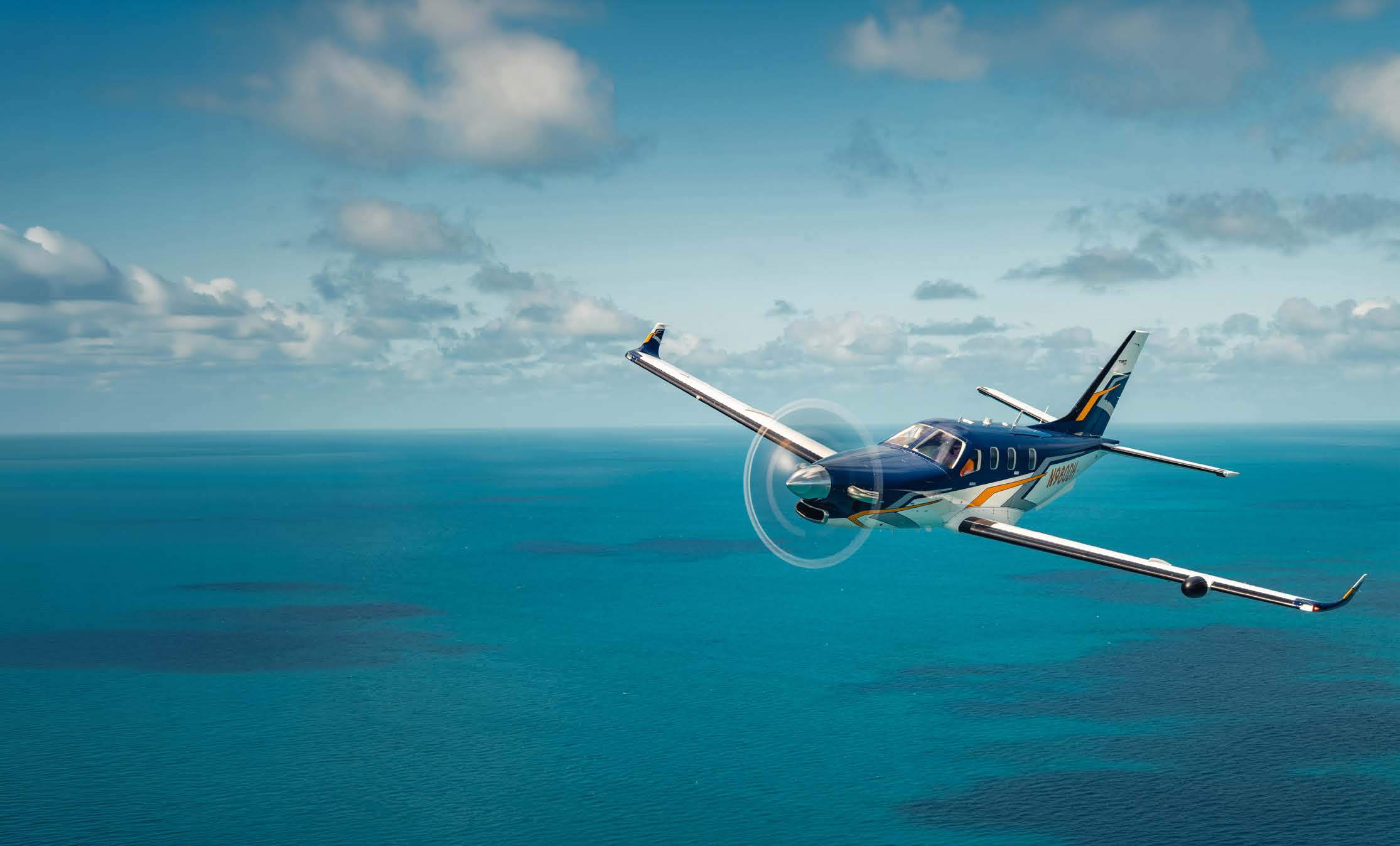
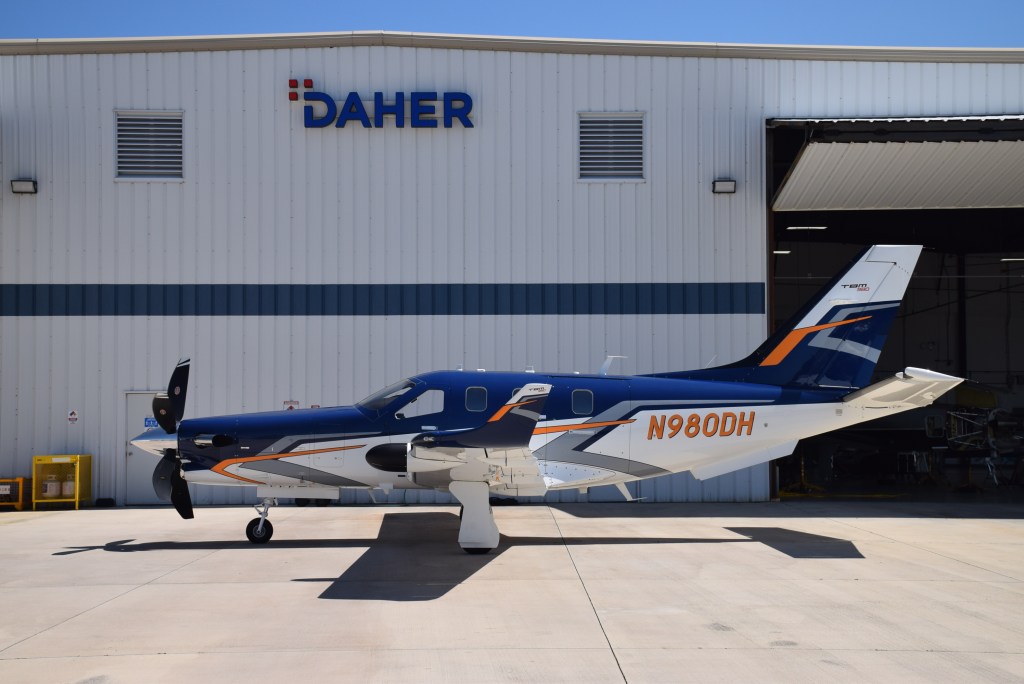
n the ramp, our demonstrator aircraft shows off Tehuano, one of six standard paint schemes offered. [Credit: Jonathan Welsh]
Spec Sheet: Daher TBM 980
Base Price: $5.82M
Engine: Pratt & Whitney Canada PT6E-66XT
Power: 850 shp
Length: 35.22 ft.
Height: 14.29 ft.
Wingspan: 42.10 ft.
Cabin Width: 3.96 ft.
Cabin Height: 4 ft.
Max Takeoff Weight: 7,615 lbs.
Max Ramp Weight: 7,650 lbs.
Standard Empty Weight: 4,760 lbs.
Max Baggage: 330 lbs.
Useful Load With Full Fuel: 919 lbs.
Max Usable Fuel: 292 gal.
Service Ceiling: 31,000 ft.
Max Rate of Climb: 4,000 fpm
Max Cruise Speed: 330 ktas
Max Range, 326 ktas: 1,440 nm
Max Range, 252 ktas: 1,730 nm
This column first appeared in the July Issue 972 of the FLYING print edition.
Jonathan Welsh is Lead Editor of Aviation Consumer and a private pilot who worked as a reporter, editor and columnist with the Wall Street Journal for 21 years, mostly covering the auto industry. His passion for aviation began in childhood with balsa-wood gliders his aunt would buy for him at the corner store. Follow Jonathan on Twitter @JonathanWelsh4
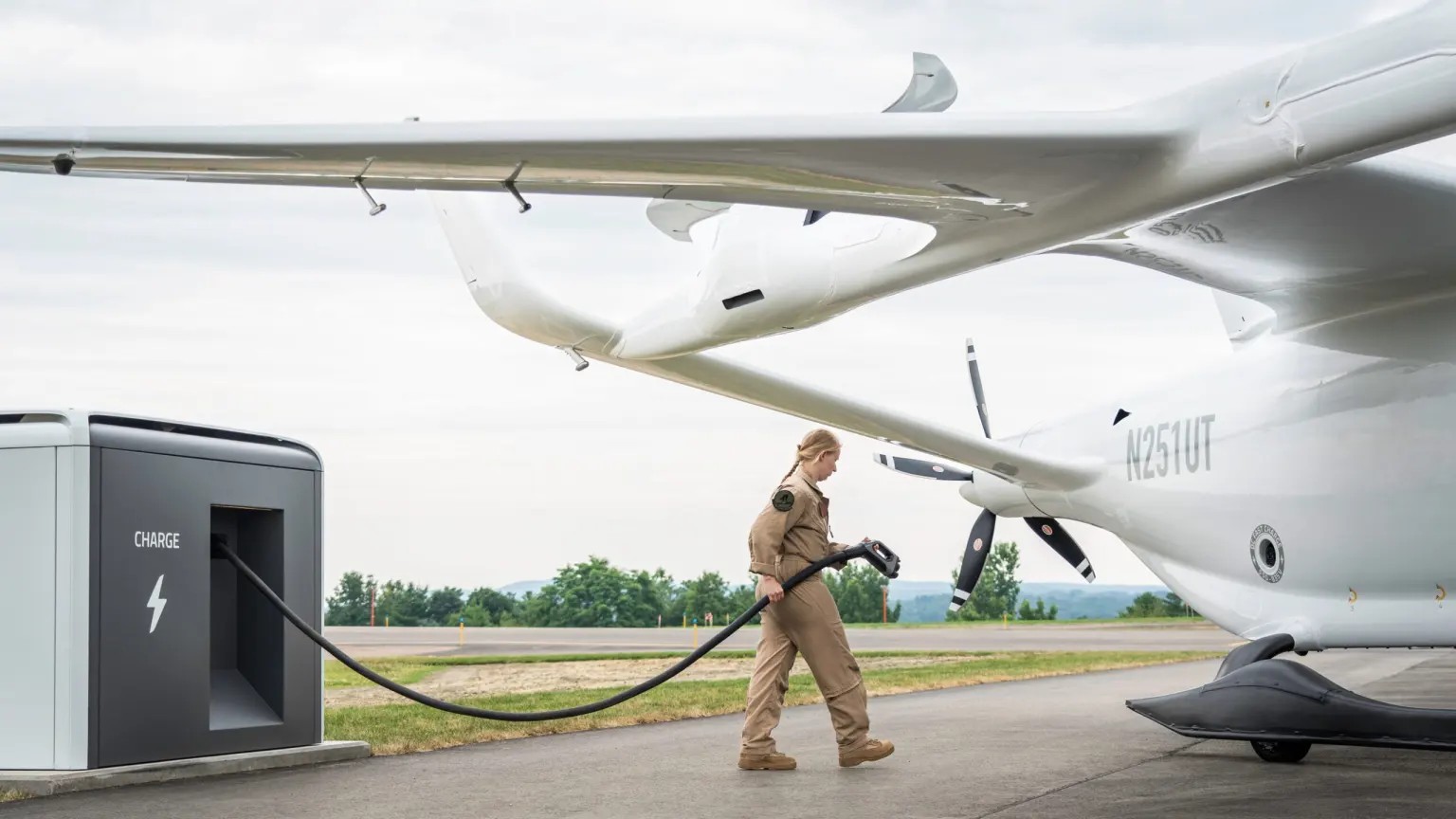
Beta is generating revenue from sales of chargers as well as components of its electric aircraft, including engines and flight control computers. [Credit: Beta Technologies]
Beta Technologies has not certified any of the electric aircraft it is developing at its facilities in Vermont. Yet the manufacturer expects to generate up to $50 million in revenue in fiscal year 2026.
Beta on Wednesday announced its operating results for the second quarter of 2026, the highlight being a record $14.7 million in revenue. That was above the company’s quarterly guidance of $8 million-$11 million and more than double the $6 million in revenue it recorded in Q2 2025.
Competitor Archer Aviation, which like Beta is developing eVTOL (electric vertical takeoff and landing) aircraft, reported $5 million in revenue this past quarter after not recording any a year ago.
Rival Joby Aviation posted revenue of about $39 million in Q2 compared to just $15,000 the year before, with the vast majority of it coming from the Blade Air Mobility business it acquired in 2025. It raised full-year revenue guidance to $115 million-$125 million. However, Blade does not yet operate the eVTOL aircraft that Joby is building.
Herman Cueto, Beta’s chief financial officer, said on the company’s Q2 earnings call this week that Beta’s revenue overperformance stemmed not from an existing business but the sales of components that will power its own aircraft.
Beta said its proprietary chargers—designed to accommodate any electric vehicle, air or ground—are installed and on line at 138 sites. It even sells charging systems to competitors such as Archer, with which it recently established a partnership to electrify 250 sites by 2030.
“The consortium operators at this point are Archer and Beta, but we expect that to grow as Beta has the only certified [Combined Charging Standard] charger suitable for electric aviation,” said Cueto.
Beta CEO Kyle Clark said on the call that a 34-charger contract with the Florida Department of Transportation (FDOT) contributed to revenue after deliveries began in Q2.
Beta’s charging offerings are widely known. The company also sells its H500A electric pusher motor to Eve Air Mobility, the eVTOL unit of Embraer, and undersea vehicle propulsion systems to General Dynamics. More recently, it began selling flight control computers to Horizon Aircraft for the Canadian company’s X7 eVTOL. Clark said Horizon is the “third major aircraft program” to purchase Beta’s flight control computers.
“We typically look at the component business to carry somewhere between a 40 percent and 60 percent margin,” said Cueto. “But when you get into flight control computers, the margin is actually a lot higher.”
Clark added that Beta has “sold motors, propellers, inverters, high-voltage systems, flight control computers, the actual flight controls like the inceptors, the throttles, and other such things,” as well as data acquisition systems and flight test services.
“The strategy behind this is that these are extremely sticky sales,” Clark said. “When somebody designs their control laws around a hardware platform or vice versa, then those things are kind of linked.”
Joby, by contrast, only plans to sell completed aircraft. Archer in 2025 made its electric powertrain available to partner Anduril for the latter’s Omen platform, but it has not announced any additional sales.
Clark laid out Beta’s philosophy: “Certify and produce aircraft designed around simplicity, develop the core propulsion technologies, aircraft systems, and components in-house, and carry those technologies across commercial and defense applications.”
Cueto added that additional revenue in Q2 came from Beta’s partnership with GE Aerospace on NASA’s Electrified Powertrain Flight Demonstration (EPFD) project, which in July flew above 30,000 feet on hybrid-electric power. GE has invested $300 million in Beta and partnered to develop a hybrid-electric turbogenerator that will power the manufacturer’s military variant, the MV250.
Looking Ahead
Beta expects revenue to continue increasing. The company raised its full-year revenue guidance to the range of $42 million-$50 million, with Q3 revenue expected to land between $8 million and $12 million.
“The improved outlook reflects execution across our commercial, government, and technology initiatives,” said Cueto.
Beta in July conducted the first operations under the FAA’s eVTOL Integration Pilot Program (eIPP), delivering organs in Maryland and Virginia. Beta is part of seven of the eight projects chosen for the three-year, 26-state effort, during which the FAA will collect data on activities with precertified aircraft.
“You’ll start to see more of the eIPP flying over…the next four to six weeks,” Cueto said, in Texas and Louisiana, with partners including Metro Aviation, Bristow Group, and Future Flight Global.
Beta sees more revenue streams from the defense-oriented MV250 it unveiled at the Farnborough International Airshow. Clark confirmed that Beta accelerated the MV250’s launch timeline by six months due to “strong demand signals.”
“We showed up there, expecting to kind of generate a little bit of further interest domestically,” said Clark. “That went to the very highest levels of the U.S. military, and there is an incredibly keen interest in moving forward.”
Clark explained that the MV250 is “developed on the same core technologies already flying in our CTOL [conventional takeoff and landing] and VTOL aircraft, including batteries, motors, and flight control computers.” He was optimistic about the certification timeline for those two aircraft, which are expected to arrive before the military variant.
“We have successfully worked through key policy interpretation issues of the FAA to enable solid progress in the certification of our H500A motor,” Clark said. “On [the CTOL] CX300, we reached a significant milestone that gives us a complete and agreed-upon foundation for the next phase of the certification program.”
He added that “FAA pilots and delegates are flying our aircraft regularly.” Clark said Beta’s aircraft have flown 190,000 nm and that the company is targeting 250,000 nm by year’s end.
Beta’s Q2 ’26 operating expenses of $166 million, compared to about $84 million the year before, included $122 million in research and development costs. Cueto said these supported certification, MV250 development, eIPP operations, and production readiness. The company’s adjusted EBITDA of minus-$110 million fell at the midpoint of previous guidance.
Beta said it ended the quarter with approximately $1.5 billion in cash and cash equivalents. It ended 2025 with about $1.7 billion in cash on hand following its initial public offering last year.
Correction: This article previously stated that Beta’s MV250 flew alongside existing military aircraft during a recent exercise. That exercise involved the company’s Alia CX300— the MV250 had not yet flown as of this article’s publication.
Jack is a staff writer covering advanced air mobility, including everything from drones to unmanned aircraft systems to space travel—and a whole lot more. He spent close to two years reporting on drone delivery for FreightWaves, covering the biggest news and developments in the space and connecting with industry executives and experts. Jack is also a basketball aficionado, a frequent traveler and a lover of all things logistics.
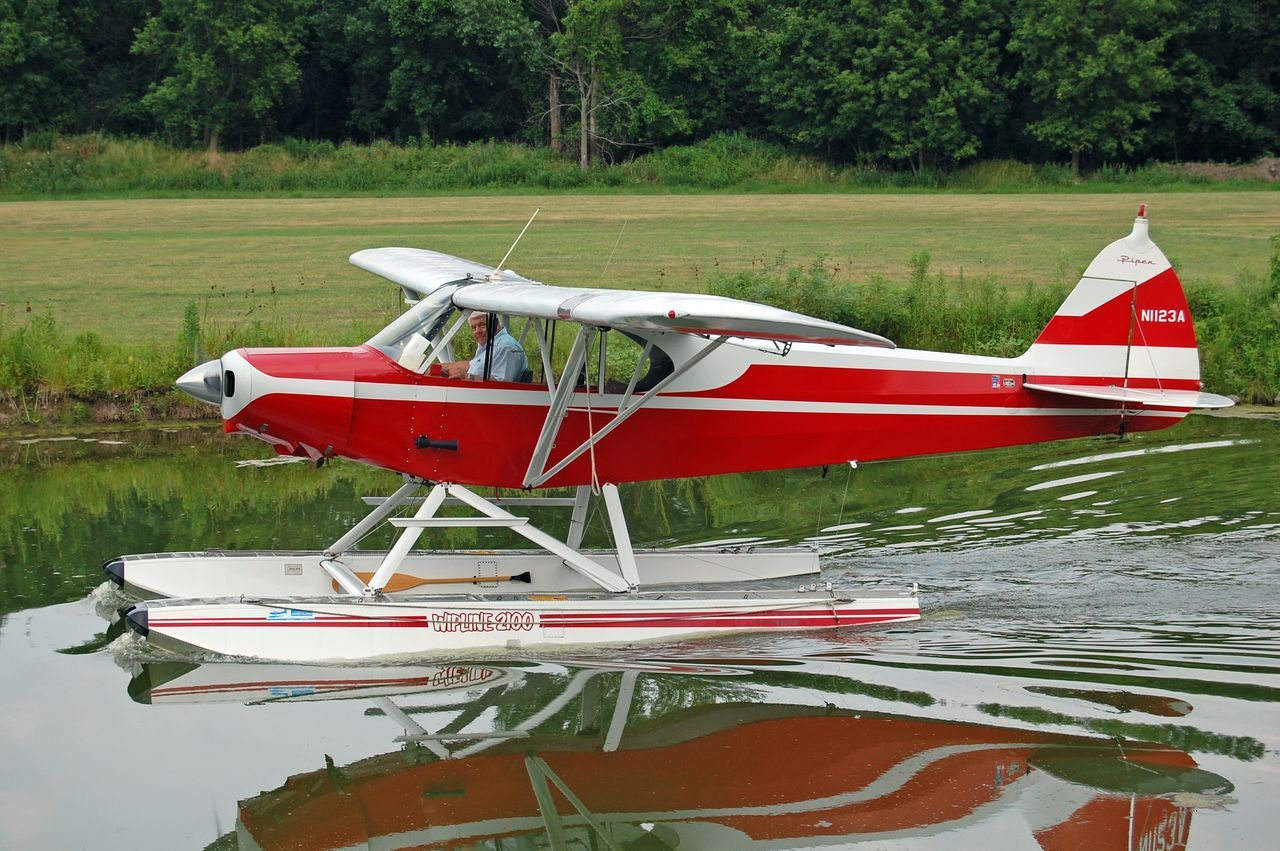
Robert ‘Wip’ Wiplinger in the cockpit of a floatplane [Credit: Wipaire LinkedIn]
Robert “Wip” Wiplinger, a second-generation Wipaire employee and the mind behind several aircraft modifications designed to improve the capability of float-equipped airplanes, died on August 4 in Inver Grove Heights, Minnesota. He was 80.
Since his death, more than 100 people have taken to social media to pay their respects.
Wiplinger, who also went by “Bob,” was born in 1945 into an aviation family. His father, Ben Wiplinger, who served as an aircraft mechanic during World War II, founded Wiplinger Aircraft Services in 1946. The company specialized in converting surplus military airplanes into corporate aircraft and executive transport.
As a boy, Bob Wiplinger often joined his father at work, learning to turn wrenches as well as fly. He soloed in a J-3 Cub and often flew the many aircraft owned by his father. Throughout his life, Wiplinger owned and flew a variety of airplanes, including a Cessna Caravan, Stearman, Beech 18, and several Cubs.
Wiplinger earned a degree in aeronautical engineering from the University of Minnesota in 1968 and soon went to work at his father’s company, and later at the float manufacturing plant located on the Mississippi River in Inver Grove Heights.
Robert ‘Wip’ Wiplinger [Credit: Wipaire LinkedIn]
Wiplinger’s aviation business experience included operating a Cessna dealership and a sales and service business at South St. Paul Airport-Fleming Field (KSGS). In 1979 he purchased the float business from his father and continued Wipaire as a family business.
Wiplinger had a passion for designing performance-enhancing equipment for aircraft and always sought ways to improve the family’s products, which included the development of composite floats. Today, Wipline floats are certified for use all over the world on a variety of aircraft, including the Cessna 208 series Caravan and Grand Caravan, and the de Havilland Beaver, Otter, and Twin Otter.
Wipaire is also the holder of more that 100 supplemental type certificates that enhance the usability of aircraft, which include a right-side passenger door for the Cessna 206 and a Laser Gear Advisory (LGA) system designed to let the pilots of amphibious aircraft verify the position of the wheels based on the terrain below, thus reducing the change of a potentially deadly wheels-down, in-water landing.
It was also under Wiplinger’s leadership that the Fire Boss Air Tractor AT-802 was developed. The aircraft is a modified single-seat crop duster that sports a 1,600 hp turbine engine and water-scooping floats that have now become a staple of aerial firefighting globally.
Meg Godlewski has been an aviation journalist for more than 24 years and a CFI for more than 20 years. If she is not flying or teaching aviation, she is writing about it. Meg is a founding member of the Pilot Proficiency Center at EAA AirVenture and excels at the application of simulation technology to flatten the learning curve. Follow Meg on Twitter @2Lewski.
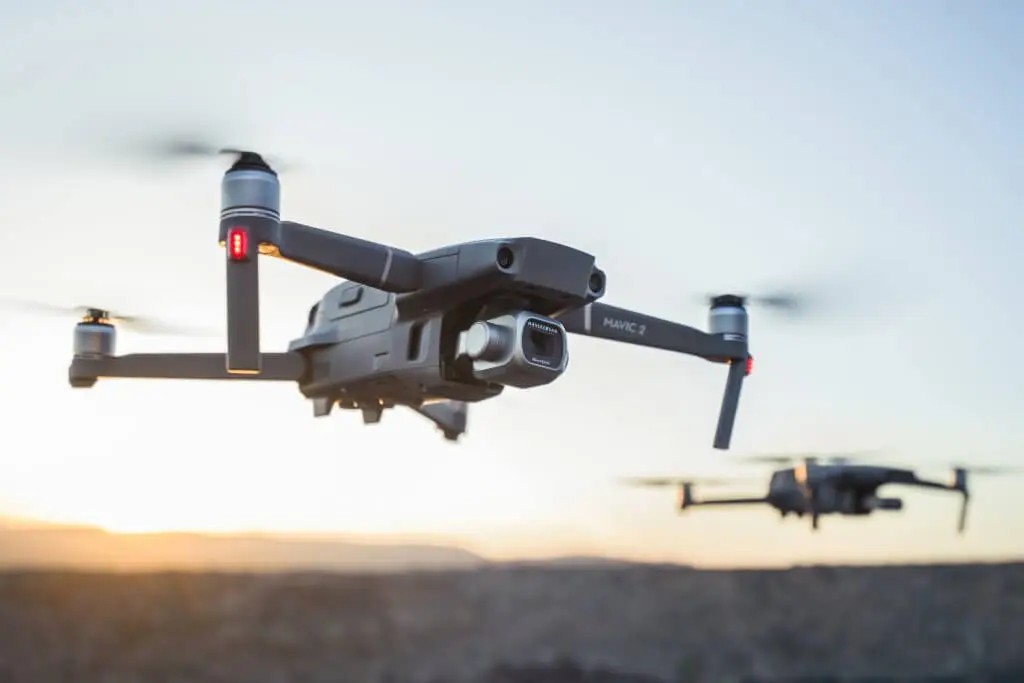
Drones produced by China’s DJI, such as this Mavic 2 model, are widespread among U.S. operators and consumers. [Credit: DJI]
Operators and casual users of commercially available drones may soon need to pay more for their preferred models or switch to American-made alternatives.
The White House on Thursday proclaimed new tariffs on foreign-made drones and their components that possess capabilities it deems “particularly sensitive for national security purposes.” That includes a 100 percent ad valorem tariff on drones with maximum takeoff weight above 55 pounds or that have “certain capabilities,” such as thermal imaging.
Hobbyist drone pilots typically fly drones weighing under 55 pounds, the FAA’s cap for a model to be considered a small uncrewed aircraft system (UAS). But the 100 percent import duty would affect larger drones used for commercial purposes, such as crop spraying.
Smaller drones with “capabilities that particularly implicate national security” also face a 25 percent levy. The tariff on drones and components made in Japan, Liechtenstein, South Korea, Switzerland, Taiwan, and the European Union is capped at 15 percent. Products built in the U.K. are limited to a 10 percent levy.
The duties impact even drones and components exempted from the Federal Communication Commission’s covered list of products banned for import and sale in the U.S. The FCC in December added all drones and components produced in foreign countries to the covered list but has since carved out exceptions such as for those on the Pentagon’s Blue List of cleared UAS.
“As the national security threats can be part and parcel of electronic infrastructure, we’ve been inserting some national security checks in that process,” FCC Chairman Brendan Carr said in July at an industry summit in Washington, D.C. “That’s the covered list.”
The tariffs will take effect by September 4, or 21 days after the proclamation was signed. New fees for drone components that are “not particularly sensitive” will be collected within 180 days of signing.
President Donald Trump’s administration has used national security as a rationale to restrict the import and sale of foreign drones, and this week’s proclamation adopts the same reasoning.
Per the document, the new tariffs stem from a report, produced by U.S. Commerce Secretary Howard Lutnick, that argued that the U.S. is too reliant on foreign drone supply chains and faces “security and safety risks” from foreign UAS.
“Such products pose an information technology security risk because their software allows data to be sent back to the manufacturer in a foreign country, which can then be exploited by the government of that foreign country,” the proclamation claims.
The document also frames U.S. reliance on foreign producers and the lack of a robust, domestic base of manufacturers as a national security concern. It directs Lutnick to create an “onshoring program for companies making new investments in manufacturing drones and drone components.”
China’s DJI holds an estimated 70-80 percent share of the global market for consumer drones, including a large share of the U.S. market.
“Since we put drones on the covered list, we’ve seen, newly, over $4 billion flow into drone and drone-related companies here in the U.S.,” said Carr. “That’s something like hundreds of thousands of square feet of manufacturing plant, thousands of jobs that have been added by creating an environment in which insecure drones are kept out, and there’s some protections to invest domestically.”
The Trump family has ties to U.S. drone manufacturers. The president’s son, Donald Trump Jr., sits on the advisory board of Florida-based Unusual Machines. Trump Jr. also holds millions of dollars in the company’s stock, which according to Forbes rose more than 14 percent in early trading Friday.
The Washington Post in July reported that Trump Jr. and his brother, Eric Trump, have invested in or advised at least four drone makers that have since received government contracts.
Restricting Foreign Drones
The U.S. has long sought to restrict the flow of foreign-produced drones into the country, to the chagrin of many users.
UAS and components produced in China, Russia, and other nations the U.S. considers adversarial are banned at the Department of Defense and other federal agencies. More recently, the government has sought to restrict their presence in the commercial market.
The White House has made the drone issue a key focus. In June 2025, it issued two executiveorders that outlined its priorities, including national security reviews of imported products and incentives to spur more domestic manufacturing.
Carr in July clarified that foreign drones’ addition to the FCC’s covered list “means new models of a particular technology or service cannot be imported or marketed in the U.S.”
“Existing models can continue to be built and bought,” Carr said. “If you have a product, you can continue to use it.”
He added that the FCC cannot “reach in and pull things out of the hands of consumers.”
However, the agency can incentivize drone users to pivot away from foreign models, such as by banning the latest equipment upgrades—or increasing their prices using tariffs.
The FCC’s December covered list additions only impact the import and sale of models produced after they took effect. But the agency is now taking aim at drones it has previously authorized.
In July, the FCC proposed banning the import and sale of drone products it authorized prior to December. The rule would affect devices and components that are “military grade,” leaving plenty of room for interpretation of what exactly that means.
Carr said the proposal targets drones capable of “aerosol dispersion and applications, LIDAR drones over 50 pounds, [and] swarming drones,” such as those used in light shows.
“You can only imagine the national security threat that comes when you have these coordinated swarming drones that are doing a fantastic light show,” he said.
Commercial and professional drone operators largely oppose the restrictions.
Per a white paper published in January by The Pilot Institute, an online aviation training provider, 70 percent of more than 8,000 respondents said they operate drone fleets that are fully DJI, and 97 percent said they use at least one of the company’s drones. More than 43 percent said their business could shutter if the covered list restrictions remain in place, including more than half of agriculture, public safety, and utility operators.
About 47 percent of drone pilots surveyed said they support targeted restrictions on foreign drones, but only for sensitive government or critical infrastructure uses.
Carr said adding DJI and other drones to the covered list “sends a clear early signal to the market that says, listen, as a long term matter, you’ve got to onshore this stuff.”
“President Trump is really seeing a couple years in the future, because we don’t want to be in a situation where five years from now, 10 years from now, we say we should not have completely offshored the production of this thing that is going to be critical economically, national security-wise.”
Jack is a staff writer covering advanced air mobility, including everything from drones to unmanned aircraft systems to space travel—and a whole lot more. He spent close to two years reporting on drone delivery for FreightWaves, covering the biggest news and developments in the space and connecting with industry executives and experts. Jack is also a basketball aficionado, a frequent traveler and a lover of all things logistics.
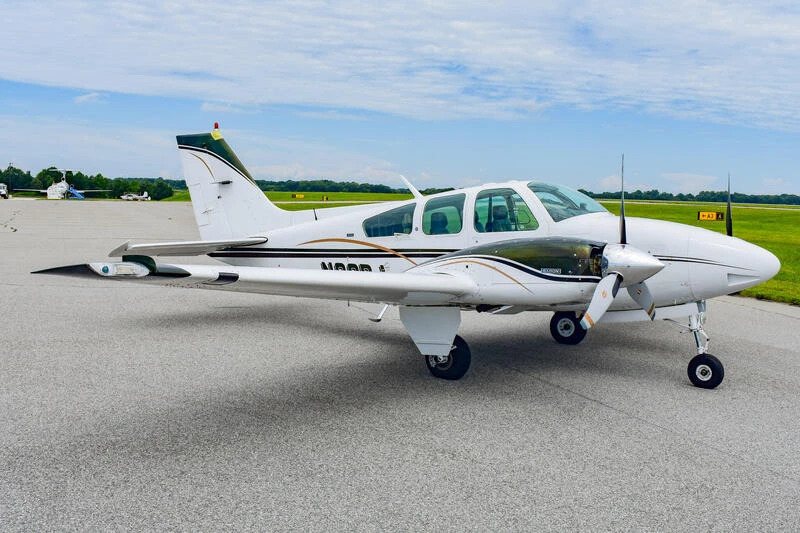
Many pilots of a certain age, including yours truly, will always consider the light twin a natural choice when stepping up to an aircraft with more power and flexibility than high-performance piston singles. Models like the Beechcraft Baron, Cessna 310, and Ted Smith Aerostar occupy the upper rungs of the piston capability ladder, and the Baron arguably is the most thoughtfully designed of the bunch.
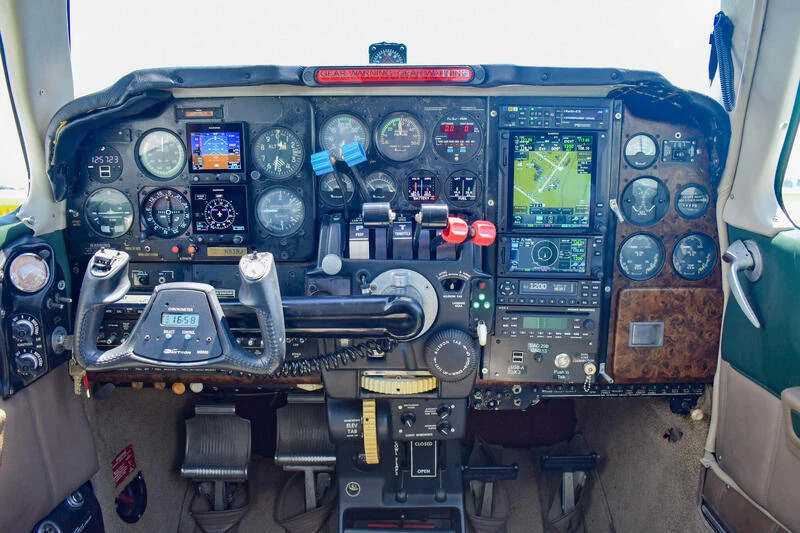
The Baron’s panel upgrades include modern Garmin instruments. [Credit: Carolina Aircraft]
With reliable engines, straightforward systems, and harmonious handling that pilots always seem to talk about, the Baron combines desirable qualities that keep pilots and passengers happy as they easily outpace other aircraft on their way to distant destinations.
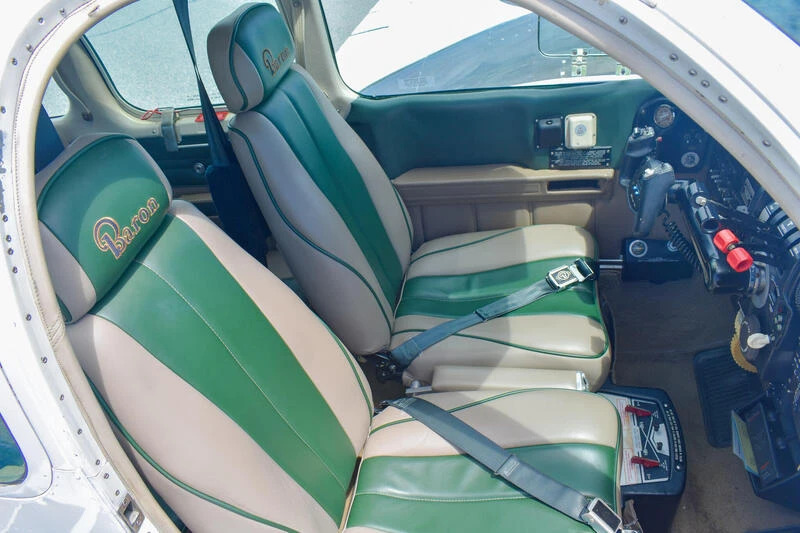
The aircraft for sale today has attractive paint, nicely trimmed interior, and panel upgrades that bring it solidly into the modern era. With low-time engines and propellers, and a price that includes Baron-specific flight instruction, this is a turnkey twin.
This 1975 Baron B55 has 5,635 hours on the airframe, 375 hours since overhaul on each of its 260 hp Continental IO-470 engines, and 375 hours since overhaul on its three-blade scimitar propellers. The aircraft is equipped with a large cargo door, GAMI fuel injectors, six-place oxygen system, Rosen sun visors, and electric elevator trim. It has a 1,542-pound useful load and 136-gallon usable fuel capacity.
Passengers will find the neat, large cabin inviting. [Credit: Carolina Aircraft]
The panel includes Garmin GTN 750Xi and GTN 650 GPS/Nav/Coms, dual Garmin G5 instruments, PS Engineering PMA 450B, Garmin GTX 345 transponder with ADS-B In and Out, WX 500 Stormscope with weather mapping, and S-TEC 3100 autopilot.
Pilots looking for a swift, stable traveling aircraft with the added redundancy of two engines for long stints over water, mountains, or at night should consider this 1975 Beechcraft Baron B55, which is available for $265,000 on AircraftForSale.
If you’re interested in financing, you can do so withFLYING Finance. Use our airplane loan calculator to calculate your estimated monthly payments. Or, to speak with an aviation finance specialist, visit flyingfinance.com.
Jonathan Welsh is Lead Editor of Aviation Consumer and a private pilot who worked as a reporter, editor and columnist with the Wall Street Journal for 21 years, mostly covering the auto industry. His passion for aviation began in childhood with balsa-wood gliders his aunt would buy for him at the corner store. Follow Jonathan on Twitter @JonathanWelsh4
Sign-up for newsletters & special offers!
Get the latest stories & special offers delivered directly to your inbox.