












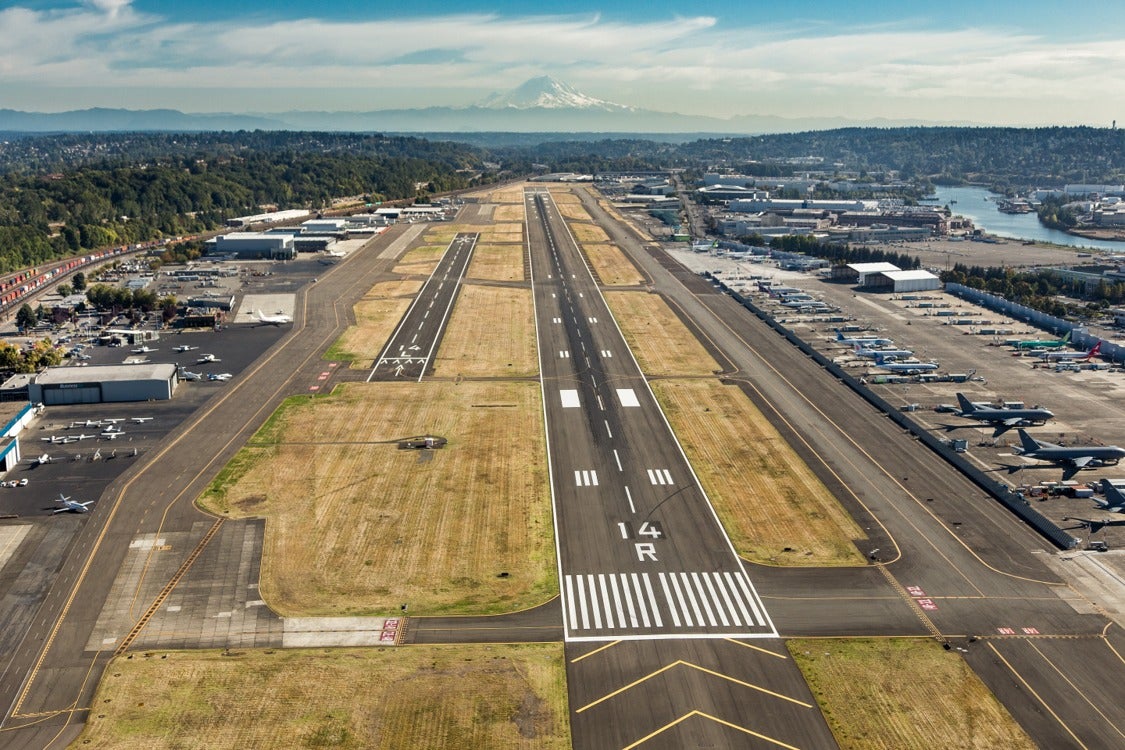


After six months of NOTAMs and closures, and the occasional pilot being forced to divert because they didn’t read the NOTAM, the smaller runway at King County International Airport/Boeing Field (KBFI) has returned to daytime service.
Airport officials marked the event Thursday with an outdoor morning ceremony. The skies were gray with clouds (this is Seattle, after all), but that didn’t stop people from coming out to celebrate the return of what is often referred to as KBFI’s “general aviation runway.”

Boeing Field has parallel runways: 14L/32R, which measures 3,709 by 100 feet, and 14R/32L, measuring 10,007 by 200 feet. The freighters, IFR traffic, and corporate jets use the big runway most of the time.
The smaller runway was shut down in March for the pavement rehabilitation project. The pavement was more than 20 years old and in need of repair.
According to airport officials and employees of the FBOs on-site, the project took a lot of coordination, as the larger runway was frequently closed from 10 p.m. to 3:45 a.m. PT to facilitate the pavement work and provide a safety buffer for the workers. Pilots had to check the NOTAMs carefully, or they would have to divert because of the closure.
- READ MORE: Beta’s Alia Lands at Boeing Field
- READ MORE: Flight School Move to Boeing Field Triggers Controversy
Airport officials said the first airplane to utilize the new pavement on the smaller runway was Beta Technologies’ Alia CTOL (conventional takeoff and landing) electric airplane.
“This all-electric aircraft represents the future of aviation, and the event was a fitting way to put the runway back into active service,” airport officials said in a news release.
They also cautioned that the smaller runway will close at dusk for a time until the precision approach path indicator (PAPI) lights can be flight checked.
The runway lighting has also been upgraded to LEDs. The old runway lights were recycled and turned into commemorative table lamps.
![The old runway lights from the Boeing Field renovation project were converted into table lamps and given away as prizes to attendees of the reopening ceremony. [Credit: Brad Schuster]](https://flyingmag1.b-cdn.net/wp-content/uploads/sites/2/2025/10/the-loghts-Large.jpeg?width=1024&height=768)
During the reopening ceremony the repurposed lights were prizes for a guessing game on various runway metrics. For example, one question was when was the last time the runway was redone. Answer: 2002.
The Details
Airport deputy director Dave Decouteau said the runway needed to be rehabilitated because it is vital to support general aviation at KBFI.
The project also included a realignment of the taxiways used to access Runway 14L/32R so that they now comply with the new FAA design standards.
The updated airport diagram has the details on the realignment of the taxiways. For generations student pilots operating out of Boeing Field learned the taxiways on the west side of the airport, where the Boeing company has a facility, are the Bravo taxiways recalled by “B for Boeing,” and the east side taxiways are Alpha for “all the rest of us.”
The diagram calls out three locations at the airport where general aviation aircraft are parked. Both Decoteau and Brad Schuster, Aircraft Owners and Pilots Association Northwest Mountain regional manager, also called attention to the importance of GA at the KBFI, which boasts over 175,000 operations annually.
![Brad Schuster, Aircraft Owners and Pilots Association Northwest Mountain regional manager, speaks at the reopening ceremony for Boeing Field's GA runway. [Credit: Brad Schuster]](https://flyingmag1.b-cdn.net/wp-content/uploads/sites/2/2025/10/Brad-from-AOPA.jpeg?width=1024&height=768)
The timing was poignant, as it was a year ago when Galvin Flying Service, the oldest flight school at KBFI, abruptly closed its doors. The school had been in operation for 94 years.
KBFI currently has one fixed-wing flight school, Rainier Flight Service, located on the west side of the airport. The student pilots learn how to fly in the complicated Class D airspace, which lies beneath the Class B that serves Seattle-Tacoma International Airport (KSEA) to the south.
The decision to allow Rainier to locate in 12 parking spots at the airport was controversial at the time, as there is a waiting list for space at KBFI.
However, the FAA compels airport sponsors to make decisions based upon the “highest and best use” of the space at the airport. A busy flight school with multiple aircraft generates more revenue than a private aircraft used intermittently.


