














Inside Beta Technologies’ IPO With CEO Kyle Clark

Electric aircraft developer raises about $1 billion in an oversubscribed initial public offering.

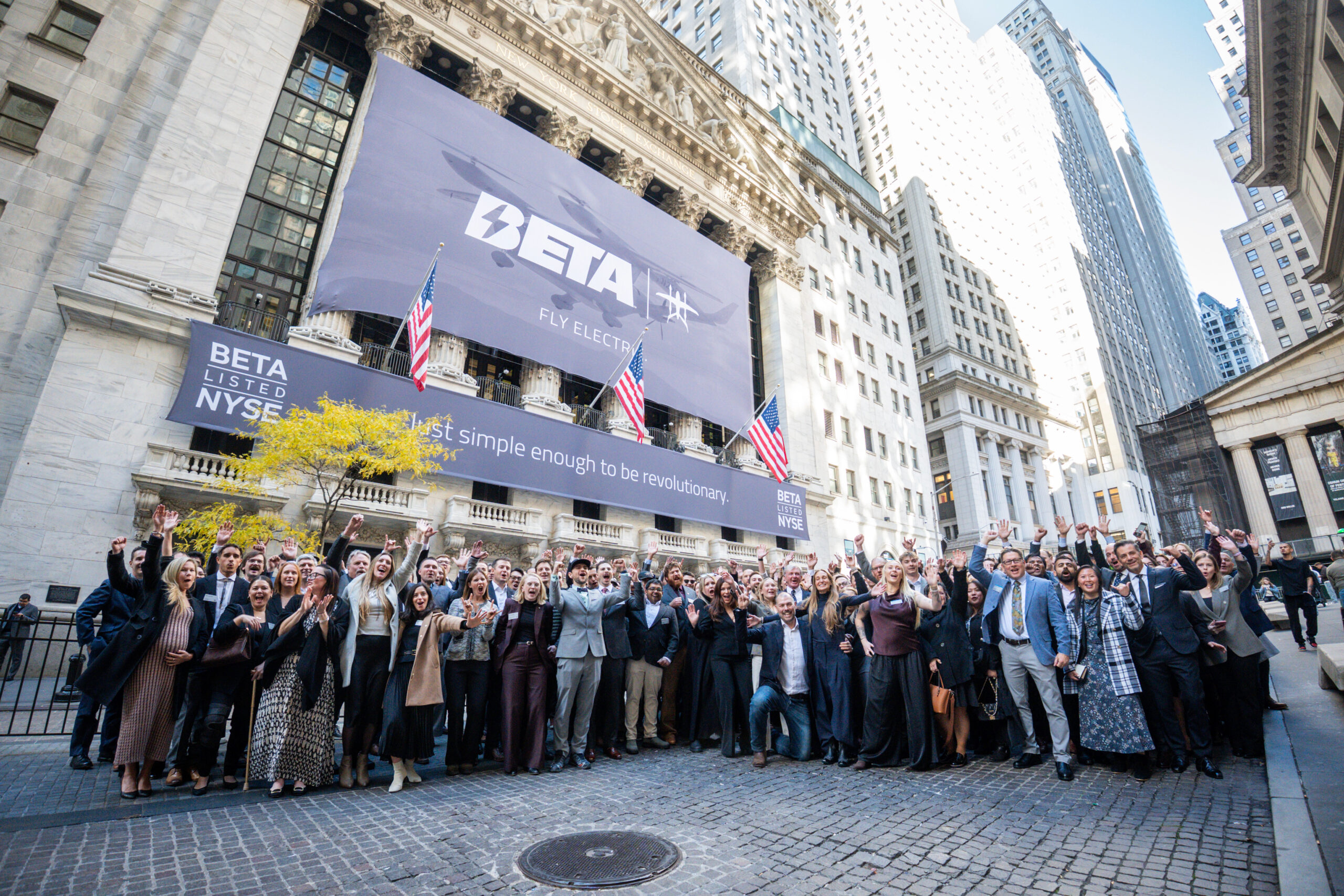
Beta Technologies at the New York Stock Exchange opening bell
Beta Technologies is the latest electric aircraft developer to go public. [Courtesy: Beta Technologies]
Gemini Sparkle

Key Takeaways:

  • Beta Technologies successfully launched its IPO with a $7.4 billion valuation, raising approximately $1 billion to advance its all-electric Alia aircraft for regional cargo and passenger routes.
  • The company strategically delayed its IPO until achieving key milestones such as production readiness, securing deposit-backed orders, shipping charging products, and completing major component certifications to maintain control and investor confidence.
  • Beta has demonstrated significant progress with extensive flight testing of its production-intent aircraft, amassed a strong order backlog, established a nationwide charging network, and secured an expedited FAA G-1 certification basis, positioning it for commercial launch by 2026/2027.
See a mistake? Contact us.

Electric aircraft are increasingly entering the public eye—and public markets.

On Monday, Kyle Clark, the founder and CEO of Vermont-based Beta Technologies, rang the opening bell of the New York Stock Exchange to celebrate the company’s initial public offering (IPO) and fresh $7.4 billion valuation. The firm is targeting regional cargo and passenger routes with its all-electric Alia conventional takeoff and landing (CTOL) and vertical takeoff and landing (VTOL) aircraft.


Beta in October said it expected to sell 25 million shares priced between $27 and $33, which would equate to a raise of $675 million to $825 million. Ultimately, it raised about $1 billion after meeting with investors multiple times during an “extended period roadshow” during the federal government shutdown, Clark told FLYING.

“As they dug deeper into our technology, our certification plans, our commercialization strategy, the investors that we spoke with continued to actually have more conviction in Beta’s differentiated approach to the market, technology, and certification strategy,” he said.

Beta’s $7.4 billion valuation places it somewhere between electric vertical takeoff and landing (eVTOL) air taxi competitors Joby Aviation and Archer Aviation, which went public via special-purpose acquisition company (SPAC). Clark said the company has plenty of capital, with a recent investment from GE Aerospace netting it $300 million. Rather, the IPO is intended to build confidence in Beta’s aircraft ahead of an anticipated commercial launch in 2026 or 2027.

“When folks started to move toward SPACs, we said we’re going to stay private,” said Clark, who founded Beta in 2017. “The folks at Joby and Archer and Eve [Air Mobility] and Vertical [Aerospace] have done a spectacular job of educating people on the benefits of electric propulsion and electric aircraft.

“I see our role as picking up that ball and running forward with the incorporation of the core technologies to exploit those benefits as we commercialize, industrialize, and get through the next phase of our business.”

Perfect Timing

Though most of Beta’s competitors are already public, Clark said the timing of its IPO “wasn’t a happenstance.”

“It was designed and thought about for a long time,” he said. “And then the government shut down, and we decided, you know what? We’ve always marched to our own drumbeat as a company.”

Clark said Beta created an “internal threshold” for the IPO—a list of milestones it aimed to achieve before going public.

“We needed to be in production, with a clear visibility on our cost to build materials,” he said. “How much would it cost us to build an airplane, a charging system, or a motor? And we needed a clear pipeline with deposit-backed orders, and in some cases—in the case of chargers, for example—shipping product.”

Beta CEO Kyle Clark at the New York Stock Exchange
Beta Technologies founder and CEO Kyle Clark rings the opening bell at the New York Stock Exchange on Monday, November 3. [Courtesy: Beta Technologies]

Beta has already rolled several production-intent Alia aircraft off its scaled production line in Vermont, which opened in late 2023 and is expected to one day churn out 300 aircraft per year. Already, these aircraft have conducted flight testing and demonstrations across the U.S., Europe, and most recently in New Zealand. Pilots with the FAA, U.S. Air Force, and customers such as United Therapeutics have flown them.

Per the firm’s latest SEC filing, it has an order backlog of almost 900 aircraft, with close to 300 firm orders. Supporting them is a nationwide network of more than 50 electric aircraft chargers, with many more installations planned.

The company has steadily checked those milestones off its list. One of the final steps, Clark said, was the completion of a “major certification” project. That came in July with the Part 35 certification of Hartzell’s five-bladed, fixed-pitch electric aircraft propeller, which will feature on both variants of Alia.

“At that point, in the boardroom midyear this year, we said, ‘You know, now is the time,’” Clark said.

Delaying its IPO until after the wave of electric aircraft SPACs also had the benefit of cementing Beta’s control over its activities. Often, SPAC combinations result in changes to the leadership or vision of a company.

“We’re able to maintain the board and the people and the leadership of the company fully intact and continue to make the progress that we’ve made to date—with the same people, with the same philosophy, driven at the same mission,” Clark said.

What’s Next for Beta?

Beta’s IPO puts an exclamation point on what has been an exciting 12 months for the company.

About one year ago, it conducted the maiden flight of its first production Alia CTOL. Since then, per filings cited by Bloomberg, CTOL models have logged nearly 83,000 nm in the air.

Over the spring and summer, Beta flew Alia through 25 U.S. states and across Europe from Ireland to Norway, where customer Bristow Group is flight testing it. Between those tours, it made historic appearances at the Paris Air Show and John F. Kennedy International Airport (KJFK) in New York. All told, the aircraft covered tens of thousands of miles, flew in day, night, IFR, and VFR conditions, and braved snowstorms and desert heat.

2025 has also seen Beta tighten its relationships with customers such as Bristow and Air New Zealand, as well as add new ones such as Republic Airways and UrbanLink Air Mobility. The biggest obstacle ahead of the company remains certification.

At the Paris Air Show, Clark said that Beta expects to conduct full-aircraft type inspection authorization (TIA) testing with the FAA this year—a target the company reiterated to FLYING on Tuesday. The certification of Hartzell’s electric propeller should simplify that process, which is a critical step toward validating Alia’s airworthiness.

Aiding the company is what Clark described as a “very clean, low compliance burden” G-1 certification basis from the FAA, obtained just a few weeks after the agency’s publication of certification guidance for powered-lift aircraft such as Alia. By following that guidance—which it had a hand in developing—Beta avoided publishing its G-1 on the Federal Register for public comment, a hurdle Joby and Archer had to overcome.

“That particular move probably put us somewhere between a year or two faster than the counterfactual,” Clark said. “And when you multiply that by the simplicity of our aircraft, we just have less things to certify.”

Clark is also optimistic about the influx of federal support for electric aircraft projects, such as through the eVTOL Integration Pilot Program (eIPP). The three-year initiative will comprise five pilot projects intended to study and develop regulations for real-world operations. Beta previously told FLYING that it intends to participate in the effort.

The eIPP was just one component of a June executive order that directed regulators to prop up U.S. manufacturers of novel aviation technology, including drones. Clark said that those developments—and a “whole lot of other test plans and things that have been very efficiently adjudicated on by the FAA”—have “given us confidence that this administration is behind our industry.”

Jack Daleo

Jack is a staff writer covering advanced air mobility, including everything from drones to unmanned aircraft systems to space travel—and a whole lot more. He spent close to two years reporting on drone delivery for FreightWaves, covering the biggest news and developments in the space and connecting with industry executives and experts. Jack is also a basketball aficionado, a frequent traveler and a lover of all things logistics.
Pilot in aircraft
Sign-up for newsletters & special offers!

Get the latest stories & special offers delivered directly to your inbox.

SUBSCRIBE
