












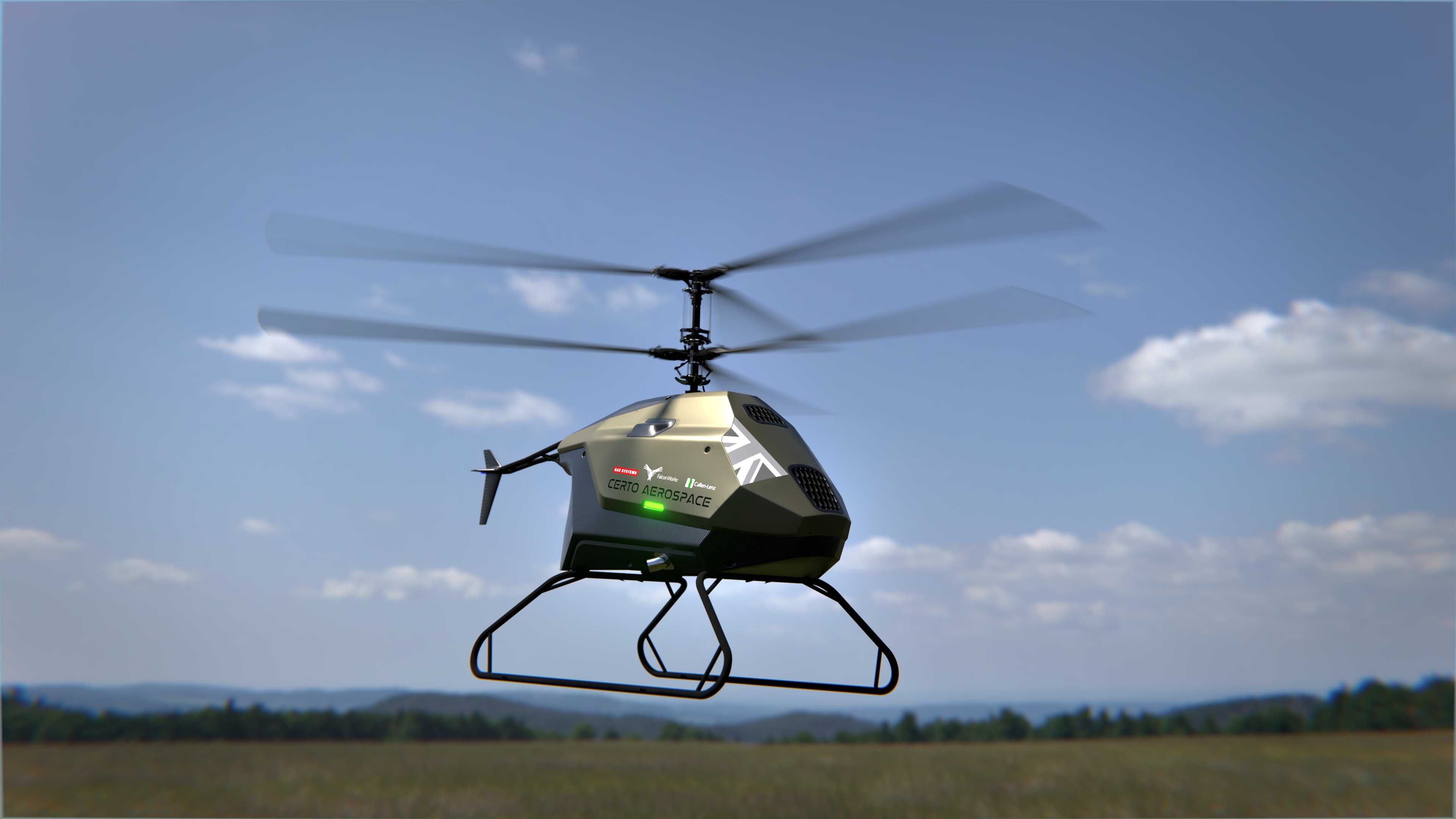


The U.K.’s Ministry of Defense (MOD) will evaluate four autonomous drone designs that could one day serve as “loyal wingmen” to AH-64E Apache helicopters.
The MOD on Friday awarded about $13 million to Anduril U.K., BAE Systems, Tekever, and Thales U.K. for Project NYX—its concept demonstrator program for uncrewed drones intended to keep Apache pilots out of harm’s way, extend operational range, and conduct operations from weapons deployment to surveillance. It said humans would make any decision involving the use of weapons.

The MOD said the four companies’ concepts include “innovative autonomy, payloads, and sensors.” At least one but possibly two final partners will be selected this fall. The goal is for the loyal wingmen to be operational by 2030.
“This government said it would act with urgency to strengthen our defences and back British industry, and that is exactly what we are doing,” said Luke Pollard, the U.K.’s minister for defense readiness and industry.
The idea of uncrewed loyal wingmen is not new. Europe’s Future Combat Air System (FCAS) program, led by France, Germany, and Spain, aims to replace the French Dassault Rafale, German Eurofighter Typhoon, and Spanish F-18 Hornet with a sixth-generation fighter. Per Airbus, the new fighter by the early 2030s will be capable of crewed-uncrewed teaming.
The U.K. has its own FCAS program, not to be confused with the multinational effort, that is centered around BAE’s sixth-generation Tempest fighter. It envisions a “20-40-20” split between crewed, reusable, and expendable air assets, with the Tempest replacing its own Typhoon. The new fighter would also replace Italian Typhoons and Japanese F-2s under the U.K., Italy, and Japan’s Global Combat Air Program (GCAP).
Similar efforts are underway in the U.S. The Air Force aims to procure about 500 next-generation fighters such as Lockheed Martin’s F-35A and Boeing’s F-47, teaming each with a pair of autonomous collaborative combat aircraft (CCA) by 2030. General Atomics’ YFQ-42A Dark Merlin and Anduril’s YFQ-44A Fury, the branch’s leading CCA candidates, began test flights last year.
U.K.’s Drone Wingman Effort
Each of the four candidates for the U.K.’s Apache drone wingman project brings autonomous expertise to the table.
Anduril said Friday that it has invested millions of dollars to develop the capabilities required for Project NYX, such as a “best-in-class payload capacity” and flexible integration with sensors and effectors. The company said it has completed early test flights with a “full-scale surrogate vehicle.” Its Fury CCA model went from clean sheet to first flight in 556 days.
Anduril’s drone will feature hybrid-electric propulsion and vertical takeoff and landing (VTOL) technology provided by its American partner Archer Aviation, which in February picked Bristol as the site of its U.K. hub. Archer CEO Adam Goldstein said Friday that the site was built “specifically to support this work.” Archer is also lending its hybrid-electric powertrain to Anduril’s Omen drone concept.
Archer and Anduril in late 2024 said they would pitch the next-generation aircraft to the U.S. military. They may instead find a customer across the Atlantic.
BAE said its submission will be built around partner Cento Aerospace’s coaxial, rotary-wing Capstone drone, a heavy-lift model designed to replace crewed helicopters. The company supplies the autonomous vehicle management system for Boeing’s MQ-28 Ghost Bat, another candidate for the Air Force’s CCA program.
In addition to its work on Tempest, BAE builds an array of drones and has shared a concept for an autonomous collaborative platform, analogous to the loyal wingmen envisioned by the U.K. MOD. The company’s FalconWorks unit is partnered with Lockheed Martin’s Skunk Works to explore other uncrewed systems designed to support crewed aircraft.
Tekever said its design will be an “advanced rotary platform paired with mission autonomy and advanced sensing capabilities.” The company opened a new Centre for Autonomy and Engineering Hub in Bristol, U.K., to support the effort.
Thales has been working with Austria’s Schiebel to develop the latter’s Camcopter S-301 into a loyal wingman. The company’s cortAIx unit is partnered with Dassault to explore the use of artificial intelligence on military air platforms.

