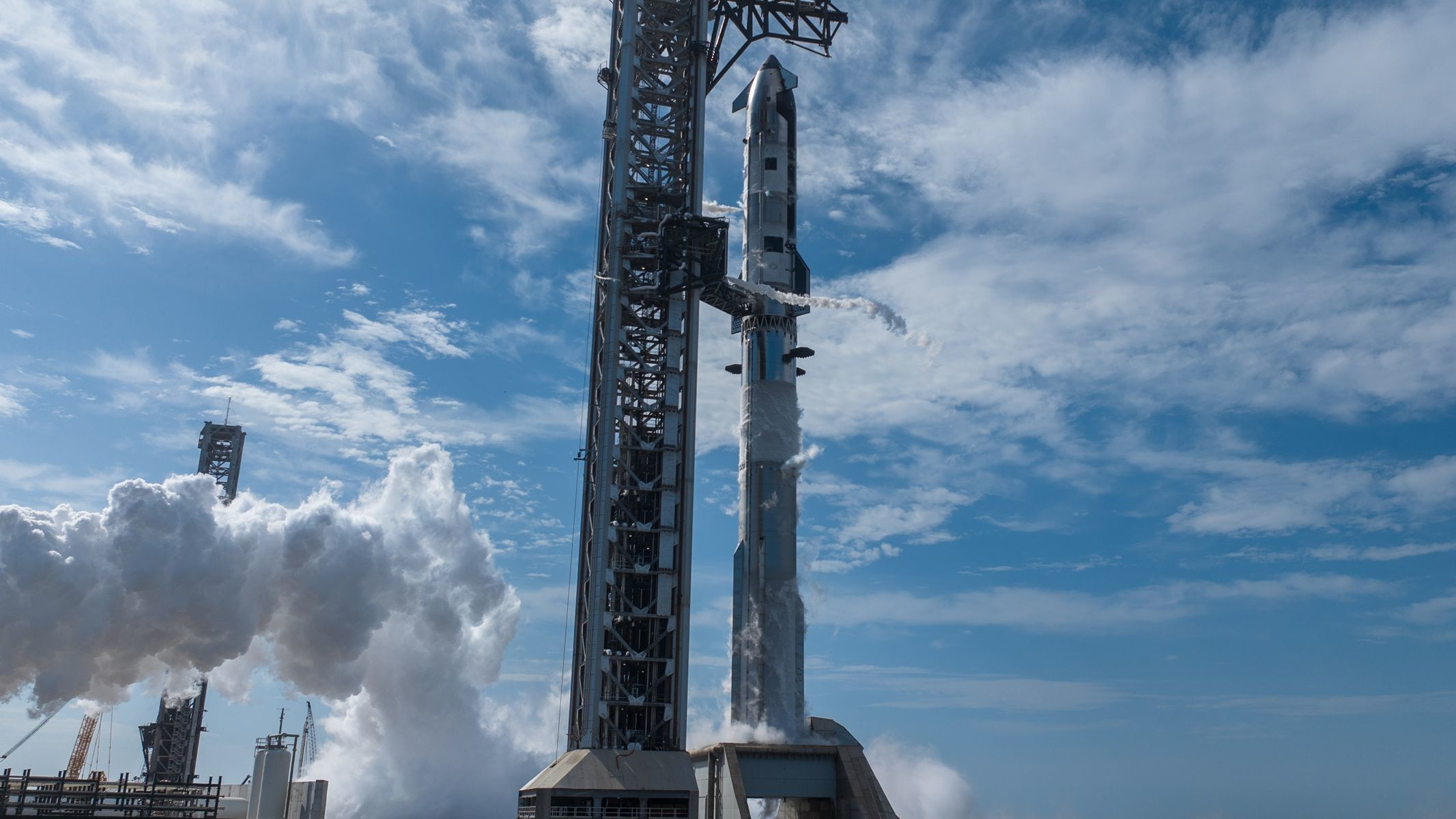
SpaceX is once again preparing to launch the largest, most powerful rocket in history.
The company in 2023 debuted the first iteration of Starship—the gargantuan spacecraft it is building to deploy satellites, create orbital data centers and, eventually, fly to the moon and Mars. It introduced the upgraded Version 2 (V2) in 2025.
Now, SpaceX is preparing to launch Starship Version 3 (V3)—its biggest, most capable vehicle yet—as soon as Tuesday, May 19, at 6:30 p.m. EDT, it said this week.
“The third generation of Starship and Super Heavy, powered by Raptor 3 [engines] and launching from an entirely new launch pad, incorporate learnings from years of flight testing and development,” SpaceX wrote in an update Tuesday, May 14.
The company said the mission’s “primary goal” is simple—to test how the V3 upgrades perform in a real flight environment and gather data to make improvements. Starship could explode, as it has on prior missions, as SpaceX pushes the rocket to its limits, driven by its philosophy of rapid iteration.
Past test flights have included more ambitious targets, such as catching the Super Heavy booster back at the launchpad in Texas—a feat SpaceX has achieved several times. The company’s expectations for the rocket’s upcoming 12th flight are less complex.
But the V3 era is expected to be a crucial one for SpaceX, with the rocket’s improved power and payload opening up orbital missions, commercial Starlink satellite deployments, and full reusability.
Further modifications will enable in-space docking and fuel transfer capabilities that will be required for missions beyond Earth orbit. NASA is evaluating a Starship human landing system (HLS) variant to complete its first lunar landing since the Apollo era on Artemis IV, planned for 2028.
To unlock the full value of Starship—which is designed to be fully reusable and turned around within days or hours rather than weeks or months—SpaceX will need to improve its launch cadence. Flight 12 will be its first of 2026 after the company conducted two missions in 2023, four in 2024, and five last year. The ship last flew in October.
SpaceX’s timeline for the mission has slipped from early 2026 to March, April, and now May. It has an opportunity to get back on track next week.
Starship’s Return to Action
SpaceX is planning at least one new wrinkle on Starship’s 12th flight.
After separating from Super Heavy, the ship’s upper stage will use its PEZ-like payload dispenser to deploy 22 Starlink simulators, which are designed to mirror SpaceX’s next-generation satellites. The payload dispenser has been upgraded for quicker deployment.
Two of those simulators are planned to scan Starship’s heat shield and beam the imagery back to Earth. The idea would be to gauge the status of the heat shield in orbit before deciding whether to attempt a catch back at the launch pad. If the satellites uncover damage, SpaceX could save its resources for a better opportunity.
Some of the heat shield tiles have been painted white to test the in-space evaluation system, which could play a role in future missions.
SpaceX intentionally removed one of the tiles in order to measure the aerodynamic load on its neighbors as Starship reenters the atmosphere. That would simulate how the heat shield might perform if a tile was actually lost during a mission. Ahead of splashdown, the ship will perform a maneuver designed to put maximum stress on its rear flaps and other “experimental actions” to test its reusability.
SpaceX will not attempt to catch the Super Heavy booster at its Starbase launchpad in Texas, as it has previously. Instead, it plans to flip the booster around after it separates from Starship, then perform a landing burn over the Gulf of Mexico where it would splash down.
Space enthusiasts will be able to follow the mission via live webcast on SpaceX’s website and X account. The V3’s upgraded cameras are expected to deliver 50 different views of the vehicle.
Bigger and Better
The V3 Super Heavy has received a range of upgrades, most notably to its 33 Raptor engines. They now produce 551,000 pounds of thrust at sea level, up from 507,000, to give Starship the juice to reach low-Earth orbit (LEO). The added thrust is expected to achieve SpaceX’s goal of delivering more than 100 tons of payload to LEO, which would enable deployments of larger Starlink batches.
That is just one of the many changes it has made to Starship over the past few months.
Perhaps most notably, new drogues and propellant feed lines will allow it to rendezvous with other Starships on orbit. Radio frequency sensors were added to measure propellant levels in microgravity.
These improvements will unlock a critical Starship propellant transfer demonstration, which SpaceX will use to prove that the vehicle can meet NASA’s expectations. SpaceX and NASA officials have estimated Artemis IV will require low-single digit or double digit tanker flights to stock an orbital fuel depot, where the Starship HLS will stop on its way to the moon.
In addition, Super Heavy now has three rather than four fins. The fins are larger, stronger, and fitted with a new catch point for Starbase’s giant metal chopstick arms to snare the booster out of the air above the launch pad.
A “clean-sheet redesign” of Starship’s propulsion systems is intended to boost its endurance and fuel volume, improve the handling of its reaction control system, combat fuel leaks, and support a redesigned Raptor ignition system.
Other improvements to Super Heavy have allowed the company to reduce Starship’s non-payload mass, making more room for satellites and other cargo.
SpaceX completed a wet dress rehearsal on Monday ahead of Flight 12, which will be the first using a new launchpad at Starbase.
The new site is larger than Starbase’s original pad, with increased fuel capacity and more pumps to accommodate the more massive V3. An upgraded launch mount structure is designed to improve the rocket’s reusability and cadence. The new launch tower has shorter, electromechanically powered chopstick arms, intended to improve the reliability of booster and—eventually—upper stage catch attempts.
High Expectations
Next Tuesday represents an opportunity for SpaceX to return to its regular cadence following one of Starship’s longest quiet periods.
SpaceX CEO Elon Musk in January estimated the mission would fly by early March. That month, NASA official Lori Glaze predicted it would launch in April. Musk in April then shifted the timeline to May.
Reestablishing a regular cadence will be critical for SpaceX’s future ambitions. Starship V3 is the version of the rocket that is expected to deliver the Starship HLS to orbit. But the company must show NASA that it can deliver enough propellant to orbit for a trip to the moon, which will require multiple flights in quick succession.
Politico in November reported that SpaceX’s Starship propellant transfer demonstration is planned for June. The company’s $4 billion HLS contract also calls for an uncrewed, pre-landing lunar ascent ahead of the crewed landing in 2028.
Any slip to those timelines could allow Blue Origin—whose Blue Moon Mark 2 lander NASA is also considering for the Artemis IV lunar landing—to step in. NASA plans to test both Starship and Blue Moon on the orbital Artemis III mission in 2027.
“Whatever one can get us there first, to the moon, we’re going to take,” said U.S. Transportation Secretary Sean Duffy in October, while serving as interim NASA administrator.
V3’s introduction is equally important for SpaceX’s commercial plans. It could ramp up Starlink satellite deployments and expand the company’s offerings to orbital data centers and other in-space technologies.
SpaceX said in a post on X this week that it is exploring international launch sites, in addition to Starbase and the Starship launchpad it is constructing at NASA’s Kennedy Space Center in Florida.
The FAA in 2025 allowed the company to increase annual launches at Starbase from five to 25. This year, it authorized new Starship trajectories that would send the rocket over larger portions of the U.S. mainland. The regulator has advised pilots to be mindful of rocket debris from space launches as orbital activity rises.