












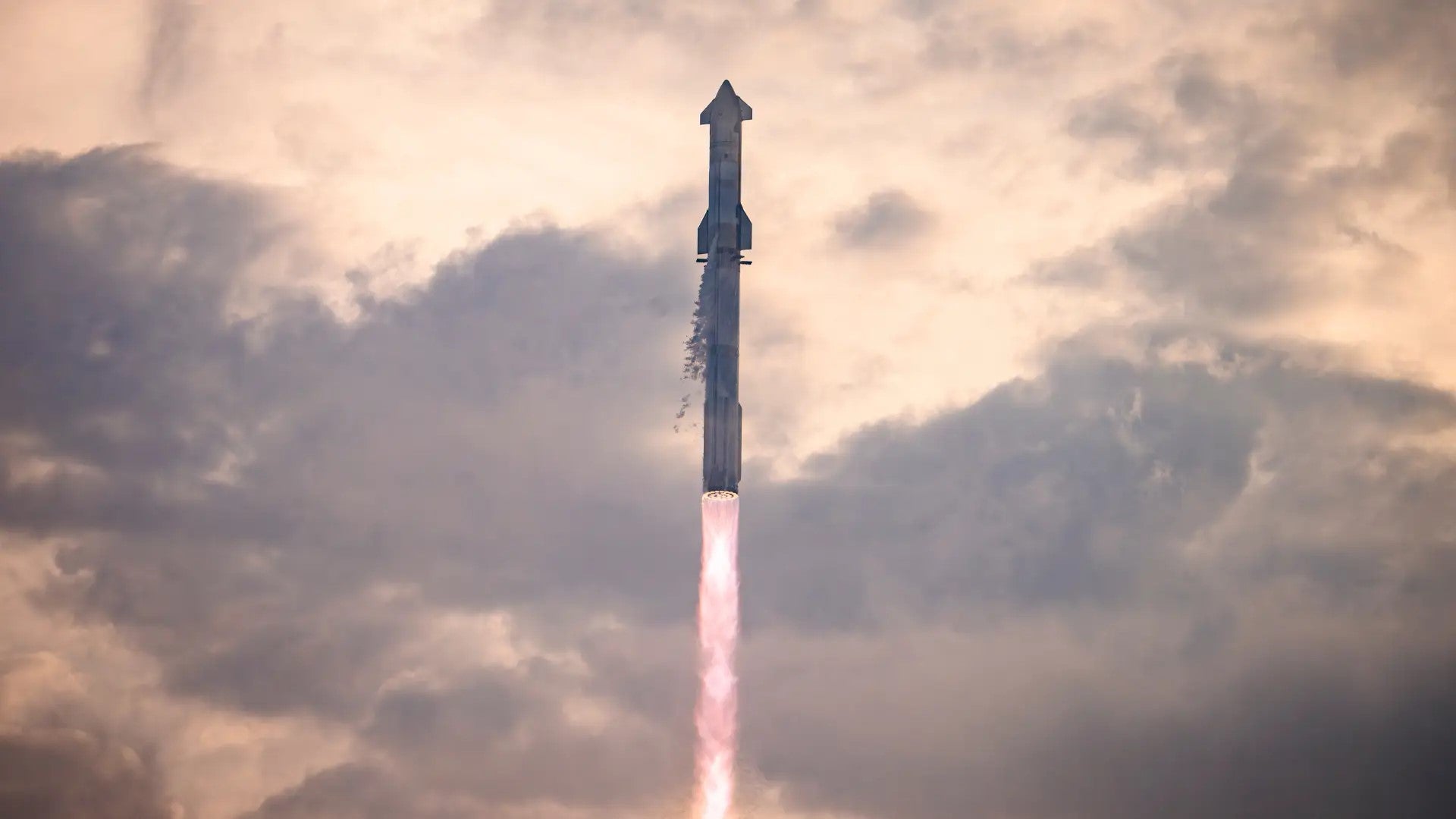


After SpaceX’s gargantuan Starship rocket exploded and disrupted air travel during a January test flight, the company was reportedly slow to inform the FAA.
Starship had separated from its Super Heavy booster and was ascending on its seventh suborbital test flight when it experienced what SpaceX called a “rapid unscheduled disassembly,” sending hunks of debris cascading through the airspace below. Citing FAA documents, The Wall Street Journal on Monday reported that the FAA activated debris response areas—predetermined zones that are cleared of aircraft when unplanned spaceflight debris could endanger them—about four minutes after flight data stopped coming in.

But SpaceX, per the documents, did not alert the FAA to the explosion until 15 minutes after that. U.S. launch operators are required to report mishaps to the FAA so that air traffic controllers (ATCs) can direct aircraft to safety.
The Journal reported that some ATCs learned of the explosion after talking to pilots, who witnessed the simmering chunks of debris firsthand, while other officials were made aware through an internal group chat.
One FAA report said the January incident created a “potential extreme safety risk” by increasing ATC workloads. Per interviews and a review of additional records, the Journal reported that some pilots had to declare fuel emergencies in order to fly through the debris response areas and land safely. Debris reportedly fell for about 50 minutes.
SpaceX responded swiftly after the report’s publication, calling it “misleading” and “based on conjecture and unscientific analysis from anonymous sources” in a social media post.
“No aircraft have been put at risk and any events that generated vehicle debris were contained within pre-coordinated response areas,” the company wrote. “These hazard areas cover a conservatively broad region, and any aircraft were appropriately routed in real-time around where debris was contained within the larger pre-coordinated hazard area.”
The post did not address the reported 15-minute gap between the FAA’s activation of debris response areas and SpaceX’s communication of the explosion.
The Journal also reported that the FAA in August suspended a panel it created in February to revisit spaceflight debris risks to aviation. The move reportedly came as a surprise to some panel members.
According to the FAA, a safety risk management (SRM) panel met twice in 2025. Some of its recommendations, such as improved communication and coordination with airlines ahead of Starship’s eighth flight, have already been implemented.
The agency said a third SRM meeting was paused because most of the panel’s safety recommendations were already underway. It added that safety efforts have since been expanded beyond the panel.
“Any safety risk posed to commercial airline operations is unacceptable,” Jason Ambrosi, president of the Air Line Pilots Association (ALPA), told FLYING. “It’s critical that a national space integration strategy include establishing launch planning and recovery standards, creating standards to make certain reentry of very large pieces of space debris occurs at predefined locations and times, and requiring timely, advanced notifications of pilots, airlines, and controllers not directly involved in a space launch about the risk level changes in the airspace.”
SpaceX’s Big Ambitions
The FAA is responsible for overseeing commercial space launches and landings on U.S. soil by awarding and modifying licenses.
SpaceX, for example, holds three licenses for Falcon 9 launches at Kennedy Space Center and Cape Canaveral Space Force Station in Florida as well as Vandenburg Space Force Base in California. The company’s license for Starship permits up to 25 launches per year from its Starbase launch pad in Texas.
SpaceX’s rise has coincided with an explosion in commercial space activity. In 2020, for example, the FAA authorized 39 launches. In 2024, that figure rose to a record 154 licensed launches. And with nearly 200 launches already licensed in 2025, it will soon be broken again.
SpaceX’s reusable Falcon 9 is responsible for the vast majority of these operations. But the company is developing a much larger reusable spacecraft, Starship, for a variety of commercial and government space missions.
Starship’s first six test flights were a mixed bag, with some successes, some failures, and little public scrutiny on the program. Though not every Starship made it to splashdown, SpaceX framed those missions not as setbacks but opportunities to collect real-world data.
Things changed with Flight 7, which was the first with Starship’s upgraded Version 2 (V2) configuration. Per data from FlightRadar24, the rocket’s explosion in January diverted or held up aircraft flying routes for American Airlines, JetBlue, Delta Air Lines, and United Airlines.
One pilot told the Journal he had to declare “Mayday” to make an emergency landing in Puerto Rico. The FAA said there were no close calls or loss of separation between aircraft within the no-fly zone.
After Flight 7, the FAA grounded Starship while SpaceX began a required mishap investigation. Unlike in the past, the agency authorized Flight 8 before the investigation was complete. It issued a return to flight determination, which can only happen when a mishap is found not to jeopardize public safety, in March.
The greenlight came with some new safety considerations. For example, the FAA doubled Flight 7’s aircraft hazard area (AHA), extending it to airspace around the Bahamas and Turks and Caicos. Those mitigations reportedly worked after Flight 8 similarly ended in an explosion, with no reported fuel emergencies or emergency landings, per the Journal. The FAA told FLYING it diverted 28 aircraft and placed another 40 in holding patterns while the no-fly zone was active.
Since then, things have been smoother for Starship.
The FAA suspended more than 70 air routes ahead of Flight 9 in May, during which the ship reached suborbit but suffered a different anomaly before reentering the atmosphere. Flights 10 and 11 in August and October—the last with V2 Starships—continued the upward trend, with the vehicle making it all the way to splashdown each time.
SpaceX has even bigger plans—literally—for 2026.
The company will soon introduce its Version 3 (V3) Starship, which will have larger propellant tanks, improved Raptor engines, and a higher payload capacity than NASA’s Saturn V. It will be the first Starship capable of orbital missions and the vehicle SpaceX hopes can demonstrate two key capabilities: reusability and in-orbit refueling. The latter is an essential demonstration for the Starship human landing system (HLS), which is expected to transport NASA astronauts from lunar orbit to the moon’s surface during the Artemis III mission, scheduled for mid-2027.
SpaceX hopes to fly the V3 Starship at a higher cadence. The V2 was capped at five annual launches and landings for most of its operational life. But the FAA earlier this year authorized as many as 25 per year. The agency is also considering whether to permit up to 44 annual Starship launches at Kennedy Space Center’s Launch Complex 39-A in Florida.
At the same time, an August executive order by President Donald Trump directs federal agencies to roll back environmental reviews and other paperwork, reducing the red tape for commercial space operations. Per the FAA’s most recent 10-year forecast, the agency expects to authorize anywhere from 2,000 to 4,000 launches over the next decade.
“As we begin increasing Starship’s flight cadence and launching missions from Florida in 2026, SpaceX will continue to ensure maximum public safety while also working to integrate Starship more efficiently into the airspace,” SpaceX said Saturday.

