














California-based electric vertical takeoff and landing (eVTOL) air taxi developer Archer Aviation is putting down roots on both sides of the Atlantic.
On Tuesday, the company revealed its plans to build an engineering hub in South West England that will be operated by a new subsidiary, Archer Aviation UK Limited. The move adds to its primary manufacturing facility in Covington, Georgia, which could also be complemented by production capabilities in the United Arab Emirates (UAE).

“The U.K. has the talent and industrial base to be a major player in driving the next era of advanced aerospace and defence,” said Adam Goldstein, Archer’s founder and CEO. “Archer’s plans to open a U.K. engineering hub underscores our commitment to being an integral part of the next-generation of aerospace and defence in the country.”
Archer also poached engineer Limhi Somerville from what would be its largest U.K. competitor—Vertical Aerospace, which last week unveiled its flagship eVTOL, Valo.
Like Archer’s Midnight, Valo is designed to carry up to four passengers on zero-emission flights in urban settings, producing a fraction of the noise of a helicopter. Somerville spent six years with Vertical and led its development of electric batteries and powertrains, most recently serving as director of engineering. He will join Archer’s team in early 2026, the company said.
Acquiring team members from competitors is a blueprint the company has deployed before. Earlier this year, for example, George Kivork, the former head of U.S. state and local policy for rival Joby Aviation, joined Archer as a general manager for the Los Angeles region.
However, the strategy has gotten the company in some hot water. Joby in November sued both Archer and Kivork, alleging that its competitor used trade secrets from Kivork to undercut an exclusive deal it had planned to finalize. Archer has rejected the allegations.
Wisk Aero, the eVTOL arm of Boeing, sued Archer in 2021, also alleging that a former employee stole trade secrets. Archer promptly countersued. The companies ultimately settled for an undisclosed amount, and Boeing made an investment intended to fund the integration of Wisk’s autonomy technology on future variants of Midnight.
Archer Across the Atlantic
Midnight is a piloted, four-passenger eVTOL model with a cruise speed of about 150 mph, designed for 10-20-minute, 20-50 sm trips. Its six electric battery packs each power a pair of motors and propellers, half of which are capable of tilting to support both hover and forward flight.
In the U.S., Archer is working with United Airlines—which placed an order for up to 200 aircraft—and Southwest Airlines to build air taxi networks in major urban centers. It has shared potential route maps for New York, Miami, and Los Angeles, where it recently acquired Hawthorne Municipal Airport (KHHR) for $126 million.
The company will operate Midnight through its Part 135 subsidiary, Archer Air. In addition, it is selling the air taxi to customers such as United and Future Flight Global, which earlier this year placed an order for up to 116 aircraft. Automaker Stellantis plans to invest up to $400 million through 2030 to support production of about 650 aircraft per year at Archer’s Covington facility.
Though Midnight is not yet FAA certified, it could quickly obtain validation from the U.K. Civil Aviation Authority (CAA) once that happens. In June, the FAA and four other aviation regulators, including the CAA, announced a partnership to harmonize their eVTOL standards. The idea of the five-way agreement is that each regulator could quickly accept any certification project that has been cleared by another.
Midnight’s potential U.K. entry may create a competitor to Vertical. Before then, though, Archer plans to partake in a series of operational demonstrations.
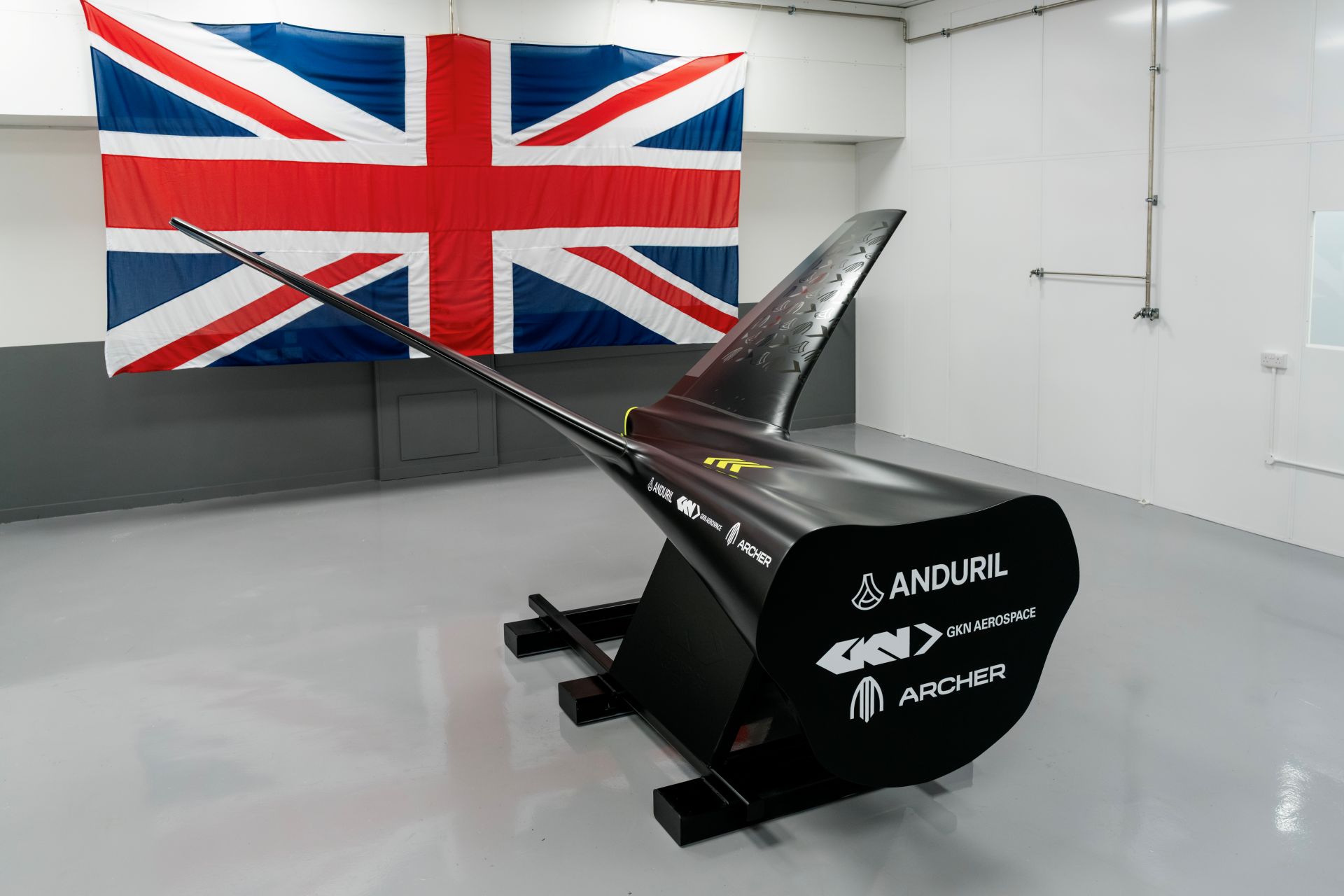
Last week, Anduril UK and GKN Aerospace announced their participation in the British Army’s Project NYX, the first phase of the U.K. Ministry of Defense’s Land Autonomous Collaborative Platform (ACP) program. Land ACP seeks an uncrewed aircraft to team with Apache AH-64E attack helicopters, similar to the U.S. military’s collaborative combat aircraft (CCA) initiative.
Project NYX will comprise the research and development of a capability concept demonstrator, with exercises planned for 2027 and 2028. GKN is the project’s airframe manufacturing and electrical integration partner. Archer will lend its expertise in eVTOL and hybrid propulsion systems to the partnership. It also said the partners will explore “other opportunities” at GKN’s Isle of Wight airframe production facility.
The collaboration tightens Archer’s relationship with Anduril, its partner for an autonomous, hybrid-electric variant of Midnight. The companies plan to pitch the concept to military customers. Archer is also lending its powertrain to Anduril’s recently announced Omen—another autonomous model with defense capabilities.
By laying down roots in the U.K., Archer continues to expand its global presence. It has announced a trio of “Launch Edition” customers—the UAE’s Abu Dhabi Aviation, Ethiopia’s Ethiopian Airlines, and Indonesia’s PT IKN—that will each operate an initial fleet of air taxis, collaborating with Archer on pilot training, flight operations, and other tasks. The idea is for these early adopters to help shape the company’s commercial rollout in other markets.
In addition, Archer has received orders for as many as 100 aircraft apiece from Korean Air, UAE’s Air Chateau, and Soracle, a joint venture between Japan Airlines and Sumitomo Corporation. KakaoMobility, another Korean operator, plans to acquire as many as 50 aircraft.

