












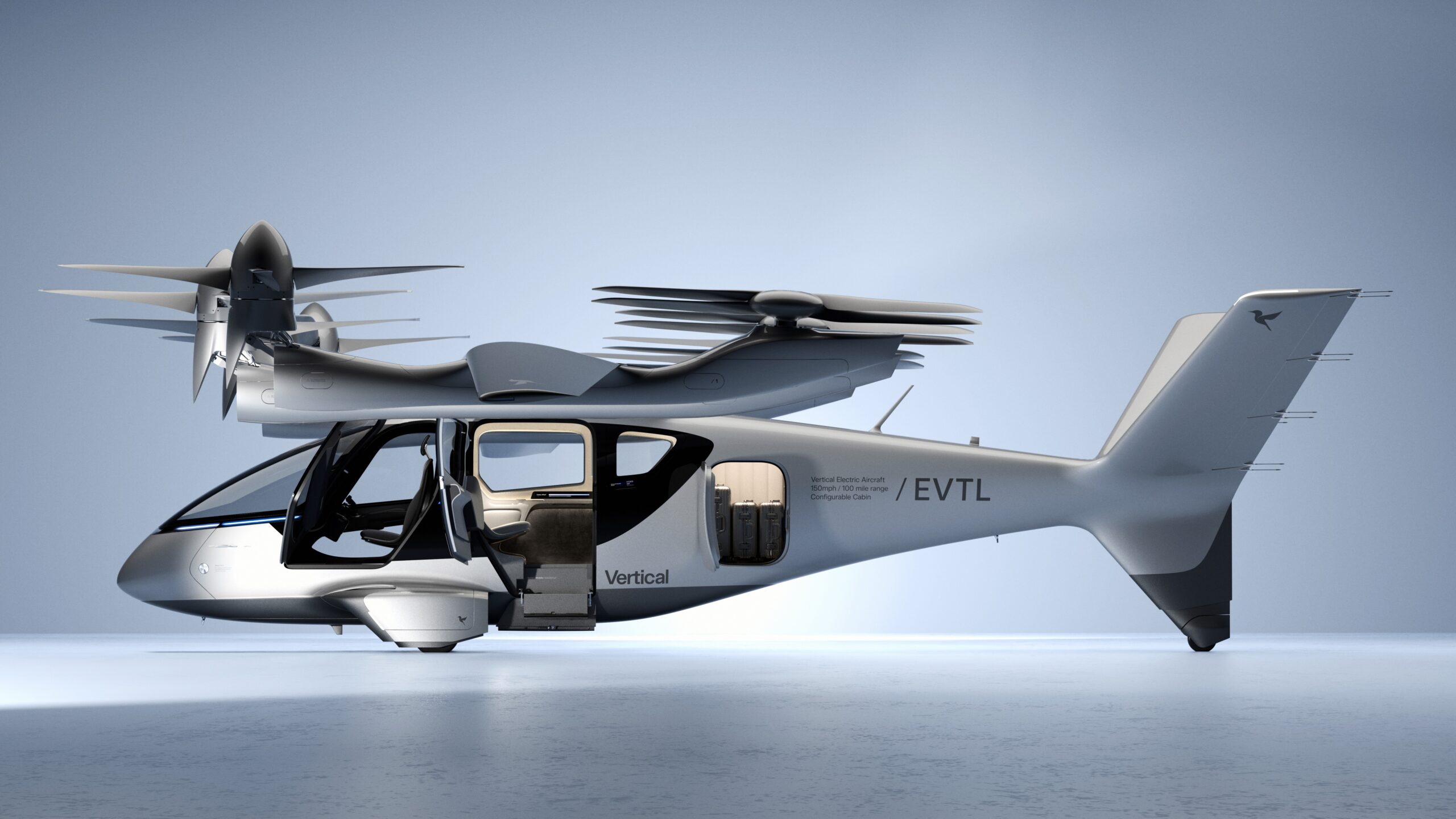


U.K. developer Vertical Aerospace this week unveiled its flagship electric vertical takeoff and landing (eVTOL) aircraft, Valo, which, according to CEO Stuart Simpson, will be the “people’s air taxi.”
A chief criticism of eVTOL aircraft is their anticipated cost, leading many to characterize electric air taxis as a service for the wealthy. But Simpson said that won’t be the case for Vertical’s flagship model.

“It’s a bit like an iPhone,” Simpson told BBC Today on Friday. “When this launches, it’ll be a premium product for the first couple of years just to prove out the routes, prove out the infrastructure. But we’ve already modeled this out on over 1,200 routes with customers. And the cost per seat per kilometer is the same as a…cab.”
The Valo is Vertical’s zero-emission successor to the VX4 prototype, designed to take off and land vertically like a helicopter but cruise on fixed wings. American developers such as Joby Aviation, Archer Aviation, Beta Technologies, and Wisk Aero are pursuing similar designs, which are expected to enable passenger operations in cities such as New York and Los Angeles.
Recently, the VX4 began piloted flight testing of the transition from vertical to forward flight—a key milestone ahead of for-credit testing with the U.K. Civil Aviation Authority (CAA) and European Union Aviation Safety Agency (EASA).
But the Valo, developed with feedback from airlines, is billed as an improvement, with better aerodynamics, “redesigned” wing and propellers, and “upgraded materials.” Domhnall Slattery, Vertical’s chair, said it will be “bigger, safer and more capable than anything in the sector.” By Simpson’s estimation, it will also be cheaper.
Vertical is seeking U.K. CAA and EASA certification for the Valo by 2028, with plans to launch a network connecting London’s Canary Wharf to Heathrow (EGLL), Gatwick (EGKK), Cambridge City (EGSC), and Oxford (EGTK) airports by 2029. A trip between Canary Wharf and Heathrow, it said, would take just 12 minutes in the Valo versus 60-90 minutes by car.
Introducing Valo
Vertical publicly unveiled the Valo on Wednesday at Canary Wharf, the central hub of its planned U.K. air taxi network.
The aircraft has a projected cruise speed of 150 mph and cruise altitude of 2,000 feet, though Simpson told BBC Today it could climb to 9,500 feet. He also said the “electric version” will have a range of 100 miles, implying a longer range for Vertical’s planned hybrid-electric variant.
Building on the VX4, the Valo has an under-floor battery system comprising eight liquid-cooled packs. These power eight carbon-fiber composite propellers, which remain vertical for takeoff and landing but tilt forward to support cruise flight. The packs use cylindrical cells from Molicel, though the battery and propeller systems are proprietary.
According to Simpson, the electric power system generates less than 50 dBA of noise in cruise flight.
“You really don’t hear it,” he told BBC Today. “It’s like the noise of a washing machine or a car going past…So this gives regulators and mayors, like in London, the permission to open up the skies.”
Vertical said the Valo airframe—manufactured by partner Aciturri with materials supplied by Syensqo—is “more aerodynamic” than the VX4’s. Leonardo in 2022 agreed to manufacture and supply a carbon composite fuselage.
The cockpit features Honeywell’s Anthem flight deck and all-digital fly-by-wire system, which Vertical said could be upgraded over time. The cabin includes panoramic windows, a cockpit divider, and “generous personal space.”

Though the Valo will launch as a four-passenger air taxi, Vertical said the design allows it to expand to six passenger seats. It will also feature the “largest cargo hold within its class,” with a total payload of about 1,200 pounds plus room for six cabin bags and six checked bags.
Vertical said it aims to produce 175 Valo aircraft by 2030, ramping up to 225 annually by the end of that year. The company is targeting “airliner-level safety certification”—the U.K. and EU’s 10-9 standard, or one catastrophic event per one billion flight hours. It will certify to EASA’s special condition for VTOL (SC-VTOL) Enhanced category, which permits commercial air transport operations and flights over congested areas.
“We are the only people in the world designing this to the same level of standard as an Airbus,” Simpson told BBC Today.
The VX4 prototype earlier this year began piloted testing of the transition from hover to forward flight—a key milestone ahead of for-credit testing with the U.K. CAA and EASA. Vertical on Friday said it is “close to completing” the campaign. It plans to build seven certification-ready aircraft for final testing.
“Within a few weeks…we will be number one in the world in terms of the technological progress we have made, overseen by the CAA,” Simpson said.
‘People’s Air Taxi’?
Vertical said the Valo could be configured for emergency medical services, cargo missions, and “in the future, defence, hybrid, and autonomous variants.” But its early commercial application will be city center-to-airport routes.
In the U.K., Vertical plans to build infrastructure in partnership with vertiport developer Skyports, which owns London Heliport and Bicester Vertiport locations and is working to create a countrywide network.

The collaboration also includes helicopter operator Bristow Group, which has placed a preorder for up to 50 Valo aircraft plus 50 options. With Bristow’s U.K. air operator certification, the partners plan to offer a “ready-to-fly” platform including the Valo, pilots, maintenance, and insurance. Bristow also has a firm commitment for up to 55 Beta Technologies Alia electric aircraft.
“This collaboration is a meaningful step as we progress a portfolio of advanced aircraft and explore how they can be deployed responsibly at scale,” said Chris Bradshaw, president and CEO of Bristow.
Vertical on Friday announced a new customer, Héli Air Monaco, which also placed an aircraft preorder and plans to fly customers between Monaco, Nice, Cannes, and Saint-Tropez in the French Riviera.
“The eVTOL has its place in the air transport offering and can provide a new short distance mobility solution in the future, including toward the hinterland,” said Franck Goldnadel, chairman of the management board of Aéroports de la Côte d’Azur, which oversees the region’s airfields. “[As] a laboratory for the airport of tomorrow, with the second largest platform in France and the gateway in and out of a landlocked region, must support these new decarbonized modes of mobility.”
In total, Vertical has about 1,500 Valo preorders, including from American Airlines and Japan Airlines. Those operators are making a bet that eVTOL air taxis will be a profitable endeavor. For that to happen, they will need demand, which makes Simpson’s “people’s air taxi” comment notable.
American eVTOL developers such as Joby and Archer have been tight-lipped about their projections for customer ticket prices, saying only that their aim is to keep costs in line with premium rideshare services such as Uber Lux. However, that may be challenging considering the multimillion-dollar cost of producing each aircraft.
Many eVTOL developers are also pursuing hybrid or autonomous variants, opening up cargo and defense applications as a potential alternate revenue stream to absorb the hit of lower ticket prices. But some, including Germany’s Lilium and Volocopter, have gone under because state investors were unwilling to fund what could end up being a premium service.
Though Vertical in September said it needs about $700 million to certify the Valo by 2028, the company has already raised most of that money. That creates a different predicament—can the company repay its investors while keeping ticket prices affordable?

