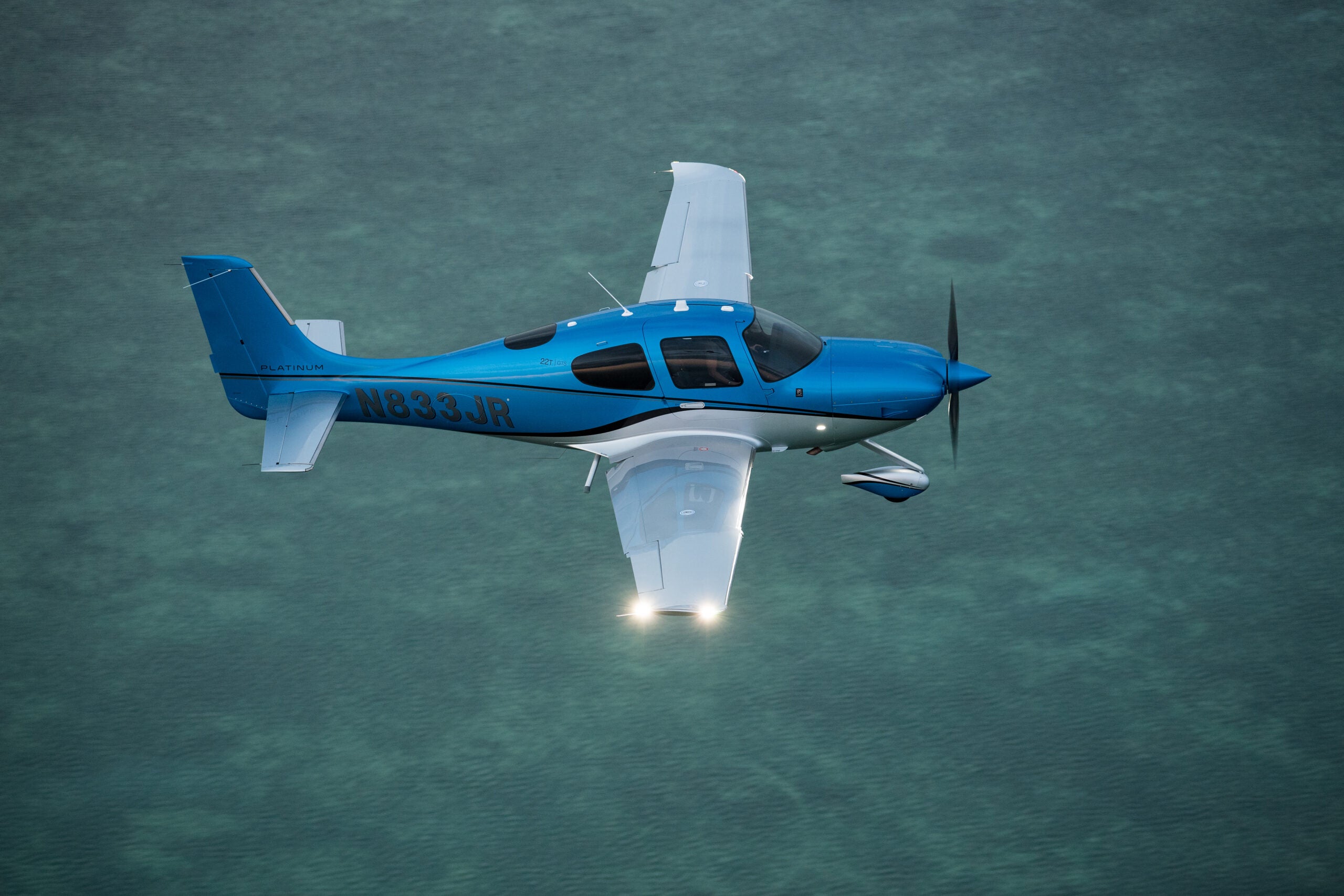
The pilot of a Cirrus SR22 in Serra Azul, Brazil, survived an in-flight fire resulting in a parachute activation Tuesday, according to early media reports. The 29-year-old man was treated for smoke inhalation but suffered no other injuries..
Video of the event shows the engine compartment of the Cirrus in flames and smoke billowing from the aircraft as it descends under the Cirrus Airframe Parachute System (CAPS). The aircraft touched down in a field, and the pilot was able to escape before it was completely consumed by fire.
According to social media, the airplane was on its way from Pampulha-Carlos Drummond de Andrade Airport (SBBH) in Belo Horizonte, to Bom Despacho Airport (SNGQ) when there was an explosion and fire in the engine compartment about 14 minutes into the flight.
The Cirrus SR series was the first mass-produced airplane to include a built-in parachute. The POH notes the “Cirrus Airframe Parachute System should be activated in the event of a life-threatening emergency where CAPS deployment is determined to be safer than continued flight and landing.”
The POH procedure for an engine fire in flight calls for securing the engine and landing as soon as possible. The decision to attempt a glide to a suitable runway or pull the CAPS is at the discretion of the pilot.
Brazilian aviation authorities, the FAA, and the National Transportation Safety Board (NTSB) will be investigating the event.
Meg Godlewski has been an aviation journalist for more than 24 years and a CFI for more than 20 years. If she is not flying or teaching aviation, she is writing about it. Meg is a founding member of the Pilot Proficiency Center at EAA AirVenture and excels at the application of simulation technology to flatten the learning curve. Follow Meg on Twitter @2Lewski.
What skills and knowledge do pilots master to obtain the CFII, and how long does it take? [Credit: Shutterstock]
Question: I just got my CFI ticket, airplane, single-engine land, and I am having trouble finding a job because the flight schools prefer to hire instructors who also have the CFII. How long does it take to get the CFII? What do I have to know?
Answer: Of all the instructor ratings, the CFI-Instrument (CFII) is the easiest to get in part because it is an add-on if you already hold a CFI rating. To be an instrument instructor you need to be able to teach the approaches and have an instructor level of knowledge about the IFR system and weather.
One of the requirements for a CFI is holding an instrument rating. Provided you have kept current and proficient, you should be able to move that knowledge to the right seat in a minimum amount of time. You will have to take a knowledge test, the Flight Instructor Instrument Airplane (FII), and a check ride.
Fun fact: Many flight instructor candidates train for both check rides at the same time. They take the CFI-A first, then a few days later take the CFI-Instrument ride. Please remember this for when you start training instructors.
Ask us anything you’ve ever wanted to know about aviation. Our experts in general aviation, flight training, aircraft, avionics, and more may attempt to answer in a future article. Email your questions here.
Meg Godlewski has been an aviation journalist for more than 24 years and a CFI for more than 20 years. If she is not flying or teaching aviation, she is writing about it. Meg is a founding member of the Pilot Proficiency Center at EAA AirVenture and excels at the application of simulation technology to flatten the learning curve. Follow Meg on Twitter @2Lewski.
Near-midair encounters are not common events, but they are not rare either. [Credit: Adobe Stock]
Near-midair encounters occupy a peculiar place in aviation. They are not common events, but they are not rare either. Ask almost any experienced pilot and you will eventually hear a story about another aircraft appearing suddenly, far closer than anyone would prefer. General aviation operates in a system built largely on shared responsibility.
Unlike tightly controlled airline corridors or military formations, much of the GA environment depends on pilots seeing each other, communicating clearly, and maintaining constant situational awareness. Most of the time the system works extremely well. Occasionally, however, the margins narrow, and those moments can leave a lasting impression on a pilot.
If you're not already a subscriber, what are you waiting for? Subscribe today to get the issue as soon as it is released in either Print or Digital formats.
Imagine a typical training scenario. A student pilot and instructor depart a nontowered airport on a routine night training flight.
The takeoff is normal. Correct radio calls are made on the CTAF frequency. Navigation lights, beacon, and landing lights are on. The airplane climbs out at best-rate speed.
Shortly after liftoff, as the aircraft climbs through roughly 1,400 feet msl, something appears in the pilot’s peripheral vision—red-and-green navigation lights moving across the departure path from the left. The aircraft is extremely close.
The student calls out the traffic and makes an immediate evasive maneuver, pulling slightly up and away. The other aircraft passes beneath and to the right. The entire event lasts only seconds.
Afterward comes a moment familiar to many pilots. Both people in the cockpit realize how little separation there was. The training flight continues, but the encounter stays on their minds.
Later, a review of flight data shows something sobering. The two aircraft’s ground tracks nearly overlapped, and their altitudes differed by roughly 100 feet. It also appears that the other aircraft’s ADS-B transmission began several seconds after takeoff, meaning the electronic traffic display never had time to provide a warning.
For a pilot early in training, that realization can be unsettling. It can also be an important lesson.
Night Flying Changes the Picture
Night flying introduces challenges that pilots must learn to manage carefully. Depth perception decreases dramatically in low light, and the human eye has difficulty judging distance using navigation lights alone. Two aircraft that appear safely separated can suddenly seem much closer as their paths intersect.
Helicopters can also add complexity. Their departure profiles are often different from fixed-wing aircraft. A helicopter may climb steeply, level briefly, or maneuver laterally soon after liftoff depending on its mission and operating procedures. When two aircraft depart the same area at roughly the same time, their flight paths can intersect quickly.
At nontowered airports, the system relies heavily on communication and vigilance. Radio calls on CTAF help build situational awareness, but they do not guarantee that every aircraft will hear or respond.
Technology Helps but Has Limits
Modern cockpit technology has greatly improved situational awareness in general aviation. ADS-B traffic displays, cockpit screens, and tablet applications allow pilots to see nearby aircraft in ways that were impossible only a generation ago.
However, these tools have limitations. Some ADS-B systems take several seconds after start-up before they begin transmitting. If an aircraft has not yet begun broadcasting, there is nothing for other aircraft to receive. Even when systems are working normally, ADS-B information can contain small delays or gaps in coverage.
Tablet applications such as ForeFlight provide helpful traffic alerts, but they are not certified collision-avoidance systems. They function as advisory tools that supplement, rather than replace, the pilot’s responsibilities.
Because of this, the hierarchy of collision avoidance in aviation has remained largely unchanged for decades. The pilot’s eyes come first. Radio awareness adds another layer of protection. Electronic traffic systems follow, and cockpit software provides additional information. Technology can assist the pilot, but it cannot replace the basic discipline of scanning the sky.
When Training Works
In the scenario described earlier, several important things happened exactly as they should. The pilot made proper radio calls and operated the aircraft with the appropriate lights on. The climb was conducted at the correct speed, and traffic was visually detected in time to react. The evasive maneuver occurred immediately, and the flight continued safely.
Those actions reflect the fundamentals of safe flying. Training is designed to build habits that allow a pilot to recognize a threat quickly and respond without hesitation.
Interestingly, the digital data from a flight can sometimes appear more dramatic than the event itself. Ground tracks plotted on a screen can make aircraft look almost superimposed, and altitude reports may contain rounding or small delays. In reality, aircraft climbing or descending can change vertical separation rapidly. Still, a hundred feet of separation is close enough to command respect.
One of the more difficult truths about aviation is that even when pilots do everything correctly, risk still exists. Weather can change. Equipment can malfunction. Other aircraft may appear unexpectedly. The aviation system manages these risks remarkably well, but it cannot eliminate them entirely. That is why vigilance remains a constant requirement in the cockpit. Most experienced pilots eventually experience at least one close call. Sometimes it happens years into a flying career. Occasionally, it happens early in training. When it does, the event becomes a powerful teacher.
Finding the Right Balance
Aviation requires a balance between two qualities that may seem opposite—confidence and respect. Confidence allows pilots to act decisively and continue learning, while respect for risk keeps them disciplined and alert.
Too much confidence without respect can lead to complacency. Too much caution without confidence can create hesitation at the wrong moment. Safe pilots learn to maintain both. Experiences like a near-midair encounter often become the moment when that balance begins to develop.
Flight training is full of milestones—the first solo, the first cross-country, the first night flight. Equally important are the quieter lessons that shape judgment and awareness. A close encounter can reinforce the fundamentals that keep aviation safe—continuous visual scanning, clear communication, and disciplined decision-making. These habits become part of a pilot’s mindset long after the event itself fades into memory.
In the end, the most important outcome is simple. The traffic was seen, a maneuver was made, and both aircraft continued flying safely. That result reflects what aviation training is designed to achieve—awareness, reaction, and safe resolution when margins narrow. Experiences like this remind pilots that flying demands constant attention and respect. They also demonstrate that when training takes hold, it can make the difference when it matters most.
This column first appeared in the July Issue 972 of the FLYING print edition.
John Barry is a retired U.S. Air Force major general who is a decorated combat pilot and 9/11 Pentagon survivor. He serves as chair of the Air Force Historical Foundation and vice chair of the National Aviation Hall of Fame.
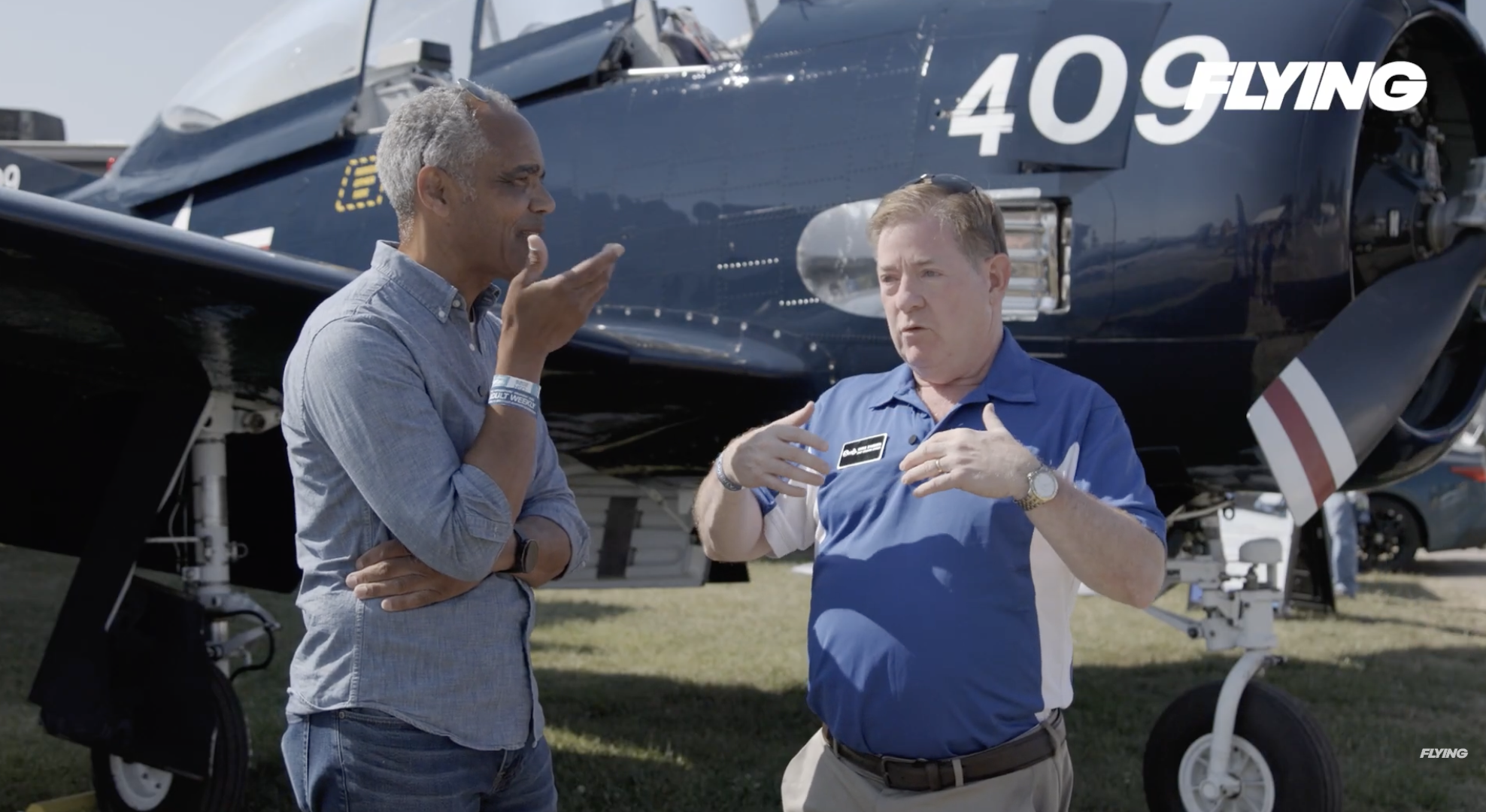
The Aviation Consumer’s Jonathan Welsh (left) talks with Chris D'Acosta, CEO of Swift Fuels, at EAA AirVenture in July. [Credit: FLYING]
Every summer, the ramps and campgrounds of Wittman Regional Airport (KOSH) fill with the same question in a hundred different forms: When will unleaded fuel actually work in my airplane? This year at EAA AirVenture Oshkosh, Swift Fuels arrived with an answer that was bigger than almost anyone expected.
Just days before the show opened, the FAA published an expanded approved model list under Swift’s existing supplemental type certificate for 100R, its 100-octane unleaded avgas. The update added more than 1,200 engine models and 1,600 airframe models. Jonathan Welsh of The Aviation Consumer visited with Swift Fuels CEO Chris D’Acosta at Oshkosh to walk through how the list got so long, so fast, and why he believes the industry is finally within sight of a lead-free ramp.
D’Acosta said that this was a long-awaited update.
“We started commercially selling unleaded fuel back in 2015 with a proprietary version of avgas, which was called UL94,” D’Acosta said. “Our UL94 STC had a rather large expanse of lower octane TCDS approved engines and aircraft, and we utilized that tranche as the starting point for our Phase I deployment of our 100-octane fuel, which is called 100R.”
That Phase I approach has paid off. Swift now counts 1,200 FAA-approved engines and 1,600 airframes under its 100R STC, using what’s known as an approved model list (AML), a mechanism that allows an FAA approval to cover broad categories of aircraft. This first tranche of various FAA approved engines and aircraft types are monitored by Swift Fuels and records show these aircraft collectively consume an estimated 56 percent of the 100LL typically consumed each year by certificated aircraft in the U.S. piston fleet.
Welsh, who flies a Rockwell Commander with a Lycoming IO-540, admitted he had already found his own airplane on the list. But he also flagged something plenty of owners are running into—the search isn’t always intuitive.
D’Acosta said that the system relies on a wide variety of documentation and data formats, but that Swift Fuels is working to help the FAA.
“Now we’re being asked to put things into a standard form in the DRS system of the FAA, which results in a transposition of some of the data,” he said.
Compounding the confusion, decades of corporate mergers mean an owner’s airplane may be filed in the Swift Fuels AML under a name that no longer appears on the type certificate.
“The classic example is something like, ‘I’m looking for my Cessna, but it’s in the DRS under Textron,’” D’Acosta said.
Swift’s fix is a purpose-built search tool that lets pilots type in their engine model, airframe, or even an old or informal manufacturer name. An AI-assisted search sorts out the rest.
Behind the announcement sits a certification process D’Acosta describes as a three-legged stool inside the FAA’s traditional certification branch—engineering, production, and flight safety, all of which have to align before a certificate is issued. Because Swift isn’t an airframe or engine manufacturer, its path runs through a supplemental type certificate (STC) rather than an original type certificate, layered on top of the underlying products it doesn’t build itself.
“The time-consuming part is getting all those parties involved, participating in an agreement and alignment before it’s issued,” D’Acosta said.
The paperwork doesn’t stop at the AML, however. Swift is also a PMA-authorized parts manufacturer, which means the fuel placards used on customer aircraft need their own sign-off. Every customer who has ever purchased a Swift STC, going back to the earliest UL94 buyers years ago, will now receive an updated packet at no additional charge. D’Acosta calls this a “Forever Avgas STC.”
The new packet includes both a fuel placard and a small metal engine tag that an A&P installs under the cowling. Pilots who haven’t yet bought an STC will still need to purchase one before they can legally burn 100R.
The certificate requirement applies specifically to certificated aircraft, not the roughly 35,000 to 40,000 experimental, light sport, or special category airplanes that fall outside that framework. Of the 225,000 piston aircraft on the U.S. registry, D’Acosta puts about 180,000 in the certificated category that will need an STC.
Many pilots grew up on 100LL but might not understand the significance of this transition. According to D’Acosta, who remembers when lead came out of automotive gasoline in the 1990s, it’s more of a chemistry problem than a mechanical one.
“Lead is a tool used in a piston engine to suppress the tendency of an engine to detonate,” said D’Acosta, describing how compressed fuel-air mixtures in the cylinder want to explode prematurely under heat and pressure. “Lead was found to be a high-octane contributor to gasoline to suppress detonation, so the combustion event will wait for the spark to fire. The trouble is [that] lead is also toxic, and it has byproducts like fouling.”
Those deposits from lead, according to D’Acosta, foul spark plugs, blow by into the oil, and contribute to the acidity that corrodes engines over time.
Swift’s answer is a proprietary additive package dosed at 250 parts per million that prevents valve seat recession, resists intake coking, and includes antioxidants to keep the fuel and engine internals clean. That formulation, along with the base fuel itself, is patented, and it underpins the production specification Swift earned through ASTM International. That consensus standards process is the result of a collaborative effort among oil companies, engine makers, and airframe manufacturers.
“We’ve earned an ASTM International production specification,” D’Acosta said. “That’s a big deal. It took a long time and a lot of extraordinary work with our fuel and aerospace industry collaborators across the globe.”
With the current tranche of engines and airframes approved, Swift’s attention is already shifting to the higher-compression “550 series” engines, including the 540s, 520s, and 390s that power much of the high-performance piston fleet. D’Acosta recently bought a Cirrus SR22T, powered by a turbocharged TSIO-550-K, specifically to generate flight data supporting the certification push, alongside dedicated endurance testing at an underground test cell at Purdue University and upcoming work with Continental Motors in Mobile, Alabama.
The AirVenture flight line itself became something of a proving ground. A visiting 9-cylinder radial warbird, powered by a Wright R-1820, had flown from its home base in Iowa to Swift’s Indiana headquarters, refueled there, and continued on to Oshkosh. After the show it was headed back to Indiana, where D’Acosta said it would run on Swift fuel exclusively for the following three to four weeks.
Elsewhere on the Warbirds grounds, Cory Miller from Strix Aero set up an Allison V-12 engine test cell operating exclusively on Swift 100R fuel. A California owner Jose Flores has been testing a Rolls-Royce Merlin V-12 engine on 100R.
In parallel, Swift has joined testing programs at the FAA’s William J. Hughes Technical Center in Atlantic City, New Jersey, which runs its own engine evaluations under a separate approval process that, unlike an STC, doesn’t result in a certificate but still requires a significant degree of FAA oversight.
D’Acosta credits a long list of FAA personnel—from Administrator Bryan Bedford and Deputy Administrator Chris Rocheleau down through the Central Certification Branch, the FAA Tech Center and FAA’s fuels research branch—for staying engaged through what has been a multiyear, multioffice process.
“We’ve had bumps in the road, from government shutdowns, staff turnover, unexpected delays, etcetera,” D’Acosta said. “That’s just normal. Happens all the time. But they’ve committed themselves to talk to us, listen to us, and adjust things where they can.”
For Welsh and thousands of owners now checking Swift’s list for their own tail numbers, the moment carried a personal note.
“I’m looking forward to being able to pull up to the fuel farm and not have my kids asking me, ‘Does that stuff still have lead in it?’” Welsh said.
Based on the pace of approvals rolling out of Indiana this summer, that day looks considerably closer than it did a year ago.
Matt Herr develops sponsored content for clients at Firecrown Media. He is a gearhead and motoring enthusiast with experience in tech, freight and manufacturing. He spends his free time hiking with his wife, son and German shepherds, or reading and writing hobby pieces.
SpaceX’s Version 3 (V3) Starship launches on its debut suborbital test flight in May. [Credit: SpaceX]
SpaceX has signaled that it will one day phase out its workhorse Falcon 9 launch vehicle for the company’s much larger Starship rocket, a move that carries major implications for other users of the National Airspace System (NAS).
SpaceX CEO Elon Musk wrote Sunday on social media that once Starship—the largest rocket ever built—is “flying reliably several times per week,” it “makes sense” to allocate resources to the gargantuan spacecraft. That, Musk said, would mean “winding down Falcon [9].”
A source also told Ars Technica last week that the U.S. government plans to end commercial Falcon 9 launches after 2028 and use the vehicle only for a limited number of contracted missions.
Starship is likely still a few years away from reaching Musk’s desired cadence. That will hinge on both Starship and its Super Heavy booster achieving full reusability, enabling quick turnarounds between missions.
But if or when Starship replaces Falcon 9, the larger rocket will carry with it larger restrictions on the NAS.
Bigger Rocket, Bigger Restrictions
Launch operators such as SpaceX coordinate with the FAA to establish aircraft hazard areas (AHAs), which are disseminated via Notices to Airmen (NOTAMs) at least 24 hours before a launch either as a temporary flight restriction (TFR) or stationary altitude reservation. The AHAs are calculated based on a spacecraft’s trajectory and debris dispersion data.
That means larger or less proven spacecraft such as Starship often receive larger AHAs. The latest Version 3 (V3) Starship and its Super Heavy booster stand more than 400 feet tall, designed to deliver 100 metric tons of payload to low-Earth orbit (LEO). For comparison, Falcon 9 is about 230 feet tall and maxes out at about 25 metric tons.
In addition, while Falcon 9 has launched hundreds of times with just a handful of commercial failures, Starship has suffered anomalies on about half of its 13 suborbital test flights.
AHAs vary by mission. In 2020, NASA required a 40 nm TFR for Falcon 9’s Demo 2 mission, the first test flight of SpaceX’s Crew Dragon spacecraft. TFRs for launches at Cape Canaveral Space Force Station in Florida, a key Falcon 9 launch site, typically span 30-40 nm.
But they can be far larger. The AHA for Starship’s ninth test flight in 2025 covered a whopping 1,600 nm, nearly double that of the previous mission. The FAA warned the restrictions could delay more than 175 flights by an average of 40 minutes.
Future Starship AHAs could restrict even more airspace. In February, the FAA published an environmental clearance report regarding SpaceX’s request for new Starship launch trajectories from its Starbase launch pad in Texas.
The new routes would allow Starship to advance from suborbital to orbital flights by flying over portions of Florida. But they would also necessitate new AHAs. The FAA estimated that AHAs for Starship launches over Florida could impact as many as 8,800 commercial aircraft operations annually. Those covering Starship return trajectories over Texas, New Mexico, Arizona, and California could impact up to 4,400 operations annually. Each could require dozens of airway closures over the Atlantic Ocean.
SpaceX is building additional Starship launchpads and aims to expand operations beyond Texas to Florida’s Space Coast.
In an October letter to the FAA, Steve Jangelis, aviation safety chair for the Air Line Pilots Association (ALPA), criticized the FAA’s analysis of the new trajectories’ impact on the NAS. Jangelis wrote that the agency “continues to ignore fundamental airspace safety and operational issues.”
Caution Advised
The FAA also activates debris response areas (DRAs) in order to safely clear airspace below a rocket’s trajectory after an anomaly occurs. Starship Flight 8’s DRA, activated after the rocket exploded, delayed 171 departures and diverted 28 flights, placing another 40 in holding patterns.
However, ALPA contends that these mechanisms are ineffective. Jangelis in October estimated that out of four Starship test flights that required DRAs, the agency activated only one of them within a required 6-minute, 30-second time frame.
That may have been because the FAA lacked information. The Wall Street Journal in December reported that SpaceX waited to alert the agency after Starship exploded in January 2025, with some air traffic controllers learning of the incident from pilots who witnessed it.
Either way, the FAA has warned pilots to use “additional situational awareness” when flying through AHAs. In a January safety alert for operators (SAFO), the agency advised pilots to identify alternate landing sites in the case of a diversion and stock enough fuel to get them through a prolonged DRA. The SAFO warned that spacecraft have potential for “catastrophic failures resulting in debris fields.”
The rate of Starship anomalies is likely to decrease as SpaceX rapidly iterates the design. The company is known for accepting early failures as a tradeoff of future success. Falcon 9, for example, conducted 26 launches in 2020 but flew a record 165 missions in 2025, dwarfing competitors and accounting for the majority of FAA-licensed space activities. Falcon 9 anomalies are incredibly rare.
Starship, meanwhile, completed just five suborbital test flights in 2025 and has flown two so far in 2026.
SpaceX won’t be able to ramp up Starship’s cadence until it begins reusing the rocket and minimizing anomalies. But even if its record improves, pilots would face broader airspace restrictions and the potential for more severe consequences if something does go wrong.
Jack is a staff writer covering advanced air mobility, including everything from drones to unmanned aircraft systems to space travel—and a whole lot more. He spent close to two years reporting on drone delivery for FreightWaves, covering the biggest news and developments in the space and connecting with industry executives and experts. Jack is also a basketball aficionado, a frequent traveler and a lover of all things logistics.
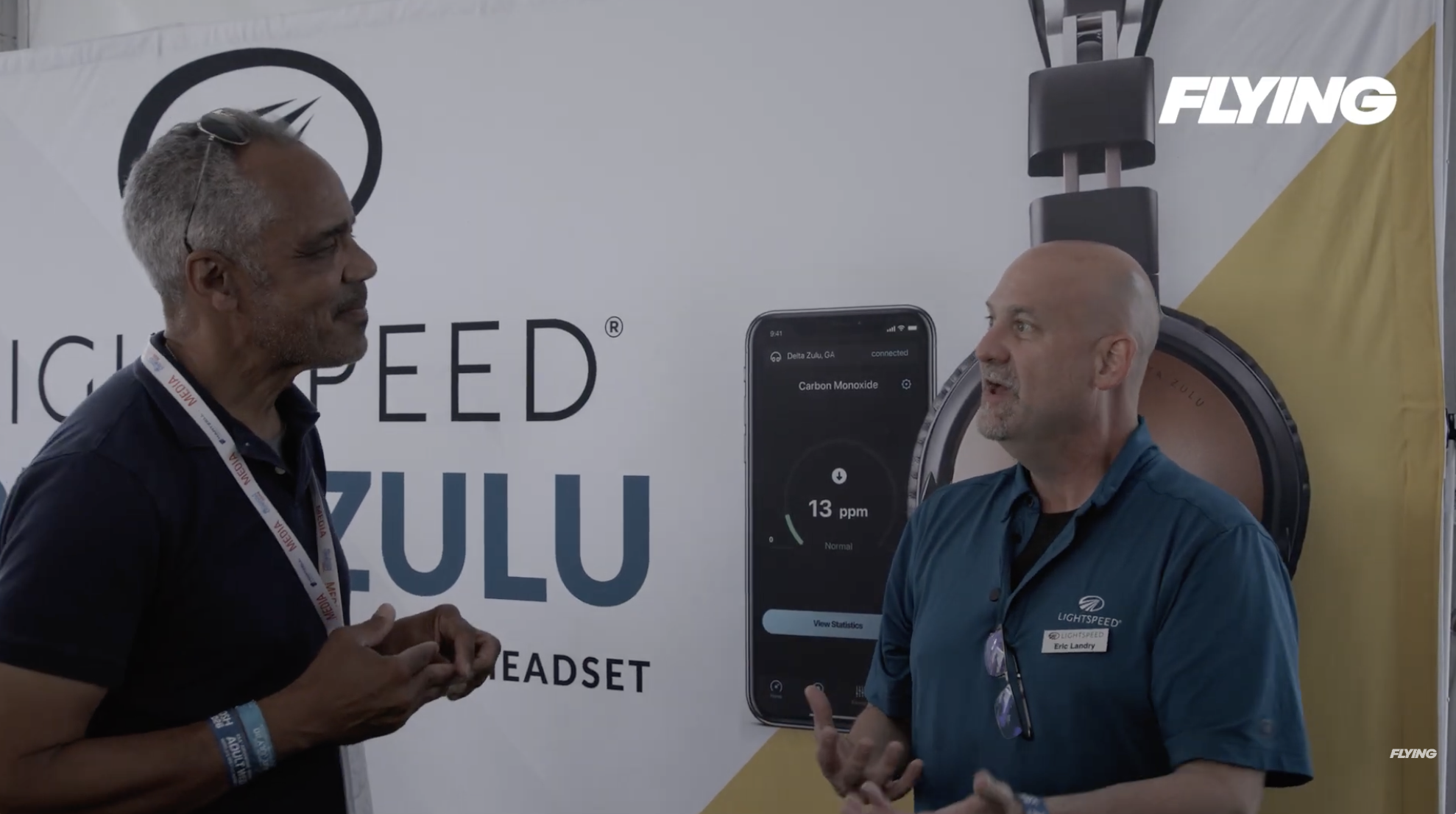
The Aviation Consumer’s Jonathan Welsh (left) talks with Eric Landry, head of marketing for Lightspeed Aviation, at EAA AirVenture in July. [Credit: FLYING]
Every July, Wittman Regional Airport (KOSH) becomes the one place on Earth where a pilot can compare notes on carbon monoxide alarms, Bluetooth pairing, and ear-seal foam density all in the same five-minute conversation. EAA AirVenture Oshkosh 2026 is a great opportunity for pros around the industry to get together and see what’s new.
This year, Jonathan Welsh from The Aviation Consumer had the opportunity to catch up with Eric Landry, head of marketing for Lightspeed Aviation and dive deep into the latest safety features, engineering upgrades, and community initiatives driving the premium ANR headset market.
Landry walked through a week’s worth of news, including a new engine-specific ANR setting built in collaboration with Rotax, a headset that just picked up a FLYING Editors’ Choice Award, and a customer volunteer program that raised quite a stir on the AirVenture grounds.
The headline news arrived just before the show opened.
“We’re really excited to talk about the new Rotax ANR and audio profile,” Landry said. “We just announced it last week.”
Lightspeed built the new audio file specifically for the Lightspeed Delta Zulu. The idea traces back to a simple observation about how different engines sound in the cockpit.
“We’ve been working with Rotax for about a year to develop an ANR and audio profile that will counter their distinct sound,” Landry said. “Every engine has a distinct sound. Rotax was the first partner we wanted to work with.”
What makes the announcement more than a one-time product drop is the platform behind it. The Lightspeed Delta Zulu, Lightspeed’s flagship ANR headset since 2022, is built on digital architecture so the company can update the ANR firmware after the sale. That means new capability can arrive to headsets already flying.
“Right now, it’s [the Rotax-specific ANR setting] available through their Rotax Care program, but the benefit of that digital platform of the Lightspeed Delta Zulu is that in the fall, we’ll push out a firmware update,” Landry said. “All Lightspeed Delta Zulu owners since we launched it in 2022 will be able to have access to this Rotax ANR and audio profile.”
Pilots with Rotax 912 iS/c, 915 iS/c, or 916 iS engines will be able to switch between the new profile and Lightspeed’s Signature ANR profile using the Lightspeed App.
The rollout illustrates something the company has tried to make part of its identity since the Lightspeed Delta Zulu launched.
“We made a promise when we launched it that you can always expect more from Lightspeed, and this is just another proof point that we’re delivering more for no charge,” Landry said. “It’s part of your investment with a premium ANR headset.”
That philosophy is also what drove the Lightspeed Delta Zulu’s built-in carbon monoxide detection with an audible cockpit alert. Welsh could speak to the feature’s effectiveness personally, recounting a flight in a friend’s Cessna 170 wearing his wife’s Lightspeed Delta Zulu when the headset began delivering warnings before the airplane had even left the ramp. The cause turned out to be a real exhaust leak.
That kind of story is exactly the scenario the feature was designed around.
“When we were developing the Lightspeed Delta Zulu, we gave a lot of thought to what kinds of problems we could solve.” Landry said. “One of the major problems was the risk of carbon monoxide in aviation, which was relatively unknown. As a headset company, what can we deliver? Audible alerts. If you’re losing some cognitive ability, those audible alerts in your ear are game changing.”
Pilots can set their own cautionary and critical thresholds, but the point, according to Landry, is having extra redundancy in a cockpit that’s already full of noise.
“If there’s a lot going on in an emergency, you’re going to have a lot of beeps and lights going off,” he said. “This is another layer on top [of the existing warning systems in the airplane].”
The panel-mounted detectors and lights already in many aircraft should be effective on their own, but the headset alert simply adds a redundant, harder-to-miss cue. Landry summarized years of unsolicited feedback from owners: “We’ve had pilots tell us for years now, ‘Your headset saved my life.’”
While the Lightspeed Delta Zulu is Lightspeed’s flagship now, it was the Zulu 3 that set the standard years before. The Zulu 3 debuted in 2017 and remains in production, and it’s still winning industry recognition despite being almost a decade old.
But sustained customer feedback pointed toward specific, mechanical wants, including a longer microphone boom, a longer and more flexible upper cable, and more comfort. Lightspeed answered with the Zulu 4, introduced at Oshkosh in 2025.
According to Landry, however, the Zulu 4 did not simply replace the older model.
“The Zulu 3 and the Zulu 4 exist as brothers,” he said.
The Zulu 4’s redesigned FrameFit™ ear seals use dual-density foam to better accommodate eyeglasses, sunglasses, and hats without pinching and to spread pressure away from the temples and nose bridge while preserving the ANR seal. The headset also added dual Bluetooth connectivity so pilots can toggle between two paired devices in flight rather than stopping to re-pair.
“We’ve had pilots come back and tell us that ATC have told them [the Zulu 4] is the clearest headset they’ve ever heard,” Landry said. “That’s another layer of safety.”
The Zulu 4 has since been recognized with an Editors’ Choice Award, which Landry was proud to accept at an Oshkosh awards dinner the night before the interview in late July.
None of the new features, according to Landry, have ever been changed for its own sake.
“Everything we do is built around safety,” Landry said. “Comfort is to reduce fatigue. We add these features because the most important thing is keeping pilots safe while they’re flying.”
Landry credits the company’s Oshkosh presence directly for that feedback loop.
“This is like research and development for us every Oshkosh, because we can have around 10,000 customer touchpoints in a week, and we’re all taking our notes and bringing them back to engineering,” he said. “That’s how we develop our roadmap for what’s next.”
Some of that direct customer contact happens by design, through the Vortex Generator team, made of longtime Lightspeed owners who volunteer to staff the booth at Oshkosh and Sun ’n Fun.
“These are customers who for years have used Lightspeed and have reached out to us and said, ‘What can I do to spread the word about Lightspeed?’” Landry said.
In exchange for housing and accommodations during the show, the volunteers wear T-shirts reading “Ask me, I’m a pilot” and spend the week trading first-hand headset stories with fellow aviators.
“It’s very one-on-one, personal contact from people who are using this product every day,” Landry said. “We’re employees. We’re in the office working. We’re not flying every day. Whereas these volunteers are flying, and pilots love to talk about their experiences.”
That arrangement has become self-sustaining.
“We’re very fortunate that someone asks, ‘Can I come again next year?’” he said.
The Zulu 3’s longevity has also made it the vehicle for Lightspeed’s philanthropic arm. Since partnering with EAA’s Ray Aviation Scholarship program in 2019, the company has donated Zulu 3 headsets to scholarship recipients as they hit training milestones. Landry estimates that Lightspeed has given away roughly 600 headsets to date.
“This is our brand giving back and helping grow the aviation community through the Zulu 3s,” he said.
Landry traced that instinct back to company founder Allan Schrader, who established Lightspeed in 1996 and remains active in shaping the company’s direction.
“[Schrader’s] vision was always to help grow the GA community,” Landry said.
That mission runs through Lightspeed’s EAA Young Eagles involvement as well.
“We’re carrying that torch that Allan started with the EAA,” Landry said. “Businesses have to give back. [EAA AirVenture] is not an industry. It’s just this passionate place.”
Matt Herr develops sponsored content for clients at Firecrown Media. He is a gearhead and motoring enthusiast with experience in tech, freight and manufacturing. He spends his free time hiking with his wife, son and German shepherds, or reading and writing hobby pieces.
According to Embraer, the Phenom 300EV is the first light jet and largest business jet certified with Garmin Emergency Autoland. [Credit: Embraer]
Embraer on Tuesday said its Phenom 300EV, billed as an “evolution” of the best-selling light jet series, received triple certification from the FAA, European Union Aviation Safety Agency (EASA), and Brazil’s Agência Nacional de Aviação Civil (ANAC).
The manufacturer said the milestone—achieved just over one month after it announced the model—cements the 300EV as the first light jet and largest business jet certified with Garmin Emergency Autoland. Embraer reiterated the 2028 target for its first 300EV deliveries that it gave in July.
Beyond Autoland, Embraer added several new safety features and performance and interior enhancements not present on earlier Phenom 300 models.
Embraer earlier this year obtained the same triple certification for its Praetor 500E and 600E in the super-midsize category.
“The Phenom 300EV builds on the legendary capabilities of the world’s best-selling light jet, now enhanced through purposeful innovations that further elevate safety technology, best-in-class performance characteristics, and the customer experience,” Michael Amalfitano, president and CEO of Embraer Executive Jets, said in the announcement.
Phenom’s Evolution
Embraer bills the Phenom 300EV as the world’s fastest and farthest-flying light jet. Its projected range of 2,055 nm with four passengers and NBAA IFR reserves—an improvement on the Phenom 300E’s 2,010 nm—would open routes such as Aspen, Colorado, to New York, or London to Athens, Greece.
Business Jet Traveller puts the Bombardier Learjet 36A’s range with NBAA IFR reserves and all passenger seats occupied at 2,425 nm, though that model has not been produced for decades.
The 300EV retains the 300E’s top speed of Mach 0.80 (533 knots) and high-speed cruise at 464 knots, as well as its maximum cabin altitude of 6,600 feet. It also adds about 430 pounds of payload capacity.
Garmin Emergency Autoland will allow the 300EV to complete a fully automated landing in the event of pilot incapacitation. It can be activated manually with the push of a button or automatically if the system detects prolonged pilot inactivity. Autoland takes full control of the aircraft, selects a suitable airfield for landings, and transmits automated messages to air traffic control (ATC). Once the aircraft is on the ground, it shuts down the engines.
Emergency Autoland saw its first real-world test in late 2025. The pilot of a Beechcraft King Air B200 reported a cabin pressurization issue to air traffic control (ATC) shortly after takeoff, and the Autoland system activated on its own after the aircraft’s cabin altitude exceeded safe levels, according to its operator. The FAA said the aircraft landed safely, and the operator said it returned to service the following day.
Autoland is installed on more than 1,000 aircraft, including models such as the Cirrus SF50 Vision Jet and SR Series, Daher TBM 940, and Piper M600/SLS.
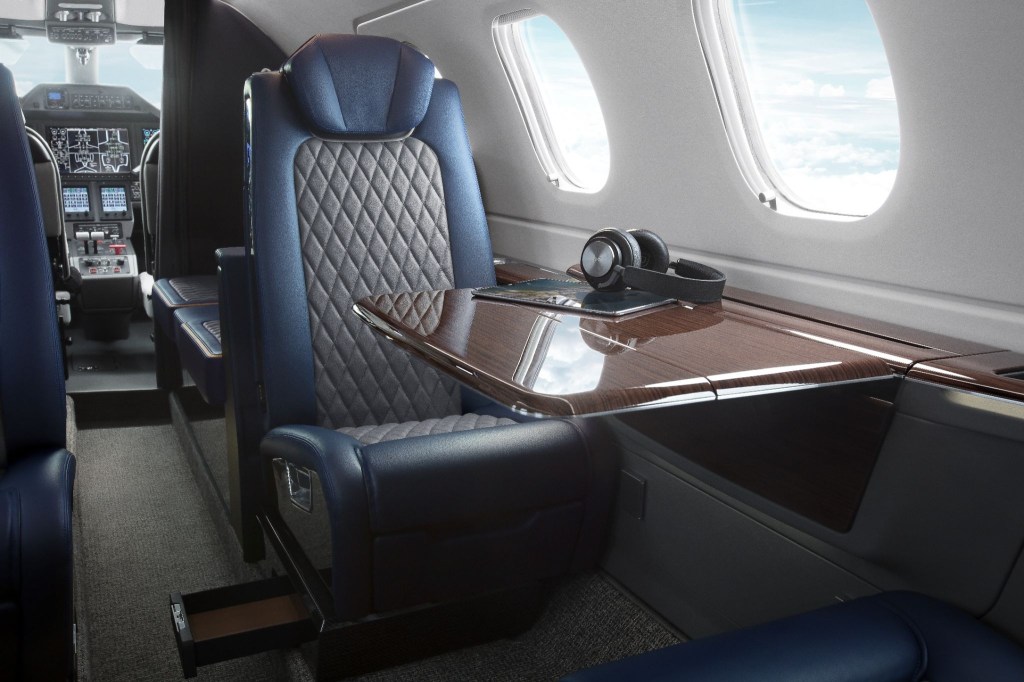
A look at the Phenom 300EV’s cockpit, which is equipped with Emergency Autoland and Garmin’s G3000 Prodigy Touch. [Credit: Embraer]
The Phenom 300EV will also include autobrake for takeoff and landing. A new system developed by Embraer manages these electronically controlled functions, which also include a rudder-by-wire system designed to reduce pilot workload.
Other safety features include emergency descent mode, autothrottle (announced for the Phenom 300E in 2023), and Embraer’s Runway Overrun Awareness and Alerting System (ROAAS), which debuted on the 300E in 2020.
The model’s Garmin G3000 Prodigy Touch flight deck will add 3D taxiway routing, runway-occupancy alerts, synthetic-vision guidance, FANS 1/A+, RNP AR 0.3 capability, and an inertial reference system. Combined with new lithium-ion batteries and LED taxi and landing light, these features are designed to improve runway and situational awareness.
The passenger cabin is line-fit with Gogo Galileo satellite Wi-Fi connectivity, and operators can use supplemental type certification (STC) to equip it with SpaceX Starlink. Other upgrades include an odorless vacuum lavatory, improved temperature control, air ionization system, and redesigned refreshment center.
Phenom 300EV passengers will be able to take advantage of a line-fit Gogo Galileo satellite connectivity system. [Credit: Embraer]
Once it hits the market, the 300EV will likely have a few next-generation competitors.
All three of Textron Aviation’s Gen3 Cessna Citation light jets—the CJ3, CJ4, and M2—are in flight testing. Textron is targeting CJ4 Gen3 certification this year, with CJ3 Gen3 and M2 Gen3 certification following in 2027. The Echelon, which manufacturer HondaJet bills as the first light jet with transcontinental range, could join them in 2028.
Per FLYING’s 2026 general aviation market survey, Textron in 2025 increased CJ4 Gen2 deliveries to 30 and CJ3+ deliveries to 31. Embraer in 2025 sold 66 Phenom 300Es.
Jack is a staff writer covering advanced air mobility, including everything from drones to unmanned aircraft systems to space travel—and a whole lot more. He spent close to two years reporting on drone delivery for FreightWaves, covering the biggest news and developments in the space and connecting with industry executives and experts. Jack is also a basketball aficionado, a frequent traveler and a lover of all things logistics.
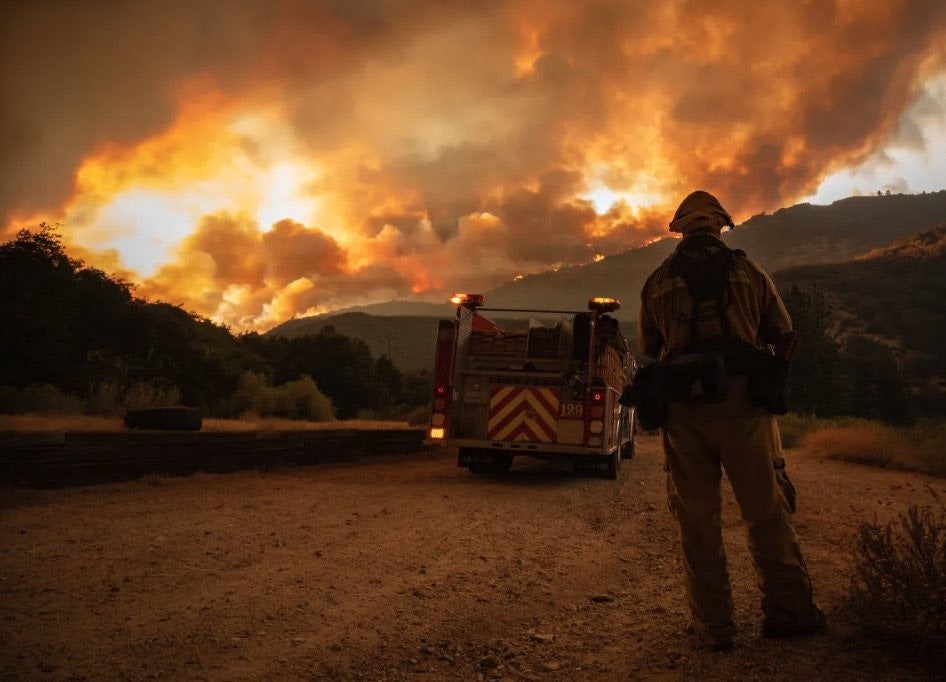
GA pilots can play a vital role in supporting air traffic controllers by reporting fires and assisting in search operations. [Credit: Los Angeles County Fire Department]
Have you ever been flying and had the control tower or ATC ask if you see a fire or oil slick, ask you to check for an ELT signal in a certain area, or ask if you have seen a downed aircraft? When those types of questions are asked, someone is having—or is about to have—a very bad day.
It definitely gets your attention.
If you get a request like this and you have the ability to comply, please do so. The controller may even ask you to orbit over the area until they can get rescue crews to the site. I have had the opportunity to do this a few times. If I am with a learner, I remind them, “This is why we learn to do turns around a point.”
There are many reasons why ATC will ask for your help.
I was flying with a learner southwest of Tacoma Narrows Airport (KTIW) in Washington state using flight following when ATC asked us to help them track down reports of an ELT in the vicinity. They had received two reports of it but had not been able to confirm. The area is primarily over water, and we were also asked to look for an oil slick or fuel sheen just in case the aircraft had gone down in the drink.
The learner’s eyes were huge as he nodded his head—of course, we would do this. I relayed this to the controller, who then gave us the approximate area. We monitored 121.5 as we flew an east-west grid search pattern using techniques learned years ago from a search and rescue pilot.
The learner’s concentration was great as he held heading and altitude while I searched the ground below. We did not see anything and reported this to ATC. We never learned if there was a lost aircraft or an accidental activation of the ELT.
Fire Season and the Pilot
This time of year in western Washington ATC has a standing request for pilots to report fires observed from the air. When reported, controllers relay the information to local fire authorities, who then dispatch personnel.
A firefighter in Pierce County,Washington, who happened to be in a private pilot ground school I taught, told the class that if we see smoke, let ATC know, saying, “Don’t assume someone else already did it.” He cautioned that they would rather get multiple calls than have the fire grow.
My first fire from the air hit very close to home, as in within a mile of the runway beneath the 45 to downwind. I was flying with a private pilot candidate and we were at an altitude of 1,000 feet agl, so I had a great view of what appeared to be two teenagers on dirt bikes in the undeveloped area.
I made a comment about hoping they had spark arresters on their exhaust systems because the area was filled with dry vegetation and dirt trails. I had seen such a fire before—when I was a kid, a motorcycle was blamed for a fire in the hills behind my home.
A few minutes later, just after takeoff with another client, I saw a column of smoke rising from the southeast corner of the airport where the bikers had been riding. As soon as we reached an appropriate altitude I contacted ATC to report the fire. ATC took the report, and we headed out to the practice area.
An hour later as we were on our way back in, we saw the fire had grown dramatically. The south end of the runway was obscured with smoke, and we could see flames taller than the trees on the southeast side of the airport.
“How are we going to make left traffic?” the learner asked, since the fire was burning under the 45.
“We’re not,” I replied. “We don’t fly over fires.”
A quick check with ATC verified there was no temporary flight restriction (TFR) over the airport. We did right traffic and landed on the first third of the runway. A few minutes later a TFR was dropped and all flights were canceled for the rest of the day as helicopters with “Bambi Buckets” attacked the blaze.
Fortunately the fire was extinguished before it could reach the homes or airport. We were darn lucky.
As I write this column I am getting updates from friends who live in Reno, Nevada, where several fires have forced wide-scale evacuations. The Hawk Fire, located south of Reno-Stead Airport (KRTS), has prompted the evacuation of some 90,000 people thus far.
According to authorities, the fire was reported just before noon PDT Saturday near the Hawk Meadow Trail, west of the city. A NOTAM indicates the airport is closed except for firefighting and military operations.
The National Guard has launched air support to help fight the fire, which has zero percent containment as of Monday afternoon.
Tips for Flying During Fire Season
Should you see smoke from the air, don’t be afraid to report it to ATC. You may be the one who sounds the alarm before significant damage is done.
When using an app like Garmin Pilot or ForeFlight, refresh the map frequently in the event a TFR pops up during your flight.
If your airport is in a fire-prone area—for example, surrounded by dry grass and trees—always have an alternate destination in mind.
Smoke is just as blinding as clouds and a lot worse to fly into because the heat can flip you upside down. Stay away.
Meg Godlewski has been an aviation journalist for more than 24 years and a CFI for more than 20 years. If she is not flying or teaching aviation, she is writing about it. Meg is a founding member of the Pilot Proficiency Center at EAA AirVenture and excels at the application of simulation technology to flatten the learning curve. Follow Meg on Twitter @2Lewski.
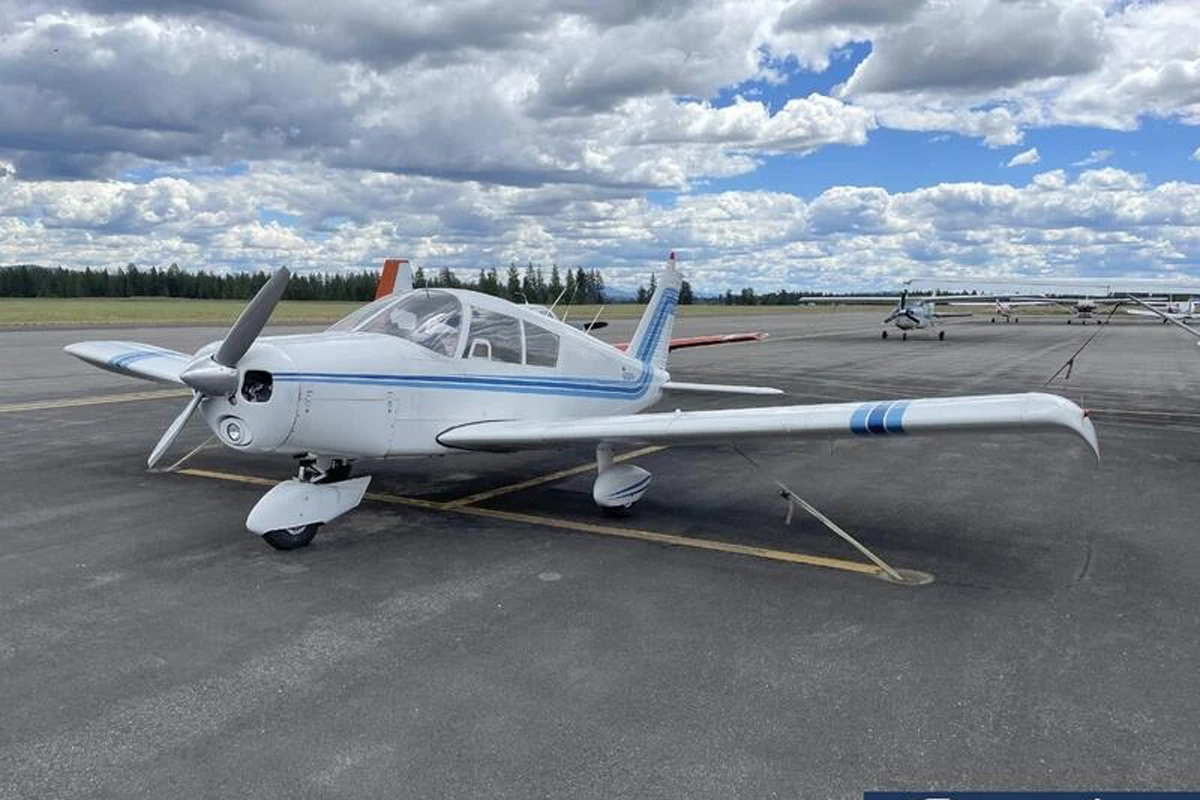
The PA-28-140 model specifically built a reputation as a steadfast platform for flight schools and private owners alike, offering stable handling characteristics and straightforward maintenance that make it an enduring favorite for both time builders and weekend flyers. Long celebrated as an approachable and forgiving aircraft, the Piper Cherokee series has introduced countless pilots to the skies.
This 1964 airframe comes to the market with 3,175 total hours logged since it rolled off the factory floor. The four-seat aircraft is active and being flown, with its next annual inspection due in January 2027. Enhancing its aerodynamic profile, the wings have been fitted with droop tips, while the cabin provides a highly practical useful load of 913 pounds.
Providing the power up front is a proven Lycoming O-320-E2A engine, which shows 1,121 hours since major overhaul. The well-maintained powerplant is reported to have good compression and is paired with a fixed-pitch Sensenich 74D-0-60 propeller that has logged 1,147 hours since its last major overhaul, delivering dependable performance for training maneuvers or cross-country flights.
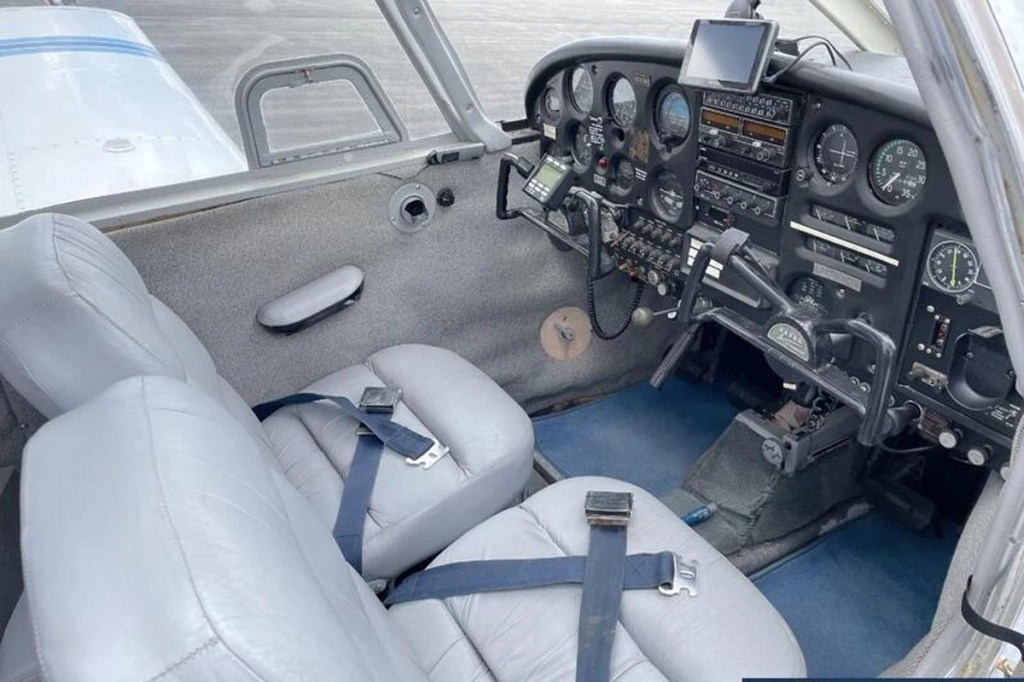
Equipped for practical VFR and basic IFR proficiency, the panel features a King KMA 24 audio selector alongside a King KX 155 nav/comm and Garmin SL 40 COM.
Additional instruments include a King KT 76A transponder and King ADF, providing an adequate and functional setup for the pilot. The interior and exterior offer a clean, usable environment well suited for cross-country trips with small families.
Listed at $59,500, this 1964 Piper PA-28-140 Cherokee Cruiser stands out as a highly logical choice for anyone seeking a time-tested trainer or an economical entry into personal aircraft ownership.
If you’re exploring ownership options, FLYING Finance can help get you airborne. Use our airplane loan calculator to estimate your monthly payments, or connect with an aviation finance expert at flyingfinance.com.
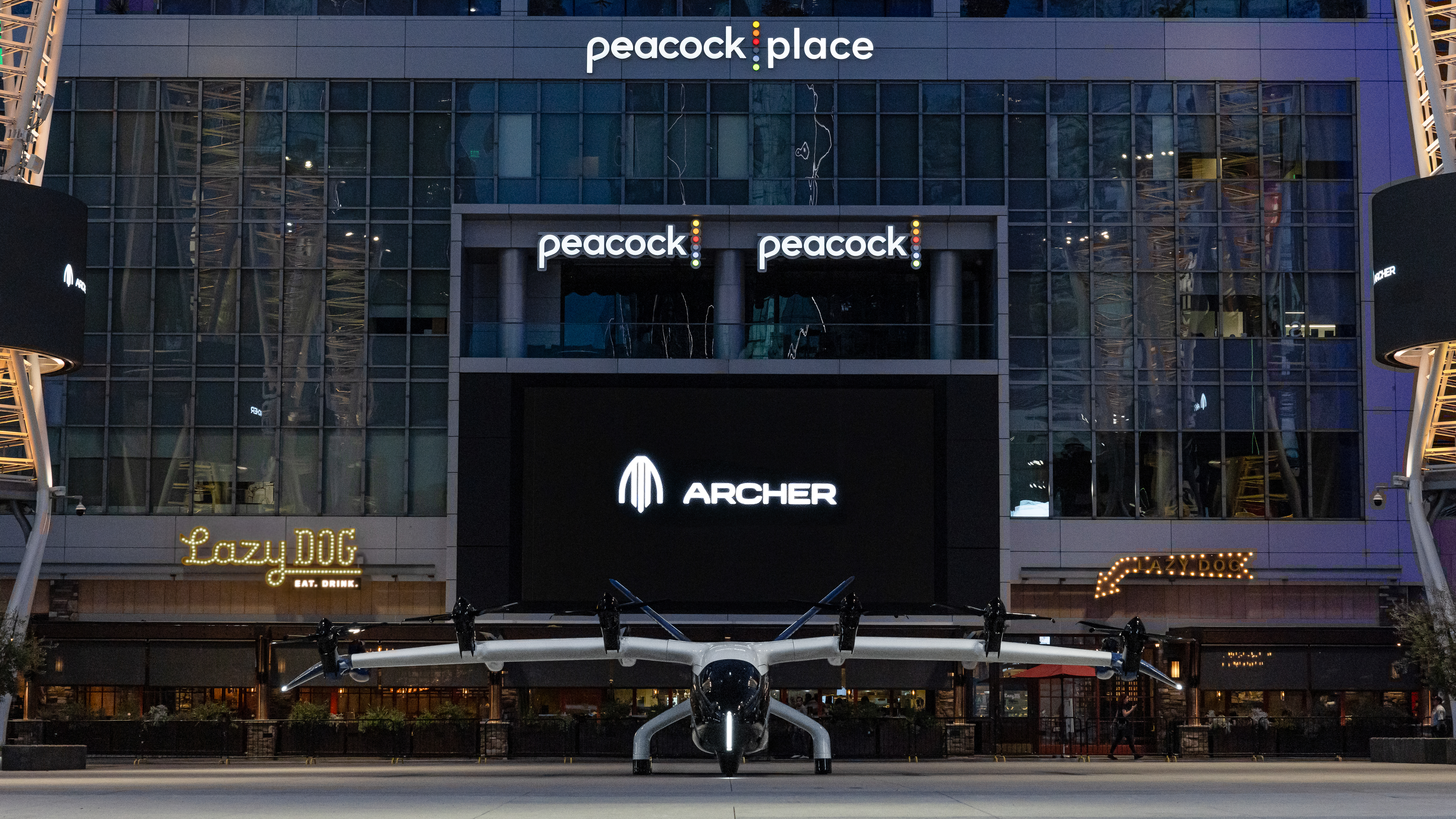
Archer’s Midnight electric air taxi, featuring a Team USA livery, on display in downtown Los Angeles, where the company hopes to fly passengers during the 2028 Olympic Games. [Credit: Archer Aviation]
Electric air taxi manufacturer Archer Aviation’s plans to ferry spectators and athletes across the 2028 Olympic Games in Los Angeles are beginning to take shape.
Archer this week revealed it partnered with entertainment company AEG to build what the manufacturer said is the first vertiport announced for downtown LA. Vertiports, which are being developed nationwide, are expected to resemble heliports with additional amenities for electric aircraft such as Archer’s Midnight, including chargers. They could be located either on- or off-airport.
Midnight, an eVTOL (electric vertical takeoff and landing) model, is designed to maintain the runway independence of rotorcraft while producing less noise and emissions. Archer envisions the air taxi replacing hour-plus drives with more direct, 10-to-20-minute trips by air. Midnight is intended for a pilot to fly up to four passengers on short, urban hops, cruising on fixed wings at a top speed of 150 mph and charging for about 10 minutes between flights.
“We see this as a one-of-a-kind opportunity to add a flagship downtown location to our planned Los Angeles air taxi network ahead of the LA28 Games,” said Adam Goldstein, founder and CEO of Archer, in remarks accompanying the announcement.
LA28, the committee organizing the 2028 Games, last year picked Archer as the official air taxi provider for the event and for Team USA. The company on Monday brought a Team USA-branded Midnight to downtown’s L.A. Live entertainment district, where it will be on public display through Tuesday.
L.A. Live, AEG’s 4 million-square-foot live entertainment center, is the planned site for the vertiport. Archer would serve as the exclusive provider of air taxi service to and from L.A. Live and said the project will turn the site into a “showcase for urban air mobility innovation”—even before the Games begin.
Powering the site will be electric aircraft chargers developed by Beta Technologies. Archer and Beta this year formed America’s Consortium for Electric Skyways (ACES) to build a Tesla-like network of 250 air taxi operating sites by 2030.
L.A. Live is adjacent to AEG-owned Crypto.com Arena, home to the NBA’s Los Angeles Lakers. Similarly, Archer in 2024 said it was in discussions with the NFL’s Los Angeles Rams on potentially exclusive vertiports near SoFi Stadium in Inglewood, a planned Olympic venue. Both locations could allow the company to provide spectators access to marquee events.
Archer described the AEG collaboration as an exclusive, multi-year partnership.
“This is an ambitious project and exactly the kind of forward-thinking collaboration that blends infrastructure and technology in service of our fans, visitors, and the broader community,” said Nick Baker, president and CEO of AEG Global Partnerships, which brokered the agreement.
Archer’s Olympic-Sized Plans
Archer is concurrently developing air taxi networks around cities such as New York, Chicago, and the San Francisco Bay Area in partnership with United Airlines and Southwest Airlines. But it has big plans for Los Angeles, both during and after the Olympics.
In 2025, Goldstein told FLYING that Archer aims to offer on-demand air taxi service for the Games. A news release announcing its selection as the official air taxi provider notes that Midnight could also be used for security and emergency response. It further hinted that the air taxi could feature in opening and closing ceremonies.
“We’re especially focused on winning Los Angeles, because if we can prove electric air taxis work in one of the world’s most congested, complex, and highly regulated cities, I believe we can subsequently scale the product across the U.S. and the world,” Goldstein said on Archer’s third-quarter 2025 earnings call.
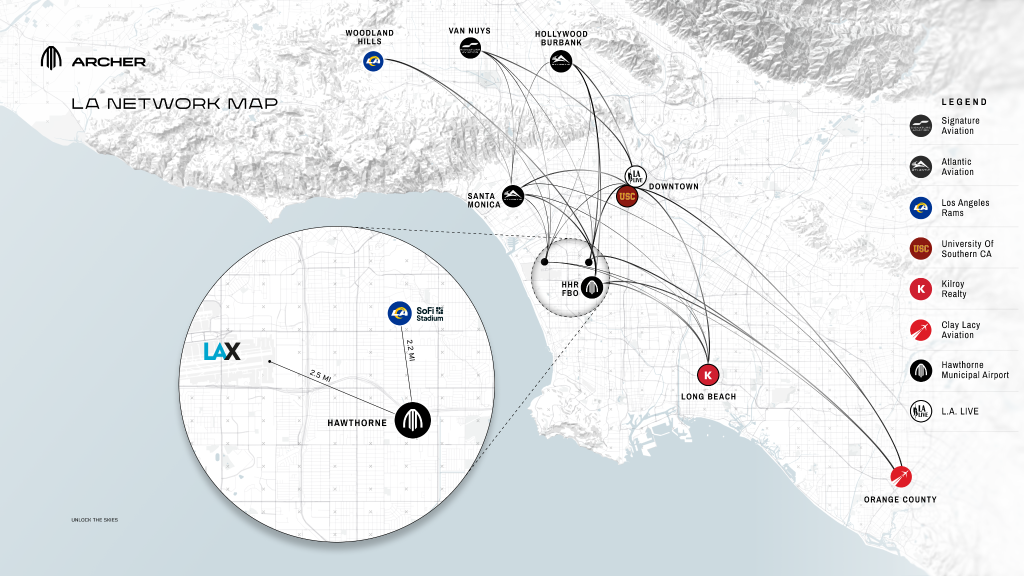
In addition to L.A. Live, Archer previously said Midnight would operate out of Los Angeles International Airport (KLAX), Orange County (KSNA), Santa Monica (KSMO), Hollywood Burbank (KBUR), Long Beach (KLGB), and Van Nuys (KVNY). Other planned nodes include SoFi Stadium, Los Angeles Memorial Coliseum, and the University of Southern California.
Archer with its announcement Monday shared an updated map of its planned Los Angeles air taxi network. [Credit: Archer Aviation]
In November, Archer announced plans to acquire Hawthorne Municipal Airport’s (KHHR) 30-year lease for $126 million. It said Hawthorne will be the LA network’s “operational hub.” Goldstein said on X that the firm views Hawthorne as “LA’s Grand Central Station for air taxis” and the “first purpose-built eVTOL hub at the center of a world-class aviation corridor,” as well as a hub for maintenance and storage.
Archer said it and AEG completed an “initial feasibility study” for the L.A. Live site, including land-use and airspace reviews as well as power availability and community impact. It said they are now reviewing the service’s operational approach and guest experience.
Still, there is no guarantee that Midnight flies passengers during the Games.
At the 2024 Paris Olympic Games, German eVTOL manufacturer Volocopter bowed to pressure from local officials, cancelling planned passenger flights and instead conducting demonstrations. In 2025, LA County Public Works, which operates five area airports, told FLYING it had no firm plans with Archer for Olympic services, adding that it was working to set up a meeting.
Archer continues to operate as though on-demand Olympic flights will happen. Earlier this month, it completed Midnight’s first piloted, city-to-city flight between Salinas and Monterrey, California. However, those airports lack the urban surroundings of L.A. Live, and Midnight operated conventionally using a runway rather than in VTOL mode.
Like Volocopter’s VoloCity, Midnight is not yet commercially certified. But Archer will look to accelerate its type certification program through the FAA’s eVTOL Integration Pilot Program (eIPP), for which it was part of three successful bids. The eIPP projects, each led by a state or local agency, will span three years and see precertified aircraft—including Midnight—fly into airports nationwide. By the end of the eIPP, operators hope to fly passengers for revenue.
Archer and its competitors have seen their certification timelines slip over the years. It will need to complete that process—and stand up vertiports outside L.A. Live—to bring its envisioned Olympic network to fruition.
Jack is a staff writer covering advanced air mobility, including everything from drones to unmanned aircraft systems to space travel—and a whole lot more. He spent close to two years reporting on drone delivery for FreightWaves, covering the biggest news and developments in the space and connecting with industry executives and experts. Jack is also a basketball aficionado, a frequent traveler and a lover of all things logistics.
Sign-up for newsletters & special offers!
Get the latest stories & special offers delivered directly to your inbox.