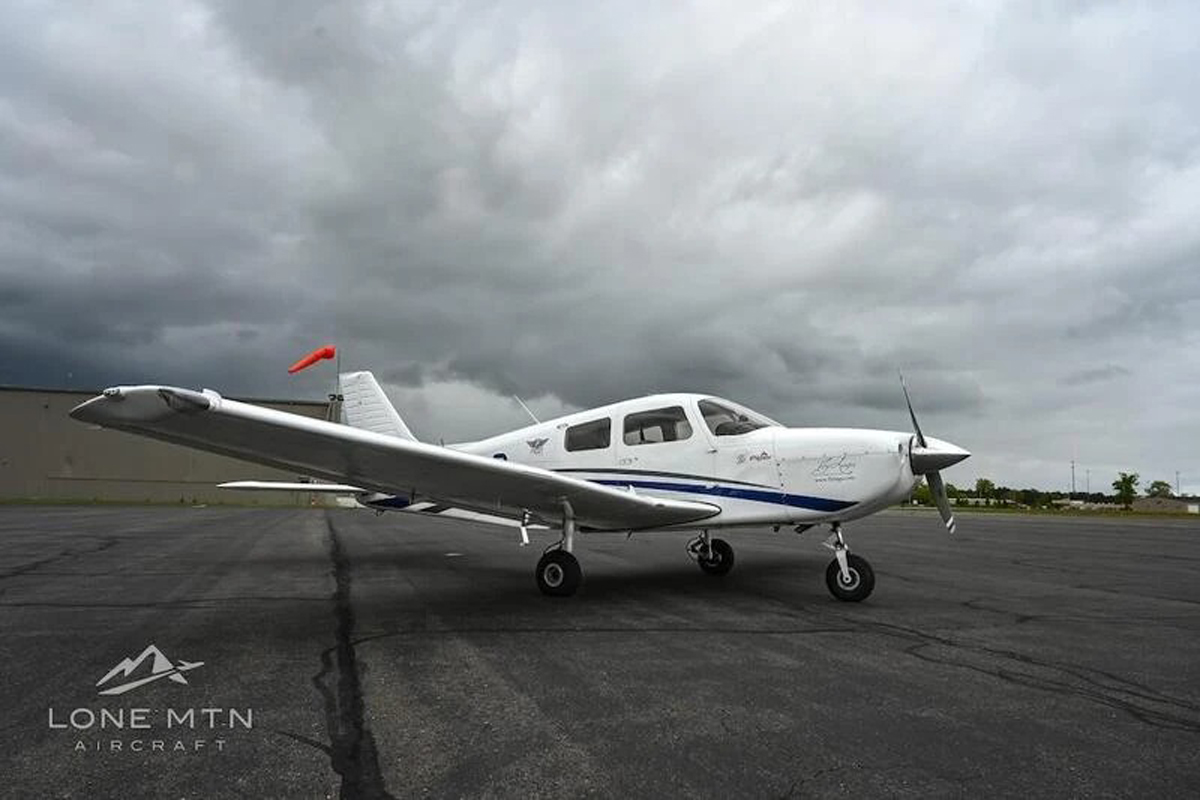
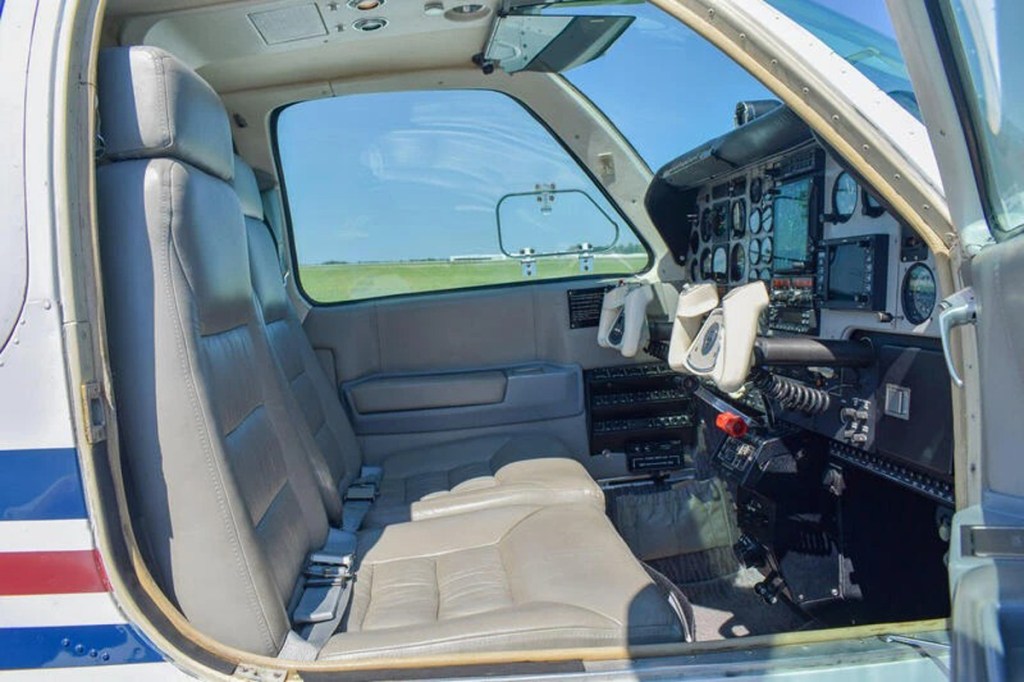
Designed specifically to meet the rigorous demands of flight training while maintaining exceptional efficiency, the Piper Pilot 100i continues the celebrated PA-28 legacy. It brings a new level of technological sophistication to the single-engine piston trainer market, serving as an ideal platform for both flight schools and individual owner-operators seeking a capable, predictable aircraft.
Based in Massachusetts, this 2021 airframe has amassed 1,650 total hours since new while actively serving in a flight school environment. The exterior sports a crisp all-over white base with striking blue-and-gray-accent striping, while the cabin is appointed with light gray leather seats, two-tone gray side paneling, and dark gray carpeting. The aircraft offers 48 gallons of usable fuel, a highly practical useful load of 976 pounds, and added conveniences like Rosen sun visors, USB charging ports, and LED wingtip lights.
Forward of the firewall sits a reliable 180 hp Lycoming IO-360-B4A engine that has recorded 1,650 hours since new. This fuel-injected powerplant comes equipped with a Tanis engine preheat system for cold weather operations. It spins a robust Sensenich two-blade, fixed-pitch propeller that also shows 1,650 total hours since new, ensuring dependable thrust for practice maneuvers and cross-country legs alike.
2021 Piper PA-28-181 Piper Pilot 100i [Credit: Lone Mountain Aircraft]
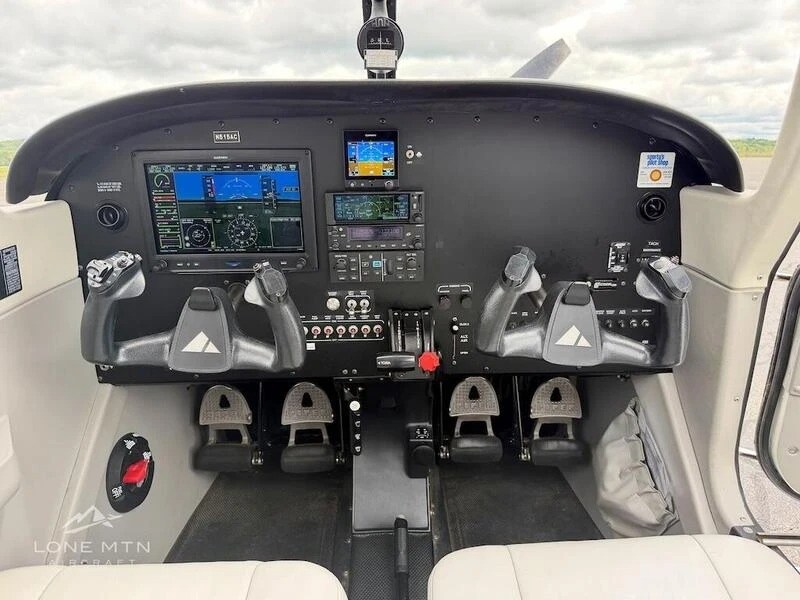
In the cockpit, student pilots and seasoned aviators alike will appreciate the highly advanced, glass-panel suite centered around a Garmin G3X Touch 10.6-inch PFD/MFD with synthetic vision.
The modern panel is fully equipped for IFR instruction and travel, boasting a Garmin G5 standby instrument, GNX 375 touchscreen navigator/transponder with ADS-B In/Out, and Garmin GFC 500 autopilot with Electronic Stability and Protection (ESP). Rounding out the impressive avionics package are a GNC 255A nav/comm, a GTR 20 second VHF comm, and Bluetooth-enabled GMA 245R remote audio panel.
Listed at $335,000, this 2021 Piper Pilot 100i underwent its last annual inspection in February 2026, making it a turnkey solution ready to build time or generate revenue on the flight line.
If you’re exploring ownership options, FLYING Finance can help get you airborne. Use our airplane loan calculator to estimate your monthly payments, or connect with an aviation finance expert at flyingfinance.com.
Treasury narrows the scope of aircraft ownership entities required to report beneficial ownership information. [Credit: Adobe Stock]
A new rule finalized this month by the U.S. Treasury Department’s Financial Crimes Enforcement Network (FinCEN) grants relief to domestic aircraft LLCs that were previously required to report beneficial ownership information to the federal government.
The rule, which took effect August 14, “clarifies and slightly narrows the scope of companies required to report beneficial ownership information” under the 2021 Corporate Transparency Act (CTA), the National Business Aviation Association (NBAA) said August 25.
Initially proposed by FinCEN in 2025, the rule permanently removes reporting requirements for U.S. companies and individuals. U.S.-formed LLCs, corporations, and other domestic aircraft ownership entities no longer need to share information about their beneficial owners’ names, dates of birth, addresses, or other “ultimate beneficial-owner information,” NBAA said.
FinCEN will also remove from its database any previously reported beneficial ownership information relating to U.S. individuals.
The rule further exempts foreign pooled investment vehicles registered in the U.S. from reporting information on U.S. persons in control of the investment vehicle. Foreign LLCs and other entities are still required to report, but they need only share information on foreign beneficial owners and not Americans who helped them register to do business in the U.S.
The 2021 CTA was designed to combat domestic and international financial crimes such as money laundering by analyzing financial data. Groups such as NBAA raised privacy concerns regarding the potential exposure of beneficial owners’ personal information.
Entities commonly establish LLCs to create leases that allow aircraft to be shared between companies, as well as for other business and tax reasons.
In March, the NBAA praised the repeal of a Washington state measure implemented in 2025, which would have levied a 10 percent tax on the purchase of new and existing aircraft valued at more than $500,000. It was replaced by a 7-cent-per-gallon increase to the state’s aviation fuel tax as well as a “moderate increase” to aircraft registration fees.
The association is also advocating for restrictions on the distribution of aircraft registry data.
Jack is a staff writer covering advanced air mobility, including everything from drones to unmanned aircraft systems to space travel—and a whole lot more. He spent close to two years reporting on drone delivery for FreightWaves, covering the biggest news and developments in the space and connecting with industry executives and experts. Jack is also a basketball aficionado, a frequent traveler and a lover of all things logistics.
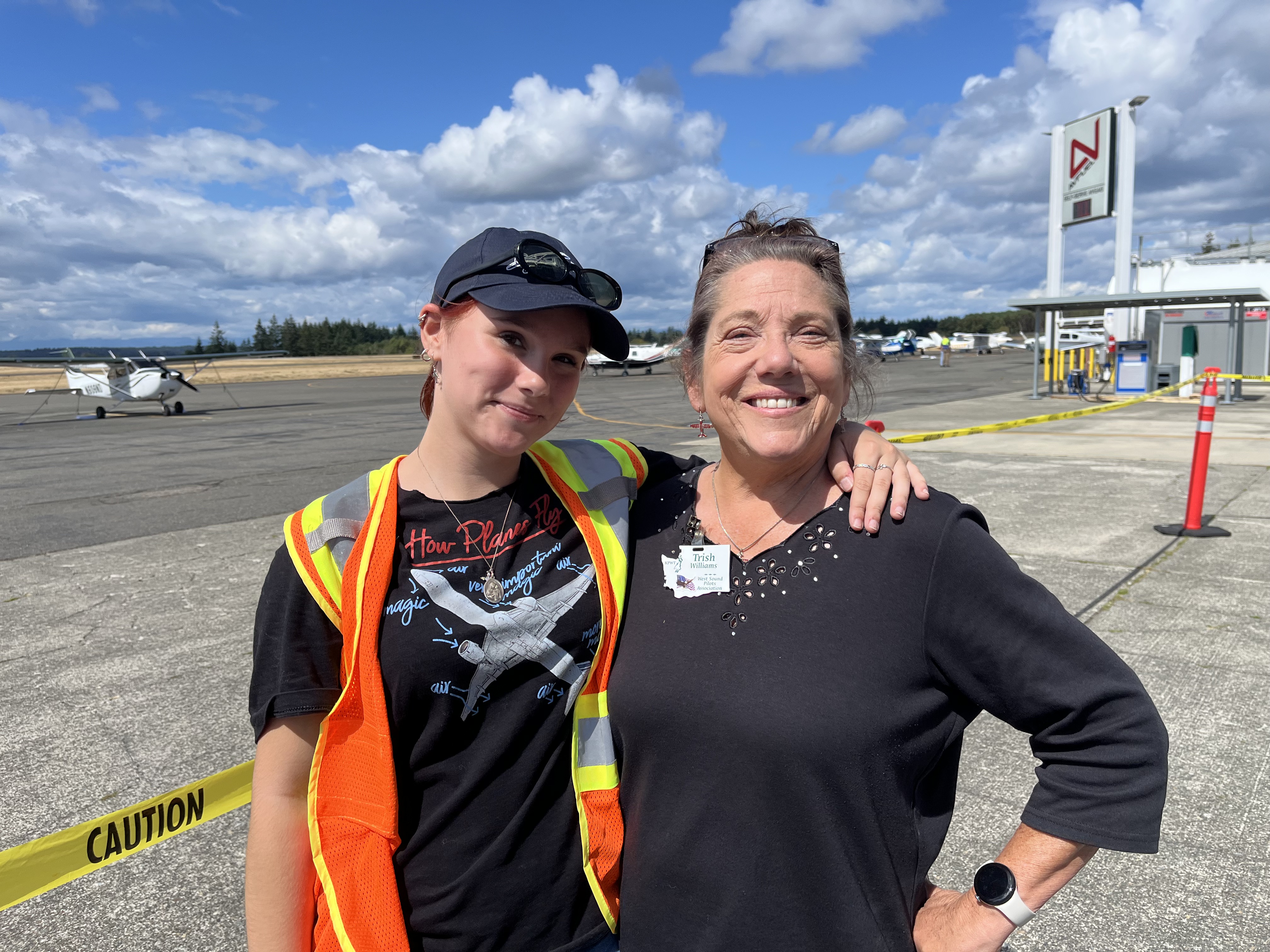
Trish WIlliams (right) poses with Violet Weir, a senior in high school who has been building airplanes with EAA Chapter 406 for several years. Weire has earned several scholarships and is pursuing her pilot certificate. [Credit: Meg Godlewski]
Do you remember the first time someone took you to the airport and you had a chance to get up close with a small airplane? I do.
I was 4 years old. It was a J-3 Cub owned by a man my father worked with. There was a celebration at the airport, and owners were allowing kids to get into the cockpits of their airplanes. The memory of that day surfaces for me every time I see a Piper Cub on display at an airport, such as the 1946 model on display at Tacoma Narrows Airport (KTIW) over the weekend as part of its annual Airport Day.
Airport Days are not necessarily an airshow but more of an open house. They are usually free or low cost and put on by the airport sponsor and public agencies such as law enforcement.
Pierce County is the airport sponsor of KTIW in Gig Harbor, Washington, so county agencies had display booths and the sheriff had its airplanes on the ramp. The county fire department gave away kiddie-sized plastic fireman hats. There were information booths from aviation businesses, including schools, charter operators, and airlines.
A few had age-appropriate games. The Plinko game at the Alaska Airlines booth earned a fair amount of attention from the younger visitors as did the putting game next door. Many pilots will tell you there is a link between golf and aviation, as both take a lot of time and money to master.
Pavco Flight Center, the mom-and-pop FBO where I did most of my early training, was handing out cookies and coffee and answering questions about pilot careers.
The ramp was filled with families, many with small children who walked up to the apron to look at vintage aircraft and cars. There’s something about painstakingly restored and well-cared machines on display that makes for family fun, and you can’t deny the link between cars and aircraft—someone with skill has to maintain them. That hobby in the garage or hangar could turn into a career with the right guidance.
The owners of the cars and aircraft stood by to answer questions about their machines.
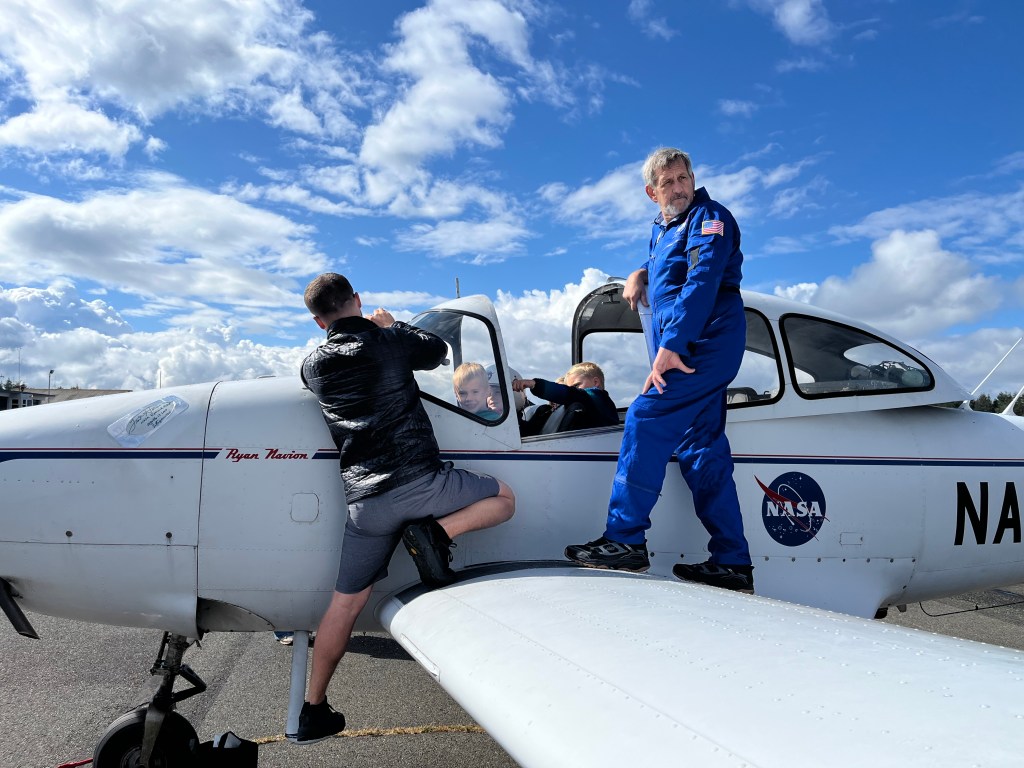
Stephen Baldwin, owner of a 1948 North American Ryan Navion L-17B, scored big points when he allowed children to climb into the cockpit. The Navion was used for reconnaissance and liaison missions after World War II then in the 1950s was turned over to the National Advisory Committee for Aeronautics, which later became NASA.
The airplane was used by NASA for research and zero-gravity tests in preparation for the Apollo space program. Astronaut Fred Haise, who would go on to be the Lunar Module pilot on the Apollo 13 mission, flew it as a civilian research pilot for the agency.
Navion pilot Stephen Baldwin shows off his airplane to kids at Tacoma Narrows’ Airport Day. [Credit: Meg Godlewski]
The Gig Harbor Vintage Aero Museum, which has both aircraft and ground vehicles, opened its hangars and had several of its aircraft on the ramp for display. What makes it different from many other aviation museums in the country is that the majority of the aircraft are airworthy and have modern equipment skillfully hidden so they can be more safely flown in today’s airspace.
Among the classic birds pulled onto the ramp for display included a 1947 Aeronca L-16A and the ultra-rare 1930 Stearman 6L Cloudboy, wearing the livery of an Army trainer.
One of the museum hangars was dedicated to the display of homebuilt aircraft. Here and there on the ramp people talked about what they were building, what they wanted to build, or programs they were part of that helped teenagers learn to construct aircraft.
A 1930s Ford with a canoe tied to the roof received a fair amount of attention as well. On the windshield there were stickers from many national parks. Keep in mind, when this car was being mass-produced, getting across the country was much more adventurous than it is now since the interstate highway system as we know it was still decades away.
Young Eagles
One of the best parts of Airport Day is often Young Eagles flights.
The program, created in 1992 by the Experimental Aircraft Association (EAA), provides short rides in airplanes for children ages 8-17. According to the EAA, over 2.5 million youths have flown, with the 2.5 millionth milestone reached on July 22 during EAA AirVenture Oshkosh.
I am willing to bet that many of you reading this got your first taste of aviation through a Young Eagles flight, or you were the pilot during one.
The pilots who provide the flights are EAA members and volunteers. They are required to complete EAA’s Youth Protection Training and undergo a background check in addition to meeting currency requirements. Each pilot must carry personal liability insurance of at least $100,000 per seat.
Kids play Plinko at the Alaska Airlines booth at Tacoma Narrows’ Airport Day in Washington state. [Credit: Meg Godlewski]
The ground team is also volunteers, as the Gig Harbor event was coordinated by Trish Williams from EAA Chapter 406. Williams, who has years of experience organizing Young Eagles events, was recognized by the EAA at July’s AirVenture for her exceptional hard work.
Volunteers are nominated by their peers to be recognized for their efforts, and Williams definitely deserves the honor, as everyone I spoke with about Young Eagles told me I absolutely needed to talk to her. They are very proud of the fact she was recognized by the EAA for her outstanding commitment to their chapter.
“[For the past four years] Williams has facilitated over 1,000 Young Eagle flights, organizing three major rallies at her chapter each year in addition to numerous individual flights outside of the rallies.” the EAA said in a statement.
Volunteer pilots are pulled in from five local chapters, and according to George Steed, an accomplished pilot and technical counselor for EAA Chapter 406, Williams’ events run like clockwork.
“She schedules the different kids in waves so we don’t have 200 kids standing around waiting for something to do,” Steed said. “She’s got them scheduled in. She negotiated a [good] fuel price, so all the pilots are glad to come. We get a buck off a gallon on the gas, so …we feel good about that. She’s got plenty of ground troops marshaling. She’s got plenty of people working the table.”
Steed added that Williams also takes care of the pilots, making sure they are fed and taking a break every so often.
“…Pilots, because this is a mission, we’ll just run flight after flight after flight,” he said. “But you [need to] have somebody to point at you and say, ‘All right…time for you to take a half hour. Go sit down.’”
When asked for tips on how to run a smooth Young Eagles event, Williams didn’t waiver on what must be done first.
“Preparation, preparation, preparation is always No. 1,” she said. “I’m blessed to have such great volunteers because they have passion for aviation the way I do… Just keeping everybody happy, letting them know we just want to get kids in the air and just to keep it simple, and make sure that the paperwork’s done right, the I’s are dotted, the T’s are crossed, so that we don’t lose our insurance, so we can keep doing this. Safety is always the No. 1 thing. We all love aviation. We love to have fun, and we want to show kids how to be safe aviators.”
To pilots and future pilots: If you have the opportunity to be a Young Eagles pilot, take it. There’s something incredibly fulfilling about sharing aviation with the next generation.
The rewards can be surprising. When asked what the best part of the day was for him, Steed didn’t hesitate.
“When the quiet 9-year-old that hadn’t said a word the whole flight shook my hand and shyly said, ‘That was the coolest thing I’ve ever done,’” he said.
To student pilots: Once you get your pilot certificate, you can be on the other side of the Young Eagles equation. Don’t miss the chance to inspire a future aviator as you were inspired.
Meg Godlewski has been an aviation journalist for more than 24 years and a CFI for more than 20 years. If she is not flying or teaching aviation, she is writing about it. Meg is a founding member of the Pilot Proficiency Center at EAA AirVenture and excels at the application of simulation technology to flatten the learning curve. Follow Meg on Twitter @2Lewski.
President Donald Trump disembarks Air Force One at Donald J. Trump International Airport (KDJT) in Florida. [Credit: Official White House Photo/Joyce N. Boghosian]
The North American Aerospace Defense Command (NORAD) scrambled F-16 fighter jets to intercept five “general aviation aircraft” that it said violated a temporary flight restriction (TFR) in Houston while President Donald Trump was in town.
NORAD said the fighters on Friday morning safely escorted the aircraft out of the restricted area. Trump visited Houston Thursday and Friday to attend a reception and award medals to NASA’s Artemis II astronauts, who earlier this year flew around the moon and traveled farther from Earth than any human.
The FAA issues Notices to Airmen (NOTAMs) to alert pilots to TFRs ahead of any presidential or vice presidential travel. The restrictions surround Air Force One—the call sign for whatever aircraft is carrying the president—like a giant bubble.
According to a NOTAM issued Wednesday, the Houston TFR covered airspace below 18,000 feet and had rings of 30 nm and 10 nm, typical of presidential TFRs. The restrictions took effect Thursday at 4:30 p.m. CDT and expired Friday at 2 p.m. The more restrictive inner ring was limited to approved law enforcement and air ambulance flights, military aircraft supporting the U.S. Secret Service or Office of the President, and certain regularly scheduled commercial passenger and all-cargo flights.
The Houston Chroniclereported that the TFR affected operations at Ellington (KEFD), Houston Hobby (KHOU), and La Porte Municipal (T41) airports.
NORAD in a statement reminded pilots to check NOTAMs for TFRs before they fly. It advised GA pilots who are intercepted to switch to radio frequency 121.5 or 243.0, turn around or reverse course, and await further instructions.
“Multiple recent TFR violations in Texas is a clear signal that we must address this together and drive that number down immediately,” said Major-General David Moar of the Royal Canadian Air Force, director of NORAD operations. “Safety is paramount, and it starts before the wheels ever leave the ground: thoroughly planning to include reading and understanding active NOTAMs is not just a checklist item, it is essential to keeping everyone in the sky safe.”
TFR Violations on the Rise
According to NORAD’s website, entering restricted airspace and failing to communicate with air traffic control (ATC) is the top reason it intercepts GA aircraft.
The procedure typically sees two fighters approach the violating aircraft from the stern and rock their wings to indicate an intercept is taking place. The GA pilot is expected to rock their wings back to confirm they received the command. At night, fighters will flash their navigation lights to signal an interception. GA pilots can respond with various signals to indicate whether or not they can comply or tell the fighter they are preparing to land.
A slow turn by the fighters signals that the aircraft should fly in that general direction, while an abrupt turn tells them to turn immediately. The jets may also dispense flares to get the pilot’s attention. To indicate a landing site, the fighters during daytime will circle an airport or at night will turn on their landing lights. GA aircraft can flash their landing lights to signal that a suggested landing spot is inadequate.
Throughout the procedure, GA pilots are expected to maintain altitude, airspeed, and heading unless directed otherwise.
Violating a TFR can trigger warnings, civil penalties, criminal fines up to $100,000, one year in federal prison, or suspension or revocation of pilot certification. The penalty depends on the severity of the violation. NORAD did not say what consequences the five GA pilots may face.
Presidential TFR violations have not been limited to Texas. Earlier this month, NORAD said F-16s intercepted two aircraft that violated a TFR over Bedminster, New Jersey, which is activated when the president visits Trump National Golf Club. In July, the agency said it intercepted more than 10 aircraft over Bedminster and East Rutherford, New Jersey.
The FAA since October 2025 has also enforced a strict, year-round TFR within 1 nm and below 2,000 feet of Trump’s Mar-a-Lago estate in Florida. The restriction altered procedures at Donald J. Trump International Airport (KDJT, formerly Palm Beach International Airport) and has drawn complaints from Palm Beach County officials.
According to a NOTAM published Friday, another TFR covering a 1 nm ring in the Houston suburb of Pasadena will be in effect from 9 a.m. to 4 p.m. CDT on Tuesday. Restrictions are also in effect for the U.S. Open tennis tournament, which began August 23 and will end September 13.
Jack is a staff writer covering advanced air mobility, including everything from drones to unmanned aircraft systems to space travel—and a whole lot more. He spent close to two years reporting on drone delivery for FreightWaves, covering the biggest news and developments in the space and connecting with industry executives and experts. Jack is also a basketball aficionado, a frequent traveler and a lover of all things logistics.
Plane + Pilot magazine’s Cayla McLeod (right) talks with Edwin Black (left), president of Blackhawk Aerospace, at EAA AirVenture in July. [Credit: AVweb]
Every summer, the grounds at Wittman Regional Airport (OSH) are abuzz with all things general aviation. EAA AirVenture in Oshkosh, Wisconsin has become an annual fixture for Blackhawk.
This year, the turboprop upgrade specialist was situated in one of the show’s most trafficked corners, within sight of Boeing on one side and Garmin on the other. There, the company rolled out two airplanes which demonstrate that an older airframe, given a modern engine, can still hold its own against modern production aircraft.
“We’re pleased to be at Oshkosh 2026 again, as usual, here at the Blackhawk booth, where we’re showcasing a couple of our masterpieces,” said Edwin Black, president of Blackhawk Aerospace. Black sat down with Plane + Pilot editor-in-chief Cayla McLeod to discuss Blackhawk’s newly certified TBM 700 engine upgrade, the performance work behind Mark Patey’s “Perry” the Pilatus, and what it’s like showing off both airplanes on the Oshkosh flight line.
The two aircraft anchoring the booth told two different chapters of the same story. One was a Pilatus PC-12 belonging to Patey, a familiar face in the homebuilt and modification community, whose airplane has become something of a mascot for Blackhawk’s work. The other was a TBM 700 whose owner had, only a year earlier, been just another attendee walking the show grounds.
‘Perry’ the Pilatus
Patey’s PC-12, known affectionately to airshow regulars as “Perry,” demonstrates the value of engine upgrade programs.
“We’ve loved working with Mark Patey and his team to put the Finnoff engine upgrade on the Pilatus PC-12,” Black said. “It’s really fun to showcase all the improvements, upgrades, and modern safety technologies you can put into some of these older legacy aircraft to keep them relevant.”
The upgrade Black is referring to swaps the PC-12’s factory Pratt & Whitney Canada PT6A-67B (rated at 1,200 shaft hp) for the uprated PT6A-67P used in the conversion program. The change comes primarily from certifying a new engine with higher allowable interstage turbine temperature limits, from 800 degrees Celsius at takeoff and 760 degrees in climb and cruise to 850 and 820 degrees, respectively.
In practical terms, that means roughly 142 additional thermodynamic horsepower is available on tap. Perhaps more importantly for owners who fly in the high teens and low 20s, the engine can hold full rated power all the way to 25,000 feet, where a stock PC-12 begins losing power above 15,000 feet under standard conditions.
Given that the PC-12’s mission has always been about hauling people and cargo into places bigger jets can’t reach, that difference shows up directly in climb rates and the margin a pilot has left over rough terrain or weather.
From a Booth Conversation to a TBM Flying Like an 850
While Perry is the result of a long-running relationship with one customer, the TBM 700 sitting nearby demonstrates just how drastic of a change Blackhawk’s upgrades can bring.
“We had a very interested customer approach us last year at Oshkosh,” Black said. “He went ahead and put in the engine upgrade, and now we’re displaying his airplane here.”
Blackhawk’s XP66D program replaces the TBM 700’s original PT6A-64, rated at 700 hp, with a PT6A-66D rated at 850 hp, the same engine that comes standard on the factory-built TBM 850. Blackhawk has said the 150 hp increase lets an upgraded TBM 700 climb to FL 310 in about 22 minutes, compared to roughly 28 minutes for a stock airplane, and reach cruise speeds up to 303 knots true airspeed, a gain of about 25 knots.
As Black put it at the booth, the goal is to give it the same performance levels as the TBM 850, effectively erasing the performance gap between two airplanes that share a fuselage but were built more than a decade apart.
The upgrade received FAA supplemental type certificate (STC) approval only months before this year’s show, making the airplane on display one of the earlier customer installations to return to Oshkosh. Such a turnaround is exactly the kind of story Black likes to tell.
“That’s what we like to do at Blackhawk,” he said. “We upgrade some of these older airplanes and give people more performance in their older legacy aircraft and bring them up to modern factory standards.”
Getting to that story this year required a bit of patience. Wildfire smoke drifting down from Canada blanketed the Fox River Valley in the days leading up to AirVenture and was thick enough that Wittman Regional’s approach controllers had to run the field under IFR even as inbound pilots tried to time their arrivals around it.
The conditions created a lot of uncertainty for exhibitors, but the forecast turned in Blackhawk’s favor. Wind moved through and cleared the haze, and by the time the show opened, blue skies had returned to Oshkosh. EAA reported that AirVenture 2026 drew roughly 734,000 attendees over the week, a new all-time record for the event.
Asked to pick a favorite among the airplanes in Blackhawk’s booth, Black didn’t hesitate to sidestep the trap gracefully.
“My favorite one is always the last one that we just approved,” he said. “That would be the TBM 700 series.”
What makes it a favorite is what happens after the wrench work is done.
“One of the best things I get to do is after we upgrade an aircraft, I’ll call the owners and say, ‘Hey, what do you think?’ And that upgrade has not disappointed,” Black said. “All the owners are thrilled with the performance.”
That enthusiasm he said is really just a smaller version of what fills the grounds at Oshkosh every year.
“That excitement level from the owners is shared among everybody at EAA who comes out to enjoy and celebrate aviation history,” Black said. “You’ve got the warbirds. You have the latest and greatest technologies. What more could you want under the blue skies of Oshkosh?”
From P-51 Mustangs performing overhead to Perry the Pilatus parked a few hundred feet away, Oshkosh 2026 offered Blackhawk a fitting backdrop. In aviation, old and new don’t have to be opposites. Sometimes, they’re just two stages of the same airplane’s life.
Matt Herr develops sponsored content for clients at Firecrown Media. He is a gearhead and motoring enthusiast with experience in tech, freight and manufacturing. He spends his free time hiking with his wife, son and German shepherds, or reading and writing hobby pieces.
Two Embraer E-Jets flew less than 50 feet over DHL Stadium in South Africa, according to FlightRadar24’s analysis of altitude data. [Credit: Airlink]
Reactions to a viral low flyover at DHL Stadium in Cape Town, South Africa, on Saturday—which the airline responsible for the stunt said was conducted with approval from the South African Civil Aviation Authority (SACAA)—have ranged from praise to condemnation.
Videos shared by attendees of the match between South Africa’s Springboks, the country’s national rugby team, and the All Blacks, represented by New Zealand, collectively garnered millions of views after being amplified on social media websites.
Aviators and other observers debated the safety and merits of the flyover. British newspaper The Timesreported that more than 56,000 fans attended the match, noting that flyovers have been a tradition at South African rugby fixtures since the 1990s.
SACAA did not immediately respond to FLYING’s request for comment on the flyover.
Just in: Airlink Embraers flew dangerously low over DHL Stadium in Cape Town
Video was backed by FlightRadar 24 data, which hinted they were as low as 50 ft AGL
— Francisco Cunha – ✈️ Aviation et al (@OnDisasters) August 29, 2026
Per FlightRadar24’s analysis of the flight paths, the lead aircraft—an Embraer E195 registered as ZS-YDE and painted in dark livery for the All Blacks—at one point passed less than 50 feet over the stadium.
It calculated that the jet was at an altitude of 205 to 210 feet msl, based on a lowest recorded ADS-B altitude of 50 feet adjusted for local air pressure and elevation. DHL Stadium stands about 164 feet above ground level, giving the aircraft an estimated 41 to 46 feet of clearance, FlightRadar24 estimated.
The other aircraft, an E190 registered as ZS-YAE and painted in dark green for the Springboks, flew through a plume of colored smoke as it passed over the stadium.
“Planning. Precision. Performance,” Airlink, a regional carrier based in Johannesburg, wrote in social media posts on Saturday. “Spectacular scenes of Airlink’s double Embraer flyover at the DHL Stadium.”
In June, videos of a Boeing 777-200LR conducting an extremely low pass in Texas similarly went viral and drove debate about aviation safety. In July, eight AH-64 Apache pilots with the South Carolina Army National Guard were suspended and reinstated after flying low over a crowded beach.
Impressive or Irresponsible?
Airlink on Sunday responded to “concerns expressed in various social media and online forums” via a statement reproduced by the South African Government News Agency.
The airline said the flyover required “careful planning and rehearsal” and that the jets flew at about 150 knots. It said the SACAA and South African Air Traffic & Navigation Services “provided valuable guidance, approval and support” and that each aircraft had a three-person crew comprising a commander, copilot, and safety or technical officer.
“The flight data recorded by both aircraft confirms that the flights were performed within the SACAA’s approved and rehearsed safety altitude and speed limits for the flypast,” Airlink said.
According to The Times, Airlink said it will ask officials to examine the jets’ data recorders independently to “review and verify that the flypast was in accordance with the flight authorisation.” It reportedly said that the flight plan was identical to that of a flyover in Johannesburg the previous week. Airlink is expected to conduct another flyover at Johannesburg’s FNB stadium this coming weekend.
“As far as I understand, the flypast was well executed, and the pilots were 100 percent happy that everything was under control,” said Springboks coach Rassie Erasmus, according to News24 South Africa. “It looked incredible.”
Not all observers agreed. Greg Bagwell, president of the U.K. Air & Space Power Association and a former senior commander in the Royal Air Force (RAF), said Saturday’s stunt was “much lower than previous flypasts” at South African rugby matches.
“Previous flypasts have been low, but not this low,” Bagwell wrote in a thread on X. “Was this flypast given lower authorisation than previous ones?”
The former RAF commander criticized the vagueness of Airlink’s statement, which did not mention the flyover’s planned or actual altitude.
“I’m not sure that we should take the [airline’s] PR post as the gospel truth, especially as it keeps some of the parameters unsaid,” he wrote.
Bagwell questioned whether the normalization of low flyovers at rugby matches could lead to future accidents.
“Flypasts are spectacular, but that should be for the right reasons and done responsibly,” he said.
Scottish pilot and author Scott Bateman, who often comments on aviation safety via his social media accounts, said he and other professional pilots were “aghast” after watching video of the stunt.
“Sometimes, even when something was legal, authorised and went exactly as planned, we still ask…Was that really a good idea?” Bateman wrote in a lengthy post on X. “That isn’t negativity. It isn’t disrespect. And it certainly isn’t an attack on South African aviation. It’s mature safety culture.”
Bateman said professional pilots are sometimes criticised as the “flypast fun police.” But he argued that questioning potentially unsafe practices is what has allowed aviation to grow into a pastime beloved by many.
“We’re not trying to take the spectacle out of aviation,” Bateman said. “Quite the opposite in fact. We’re trying to make sure everyone gets to enjoy it again tomorrow.”
Some South African officials derided online criticism of the flyover. Dean Macpherson, South Africa’s Minister of Public Works and Infrastructure, said Sunday that he watched the low pass over DHL Stadium in person and that the country’s pilots are the “best and most skilled…in the world.”
“Laughable to see ‘aviation experts’ going on about the Airlink flyover,” Macpherson said in another post on Sunday. “You don’t see headlines about our pilots being drunk and disorderly like you do in other countries. We are just fine here in South Africa.”
Macpherson added that he is “looking forward” to Airlink’s next flyover at Johannesburg’s FNB Stadium and in subsequent posts said he hoped it would include the carrier’s “entire fleet.”
“That would be amazing and drive the internet even more crazy,” he said.
Gayton McKenzie, South Africa’s Minister of Sport, Arts, and Culture, also dismissed the safety concerns, adding, “It’s a well known fact that we have the best pilots in the world, that was spectacular, next time I will ask the pilots to land on the field, prepare to be amazed further.”
Airlink is a sponsor of matches between the Springboks and All Blacks. The Athleticreported that the airline is flying players, coaches, and management and support staff for both teams.
Jack is a staff writer covering advanced air mobility, including everything from drones to unmanned aircraft systems to space travel—and a whole lot more. He spent close to two years reporting on drone delivery for FreightWaves, covering the biggest news and developments in the space and connecting with industry executives and experts. Jack is also a basketball aficionado, a frequent traveler and a lover of all things logistics.
National Transportation Safety Board Vice Chairman Michael Graham has announced his retirement. [Credit: NTSB]
National Transportation Safety Board Vice Chairman Michael Graham announced Friday that he will retire effective October 2. A former F/A-18 pilot and top safety official for Textron Aviation, Graham has served on the NTSB board since 2020.
NTSB board members are presidential appointees confirmed by the U.S. Senate.
“Mike’s integrity, hard work, and passion for safety made him an incredible asset to the NTSB, and I am deeply grateful for his service,” said NTSB Chair Jennifer Homendy in a statement. “This is a job in which tragedy and loss are part of our daily work, and Mike’s commitment to the NTSB’s mission, expertise, and coolness under pressure will be missed. I wish him and his family all the best in his retirement.”
Graham is perhaps best remembered as the face of the agency following the 2022 midair collision during the Wings Over Dallas airshow involving a Bell P-63F and the Boeing B-17G Texas Raiders. The airshow, put on by the Commemorative Air Force (CAF), was held at Dallas Executive Airport (KRBD).
The collision took place in front of the grandstands and killed all six people aboard both aircraft. There were no injuries to persons on the ground. Graham was on-site, and during the media briefings he thanked the public for providing the agency with hundreds of photographs and videos of the collision that were to be used in the NTSB investigation.
He is also remembered for overseeing the investigations into the train derailment in East Palestine, Ohio, in 2023 and a Mexican naval vessel collision with the Brooklyn Bridge in ’25.
Graham was an advocate for deploying connected vehicle technology, efforts to reduce distracted driving, and expanding the adoption of safety management systems (SMS) across all modes of transportation.
“Serving our nation as board member and vice chairman of the NTSB has been one of the greatest honors of my professional career,” said Graham. “I want to thank President Trump for placing his trust and confidence in me for this position, and I am especially grateful for the dedicated safety professionals throughout the NTSB who have helped me fulfill this role. As I conclude my federal service and begin my retirement, I do so with immense pride in what has been accomplished and with confidence in the continued strength and importance of the NTSB’s safety mission.”
Meg Godlewski has been an aviation journalist for more than 24 years and a CFI for more than 20 years. If she is not flying or teaching aviation, she is writing about it. Meg is a founding member of the Pilot Proficiency Center at EAA AirVenture and excels at the application of simulation technology to flatten the learning curve. Follow Meg on Twitter @2Lewski.
Long regarded as a premier twin-engine piston aircraft, the Beechcraft Baron 58 offers an impressive combination of speed, heavy-hauling payload, and passenger comfort. Its reputation as a rugged and stable platform makes it a highly sought-after model for both private owners and business operators needing reliable, all-weather capabilities.
This particular 1998 model is located in North Carolina and comes to market with 4,715 total hours on the airframe. The exterior features a sharp white base, elegantly accented by blue, red, and tan striping in good condition.
Passengers will appreciate the spacious six-seat club interior, which includes gray leather seating, matching gray carpet, factory air conditioning, and an executive writing desk for maximum productivity or relaxation during flight. It also boasts a highly practical useful load of 1,425 pounds.
Powering this sophisticated twin are proven engines showing 1,110 hours since major overhaul in December 2015. They are mated to three-blade hot props that have logged 780 hours since their last major overhaul. The aircraft is comprehensively outfitted for serious instrument flying with a known-icing package, wing ice lights, heavy-duty brakes, JPI EDM 760 engine monitor, and 194-gallon fuel system for extended range.
The instrument panel is heavily upgraded and centers around a Garmin GTN 750 WAAS gps/nav/com and King KFC 200 autopilot equipped with flight director, HSI, altitude preselect, and KFC 150 yaw damper. Situational awareness is further modernized through a Garmin GTX 330ES ADS-B Out transponder, subscription-free Garmin ADS-B weather, BFG SkyWatch 497 traffic, WX-1000E Stormscope, and Bendix RDR 2000 vertical profile color weather radar.
Available for $575,000, this beautifully maintained 1998 Beechcraft Baron 58 represents a fantastic opportunity to own a well-equipped light twin. The listing notes an old damage history but features original logbooks, annual inspection completed in April 2026, and even includes Baron 58 training school with the purchase price.
If you’re exploring ownership options, FLYING Finance can help get you airborne. Use our airplane loan calculator to estimate your monthly payments, or connect with an aviation finance expert at flyingfinance.com.
The evolution of aviation infrastructure is being evaluated alongside new aircraft technologies (pictured, Hexa from LIFT Aircraft). [Credit: Springfield-Beckley Municipal Airport/Google AI]
The first advanced air mobility (AAM) operations in the U.S. may be closer than you think.
The industry could be within a few years from seeing its first certified electric vertical takeoff and landing (eVTOL) aircraft. Some of the manufacturers believed by industry observers to be the furthest along in the certification process include Archer Aviation, Beta Technologies, and Joby Aviation.
Upon certification, the proposed new aircraft model entrants are poised to support transportation needs in varying ways. The expectation is that they will not initially replace traditional aircraft—rather augment how the industry serves us.
If you're not already a subscriber, what are you waiting for? Subscribe today to get the issue as soon as it is released in either Print or Digital formats.
Dan Sloat is the founder and president of the Advanced Air Mobility Institute, which is a nonprofit research center that educates and advocates for the broadest public benefit through the aviation ecosystem globally. Orchestrating drones as a captain and air battle manager in the U.S. Air Force shaped Sloat’s vision that the evolving AAM technology would provide a real benefit in the civilian world as well.
Sloat feels that using these vehicles in support of EMS missions, cargo delivery, and wildfire suppression efforts are some of the strongest contenders for early use of the technology. As with traditional aircraft, payload capability remains of the utmost importance, and these aerial vehicles’ mission profile will continue to grow as their payload and range capabilities increase with improved battery technology.
Evolving Infrastructure Needs
Looking to the future with eager anticipation for the first operations of the forthcoming AAM technologies, it’s interesting to think about the infrastructure required to support these next-generation air transportation vehicles. Even with the expectation that there will be new aircraft types flying soon, few airports have prepared themselves for the forthcoming reality.
“It is really unmistakable that for any airport that is sincerely interested in being a leader in the space, the first step is to get a clear sense of the current state of your electrical capacity,” Sloat said. “How much can the local [power] grid support? That will give you an understanding of what pace of operations are feasible with the mix of electric aircraft fleets that can be accommodated.”
Joe Mattern has spent 17 years of his career supporting the development of these technologies. Much of Mattern’s attention has related to AAM toward guiding infrastructure needs, through the design of vertiports and consulting various companies on infrastructure topics.
He similarly believes that charging capabilities are of primary concern for airports that want to accept these new aerial vehicles. Many airport managers are excited about the future but hesitant to invest in supporting it before the FAA certifies one or more eVTOL aircraft.
“When I have talked to prospective customers about the purchase of chargers, they are very skittish: ‘Joe, why do we want to buy a charger when these aircraft are not even certified?” said Mattern, noting that portable chargers carried aboard the aircraft may be a reality but not something airports should rely on always being available. “At the end of the day airport managers know that they need to get ready, but they don’t want to be ready too early.”
The design of vertiports will vary by the area’s local needs and other factors, but many will have a similar layout as many heliports. [Credit: Floria Vertiport Sim/Joe Mattern]
Manufacturers also recognize the need of infrastructure investment to match the effort put toward the creation of the aircraft themselves. For example, Beta’s charge network already boasts more than 50 sites online, from California to Maine, and the company continues to add more.
In addition to these two staunch AAM advocates, there are hundreds of other researchers, organizations, and educational institutions looking to get these technologies off the ground. The FAA appears in step with these groups and focused on the future of flight as well.
One of the most important recent updates to the validation of new technologies in the AAM space was the introduction of the eVTOL Integration Pilot Program (eIPP). It seeks to serve as a basis for regulations and a guide for the future of AAM. Operations in eight related projects are expected to begin this summer and include 26 states.
Airports Advancing AAM
Springfield-Beckley Municipal Airport (KSGH) sits in Ohio in the greater Dayton metropolitan area. The airport’s proximity to the “Birthplace of Aviation” bodes well for its positioning as one of the leaders in supporting the future of flight.
“Our efforts [in AAM] started at the beginning due to our proximity with Wright-Patterson Air Force Base and our good relationship with the Air Force Research Laboratory (AFRL),” said Drake Huffman, KSGH’s manager.
Springfield-Beckley has been viewed as an attractive site to validate evolving technologies for more than a decade. An airspace study was completed in 2014 which determined that a 225 square nautical mile area in and around our airport would be a great location for what is now called SkyVision.
“This is a partnership agreement between the AFRL, Ohio UAS through the Department of Transportation, and the city of Springfield, which includes that radius of airspace up to 18,000 feet. In this airspace you do not need a chase plane for [unmanned aircraft systems] testing.”
The SkyVision radar technology allows UAS to fly beyond visual line of sight (BVLOS), which reduces the complexity and costs associated with testing. It also sets a precedent for real-world operation of these vehicles following their certification. This technology, along with the local military and governmental organizations’ efforts, has attracted numerous forward-thinking aerospace companies to Springfield-Beckley.
“The construction of the National Advanced Air Mobility Center of Excellence (NAAMCE) building here also really put southwestern Ohio on the map in the AAM world,” Huffman said. “This has created an environment where tenants and partners can get together to collaborate and feed off of each other. We have basically built a sandbox, per se, where organizations come to test out new technology.”
The NAAMCE touts itself as the United States’ only build-test-fly ecosystem. On-site there is 30,000 square feet of collaboration space and 25,000 feet of hangar space, which are used by a variety of organizations to test aircraft and various technologies. Some current tenants and partnerships include Aura Aerospace, Beta, Joby, and the Ohio UAS Center.
Not only are these companies and others testing the operation of new aircraft types from a functional standpoint, eyes are also turned toward how they integrate within the airspace system. Thus far, the incorporation at the airport has proven highly effective through close collaboration as the management team provides clear, transparent communication to its operators (traditional aircraft or other) to ensure the safest airspace possible.
Sugar Land Regional Airport (KSGR) in Texas is another facility that has already invested time and money into supporting the future of flight. Understanding evolving technologies is something the management team at the airport has long been interested in, and one of the elements it sought to understand early was the potential impact of urban air mobility (UAM).
Sugar Land Regional Airport (KSGR) has incorporated the prospect of UAM operations into the airport’s master plan. [Credit: Sugar Land, Texas/Mitchell Davies]
“There are a lot of cities surrounding Houston and low access to public transportation, so we thought that this would actually be a compliment to what we do,” said Mitchell Davies, KSGR’s airport director.
“Our customers spend a lot of money to save time traveling to Houston. Having a vertiport at the airport will allow them to seamlessly transition to their final destination, right over all the traffic. And opening it to the public will provide the local community with a more efficient way to move around the city.”
To position itself for this promising future, the team at Sugar Land Regional has invested a considerable amount of resources identifying potential challenges and concerns. The prospect of UAM operations were actually incorporated into the airport’s master plan, meaning that the changes needed to accommodate these new vehicles will be smoother when the time comes. The airport was already prepared for conversations when a leading manufacturer sought a site to test its technology in the Houston market.
“Wisk [Aero] reached out to us and asked if we ever considered having a vertiport,” Davies said. “It was really advantageous for us to be looking ahead at that point in time because Wisk saw us as forward-thinking, innovative, and not afraid to take some risks because we saw this as something beneficial.”
In addition to being a site for air taxi testing, Davies advises that the airport will be included in a larger FAA initiative. Sugar Land will be one of the cities from Texas participating in the eIPP.
“This was huge news for us because it means we get certain resources from the federal government to help actually test real aircraft in the National Airspace System [NAS],” he said. “I think you are going to see a lot of regulatory answers from the pilot program. It’s going to be really cool that we get to be part of that.”
Vertiport Chicago (43IL) was initially constructed with the future in mind, prompted by one of the country’s most jarring airport stories in history—the overnight closing of Meigs Field in 2003. Investors saw the need to create a helicopter facility to fill the demand for aerial transportation that did not go away following the closing of the downtown airport.
“Our founders were able to achieve approval, zoning, and everything to open up this centrally located, 10-acre facility in 2015,” said Daniel Mojica, Vertiport Chicago’s executive director. “We are about a mile from all the major highways that connect the north, west, and south suburbs to the heart of downtown and are in the Illinois Medical District, which is one of the most forward-thinking medical districts globally.”
Helicopters utilize the facility for transporting people for business and leisure purposes, as well as for medical reasons. The vertiport’s proximity to major hospitals has enabled it to become an extremely important asset to that community.
It entered a private-public partnership where certified staff are available 24 hours a day, 365 days a year to support patient and organ transports at no cost to taxpayers or the local government.
Mojica said naming the facility “vertiport” rather than “heliport” was intentional as the development was always viewed to support emerging technologies. Being that it is privately owned, Vertiport Chicago sits in a good position to quickly accept the future of flight quickly once it arrives. eVTOL aircraft will fit in easily among the existing helicopter traffic, and there is room to build additional buildings on-site to better accommodate the new vehicles and their passengers.
“Being in the Illinois Medical District, the electrical infrastructure is designed to provide backup power to the hospitals,” Mojica said. “So we have an advantage to electrification, and our footprint allows for a lot of flexibility. We have enough room to have both aircraft and unmanned drone activity coming in and out.”
Future integration is being considered with safety and community in mind, which will be supported by information gathered through the eIPP study that includes Vertiport Chicago. Regardless of when these new aircraft take to the skies, the vertiport team is as excited to accommodate them as they are current aircraft.
Positioned within immediate proximity to multibillion-dollar developments in the city, Vertiport Chicago appears uniquely situated in a rapidly expanding hub of business and hospitality, reinforcing its potential to play a leading role in the future of UAM.
Summer 2028 Olympic Games
The Olympics serve as a thrilling showcase of international athletic competition and sportsmanship. The Games can also be an important backdrop for what is going on in the world economically and politically.
The 2028 Summer Olympics will be a place where the U.S. can highlight its competitiveness within the advanced air mobility (AAM) ecosystem, which is also an important priority for many other countries. Visitors to the LA28 Games are expected to observe the future of flight firsthand aboard Archer Aviation’s four-passenger Midnight eVTOL aircraft.
The company was chosen as the official air taxi provider for the event, taking spectators across Archer’s Los Angeles network of vertiports. To support this vision, in 2025 Archer announced that it was acquiring control of Hawthorne Municipal Airport (KHHR) in central LA. The property will be an integral site during the Olympics, as well as Archer’s continued testing efforts.
This feature first appeared in the July Issue 972 of the FLYING print edition.
Grant Boyd is a private pilot with eight years of experience in aviation business, including marketing, writing, customer service, and sales. Boyd holds a Bachelor's and a Master's of Business Administration degree, both from Wichita State University, and a Doctor of Education degree from Oklahoma State University. He was chosen as a NBAA Business Aviation ""Top 40 Under 40"" award recipient in 2020.
Beta Technologies’ electric Alia aircraft performs a flyover at Bristow Group’s Houma, Louisiana facility. [Courtesy: Beta Technologies]
The Louisiana Department of Transportation and Development (DOTD) said Thursday that it and its partners officially launched LIFTOff Louisiana—one of eight projects comprising demonstrations of electric, autonomous, and other novel, precertified aircraft being overseen by the FAA.
LIFTOff is the latest component of the agency’s eVTOL (electric vertical takeoff and landing) Integration Pilot Program (eIPP) to get underway. It will span at least three years and aim to provide the FAA with data that could be used to safely integrate electric air taxis, cargo drones, and other emerging technologies into the National Airspace System (NAS). These novel models are expected to share airspace with crewed helicopters and fixed-wing aircraft.
It appears that demonstration flights have not yet begun, but they could soon. Representative Clay Higgins (R-La.) said in an announcement Thursday that the launch marked the start of construction of facilities that the aircraft will use during the program.
Louisiana Governor Jeff Landry said in a statement that he hopes LIFTOff Louisiana will put the state at the “forefront of aviation innovation.”
How It Will Work
With LIFTOff, the FAA aims to study cargo and personnel transportation to offshore oil and gas facilities as well as energy industry sites in Louisiana, Texas, and Mississippi.
Aircraft manufacturers participating in the effort are Beta Technologies, Elroy Air, and Electra, which in March described itself as a “supportive partner” through its relationship with helicopter operator Bristow Group.
Beta is manufacturing both VTOL and conventional takeoff and landing (CTOL) electric aircraft for passenger and cargo transport. Elroy’s Chaparral is an uncrewed, autonomous drone designed to move up to 300 pounds of cargo over 300 miles. Electra is developing the EL9 “Ultra Short,” a hybrid-electric model intended for operations out of soccer field-sized spaces.
All three companies have been conducting flight testing with prototype or demonstrator aircraft. Beta’s two Alia models, for instance, have flown close to 200,000 nm under the company’s market survey authorization. But the eIPP will give the FAA a firsthand look at these activities, allowing it to study them as it develops future regulations.
The LIFTOff operating partners are Bristow, which has ordered aircraft from all three manufacturers, and Metro Aviation. Beta in March said its activities will include onshore logistics support for offshore energy production, as well as rural medical trials.
The DOTD said all LIFTOff operations will be subject to FAA oversight and approvals. It and other lead participants were required to sign Other Transaction Agreements (OTAs) that laid out their flight test plans.
The agency said that regional communities, tribes, local governments, and economic development organizations will be able to share input on LIFTOff routes, emergency response capabilities, and any concerns held by local communities. They will also work to bring new jobs to the region.
Why Louisiana?
LIFTOff activities will be centered around Houma-Terrebonne Airport (KHUM) in Houma, which the DOTD described as “one of the nation’s busiest hubs for helicopter operations.”
The agency said the high-traffic, Gulf Coast location will be ideal for the FAA to collect data on real-world operations. Activities will span “multiple states and population centers, industrial regions, and coastal communities,” it said, while contending with highly variable coastal weather.
“By testing advanced aircraft in demanding, real-world environments, we can build the evidence, standards, and confidence needed to scale these technologies safely,” said Michael Kratsios, director of the White House office of science and technology policy.
Higgins wrote in a 2025 letter to Transportation Secretary Sean Duffy and FAA Administrator Bryan Bedford that three “major operators” at Houma-Terrebonne have signed letters of intent for more than 200 large uncrewed aircraft systems (UAS) and 500 advanced air mobility (AAM) aircraft. AAM is an umbrella term covering aircraft that are typically highly automated and powered by electric propulsion. Many AAM aircraft are VTOL-capable.
The DOTD outlined a phased approach to LIFTOff, beginning with initial activities such as route mapping and procedures for safe operations alongside regular aircraft. It will advance to more complex operations once the program meets safety benchmarks and earns certain approvals.
What’s Next?
In other states, eIPP demonstration flights have already begun.
Beta was the first manufacturer to begin operations, conducting organ deliveries in Maryland and Virginia in July. In early August, Utah hosted its first eIPP operations with Ampaire’s hybrid-electric EEL demonstrator. Less than two weeks later, Electra began flying its EL2 demonstrator in New Jersey, Pennsylvania, and Virginia.
Additional eIPP participants will lead activities in Texas, Florida, New York, North Carolina, and New Mexico. Other key states such as California plan to host activities through partnerships with the lead participants.
Aerospace America in June reported, however, that the FAA is still “working through” a process for moving from cargo to passenger eIPP activities. Program director Tina Buelo said the goal is for participants to eventually begin flying for revenue, though the agency does not yet have a timeline.
Jack is a staff writer covering advanced air mobility, including everything from drones to unmanned aircraft systems to space travel—and a whole lot more. He spent close to two years reporting on drone delivery for FreightWaves, covering the biggest news and developments in the space and connecting with industry executives and experts. Jack is also a basketball aficionado, a frequent traveler and a lover of all things logistics.
Sign-up for newsletters & special offers!
Get the latest stories & special offers delivered directly to your inbox.