Register

South African CAA ‘Looking Into’ 50-Foot Stadium Flyover

Two jets operated by carrier Airlink came within 50 feet of a crowded sports venue.

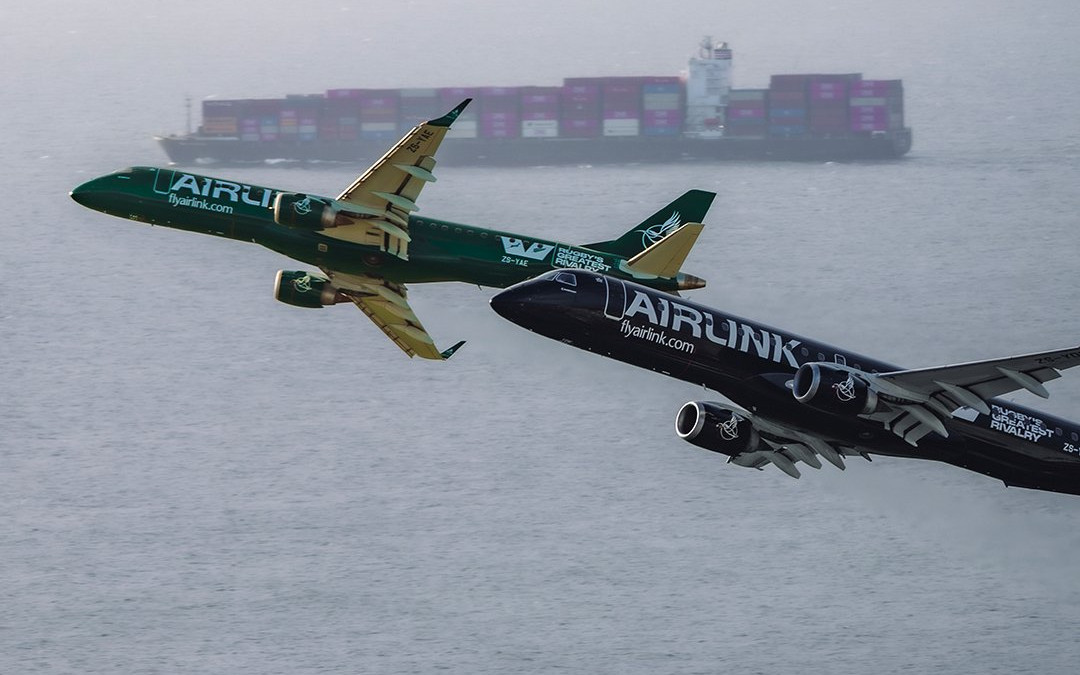
Airlink Embraer E-Jets in rugby livery flying in South Africa
Two Embraer E-Jets operated by South African carrier Airlink flew within 50 feet of a stadium on Saturday, according to analysis by FlightRadar24. [Credit: Airlink]

Two Embraer E-Jets operated by South African carrier Airlink passed within 50 feet of a crowded stadium during a flyover Saturday, drawing praise, scrutiny, and now a review by the country’s aviation regulator.

The South African Civil Aviation Authority (SACAA) said Wednesday that it is “looking into” the flyby, which took place at Cape Town’s DHL Stadium ahead of a rugby match between the national teams of South Africa and New Zealand that was attended by more than 56,000 fans.

Flyovers have been a tradition at South African rugby events since the 1990s. But Saturday’s stunt—which saw the lead aircraft clear the stadium by an estimated 41 to 46 feet, per FlightRadar24’s analysis—prompted SACAA to take a closer look. The FAA’s minimum safe altitude regulations require pilots to maintain an altitude of 1,000 feet above the highest obstacle within a horizontal radius of 2,000 feet of the aircraft when flying over congested areas.

According to SACAA, Airlink has canceled another flyby that was planned over Johannesburg’s FNB Stadium on September 5. The carrier is a sponsor of matches between South Africa’s Springboks and New Zealand’s All Blacks and conducted a stadium flyover in August ahead of the more recent display.

Airlink in a statement Tuesday said it withdrew its application for the September 5 flyby due to unfavorable weather conditions. The carrier said SACAA’s action is a review and not a formal investigation.

“South Africa has one of the most sought-after aviation talents in the world, and as a country we remain proud of the 0 percent record in fatal accidents in the commercial airline operations space for over four decades,” SACAA said. “This is a record we intend to uphold well into the future, and it is therefore critical that we interrogate this past week’s events with clear minds and data at our disposal to determine if there were any safety concerns which warrant a review.”

Flyover Analysis Begins

SACAA on Wednesday confirmed Airlink’s claim that the flights were approved as a Special Air Event. It said the carrier submitted applications for three flyovers that were “in line” with regulations governing nonpassenger or cargo-carrying flights under the regulator’s Part 91. Airlink pilots conducted a safety briefing and practice flight in a simulator in preparation for the display, SACAA said.

After “various discussions in the media,” the regulator said it “initiated compliance verifications, engaged the operator, [and] obtained the flight data recording downloads as well as other additional requirements.” British newspaper The Times reported Sunday that Airlink would invite officials to examine the jets’ data recorders in order to “review and verify that the flypast was in accordance with the flight authorisation.”

“The flight data recorded by both aircraft confirms that the flights were performed within the SACAA’s approved and rehearsed safety altitude and speed limits for the flypast,” Airlink said in a statement Sunday.

The carrier said the flyover required “careful planning and rehearsal” and that the jets flew at about 150 knots. Each had a three-person crew comprising a commander, copilot, and safety or technical officer, it said. The airline did not provide an estimate of the jets’ clearance over DHL Stadium.

SACAA said it requested “additional information” from Airlink in order to make recommendations. It plans to share a full report with the carrier once the assessment is complete.

Mixed Reactions

As videos of Saturday’s low flyover spread on social media over the weekend, reactions were split between praise for the pilots’ precision and condemnation over the potential of a devastating crash if things did not go to plan.

Some South African officials, including Gayton McKenzie, the country’s Minister of Sport, Arts, and Culture, dismissed safety concerns and lauded the stunt as an example of South African pilots’ elite skill.

“It’s a well known fact that we have the best pilots in the world, that was spectacular, next time I will ask the pilots to land on the field, prepare to be amazed further,” McKenzie wrote on X on Sunday.

Web developers even turned the flyover into an online game called “Flappy Link,” inspired by the popular game Flappy Bird. Players attempt to fly a jet as low as possible over DHL Stadium and other venues while avoiding striking the roof or other obstacles.

Jack Daleo

Jack is a staff writer covering advanced air mobility, including everything from drones to unmanned aircraft systems to space travel—and a whole lot more. He spent close to two years reporting on drone delivery for FreightWaves, covering the biggest news and developments in the space and connecting with industry executives and experts. Jack is also a basketball aficionado, a frequent traveler and a lover of all things logistics.

WATCH: Regent Electric Seaglider Prototype Makes First Crewed Flight

Manufacturer says launch of crewed testing marks final stage of prototype trials.

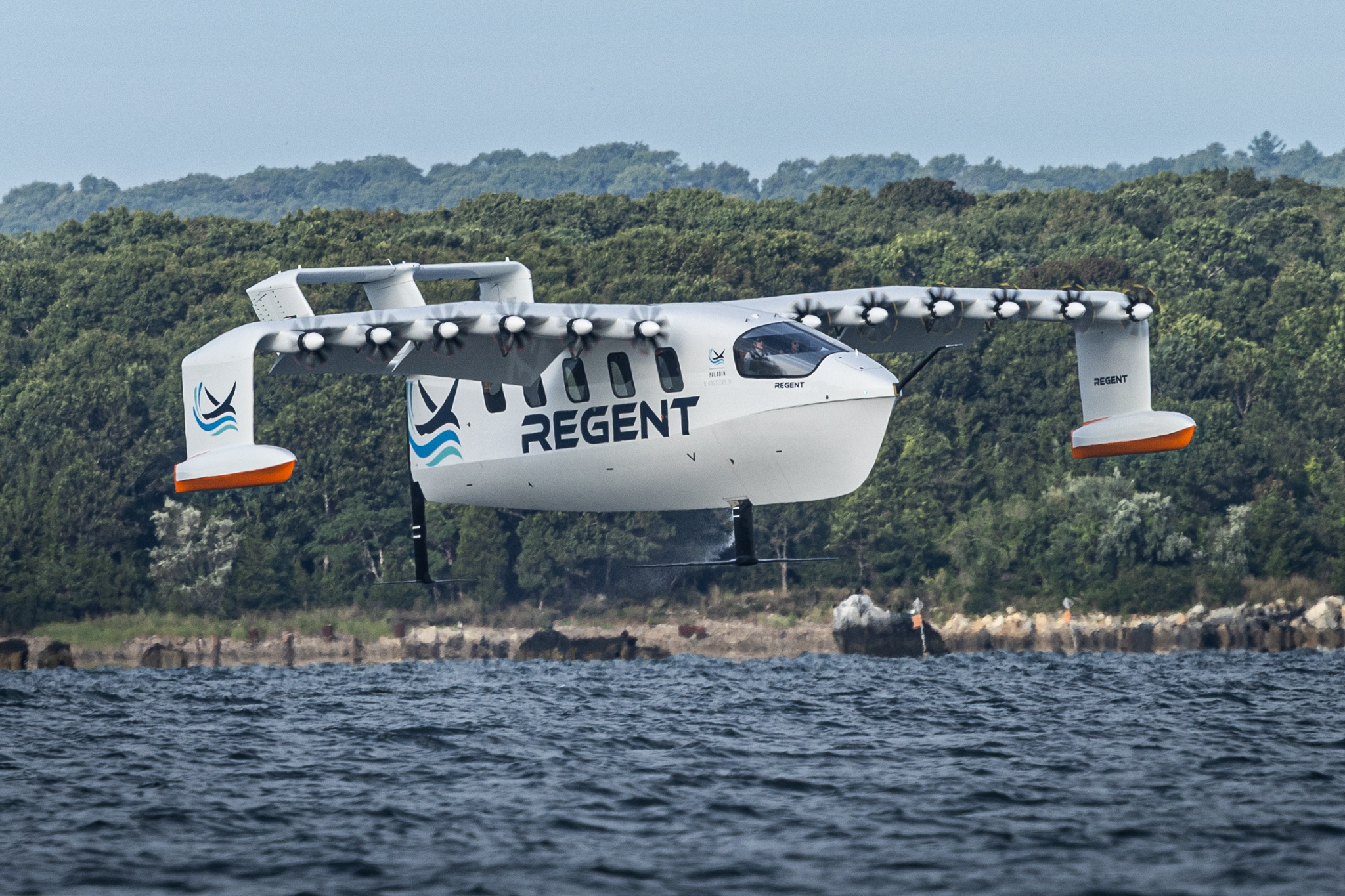
Regent Craft Viceroy electric wing in ground effect seaglider first crewed flight
Regent’s all-electric Viceroy seaglider prototype made its first human-crewed flight. [Credit: Regent Craft]

Regent Craft said Wednesday that its prototype electric seaglider, Viceroy, made its first human-crewed flight. According to the Rhode Island-based manufacturer, Viceroy—which combines aspects of traditional aircraft and maritime vessels—is the largest all-electric, wing-in-ground effect (WIG) craft to fly with people on board.

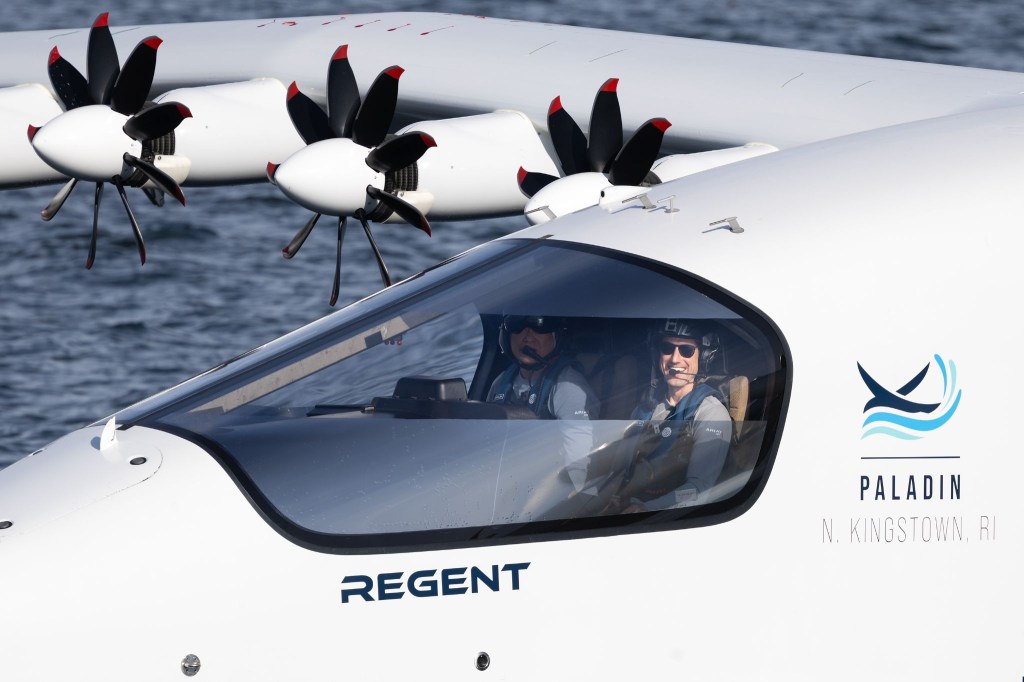
Regent said two captains took the prototype out on Rhode Island’s Narragansett Bay. Categorized as a Type A WIG craft and defined as a maritime vessel, the model is designed to be operated by maritime captains who secure a type rating after completing a training course. It will be certified and regulated by the U.S. Coast Guard rather than the FAA.

The manufacturer said Viceroy flew 33 feet above the water for about 30 seconds, covering 1,956 feet. That distance equals the height of the world’s largest radio and television broadcast towers. Regent said the flight marks the prototype test program’s final stage of sea trials.

Video: Regent Craft

Billy Thalheimer, co-founder and CEO of Regent, said the sortie “marks the start of a new era in mobility, unlocking opportunities across passenger travel, defense missions, and cargo transport.”

Mike Klinker, co-founder and chief technology officer, added that the flight “gives us the confidence to move into full-rate production.”

Viceroy’s first human-crewed flight was a long time coming. Regent in August 2024 received Coast Guard approval to begin testing prototypes in Narragansett Bay and Rhode Island Sound. It communicated throughout 2024 that it aimed to begin crewed testing by year’s end.

Regent Viceroy electric seaglider prototype with two captains on board
Categorized as a Type A WIG craft and defined as a maritime vessel, Viceroy is designed to be operated by maritime captains who secure a type rating after completing a training course. [Credit: Regent Craft]

Regent did not begin full-scale Viceroy prototype flights until the following year. It predicted the vessel would fly with humans by the summer, but that did not come to fruition, either.

WIG seagliders have been studied by government entities such as the U.S. Defense Advanced Research Projects Agency (DARPA)—which explored the Liberty Lifter—as well as by China and Iran. Building a vessel that is viable for long-term commercial, recreational, or military use has proven challenging.

Regent on Wednesday, however, said Viceroy is the first WIG craft that is “engineered and readied for commercial and defense operation at scale.”

Regent’s Viceroy Seaglider

Viceroy is intended for zero-emission coastal travel with two crew and up to 12 passengers. It combines hydrofoils—essentially underwater aerofoils—with autonomous control systems, sensors, and blown-lift propulsion technology. The idea is to combine the speed of an aircraft with the functionality and low-cost operation of a boat.

The model’s only controls are boat controls. It is commanded using a single lever thrust control and fly-by-wire system, with digital interfaces displaying moving maps, radar, traffic advisories, and other information. Stability and certain maneuvers, such as landing, are augmented by a proprietary autonomous digital control system. Regent claims the system “offers a level of safety and control that no WIG craft has achieved before it.”

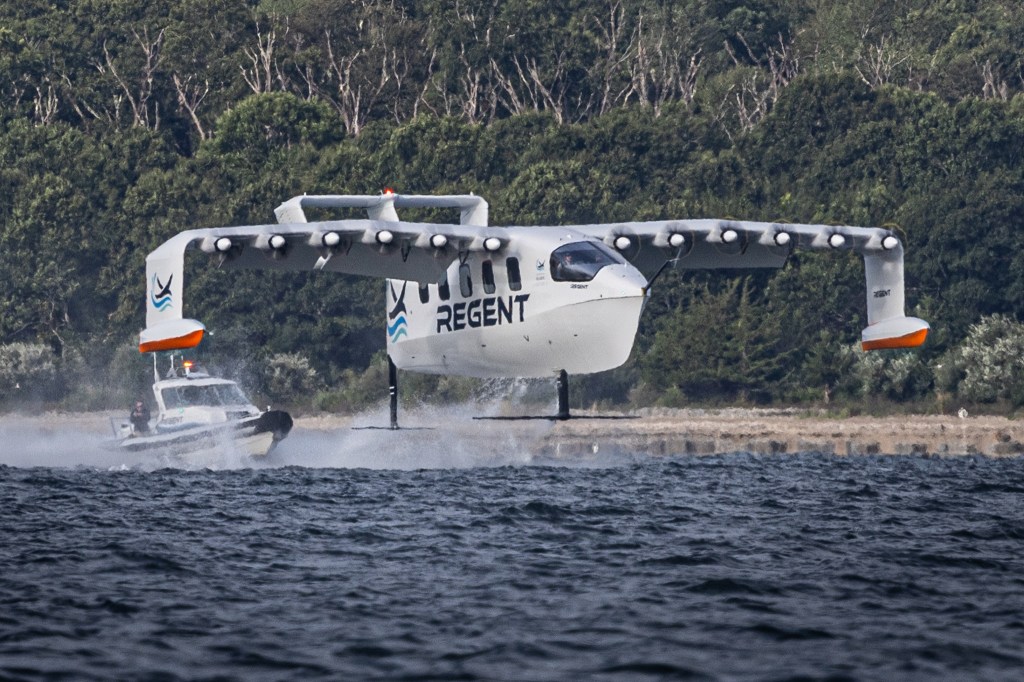
Over open water, the hydrofoils retract into the vessel’s deep-V hull, allowing it to fly in ground effect within one wingspan of the water’s surface. It can also rise up on its foils for a smoother, more controlled ride near harbors or float like a boat at docks and marinas. Propellers, powered by redundant electric motors, provide propulsion.

Regent Viceroy electric seaglider hydrofoils extended over water
Viceroy’s hydrofoils retract into its deep-V hull when the vessel switches to WIG mode over open water. [Credit: Regent Craft]

At launch, Viceroy will have a range of about 180 sm (156 nm). Regent’s first U.S. launch customer, luxury coastal travel operator The Twenty Five, said it could open up routes including Boston to Nantucket, Massachusetts, in one hour or Palm Beach to Miami, Florida, in 40 minutes. As battery capacity improves, the range could rise to 500 sm (436 nm).

Per The Twenty Five, the first electric seaglider deliveries are expected in 2027. Regent in August raised $240 million that Thalheimer said will help the company “execute key certification milestones” as well as scale manufacturing. The company is working with Lloyd’s Register and other partners to enable operations outside the U.S. in places such as Japan.

Regent in June completed a 255,000-square-foot electric seaglider production facility in Rhode Island that it said will anchor global manufacturing for Viceroy. It described the waterfront site as the world’s first production hub for WIG craft. On Wednesday, the company said the facility will come online in 2026.

Regent is also developing an autonomous, hybrid-electric variant of the Viceroy, as well as a military model called the Squire, which made its first ground effect flight in April. The manufacturer is collaborating with the U.S. Marine Corps under contracts worth about $15 million.

Jack Daleo

Jack is a staff writer covering advanced air mobility, including everything from drones to unmanned aircraft systems to space travel—and a whole lot more. He spent close to two years reporting on drone delivery for FreightWaves, covering the biggest news and developments in the space and connecting with industry executives and experts. Jack is also a basketball aficionado, a frequent traveler and a lover of all things logistics.

Bird Strikes, Powerplant Failures Commonly Cited in Recent Business Aviation Safety Events

Powerplant system or component failure are among leading occurrence category for fatal accidents.

business aviation aircraft
Bird strikes, powerplant failures, and collisions were among the most commonly cited factors in recent business aviation accidents and incidents, per the NBAA. [Credit: Adobe Stock]

Bird strikes, powerplant failures, and collisions were among the most commonly cited occurrences for business aircraft accidents and incidents from April through June 2026, according to the National Business Aviation Association (NBAA).

NBAA’s analysis of business aviation accidents and incidents for the three-month period, published Tuesday, examined 66 reportable events. Based on the data, the group listed wildlife-hazard awareness, proactive maintenance, thorough inspections, and effective procedures as key safety measures that pilots of business aircraft should prioritize.

“The Q2 findings reinforce the need for rigorous preflight preparation, disciplined takeoff and landing practices, runway-excursion prevention, and close attention to aircraft system and powerplant reliability,” said Mark Larsen, NBAA director of safety and flight operations, in a statement.

In the second quarter, the NBAA said six accidents involving two business jets, two business turboprops, and a turbine helicopter resulted in 22 deaths. Powerplant system or component failure was cited in two of the events, making it the leading occurrence category for fatal accidents during the quarter.

In June, a NetJets-operated Cessna Citation Latitude crash-landed on a highway in Laredo, Texas, killing one passenger and injuring five other occupants. The National Transportation Safety Board’s preliminary investigation found that the Citation’s right engine starter generator was missing multiple screws, and the flight crew reported a generator failure and “multiple other failures.” A final report likely remains several months away.

The NBAA analysis examined a total of 24 accidents. The most frequent type was collision during takeoff and landing, which the association said contributed to one fatal and four nonfatal accidents. Next on the list were runway excursion and powerplant failure, each cited in three accidents.

The report also examined 42 incidents, which the NBAA said can “still reveal operational hazards.” Among all 66 reportable events, bird strikes were cited in 12, followed by 11 nonpowerplant failures and nine powerplant failures.

The organization noted that the analysis is intended to “identify trends and areas for further attention” rather than assign probable cause. Data is compiled from the FAA and NTSB, and many of the events remain under investigation with probable cause not yet determined.

However, the NBAA does “connect observed trends with NBAA Safety Committee priorities,” it said.

“By bringing these events together and examining the patterns behind them, NBAA helps operators turn data into conversations, training priorities and actions that can strengthen safety,” said Larsen.

Full quarterly business aviation accident and incident analyses are available only to NBAA members. The organization released its first quarterly report in late 2025, covering the third quarter of that year.

NBAA’s Q1 2026 report examined 40 accidents and incidents that occurred in the first three months of the year, during which there were also six fatal accidents. Seven of the 40 events involved business jets, 10 involved turboprops, and eight involved turbine helicopters.

Larsen in a statement identified runway excursions, landing gear events, and environmental hazards as “common elements” of Q1 accidents and incidents. He advised pilots to focus on “strict adherence to stabilized approach criteria” and “heightened vigilance and enhanced ground control procedures in the airport ramp and runway environments.”

Beyond quarterly analyses, the NBAA’s Business Aviation Accident and Incident Analysis resource allows members to filter events by date, aircraft category, operation type, phase of flight, and other criteria. Membership grants access to 10 years of historical trend data as well as detailed individual reports, charts, and data tables.

The association said in November that in the future data will be expanded to cover piston-powered business aircraft.

Jack Daleo

Jack is a staff writer covering advanced air mobility, including everything from drones to unmanned aircraft systems to space travel—and a whole lot more. He spent close to two years reporting on drone delivery for FreightWaves, covering the biggest news and developments in the space and connecting with industry executives and experts. Jack is also a basketball aficionado, a frequent traveler and a lover of all things logistics.

Florida Man Convicted of Smuggling $900K in Aircraft Parts to Russia

Former Aeroflot employee faces sentencing in November after illegally exporting aviation tech.

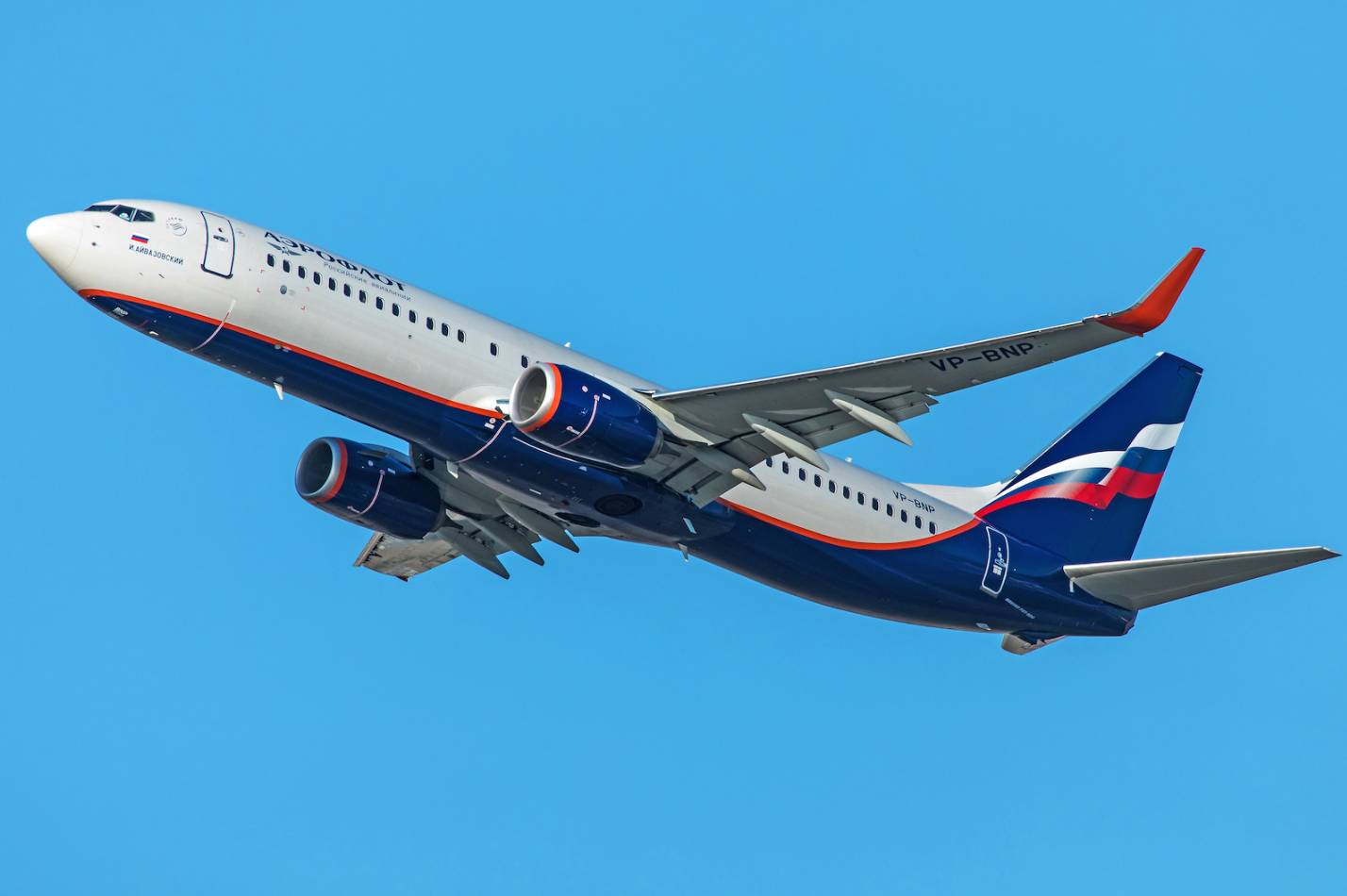
An Aeroflot Boeing 737-800 [Credit: AirlineGeeks/William Derrickson]

A 62-year-old Florida resident and Russian national accused of illegally exporting aircraft parts from the U.S. to his home country has been convicted on all counts.

According to a media release from the FBI, Alexander Mamonov was convicted August 27 following a jury trial related to a scheme to illegally export aircraft parts from the U.S. to supply PJSC Aeroflot, the state-owned Russian airline. 

Mamonov was found guilty in the Southern District of Florida of 12 counts related to that scheme, including conspiracy to violate the Export Control Reform Act (ECRA) of 2018, illegal export of items subject to ECRA, conspiracy to commit smuggling, smuggling of goods, submitting false or misleading export information, and conspiracy to commit money laundering. 

Following Russia’s invasion of Ukraine in early 2022, the U.S. Department of Commerce increased restrictions on exports to Russia and issued a temporary denial order barring Aeroflot from receiving U.S.-origin goods. According to court documents and testimony, Mamonov is a former Aeroflot employee who relocated from Russia to South Florida.

After the DOC increased restrictions on Russian exports, Mamonov conspired with Ignat Vakorin, another Russian national, to acquire and illegally ship over $900,000 in aircraft parts to Russia and Aeroflot. Mamonov and Vakorin misled American suppliers into believing the parts were being sent to other destinations, such as the United Arab Emirates and China.

“This guilty verdict—on all counts—shows the United States government’s resolute commitment to upholding our export-control laws and to prosecuting those who violate them,” said Assistant Attorney General for National Security John Eisenberg in the release. “The National Security Division and our U.S. Attorney’s Offices and law enforcement partners will continue to safeguard U.S.-controlled items from being exported unlawfully.”

The case was investigated by the FBI Miami Field Office with assistance from the DOC’s Bureau of Industry and Security. 

“Mamonov illegally exported nearly $1 million dollars of aviation parts to Russia by lying to U.S. suppliers about their destination, and this conviction on all counts holds him accountable,” said Assistant Director Roman Rozhavsky of the FBI’s Counterintelligence and Espionage Division. “The FBI and its partners will continue to prioritize the enforcement of export laws and sanctions to defend the homeland. Let this verdict serve as a warning to anyone considering smuggling U.S. technology to our adversaries.”

Mamonov and Vakorin were charged by indictment in April 2025. Vakorin remains a fugitive.

“Russia cannot evade American sanctions and export controls by routing its purchases through South Florida,” said Jason Reding Quiñones, U.S. Attorney for the Southern District of Florida. “You cannot put a fake destination on a shipping label and make American export laws disappear. This defendant conspired to secretly funnel nearly $1 million in American aircraft parts to Russia and Aeroflot, then used false destinations and financial transactions to conceal what he was doing. A federal jury held him accountable on every count.

“We will continue to aggressively pursue those who use our district, our financial system, or American businesses to undermine U.S. national security.” 

Sentencing is scheduled for November 20.

Meg Godlewski

Meg Godlewski has been an aviation journalist for more than 24 years and a CFI for more than 20 years. If she is not flying or teaching aviation, she is writing about it. Meg is a founding member of the Pilot Proficiency Center at EAA AirVenture and excels at the application of simulation technology to flatten the learning curve. Follow Meg on Twitter @2Lewski.

 This 2025 Cirrus SR22T G7+ Is a Top-Tier ‘AircraftForSale’ Top Pick

Factory warranty through 2028, 130 flight hours, and Safe Return Emergency Autoland make fully loaded piston stand out.

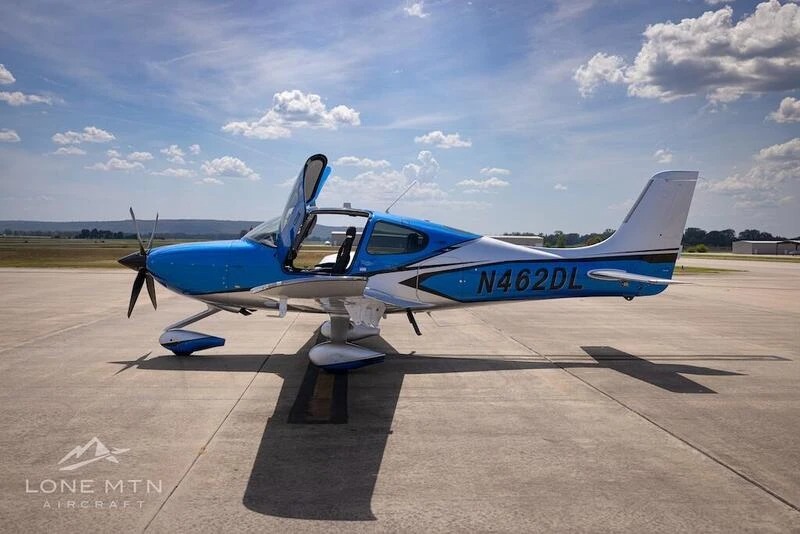
2025 Cirrus SR22T G7 [Credit: Lone Mountain Aircraft]

Every day, the team at Aircraft For Sale chooses an airplane that catches our attention because it is unique, a good deal, or has other qualities we find interesting. You can read Aircraft For Sale: Today’s Top Pick at FLYINGMag.com daily.

Today’s Top Pick is a 2025 Cirrus SR22T G7+.

Representing the pinnacle of modern single-engine piston innovation, the Cirrus SR22T G7+ continues the brand’s tradition of blending high-performance touring with ultimate safety. It stands out in the owner-flown market by offering jet-like technology and luxury in a piston platform, making it a highly desirable choice for cross-country travelers who refuse to compromise on capability or comfort.

Delivering exceptional thrust to the sleek airframe is a 315 hp Continental TSIO-550K turbocharged engine that shows just 130 hours since new. The potent powerplant is equipped with a Tanis engine and avionics pre-heater for reliable cold-weather operations, and it spins a visually striking MT four-blade lightweight propeller that also shares the matching 130-hour total time.

This nearly new 2025 airframe has logged the same 130 hours since rolling off the factory floor. The exterior commands attention on any ramp with a striking carbon scheme featuring blue over silver. 

Inside the cabin, passengers are treated to a lush black interior with Alcantara seat inserts, 60/40 flex seating for up to five, factory air conditioning, and convenient USB-C charging ports, all complemented by a useful load of 1,099 pounds.

2025 Cirrus SR22T G7 [Credit: Lone Mountain Aircraft]

Commanding the aircraft is made effortless thanks to the highly intuitive Cirrus Perspective Touch+ by Garmin flight deck. The system spans dual 14-inch high-resolution widescreen displays and incorporates a GFC 700 three-axis autopilot, Garmin GTS800 Active Traffic, and Certified Flight Into Known Ice (FIKI). Furthermore, safety is taken to unprecedented levels with the inclusion of the Safe Return Emergency Autoland system and the signature Cirrus Airframe Parachute System (CAPS).

Listed at $1,399,000, this fully loaded Cirrus SR22T G7+ provides a rare opportunity to bypass factory wait times. The aircraft is backed by a Spinner-to-Tail Warranty and the Cirrus Maintenance Program (CMX) active until September 2028, offering a top-notch ownership experience.

If you’re exploring ownership options, FLYING Finance can help get you airborne. Use our airplane loan calculator to estimate your monthly payments, or connect with an aviation finance expert at flyingfinance.com.

FLYING Staff

FLYING Magazine is a one-stop resource for everything aviation, including news, training, aircraft, gear, careers, photos, videos, and more.

Why Are Airplane Clearing Turns First Made to the Left?

It’s vital to understand safety procedures and overtaking traffic rules that govern this essential flight training maneuver.

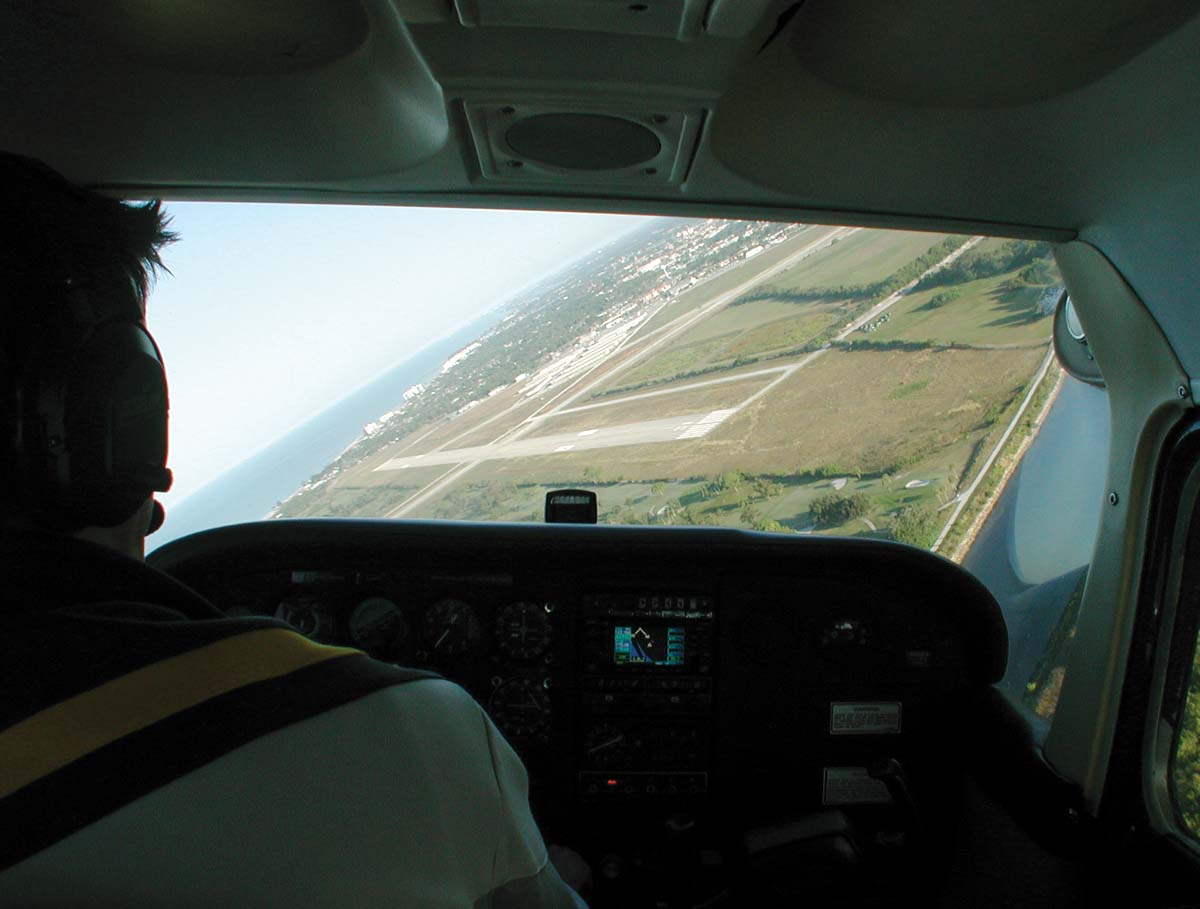
Performing proper clearing turns before any maneuver ensures an open path and keeps you safe from nearby traffic. [Credit: FLYING Archive]

Question: I have just started my flight training, and I have learned how to do a clearing turn. It makes sense to me to look around before you do a maneuver, but why is the first one always to the left? My CFI has me doing a 360-degree turn. I asked my CFI, and he said that’s how he learned it, so that’s how he’s teaching me. Is there more to it than that?

Answer: I am sure your CFI did learn to make the first clearing turn to the left. The 360-degree turn is a good choice, and there are also instructors who use two 180-degree turns—first to the left then to the right to clear the area before a maneuver is attempted.

The reason the first turn is made to the left is because, in theory, if another aircraft is overtaking you, it will be passing off your right side. Turning to the left gives you a better chance of avoiding the traffic. That being said, always make the turn a three-part process—look left (or right), clear left (or right), turn left (or right).

The important thing to remember when doing clearing turns is to look around to clear the area. There are some pilots who simply roll into the turn when told to do one without looking outside of the aircraft. This negates the efficiency of the turn. Please don’t be that pilot. 

If you’re in a maneuver and see another aircraft getting too close, break off the maneuver and take prompt and corrective action to avoid the other aircraft.


Ask us anything you’ve ever wanted to know about aviation. Our experts in general aviation, flight training, aircraft, avionics, and more may attempt to answer in a future article. Email your questions here.

Meg Godlewski

Meg Godlewski has been an aviation journalist for more than 24 years and a CFI for more than 20 years. If she is not flying or teaching aviation, she is writing about it. Meg is a founding member of the Pilot Proficiency Center at EAA AirVenture and excels at the application of simulation technology to flatten the learning curve. Follow Meg on Twitter @2Lewski.

How Pilots Set Personal Minimums

Move beyond instructor limitations and use risk management tools to take full ownership of your safety.

The difference between pilot limitations and personal minimums often can be the level of pilot certification. [Credit: Adobe Stock]

What’s the difference between pilot limitations and personal minimums? I submit it’s the level of pilot certification.

For the student pilot about to make their first solo flight, the CFI carefully records the weather limitations as part of the solo endorsement. These usually include references to the ceiling, visibility, and winds: “Visibility at least 3 miles and ceiling must be at least 2,500 feet for in pattern, visibility 5 miles and 4,000 feet for flight in the practice area. Crosswinds no greater than 6 knots, with gusts no greater than 10.”

These limitations are often tailored to the individual pilot, or they may be drawn from the procedures culled from the flight school’s training course outline (TCO). Since the invention of the text message, some CFIs add a note: “Must notify flight instructor before solo.” This is particularly popular for Part 61 training as the learner is “riding on the CFI’s certificate.”

This Article First Appeared in FLYING Magazine

If you're not already a subscriber, what are you waiting for? Subscribe today to get the issue as soon as it is released in either Print or Digital formats.

Subscribe Now

As the student’s experience and skill increase, the limitations change. The winds get higher, and the ceilings may get lower. After you achieve pilot certification, the limitations help establish your personal minimums. These are self-imposed limitations that are yours and yours alone.

Establishing personal minimums is something every pilot should do—and it’s not easy. This is one of those things often done best using paper and pencil and creating a list. There’s something about writing it down, and I mean writing it down manually rather than typing them, that makes you follow through with them.

If anecdotal evidence is any indication, one of the most challenging questions to be asked during the private pilot check ride is: “What are your personal weather minimums?” According to several DPEs I know, there are some pilot candidates who have never even given it a thought. 

Although they’ve been taught to access and interpret a weather briefing, they’ve not had a chance to develop their personal minimums outside the training environment because throughout their training they’ve relied on their instructor to tell them when the weather is good enough to fly. Many are surprised by the question, especially when realizing there’s not a one-size-fits-all reply.

Factors to Consider

Risk management and mitigation lies at the heart of personal minimums. This begins with using the IMSAFE checklist (Illness, Medication, Stress, Alcohol, Fatigue, Emotion) we learned as student pilots, followed by the PAVE model (Pilot, Aircraft, enVironment, Expectations).

P is for Pilot: Can you pass the IMSAFE checklist? Are you current? Are you proficient? If you hold an instrument certificate, would you be comfortable flying an IFR approach in the airplane if the weather goes sour?

A is for Airplane: How much time do you have in this make and model? If you’re renting from a business that has a fleet of aircraft, have you flown this particular aircraft before? Some airplanes, like people, have quirks. One Cessna 172 has articulating seats that you need to crank all the way down or else you don’t fit in the airplane, or the dispatch person, trying to thwart a maintenance challenge, may move you into the low-wing model that you haven’t flown in months.

Are you familiar and comfortable with the use of the instruments and radios? It can be a challenge when the dispatch person is unfamiliar with the differences between the aircraft in the fleet and puts you in the G1000-equipped model when all you’ve ever flown is round dial.

All those buttons can be confusing, and using the airspeed and altimeter tapes for the first time comes with a learning curve. On takeoff, put the nose on the horizon out the windscreen and note what that looks like on the computer screen. Add power and let the appropriate V speed (VR, VX, and/or VY) come to you. Avoid the urge to “pull back” to capture the speed.

If it’s a new-to-you airplane, spend a little more time on the performance calculations, paying special attention to the weight and balance and performance numbers. Look for placards that warn of increased fuel burn because of an engine modification. Double-check the usable fuel, noting the placards on the fuel tanks. You don’t want to be the pilot who thinks they have 36 gallons of usable fuel and finds out it’s more like 33 when they’re still a few miles from the airport.

V is for enVironment: Is the weather something you’re comfortable flying in? Here’s a big question: Are you trying to stay ahead of a descending ceiling or increasing winds as a front approaches? If you hold an instrument certificate, would you be comfortable flying an IFR approach in this airplane?

In addition to the weather, consider your knowledge of the area, including terrain and airspace, and the mission (purpose) of the flight, the technical knowledge and skill required, and the concerns of the passengers. With the latter, it’s often a good idea to be conservative. While you may enjoy orbiting at 1,000 feet over a field of tulips or a corn maze on a slightly bumpy day, it might be unpleasant for a non-pilot passenger.

If the flight involves going to airspace that you rarely go into—like the class B, C, or D for towered airport operations or even a nontowered airport if that’s outside the norm for you—you will want to study the procedures before you get there. You may even want to do the flight with a qualified and experienced flight instructor on board to make sure you don’t become task saturated and get behind the airplane

E is for Expectations: You really wanted to make this flight, but the weather is starting to drop. Or you promised someone you’d take them flying, and now the clouds are gathering, and the wind is kicking up. It can be hard to disappoint people, including yourself.

There are some schools that push the instructors to take their students into questionable weather under the guise of providing the students with experience they’ll need. There’s some validity to this, as calm wind days are a rarity. Student pilots should be introduced to more challenging weather when they have already learned basic skills.

However, if the ceiling is barely high enough for the pattern, and the winds are such that the CFI has to do the bulk of the flying, it’s not so much a flight lesson as it’s an hour grab by the instructor. Always be prepared to turn around or divert if the weather gets worse, and always have a place to go in mind.

Developing Personal Minimums

To the CFIs: Give your learners the tools to develop their personal minimums early in their training. When you endorse them for first solo and cross-country flights, point out the weather limitations included.

On the endorsement for the individual cross-country flights you may want to include the phrase: “Weather checked as of (insert the time and date)” and stress to learners that if the weather changes significantly for the worse during the flight, or is outside the published minimums for the flight school or club, a discontinuance or no-go is the correct decision. 

It’s also important to teach learners to recognize hazardous weather and calculate aircraft performance early in their training. By the time they are soloed they should know how to crunch the numbers and determine and mitigate the risks.

Help learners build their confidence by pointing out when you increase their weather limitations. For example, if they were soloed with a limitation of a crosswind component of 6 knots with gusts to 9, and several hours of flight training later when they need another endorsement, you increase it 8 knots and gusts to 12, make sure you mention the reason you’re changing the limitations is because their experience and skills have increased.

Teach learners it’s OK to express concerns about weather. One of the ways you can do this is by modeling good behavior.

The day of my flight instructor instrument check ride a storm was moving into Seattle. Both the examiner and myself noticed the sound of the wind picking up while we did the ground portion of the exam.

The DPE asked if I wanted to do the flying portion of the ride—I think he was testing me. I replied no, saying the weather wasn’t something I would feel comfortable taking a client into because they need to build skills, not get scared, and this wasn’t about me building my hours.

That was apparently the correct answer, because as we walked into the main building to use the weather computer—we were both curious about the wind gusts—we exited just in time to see the flag attached to the pole outside lose a corner attachment. The metal hook snapped, and the flag ripped loose and flailed around like a rag, then stuck straight out.

That was good enough for me. I took a discontinuance—and the DPE heartily agreed. 


This column first appeared in the July Issue 972 of the FLYING print edition.

Meg Godlewski

Meg Godlewski has been an aviation journalist for more than 24 years and a CFI for more than 20 years. If she is not flying or teaching aviation, she is writing about it. Meg is a founding member of the Pilot Proficiency Center at EAA AirVenture and excels at the application of simulation technology to flatten the learning curve. Follow Meg on Twitter @2Lewski.

GA Pilots, Prepare for More Traffic at Washington Manassas Airport

FAA authorization for commercial service will raise activity at Virginia’s busiest general aviation facility.

Washington Manassas Airport commercial service rendering
Rendering of modernized passenger terminal at Washington Manassas Airport [Credit: Avports]

General aviation pilots flying into Virginia’s Washington Manassas Airport (KHEF) can soon expect thousands of commercial flights to share the airspace each year.

Washington Manassas, renamed earlier this year from Manassas Regional Airport, is the busiest GA airport in Virginia, with more than 420 based aircraft and 100,000 annual operations. It is also a designated reliever for Washington Dulles International (KIAD).

After the FAA awarded a Part 139 airport operating certificate to KHEF on Monday, airport officials estimate it could accommodate up to 3 million commercial passengers annually, starting in late 2027. Assuming commercial flights average 75 passengers, that would equate to about 40,000 operations each year on top of existing private aviation and flight school activities.

Part 139 is the FAA’s formal authorization for an airport to serve scheduled passenger operations by air carriers. Washington Manassas Airport in a news release described it as the “final federal milestone required before the airport can begin commercial passenger service.”

Airport director Juan Rivera in a statement said obtaining the airport operating certificate required “years of detailed preparation.” Per the FAA, that included meeting federal safety standards for runway and taxiway pavement conditions, aircraft rescue and firefighting, emergency planning, personnel training, and more.

Dan Edwards, the FAA’s associate administrator for airports, said Washington Manassas is the first Virginia airport to obtain Part 139 certification in 53 years.

“Commercial flights coming into Manassas will provide more economic growth within the community and create another commercial airport to service the Washington D.C. area,” Edwards said in a statement.

Washington Manassas would become the fourth and smallest commercial airport in the D.C. area, joining Washington Dulles, Reagan National (KDCA), and Baltimore/Washington (KBWI).

Rivera told D.C.’s WJLA-TV that it will gradually ramp up commercial service. He said the airport will initially offer three or four daily round-trip flights to vacation destinations. In five or six years, the plan is to offer about 24 flights per day.

“Hopefully you’d get a flight from Manassas directly to Orlando, for example,” he told the local news station. “Hopefully in the future we’ll be able to throw in a couple business markets, like Chicago for example, or Charlotte.”

Though no passenger airlines have publicly committed to offer commercial service at Washington Manassas, Rivera said he expects a low-cost or ultra-low-cost carrier to be the first. He declined to say which but said the airline will likely be announced later this year.

The airport in its news release said airport manager Avports will play a “key part” in recruiting airlines. Discount carriers Avelo and Breeze Airways both offer service at Avports-operated Tweed New Haven Airport (KHVN) in Connecticut. Avelo ended service at Dulles earlier this year.

Manassas’ Transformation

Washington Manassas is owned and operated by the city of Manassas and contributes more than $517 million to the regional economy while supporting more than 2,300 jobs, per the airport’s news release.

For years, the airport has served only general aviation. It has two runways that are used primarily by private owners and flight schools. But over the past three years, the city of Manassas and Avports have led a $125 million renovation and expansion to accommodate larger commercial aircraft, such as the Boeing 737-800.

The FAA said Monday that, over the past five years, it has separately invested more than $46 million toward runway rehabilitation and other infrastructure improvements at the airport. Construction of a new air traffic control (ATC) tower is expected to wrap up in 2029, while a modernized passenger terminal is scheduled to be complete by fall 2027.

Washington Manassas is also receiving upgrades under the FAA’s $12.5 billion ATC modernization effort.

Copper wiring was transitioned to high-speed fiber in May. A National Airspace System (NAS) voice recorder—similar to an airplane’s black box but installed on the ground—was installed in August to improve the capture, storage, and management of audio communications between pilots, ATCs, and facilities. Also in August, modern voice switches replaced decades-old analog systems.

In October 2027, the airport is scheduled to receive a Surface Awareness Initiative (SAI) system that is designed to enable better aircraft tracking in low-visibility conditions, reducing delays and improving safety as it accommodates more traffic.

The airport could even receive infrastructure for next-generation aircraft such as Electra’s hybrid-electric EL9, which is designed for operations out of soccer field-sized spaces. The company’s EL2 demonstrator recently began flying at Washington Manassas and other local airports, the first activities under a three-year FAA demonstration program.

Reagan National Airport and Dulles International are also undergoing or planning multibillion-dollar renovations.

Jack Daleo

Jack is a staff writer covering advanced air mobility, including everything from drones to unmanned aircraft systems to space travel—and a whole lot more. He spent close to two years reporting on drone delivery for FreightWaves, covering the biggest news and developments in the space and connecting with industry executives and experts. Jack is also a basketball aficionado, a frequent traveler and a lover of all things logistics.

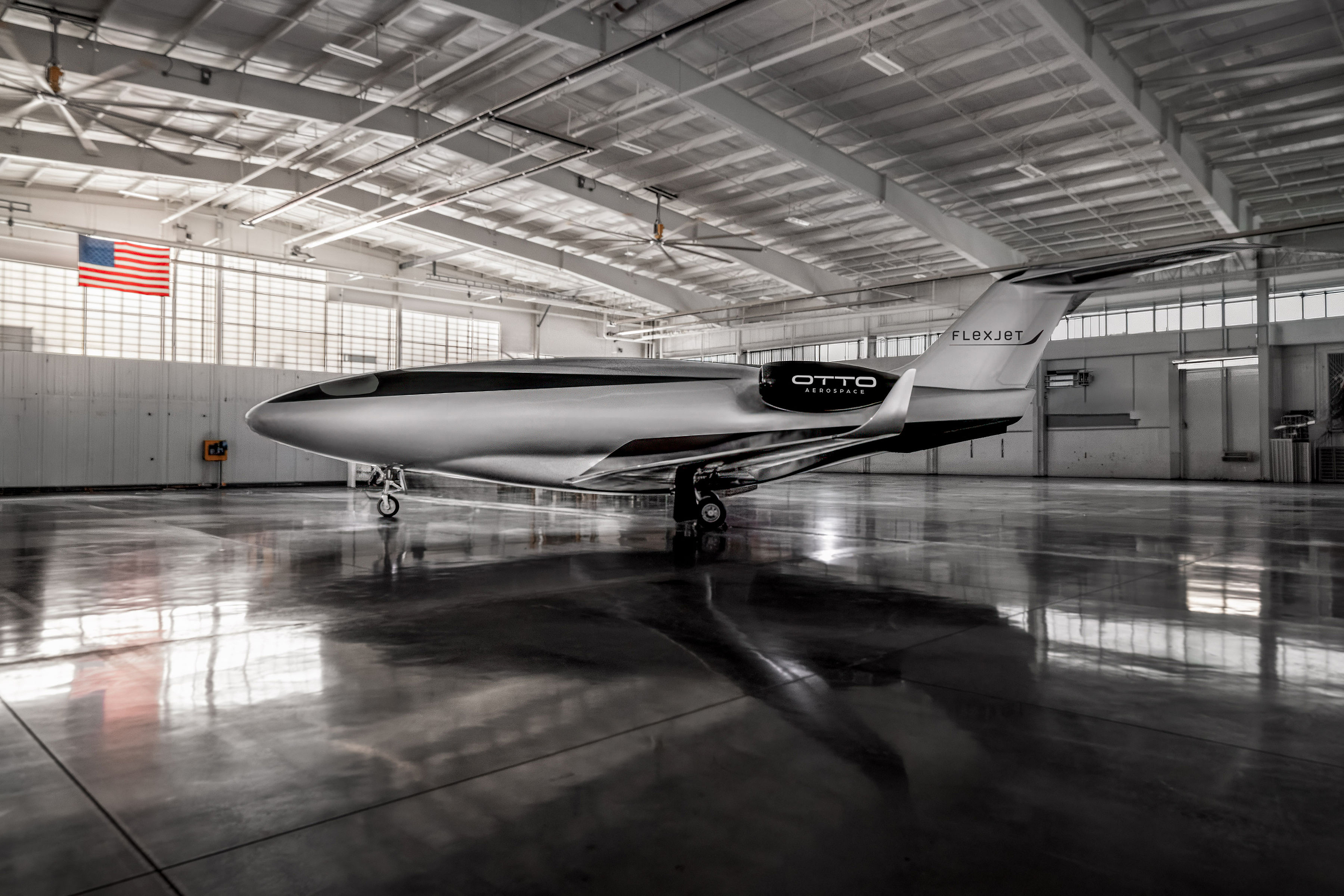
Otto to Build Fuel-Saving Bizjet Manufacturing Hub in 2028

Company aims to certify and deliver its Phantom 3500 around 2030 and make about 1,600 jets over the following decade.

Otto Aerospace Phantom 3500 super midsize business jet
The windowless passenger cabin of Otto’s Phantom 3500 super-midsize business jet is designed to smooth out the airframe and achieve laminar flow. [Credit: Otto Aerospace]

Otto Aerospace in about two years plans to break ground on a manufacturing facility for its fuel-efficient, super-midsize Phantom 3500 business jet, according to an official with the Jacksonville Airport Authority (JAA) in Florida.

The Jacksonville Daily Record reported that Tony Cugno, JAA’s chief operating officer, last week told a Jacksonville City Council committee that Otto will begin construction at Cecil Airport (KVQQ) in 2028. In 2025, Otto announced the relocation of its headquarters from Texas to Jacksonville and said it planned to base Phantom 3500 production there.

FLYING has reached out to Otto to verify the construction timeline.

“Their plan is to start manufacturing aircraft out of that facility around 2030,” Cugno said, according to the Daily Record.

That is the year Otto hopes to certify and begin delivering the nine-passenger jet—which it says is designed to cut drag by about 35 percent and fuel burn by about 60 percent—to customers. Former CEO Paul Touw said at the 2025 Paris Air Show that the manufacturer aims to produce about 1,600 aircraft over the following decade.

The Daily Record in August reported that Jacksonville issued a permit for the $12.1 million renovation of a hangar at Cecil Airport that was once occupied by Boeing. The plan is to convert more than 59,000 square feet of maintenance, repair, and overhaul facilities into a research-and-development hub for Otto’s flight test vehicles. The company aims to begin flight testing in 2027 using four production-conforming aircraft.

Otto in 2025 said it would build more than 600,000 square feet of manufacturing and office space in Jacksonville by 2032. Florida Governor Ron DeSantis said at the Paris Air Show that Otto would receive $430 million in tax credits and grants, which it plans to invest in the Cecil Airport facility, to incentivize the move. It also received a separate $35 million incentive package and $20 million grant.

Otto and the FAA in June agreed upon a Part 23 certification basis for the Phantom, which completed preliminary design review in May.

Touw estimated the program would cost $1 billion, with half going toward aircraft development and the rest supporting construction of a final assembly line. Per online news outlet FlightGlobal, Scott Drennan, who replaced Touw as CEO this year, estimated the Phantom will cost $1.5 billion to bring to market, with about $1 billion earmarked for certification.

Building the Phantom

Otto has tested the Phantom’s fuel-saving capabilities using a few early prototypes, but it has yet to build or fly the real deal.

Manufacturing the flagship model could be complex. The aircraft’s defining feature is a laminar-flow airframe that Otto says has been tested and proven to reduce drag and fuel burn compared to existing super-midsize models. Smoothing out the airframe to eliminate turbulence will require the company to eliminate rivets, gaps, and microscopic defects that could disrupt the delicate laminar flow.

The aircraft will cruise at around 51,000 feet to avoid turbulence from inclement weather. It will also swap porthole-style cabin windows for high-definition displays that use cameras to give passengers a real-time external view. Removing the windows further smooths out the airframe.

Otto has tested laminar flow using its Celera 500 demonstrator and in May completed a flight campaign with an uncrewed demonstrator that it said incorporated the same capability. Next up is Phantom prototype testing scheduled for next year.

“Advanced manufacturing capabilities have improved significantly, allowing for extremely precise, high-tolerance production methods,” Touw said.

The Phantom will be powered by a pair of gas- or SAF-powered Williams International FJ44 engines. Touw at the Paris Air Show said it could achieve carbon neutrality by 2030, decades ahead of international aviation targets, without using electric or hybrid propulsion.

“Electric energy storage systems are vastly too heavy to effectively fly anything beyond approximately 200 nm,” he said. “Turbofan aircraft can fly 8,000 to 9,000 nm—something electric aircraft will likely never achieve.”

The Phantom will be designed to reach transonic speeds beyond 260 knots, which combined with low fuel burn is intended to offer hourly operating costs that are about 43 percent lower than a super-midsize burning Jet A. Its maximum takeoff weight (MTOW) of about 19,000 pounds would be at the top of the FAA’s range for Part 23 models, but its planned range of 3,500 nm would be longer than many normal category aircraft.

Flexjet, which ordered 300 Phantom 3500s plus options for more in September, is the model’s intended launch customer, but Otto is also pursuing opportunities in defense.

Jack Daleo

Jack is a staff writer covering advanced air mobility, including everything from drones to unmanned aircraft systems to space travel—and a whole lot more. He spent close to two years reporting on drone delivery for FreightWaves, covering the biggest news and developments in the space and connecting with industry executives and experts. Jack is also a basketball aficionado, a frequent traveler and a lover of all things logistics.

FAA Proposes Unusual Airspace Restriction for Trump’s Mar-a-Lago Estate

Agency could add to a short list of Special Flight Rules Areas with new restrictions for president’s residence.

President Donald Trump Mar-a-Lago estate in Palm Beach Florida
President Donald Trump’s Mar-a-Lago residence in Florida [Credit: White House]

The FAA has proposed the creation of a Special Flight Rules Area (SFRA) near Donald J. Trump International Airport (KDJT, formerly Palm Beach International Airport), the agency told FLYING Tuesday.

The rare restriction would join only a handful of SFRAs the FAA already maintains and add to limitations that are already in place at the president’s Mar-a-Lago residence in Palm Beach, Florida.

The regulator in October 2025 implemented a year-round Temporary Flight Restriction (TFR) below 2,000 feet within 1 nm of Mar-a-Lago, which is active regardless of whether the president is at the property. Previous presidential TFRs have activated only when the president is in residence. A mobile TFR also travels with Air Force One—the call sign for whatever aircraft is carrying the president—like a giant bubble.

According to Reuters, new restrictions at Mar-a-Lago with the same 1 nm and 2,000 feet parameters are being sought by the U.S. Secret Service due to security concerns raised by threat intelligence. Reuters quotes the FAA as saying the special flight rules will “greatly increase ​the ability to mitigate ​the ⁠persistent risks posed by unauthorized aircraft and ⁠unmanned ​aircraft systems,” or UAS, commonly referred to as drones.

“At the request of the U.S. Secret Service in the interest of national security, the FAA is proposing Special Air Traffic Rules for the airspace near Donald J. Trump International Airport (DJT),” the FAA said in a statement to FLYING.

The agency said only flights meeting “specific safety and operational conditions” would be permitted within the new “DJT Special Flight Rules Area.” A notice of proposed rulemaking (NPRM) laying out the restrictions is scheduled to be published Wednesday in the Federal Register.

According to the unpublished NPRM, the proposed SFRA would replace the restrictions the FAA created for Mar-a-Lago last year, which are set to expire October 20.

D.C. Airspace Restrictions

The FAA maintains an SFRA covering a 30 nm radius in Washington, D.C., which carries with it certain requirements for pilots and air traffic controllers. Extending for a 15 nm radius around Ronald Reagan Washington National Airport (KDCA) is a more stringent Flight-Restricted Zone (FRZ) that permits only government and scheduled commercial flights without a waiver.

Within the FRZ are Prohibited Areas 56 A and B (P-56A and P-56B) surrounding the White House, National Mall, and vice president’s residence in D.C. Only specially authorized flights supporting the U.S. Secret Service, Office of the President, or other government agencies requiring air support are permitted within P-56A and B.

It is unclear whether the proposed Mar-a-Lago SFRA would contain an FRZ or another more restrictive layer.

The FAA’s proposal follows several recent TFR violations.

In August, five general aviation aircraft were intercepted for flying in a presidential TFR covering airspace near Houston and active while Trump was visiting the area Thursday and Friday. Earlier that month, two aircraft were guided out of a TFR over Bedminster, New Jersey, which is activated when the president visits Trump National Golf Club.

Neither incident was reported to have constituted a threat to the president.

Earlier this year, multiple unidentified drones overflew a D.C.-area military installation housing U.S. Secretary of Defense Pete Hegseth, U.S. Secretary of State Marco Rubio, and senior Pentagon leaders. The incident reportedly prompted officials to consider relocating Hegseth and Rubio.

Though the president travels often, Mar-a-Lago since 2019 has been established as Trump’s permanent residence.

According to Reuters, the proposed 1 nm SFRA around the estate would be much smaller than D.C.’s SFRA or FRZ. But it could still face pushback from Palm Beach residents, who have complained that the Mar-a-Lago TFR’s modification of certain flight paths has led to greater aircraft noise in neighboring communities.

Jack Daleo

Jack is a staff writer covering advanced air mobility, including everything from drones to unmanned aircraft systems to space travel—and a whole lot more. He spent close to two years reporting on drone delivery for FreightWaves, covering the biggest news and developments in the space and connecting with industry executives and experts. Jack is also a basketball aficionado, a frequent traveler and a lover of all things logistics.
Pilot in aircraft
Sign-up for newsletters & special offers!

Get the latest stories & special offers delivered directly to your inbox.

SUBSCRIBE