
Register

NTSB Releases New Details on Fatal Philadelphia Learjet Crash

Investigation into 2025 air ambulance accident focuses on pitch trim settings and nonfunctioning cockpit voice recorder.

NTSB investigators document the scene of the January 31, 2025, Learjet 55 crash in Philadelphia. [Credit: National Transportation Safety Board]

The National Transportation Safety Board has released the docket on the 2025 fatal air ambulance crash in northeast Philadelphia, containing several hundred pages of new information, analysis, and photographs gathered as part of its ongoing investigation.

The accident flight was operated by Med Jets, doing business as Jet Rescue Air Ambulance, an international aeromedical long-distance transport provider based in Toluca near Mexico City.

Per the NTSB, Jet Rescue Air Ambulance was conducting operations in the U.S. under operations specifications issued by the FAA’s Dallas International Field Office under Title 14 Code of Federal Regulations Part 129.

“The operator was not authorized to operate any scheduled passenger operations, and the accident flight was a charter air ambulance flight,” the NTSB docket read.

Per the docket, the night of the accident on January 31 the jet took off at approximately 6:07 p.m. EDT from Runway 24 at Northeast Philadelphia Airport (KPNE) and was scheduled to fly to Springfield-Branson National Airport (KSGF) in Missouri to take on fuel before continuing to its final destination. The jet took off into IMCi with a ceiling reported as 400 feet.

Accident Details

Air traffic control (ATC) instructed the pilots to fly runway heading and climb to 2,000 feet. The controller subsequently gave the flight a right turn to 290 degrees. The crew acknowledged the instructions, but that was their last communication with the ATC.

The aircraft crashed less than a minute after takeoff, killing all six people on board and one on the ground when the aircraft went down in a densely populated urban neighborhood. Four people sustained serious injuries, 20 received minor injuries, and more than 366 properties were damaged when the aircraft, operating at full power, disintegrated on impact, spreading debris for a quarter of a mile.

Videos of the accident captured by dash and doorbell cameras show the jet coming down in a near-vertical attitude then exploding when it hit the ground, triggering fires that reached businesses, homes, and cars. The aircraft hit so hard that the cockpit voice recorder (CVR) was recovered from the bottom of a crater eight feet deep.

The Investigation

Per the ADS-B information, the Learjet reached an altitude of approximately 1,650 feet then entered a dive. The aircraft continued down, still producing takeoff power and reaching 242 knots before impact.

One of the areas of focus for the NTSB is the possibility of a pitch issue during the climbout. According to the weight and balance provided and a Learjet 55 checklist found in the wreckage, which showed a takeoff trim table, the takeoff trim should have been set to about 5.5 degrees. The pitch trim actuator was found in the wreckage, and when measured it equated to a pitch trim indication of 3.97 degrees.

Based on ADS-B data and performance calculations the airframe manufacturer was able to estimate the control forces the crew would have felt on the yoke throughout the flight at differing pitch trim settings,” the docket read. “While the exact pitch trim settings for each ADS-B data point are unknown, the maximum force the crew would have needed to maintain level pitch (zero flight path angle) from the takeoff pitch trim setting to the found pitch trim setting was 53.5 [pounds]. Based on the final ADS-B data point and the pitch trim setting as found in the wreckage the airplane would have been trimmed slightly nose-up at that speed, weight, and center of gravity, needing about 12 [pounds] of pitch down force to maintain level pitch.”

Although jammed by impact, when the pitch trim actuator was disassembled, NTSB investigators found the screw threads were intact with no signs of overload or stripping. The actuator gear box showed no signs of overload.

ADS-B information also showed that as the aircraft turned right to the heading of 290 and entered the clouds it then began to slowly roll to the left. The left bank continued, reaching nearly 90 degrees as the jet’s nose began to drop, putting the aircraft into the dive as the rate of descent and airspeed picked up.

The aircraft was equipped with a CVR that iInvestigators retrieved from the wreckage and were able to clean up. However, they determined it was not working at the time of the accident and likely had not been operational for several years, therefore the accident flight was not recorded.

The Crew

The pilots held Mexican pilot certificates and were English proficient, according to the NTSB. 

The captain held an ATP rating and had approximately 9,200 hours of flight time. The second in command held a commercial certificate and had approximately 2,600 hours.

The recency of the pilots’ instrument and night experience, and therefore currency, could not be determined. Investigators have also not been able to determine which pilot was flying at the time of the accident.

The NSTB’s final report on the accident is likely eight months to a year out. The agency’s full preliminary report on the crash can be found below.


Meg Godlewski

Meg Godlewski has been an aviation journalist for more than 24 years and a CFI for more than 20 years. If she is not flying or teaching aviation, she is writing about it. Meg is a founding member of the Pilot Proficiency Center at EAA AirVenture and excels at the application of simulation technology to flatten the learning curve. Follow Meg on Twitter @2Lewski.

This 2022 Tecnam P2010 TDI Is a Swift, Premium ‘AircraftForSale’ Top Pick

Versatile four-place high-wing combines impressive all-around performance with great looks.

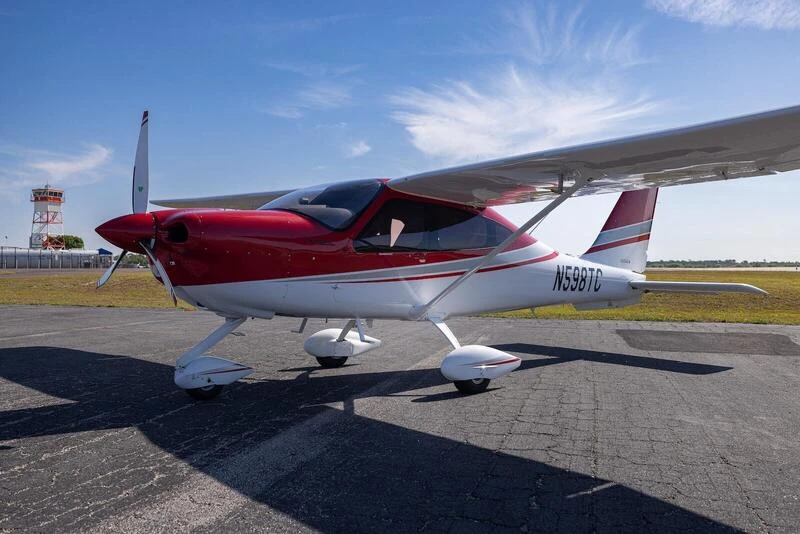
2022 Tecnam P2010 [Credit Lone Mountain Aircraft].

Each day, the team at Aircraft For Sale picks an airplane that catches our attention because it is unique, represents a good deal, or has other interesting qualities. You can read Aircraft For Sale: Today’s Top Pick at FLYINGMag.com daily.

Today’s Top Pick is a 2022 Tecnam P2010 TDI.

When Tecnam unveiled the P2010 at the 2011 AERO Friedrichschafen show, observers quickly pegged it as a modernized Cessna 172 Skyhawk. Yes, it has a high, strut-braced wing and four seats in becoming a staple for flight schools around the world, but the P2010 is far more airplane than the tried-and-true Skyhawk.

The Tecnam has a premium panel. [Credit: Lone Mountain Aircraft]

With an efficient engine and airframe, and a constant-speed propeller, the P2010 is faster and more versatile than the 172. While not an absolute speed demon, the Tecnam is fast enough to make it a solid traveling machine without the Cessna’s compromises in pace and load. Its sleek shape and a cabin with luxury car-style details give it an element of desirability that other training airplanes lack.

The aircraft for sale today comes across more like a European sport sedan with wings than a trainer that can also double as a personal transport. It is stylish enough to spark conversation on the ramp and bring smiles to new owners when they open their hangars or leave the FBO to begin a preflight walkaround.

The P2010 has a stylish, high-end interior. [Credit: Lone Mountain Aircraft]  

This 2022 P2010 has 575 hours since new on the airframe, its 170 hp Continental CD-170 engine, and MT constant-speed, three-blade composite propeller. The aircraft has a maximum takeoff weight of 2,645 pounds and a useful load of 837 pounds. Its maximum cruise speed is 140 ktas with a service ceiling of 18,000 feet.

The panel features Garmin G1000 NXi avionics with dual 10-inch GDU 1050 displays for PFD and MFD, Dual GEA 71 engine and airframe units, Dual Gia 64 WAAS GPS/Nav/Coms, GMA 1347 audio panel, GMU magnetometer, GDC 72 air data computer, GRS 79 AHRS, GTP 59 OAT, GTX 345R transponder, GFC700 autopilot, MD 302 standby attitude module, and electronic stability and protection (ESP).

Pilots looking for a swift, stable, and efficient personal aircraft with all-round capability should consider this 2022 Tecnam P2010 TDI, which is available for $495,000 on AircraftForSale.

If you’re interested in financing, you can do so with FLYING Finance. Use our airplane loan calculator to calculate your estimated monthly payments. Or, to speak with an aviation finance specialist, visit flyingfinance.com.

Jonathan Welsh

Jonathan Welsh is Lead Editor of Aviation Consumer and a private pilot who worked as a reporter, editor and columnist with the Wall Street Journal for 21 years, mostly covering the auto industry. His passion for aviation began in childhood with balsa-wood gliders his aunt would buy for him at the corner store. Follow Jonathan on Twitter @JonathanWelsh4

Cast Your Vote to Name Virgin Galactic’s Next Spaceplane

Suborbital expedition provider calls on public to provide moniker for one of its next-generation vehicles.

Virgin Galactic next generation Delta class spaceplane on runway
Virgin Galactic is letting the public vote on the name of its second next-generation 'Delta-class' spaceplane. [Credit: Virgin Galactic]

Virgin Galactic on Friday extended the deadline for the public to name one of its next-generation spaceplanes, giving space enthusiasts until Thursday to cast their votes.

Virgin Galactic, which offers suborbital expeditions for paying customers, launched its first commercial mission in June 2023 and has not flown one since ’24, when it retired its earlier SpaceShipTwo-class spaceplane, VSS Unity. The company is now building two “Delta-class” vehicles and will allow the public to put its stamp on one of them.

The vote is open to people around the world, so long as they are over the age of 13.

The competition began earlier this month, allowing voters to choose one of four finalist names submitted by Virgin Galactic employees and ticket-holding customers: Horizon, Explorer, Ascend, and Apeiron.

The first three candidates are fairly self-explanatory. The word “apeiron” comes from ancient Greek philosophy and is often translated as “unlimited,” “boundless,” or “infinite.”

“It captures what astronauts actually see from above: a view so vast that borders dissolve and the divisions we live inside fall away,” Virgin Galactic said of the latter name. “Human spaceflight is still in its opening chapter, and we don’t yet know how it will change us or what new understanding it will unlock.”

Per a news release shared with FLYING via email, Virgin Galactic said it received a “phenomenal number of responses” coming from people in more than 120 different countries.

The company said the name selected by the public will belong to its second Delta-class spaceplane. The first, which it said Friday is preparing for flight testing, has already been named.

When Will it Fly?

Virgin Galactic had been targeting a resumption of commercial service this year, but CEO Michael Colglazier said earlier this month on the company’s second-quarter 2026 earnings call that it will be pushed to February, due to delays in the build of the first Delta-class vehicle. Colglazier said a second spaceplane will join the first around March 2027.

The CEO added that Virgin Galactic has seen strong demand for passenger bookings, with plans to move from a price of $750,000 per seat to a higher price point this fall. It returned VSS Unity to the skies earlier this year for a series of glide flights that it said would set the stage for its next-generation spaceplanes.

Chief financial officer Doug Ahrens said the company hopes to achieve a cadence of 10 or more flights per month by mid-2027. He estimated that each Delta vehicle will cost about $60 million to produce but have potential to generate up to $1.4 billion in lifetime contribution margin.

Unlike Unity, which achieved a peaked cadence of about one flight per month in mid-late 2023, Delta class vehicles are designed for up to two flights per week. Like its predecessor, the vehicles will seat up to six passengers and a pilot.

A “mothership” or carrier plane will take off from a runway at Spaceport America in New Mexico and lift the Delta vehicles to an altitude of about 50,000 miles. It would then release the spaceplane for a 60-90-minute suborbital tour before it lands at the same runway used by the mothership.

Unity surpassed the FAA and U.S. military-defined boundary of space at about 50 miles. But it fell short of the Kármán line at about 62 miles, which is the World Air Sports Federation-defined (FAI) boundary of space that is commonly accepted by the international community. Virgin Galactic has not made clear whether Delta class vehicles will pass the Kármán line.

Blue Origin has taken a few customers beyond the boundary using its New Shepard. The company, Virgin Galactic’s chief competitor in the space tourism industry, said in January that it would halt commercial operations for at least two years in order to allocate more resources toward NASA’s human lunar spaceflight program, for which it is a contractor.

That means Virgin Galactic could be the only company flying customers to the edge of the atmosphere in 2027.

Jack Daleo

Jack is a staff writer covering advanced air mobility, including everything from drones to unmanned aircraft systems to space travel—and a whole lot more. He spent close to two years reporting on drone delivery for FreightWaves, covering the biggest news and developments in the space and connecting with industry executives and experts. Jack is also a basketball aficionado, a frequent traveler and a lover of all things logistics.

How New FAA Program Plans to Tackle Increased Drone Integration

Phase is a follow-on to a previous effort that ended in 2025 but identified more challenges.

small uncrewed aircraft system (UAS) or drone
Phase 2 of the FAA’s BEYOND program will tackle challenges raised during the initiative’s first phase, which ended in 2025. [Credit: iStock]

The FAA is launching a new program that could see small uncrewed aircraft systems (UAS), or drones, integrated at greater scale.

The agency Thursday announced it will select eight new state, local, tribal or territorial government participants to launch the second phase of its BEYOND program, which aims to safely increase drone operations in the National Airspace System (NAS). Phase 1 began in 2020 and ended last year.

In remarks accompanying the announcement, FAA Administrator Bryan Bedford said BEYOND Phase 2 will seek to answer challenges raised in the previous phase, which include “on-airport operations.” An FAA spokesperson clarified that the administrator was referring to on-airport drone operations already taking place and coordinated with air traffic control (ATC), such as emergency response or runway inspection missions.

The agency aims to test increasingly complex on-airport operations, and possibly new use cases, but it does not intend to expand drone activities to new airspace, the spokesperson said. The FAA’s proposed Part 108, which headed to the federal Office of Information and Regulatory Affairs (OIRA) for review in July, includes a provision that the FAA said will “prohibit any UAS operations that interfere with operations and traffic patterns at airports.”

The spokesperson described BEYOND Phase 2 as a separate effort.

Per a screening information request (SIR) for the BEYOND Phase 2 competitive selection process, on-airport operations are just one of five “operational focus areas” for the program. Others include operations in controlled airspace and cross-border operations.

“Phase 2 of BEYOND will expand the partnerships and operations needed to address remaining challenges in beyond visual line of sight [BVLOS] operations,” Bedford said.

BEYOND Phase 2 could ramp up around the time that Part 108 takes effect, barring any other setbacks to the long-delayed proposal.

The proposed rule is designed to enable scalable BVLOS operations for drones weighing up to 1,320 pounds and flying up to 400 feet. Under Part 108, the UAS would be authorized to use detect-and-avoid or electronic conspicuity technology to detect other aircraft, rather than a human operator. Today, that authorization can only be obtained via waiver or exemption.

Simultaneously, the FAA is overseeing the eVTOL (electric vertical takeoff and landing) Integration Pilot Program (eIPP), which is facilitating activities at airports nationwide with larger uncrewed and electric aircraft.

How We Got Here—and What’s Next

Since the FAA published its Part 107 rule for small UAS operations in 2016, activities have exploded. But the agency, facing pressure from the drone industry, seeks to safely open up even greater scale.

The FAA during President Donald Trump’s first administration launched the UAS Integration Pilot Program (IPP), which began in 2017 and ended in 2020, to evaluate civil and public drone operations. The IPP comprised nine lead participants and studied night operations, flights over people, and other operations that were either absent from or only partially covered by existing regulations.

The effort succeeded in generating data on complex operations, uncovering viable early use cases—including package delivery, public safety, and emergency management—and improving coordination between government and industry. It directly informed new regulations, such as the Operation of UAS Over People final rule published in 2021.

At the same time, the IPP identified gaps, most notably a lack of scale for operations beyond the visual line of sight (BVLOS) of human personnel. That’s where BEYOND comes in.

Phase 1 launched in 2020 and sought to shift FAA approval of BVLOS operations from waivers and exemptions to firm regulations, which are now being finalized as Part 108. The eight BEYOND Phase 1 participants logged more than 70,000 flights, more than 48,000 of which were BVLOS.

The Transportation Department’s Office of the Inspector General in 2025 found that the FAA increased BVLOS approvals from 1,229 in 2020 to nearly 27,000 in 2023. But it said that only a “small percentage” of BVLOS flights under Phase 1 were completed without human observers.

The OIG said the program’s effectiveness was hindered by a “lack of participant and mission variety,” and that data from the program has “limited use informing rulemakings.” Four of the eight lead participants said that performance metrics provided by the FAA were improperly tailored for their operations, and per the OIG, the majority failed to meet them.

In response, the FAA modified the performance metrics for Phase 2. Six of them will be tracked annually. These include operations in more complex airspace; decreasing or stabilizing accident rates; and the use of UAS traffic management (UTM) systems to expand service areas from primarily Class G to more complex airspace.

Phase 2 will double BEYOND’s current size by awarding up to eight Other Transaction Agreements (OTAs). The contracts would terminate in September 2028, unless the FAA Reauthorization Act of 2024—whose Section 920 authorized the expanded Phase 2—is updated to extend the program. Proposals are due by September 10.

“America leads the world in aviation, and this expansion will help keep it that way,” said Transportation Secretary Sean Duffy in Thursday’s announcement.

Jack Daleo

Jack is a staff writer covering advanced air mobility, including everything from drones to unmanned aircraft systems to space travel—and a whole lot more. He spent close to two years reporting on drone delivery for FreightWaves, covering the biggest news and developments in the space and connecting with industry executives and experts. Jack is also a basketball aficionado, a frequent traveler and a lover of all things logistics.

Report: ATC Staffing Levels Scrutinized in LaGuardia Collision Investigation

Wall Street Journal reports two controllers possibly left work early on night of fatal March ground crash.

NTSB investigators LaGuardia Airport CRJ 900 fire truck collision
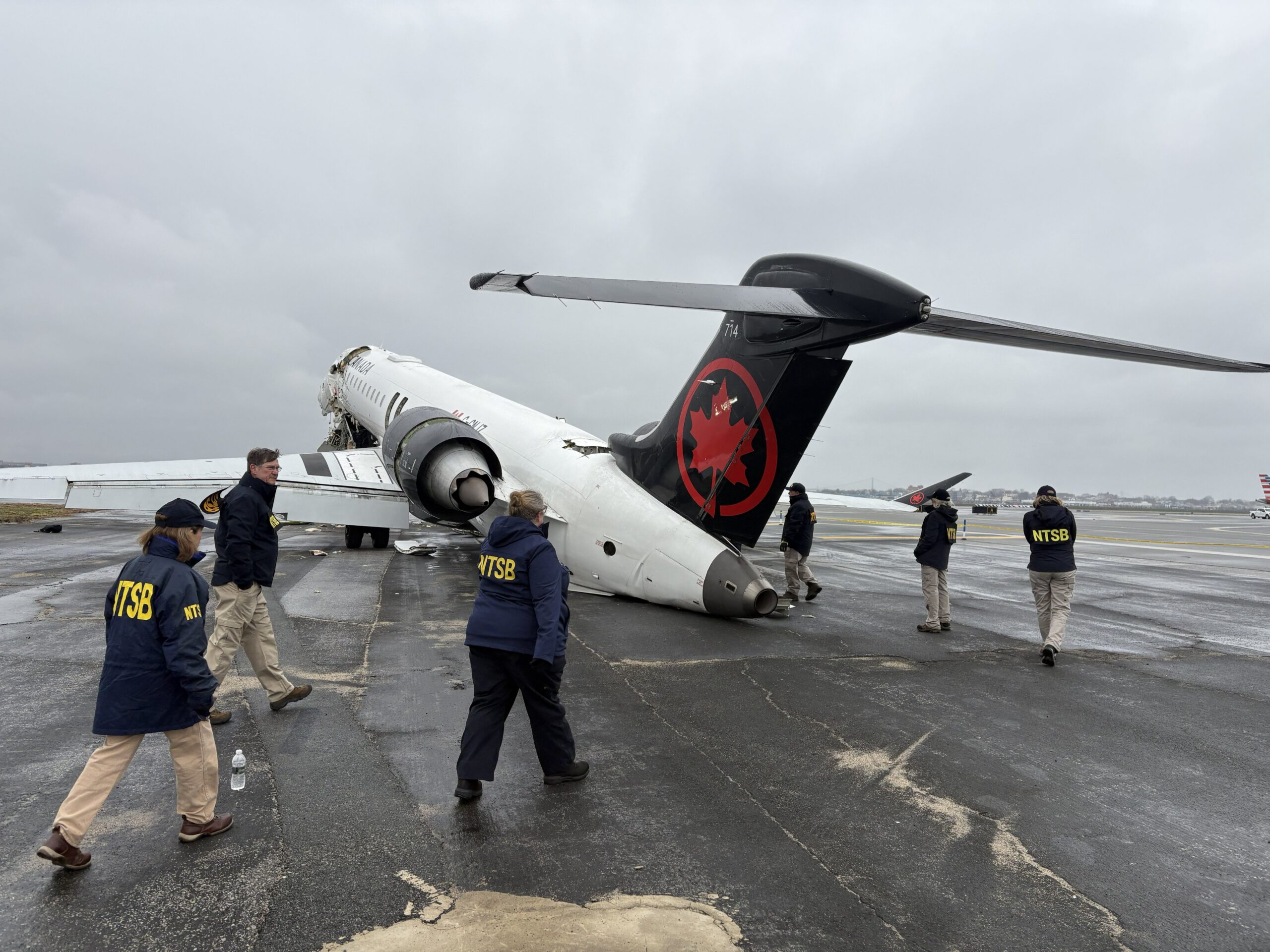
National Transportation Safety Board investigators arrive at LaGuardia Airport’s Runway 4 following the fatal collision between a passenger jet and fire truck. [Credit: NTSB]

The investigation into the ground collision between an airport fire truck and a regional jet at New York’s LaGuardia Airport (KLGA) in March is looking at the possibility that two air traffic controllers in the tower left work early that night.

According to a Wall Street Journal report on Thursday, a source close to the National Transportation Safety Board (NTSB) investigation has found the controllers have been placed on unpaid leave.

The accident, which took place March 22, involved a landing aircraft and a fire truck that was attempting to cross the active runway to reach an incident on the other side of the field.

The pilots of Air Canada Express Flight 8646 were killed when the jet collided with the fire truck that had entered the active runway. There were 72 passengers and four crewmembers on board the aircraft. Several people were injured.

“The FAA is committed to holding employees accountable, and we will not compromise the safety or efficiency of the National Airspace System,” the FAA said in a statement. “At the same time, we are strengthening our workforce at a record pace, with more than 2,000 controllers hired in 2026, the most in a single year and 20 percent more than in 2024. We have already met 94 percent of our hiring goal for the year.”

The NTSB is still investigating the accident. The National Air Traffic Controllers Association (NATCA) and FAA are also part of the investigation.

Meg Godlewski

Meg Godlewski has been an aviation journalist for more than 24 years and a CFI for more than 20 years. If she is not flying or teaching aviation, she is writing about it. Meg is a founding member of the Pilot Proficiency Center at EAA AirVenture and excels at the application of simulation technology to flatten the learning curve. Follow Meg on Twitter @2Lewski.

EAA’s CEO Named to Corporate Angel Network Board

Jack Pelton’s decades of aviation leadership will help support free flights for cancer patients.

Experimental Aircraft Association CEO Jack Pelton has joined the board of the Corporate Angel Network. [Credit: Corporate Angel Network LinkedIn]

The Corporate Angel Network (CAN), a nonprofit organization that arranges free flights on corporate aircraft for cancer patients traveling to treatment facilities, has announced that Jack Pelton has joined its board of directors.

Pelton brings decades of aviation leadership to the volunteer position. He serves as chairman and CEO of the Experimental Aircraft Association (EAA) and previously occupied the position of chairman, president and CEO of Cessna from November 2000 to May2011.

“I eagerly anticipate collaborating with the members of the board to further enhance CAN’s vital mission,” Pelton said in a statement. “Public benefit flying stands as one of the most impactful humanitarian initiatives in aviation. It not only brings important support to the people it serves but also offers profound fulfillment to the individuals and organizations that champion this important cause.”

Pelton’s dual leadership roles naturally highlight the alignment between EAA’s extensive aviation community and CAN’s mission, creating opportunities for shared advocacy and outreach within general aviation.

“While EAA and CAN don’t have an official relationship, we have over the past two years featured Public Benefit Flying at AirVenture to raise the visibility of the opportunities,” said EAA spokesman Dick Knapinski. “That includes Corporate Angel Network and a large number of other groups that use aviation for the public good.”

Meg Godlewski

Meg Godlewski has been an aviation journalist for more than 24 years and a CFI for more than 20 years. If she is not flying or teaching aviation, she is writing about it. Meg is a founding member of the Pilot Proficiency Center at EAA AirVenture and excels at the application of simulation technology to flatten the learning curve. Follow Meg on Twitter @2Lewski.

Ex-Spirit Pilots Receive Help Getting Their Logbooks in Order

AIROS assists aviators in entering and consolidating records, pulling needed information, and checking for potential mistakes.

AIROS digital logbook and paper logbook side by side [Credit: AIROS]

Former Spirit pilots left out of work by the discount carrier’s sudden collapse earlier this year are receiving some help with a critical part of the job search—getting their logbooks in order.

AIROS, which assists aviators in consolidating and checking their records through a cloud-based digital logbook, decided in May that it would make its service free for ex-Spirit pilots.

“We knew we had to do something, and we knew that whatever we did, out-of-work pilots weren’t going to be asked to spend money,” AIROS founder and CEO David Spektor told FLYING. “So we arrived at offering six months free for Spirit pilots. The thought was, we can bear that cost, and hopefully it comes back to us in the long run. And what it turned into was something quite special.”

AIROS’ system is more than a digital form of paper records, or, as Spektor compared it to some competing platforms, “more than a spreadsheet with an app wrapped around it.”

AIROS' digital logbook [Credit: AIROS]
AIROS’ digital logbook [Credit: AIROS]

The system can retrieve tail numbers for flights, calculate details like night and cross-country flight time automatically, and render flight information in a way that complies with airline hiring requirements. It stores all that information in the cloud, a step up from paper records, which can be destroyed or misplaced, and much safer than device-based products that rely on local storage on devices such as phones, which can break.

Unlike other digital logbooks, AIROS can catch mistakes and entries that don’t make sense before they become a permanent part of the logbook, Spektor said.

“We go a step further,” he said. “When a pilot is logging in AIROS, it will protect the pilot and audit as you go. Whereas in a spreadsheet, you can enter anything. It doesn’t protect you from the same vulnerabilities presented by paper.”

Accuracy and attention to detail are critical when assembling a logbook because it serves as the definitive record of a pilot’s experience.

“The granularity is important,” Spektor said. “It really gives the reviewer a picture of who you are as an aviator. It is the official legal record of what you have done as a pilot. It’s your journey captured in a document.”

Ryan Bingel flew for Spirit for 11 and a half years before the airline ceased operations in May. While he had scheduling records, he hadn’t kept a formal logbook in many years, and he sought out AIROS for assistance.

“They had a big task, because I knew what I had to have in order, and I didn’t have any of that,” Bingel said. “And David said, no problem at all, we can pull all these records, we can get tail numbers…I was able to give them this mess, and they could convert it all into AIROS.”

Bingel knew that he would have to get his logbook solidified before approaching potential employers.

“The airlines are really picky with logbooks right now,” he said. “You have to have every ‘I’ dotted and ‘T’ crossed. We spent a lot of time going through everything and putting it in a format that works for the airlines.”

The hard work is paying off. Bingel said that he has received job offers from two airlines so far.

Spektor, who currently works as an airline pilot, started building the company that became AIROS after receiving a furlough notice during the COVID-19 pandemic.

“I went to go catch up my logbook and very quickly discovered that the digital options at that time in 2020 had not changed and had not improved since 2010,” he said. “A decade had gone by and nothing had changed. So I said, now I know what I’m going to do while I’m furloughed. I’ve found a problem to solve, and no one’s flying anyway, so this is a good time to solve it.”

Today, AIROS has pilots on its operational team, board of directors, and among the investor group, according to Spektor, giving the company valuable perspective on its work.

“It has allowed us to keep a very good pulse on the industry, and it makes it easy for us as a company to make good decisions with the pilot top of mind,” he said. “Because that’s who we’re here for, the pilots. We don’t take lightly that what we are charged with is being responsible custodians of a pilot’s most important legal document.”

Spektor said AIROS has assisted over 200 former Spirit pilots so far and would welcome the chance to work with more.

Zach Vasile

Zach Vasile is a writer and editor covering news in all aspects of aviation. He has reported for and contributed to the Manchester Journal Inquirer, the Hartford Business Journal, the Charlotte Observer, and the Washington Examiner, with his area of focus being the intersection of business and government policy.

Exploring the Corner Case Approach for a Pilot

Solar storm or poor signal quality can force a downgrade past minimums.

GA airplane approach point of view [Credit: FLYING Archive]

LNAV/VNAV minimums are a bit of a mystery to most U.S. pilots. That’s probably because they’re rarely encountered, except at the relatively few airports with RNAV (GPS) approaches that have LNAV/VNAV minimums but no LPV minimums.

However, as will be explained, I encountered them while flying an approach with LPV minimums when the satellite signal quality was insufficient to support LPV minimums.

This Article First Appeared in FLYING Magazine

If you're not already a subscriber, what are you waiting for? Subscribe today to get the issue as soon as it is released in either Print or Digital formats.

Subscribe Now

LNAV/VNAV minimums are less of a mystery to pilots in other parts of the world. For example, I flew my first approach to LNAV/VNAV minimums when teaching at a Cirrus Pilot Proficiency Program in Australia in 2019. To have LPV minimums, there must be a set of ground reference stations nearby to generate the WAAS correction signals required to fly to LPV
minimums. Australia doesn’t yet have that infrastructure, so the lowest minimums commonly available for its RNAV (GPS) approaches are LNAV/VNAV. 

One of the most overlooked aspects of flying an RNAV (GPS) approach is that pilots often fail to look and see what minimums the system has authorized.

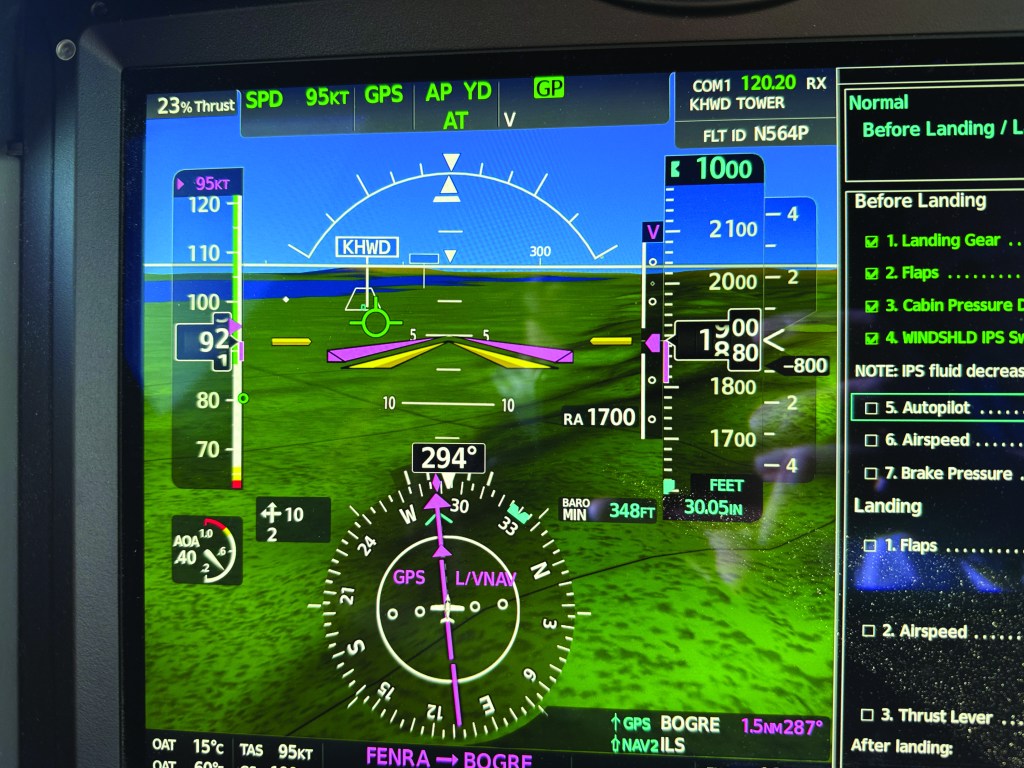
With a modern WAAS-capable GPS receiver, as soon as the final approach fix (FAF) becomes the active waypoint, the WAAS receiver evaluates the GPS satellite and WAAS correction signals. If the receiver’s analysis shows the signals are of sufficient quality to fly to LPV minimums, the TERM annunciator turns to a magenta LPV annunciator. Other common annunciations are L/VNAV (for LNAV/VNAV), LNAV, LNAV+V, LP, and LP+V. In Garmin G1000, G3000, G5000 and Perspective systems, these annunciators appear inside the HSI. 

A yellow LPV annunciator means the current satellite signal quality isn’t yet adequate for the approach. That’s an early indication LPV minimums may not be approved, unless the satellite signal improves. If satellite signal quality at the FAF is insufficient for LPV minimums, the approach minimums will be automatically downgraded, and typically the LNAV minimums annunciator and a message saying the approach was downgraded will appear. 

Approaches with LPV minimums of 250 feet agl and higher and LNAV/VNAV minimums both require the same 50-meter Vertical Position Level (VPL) signal quality. If that limit isn’t met, the approach will downgrade to LNAV minimums. Approaches with LPV minimums of less than 250 feet agl require a VPL of better than 35 meters, so those approaches could downgrade to LNAV/VNAV. 

Another scenario under which an approach could downgrade from LPV to LNAV/VNAV minimums is if the 40-meter Horizontal Alarm Limit (HAL) is exceeded. This is unlikely, since horizontal accuracy in the continental U.S. is extremely good and usually better than vertical accuracy. However, if the HAL limit were exceeded, the approach would downgrade to LNAV/VNAV minimums.

When flying to LNAV/VNAV minimums, the magenta pentagon needs to stay in the small gap between the two vertical white lines. [Credit: Max Trescott]

The big difference in flying to LNAV/VNAV minimums is that the glide path indicator appears as a magenta pentagon. From the FAF to the missed approach point, the LNAV/VNAV glide path must be flown within a plus-or-minus, 75-feet vertical window. The limits are displayed on the vertical deviation indicator as vertical white lines above and below the window, and the length of the lines vary as you approach the MAP.

When you’re flying the approach correctly, the magenta pentagon glide path indicator stays within the gap between the two white lines. If the pentagon glide path indicator moves outside the gap and points at one of the lines, you have excessive deviation, and the lines and the pentagon glide path indicator turn yellow.

Note that this is very different from flying to LPV minimums. LPV vertical guidance is angular, like an ILS, and becomes progressively more sensitive inbound. In certified avionics, that sensitivity is commonly limited to a minimum full-scale value of plus-or-minus 15 meters (plus-or-minus 49 feet) near the runway. The difference between 49 feet and 75 feet might not seem that great. But it’s important to recognize that the 49 feet for LPV representsfull-scale deflection, while the 75 feet for LNAV/VNAV requires staying between the white lines, which is far less than full-scale deflection.

A variety of equipment can be used to fly LNAV/VNAV minimums. GA pilots typically use a modern WAAS-capable GPS receiver. But airliners certified to fly these approaches can use barometric-VNAV systems, sometimes known as Baro-VNAV systems, which combine an IFR GPS receiver, which doesn’t have to be WAAS capable, with an additional barometric pressure input. These systems use barometric altitude information to compute a descent path between two waypoints, or an angle from a single waypoint.

There are many limitations, found in RNAV GPS instrument chart notes, that apply to Baro-VNAV systems. However, these notes don’t apply when flying with a WAAS-capable GPS receiver.

For example, you’ll find notes for high and low outside temperature limits for flying the approach. Also, remote altimeter settings are not permitted for use by airliners with Baro-VNAV systems, since the farther you are from the altimeter setting source, the greater the possible error when you use that altimeter setting. But with a WAAS-capable receiver you can use a remote altimeter setting listed on an approach to fly to LNAV/VNAV minimums.

KHWD RNAV (GPS) 28L

I recently experienced an approach to LNAV/VNAV minimums at Hayward, California (KHWD) while flying the RNAV (GPS) 28L approach in a Cirrus Vision Jet (see Chart Wise on page 20).

At some point early in the approach, the LPV annunciator in the HSI began flashing yellow. At about the same time, the autopilot’s vertical navigation, controlled by the VNV key, kicked off, and it would not make the initial stepdowns on the approach automatically. So, I had two issues to deal with.

The first thing I did was use my time machine—the thrust lever. I pulled it back to slow down and gain time. Dealing with the vertical navigation was the simpler of the two issues. Instead of using vertical navigation, I used the VS key to do the stepdowns individually. 

The GPS downgrade was a little more complex. After LPV flashed yellow for a while, L/VNAV appeared, and it too was flashing yellow. But then after a time it turned to magenta, and I knew the overall signal quality was sufficient to fly to LNAV/VNAV minimums. However, we were initially outside the white lines, above the glide path, with a yellow vertical deviation indicator. By slowing and increasing my descent rate, I got between the white lines, and the indicator turned magenta. 

Why the unusual downgrade to LNAV/VNAV? This occurred during a solar storm on January 19 that disrupted radio communications and greatly shrunk the area in which LPV service was available. As pilots, we need to be prepared for the unexpected. Knowing all you can about GPS approaches can help when the unexpected occurs.


Airports Without LPV Minimums

Here are a few of the airports in the U.S. with RNAV (GPS) approaches for which there are LNAV/VNAV but not LPV minimums: 

• Treasure Coast (KFPR), Florida: RNAV (GPS) RWY 28L 

• Stewart (KSWF), New York: RNAV (GPS) RWY 27 

• Peoria (KPIA), Illinois: RNAV (GPS) RWY 22 

• Carbondale/Murphysboro (KMDH), Illinois: RNAV (GPS) RWY 18L 

• Harvey (5H4), North Dakota: RNAV (GPS) RWY 29 

• Akutan (PAUT), Alaska: RNAV 27 

• Kona (PHKO), Hawaii: RNAV (GPS) RWY 35

If you fly into one of these airports, you’ll want to understand how flying to LNAV/VNAV minimums differs from flying to LPV minimums.


This column first appeared in the July Issue 972 of the FLYING print edition.

Max Trescott

Max Trescott is the host of the Aviation News Talk podcast, which focuses on GA and safety. He’s the author of Max Trescott’s G1000 and Perspective Glass Cockpit Handbook and another book on the G3000. He was inducted into NAFI’s Flight Instructor Hall of Fame in 2026 and earned the 2008 National CFI of the Year.

Piper PA-24 Crashes Off Alaska Coast, Killing 4

Preliminary investigation determines small aircraft submerged completely after going down near Seldovia.

Seldovia Alaska airport
The airport at Seldovia, about 136 miles southwest of Anchorage, Alaska. [Credit: Rebecca Douglas/Alaska Department of Transportation and Public Facilities]

A Piper PA-24-260 Comanche crashed off the coast of Alaska on Wednesday, killing all four occupants, according to officials.

Per a news release from state troopers with the Alaska Department of Public Safety, the small airplane departed Merrill Field Airport (PAMR) in Anchorage and was bound for the community of Seldovia, located about 136 miles southwest of Anchorage on Alaska’s Kenai Peninsula. A preliminary investigation determined that the aircraft submerged completely after crashing.

The National Transportation Safety Board (NTSB) will conduct a more thorough investigation to determine why the PA-24 crashed.

Per the Department of Public Safety, troopers were notified of the crash Wednesday around 1:18 p.m. local time. Personnel responded in a marine vessel and helicopter sent from Anchorage.

Troopers later that day recovered the airplane’s four deceased occupants, who were identified Thursday as pilot Eric Middlebrook, 68, of Anchorage, and Ronald Schmidt, 65, Lance Schmidt, 20, and Daniel Simons, 82, all from California.

The Anchorage Daily News reported the aircraft was submerged in 13-17 feet of water, according to Clint Johnson, Alaska region chief for the NTSB. Johnson said people at the scene tried to rescue the occupants but could not reach the aircraft. Anchorage’s KTUU-TV reported that Seldovia City Manager Heidi Geagel was on the scene following the crash.

The incident marks the second fatal crash in Alaska within the past week.

On Friday, a Cessna 441 chartered by the U.S. Army Corps of Engineers for travel to Cape Newenham Long Range Radar Site Airport (PAEH) crashed in a remote part of the state, killing both pilots and all six passengers. The aircraft was flying in foggy conditions, according to a preliminary investigation. Cape Newenham is part of a larger network of remote radar sites that tracks aircraft operating in Alaska’s airspace and along its borders.

Alaska is known for having a high incident rate compared to the contiguous U.S. states. U.S. Transportation Secretary Sean Duffy in August called the frequency of accidents “unacceptable” and vowed to lower it.

Per the NTSB, between 2008 and ’17, Alaska’s total aircraft accident rate was nearly 2.35 times higher than the rest of the U.S. Its fatal aircraft accident rate was about 1.34 times higher.

Under its $12.5 billion air traffic control modernization effort, the FAA intends to install 110 additional weather stations and 64 new weather camera sites in Alaska, which it has designated one of the project’s five main focus areas.

Jack Daleo

Jack is a staff writer covering advanced air mobility, including everything from drones to unmanned aircraft systems to space travel—and a whole lot more. He spent close to two years reporting on drone delivery for FreightWaves, covering the biggest news and developments in the space and connecting with industry executives and experts. Jack is also a basketball aficionado, a frequent traveler and a lover of all things logistics.

Atlantic Aviation Valued Close to $10B With Private Equity Injection

Apollo Global Management funds acquire ‘significant interest’ in FBO under new strategic partnership.

Atlantic Aviation FBO
Private investors continue to bet on aviation infrastructure providers such as Atlantic Aviation, which has more than 100 North American FBO locations. [Credit: Atlantic Aviation]

Apollo Global Management said Thursday that its managed funds have taken a “significant interest” in Atlantic Aviation, which operates one of the world’s largest FBO networks. Apollo said the deal values Atlantic at nearly $10 billion.

Atlantic offers fueling, maintenance, deicing, hangar leasing, and concierge services for private aircraft out of more than 100 North American locations. The company also seeks to accommodate future aircraft, including electric vertical takeoff and landing (eVTOL) air taxis, by building a network of electrified vertiports under its Vertiports by Atlantic (VbA) unit.

Per Apollo, the FBO has one of the best safety records in the industry. Atlantic in 2025 said that 62 individual employees in its “Safety Pays” program were recognized for their efforts, with its facilities at Harry Reid International Airport (KLAS) in Las Vegas and Hilo International Airport (PHTO) in Hawaii earning awards.

Investors Snap Up FBOs

The strategic partnership between Apollo and Atlantic will see private investors take an even larger slice of the FBO’s pie.

In 2021, investment firm KKR acquired about 70 Atlantic FBOs from Macquarie Infrastructure Holdings for about $4.5 billion, later merging Atlantic’s business with Ross Aviation’s 19 locations. The partners have since expanded Atlantic’s presence in the U.S. and globally.

Apollo said KKR will remain a “substantial shareholder” in Atlantic following the transaction. Bloomberg in 2025 reported that KKR was exploring a possible $10 billion exit from the FBO through either a sale or initial public offering, though sources said the investor could retain its stake.

Private equity firms have shown an appetite for aviation infrastructure that many investors view as stable assets.

Apollo Infrastructure Funds in 2023 agreed to acquire a majority stake in Atlantic competitor Modern Aviation, which has also been backed by Tiger Infrastructure Partners. A few years earlier, Blackstone, Global Infrastructure Partners, and Bill Gates’ Cascade Investments acquired Atlantic’s chief rival, Signature Aviation, for about $4.7 billion.

In January, Bain Capital entered the FBO sector with its acquisition of APP Jet Center and its five locations for an undisclosed fee. Bain said that increased flight activity, modernized aircraft requiring new infrastructure, and limitations on developments at airports have driven strong demand for private and business aviation.

Demand could expand with new aircraft entrants that promise quieter and more efficient regional flights. Atlantic is working with eVTOL air taxi manufacturers Archer Aviation, Joby Aviation, and Beta Technologies—all backed by Blackrock—to prepare its locations for electric aircraft operations.

Apollo said Thursday that it has originated more than $155 billion in infrastructure investments over the past five years. It said KKR manages more than $120 billion in infrastructure assets and has poured more than $12 billion into the aviation sector since 2015.

Jack Daleo

Jack is a staff writer covering advanced air mobility, including everything from drones to unmanned aircraft systems to space travel—and a whole lot more. He spent close to two years reporting on drone delivery for FreightWaves, covering the biggest news and developments in the space and connecting with industry executives and experts. Jack is also a basketball aficionado, a frequent traveler and a lover of all things logistics.
Pilot in aircraft
Sign-up for newsletters & special offers!

Get the latest stories & special offers delivered directly to your inbox.

SUBSCRIBE