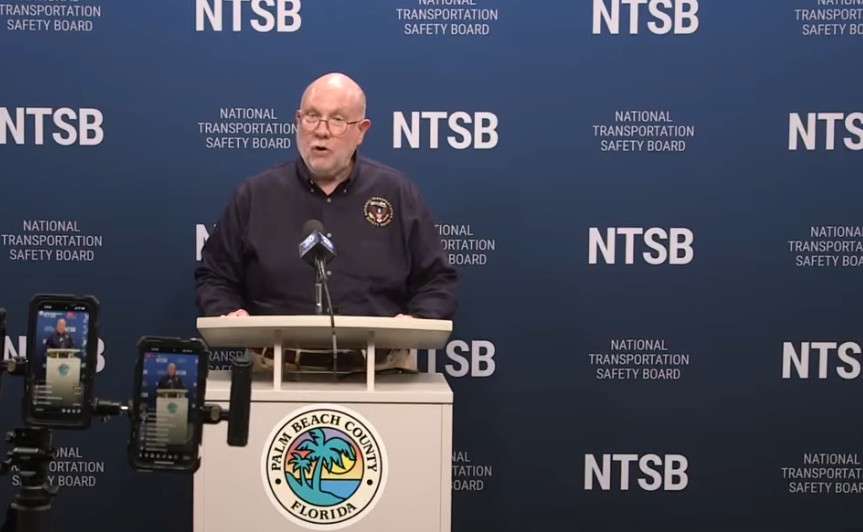
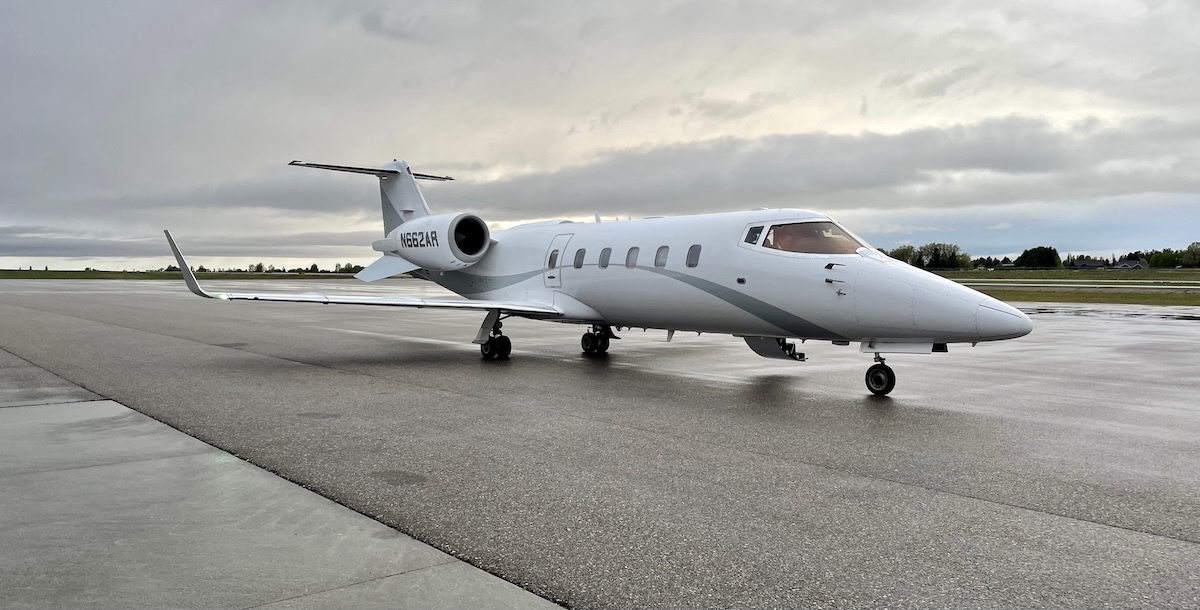
The National Transportation Safety Board said Tuesday that investigators recovered the “majority” of the left elevator of the Learjet 60 that fatally crashed in Palm Beach County, Florida. NTSB member Tom Chapman believes the recovered components are evidence that “at least some” parts of the aircraft separated before it impacted the ground.
Chapman said the elevator was located in three pieces between 1.3 and 3.8 miles away from the airplane’s impact site, indicating that it is “implausible that it would have been a result of the impact. It would have separated before the impact.”
Elevators are the movable parts of an aircraft’s horizontal stabilizer, located on the tail, that control pitch. The elevator is actuated by high-strength steel cables threaded through pulleys inside the fuselage, requiring a great deal of force to detach them.
Automobile dash cam images captured moments before the Learjet impacted the ground appear to show that the jet’s horizontal stabilizer was partially or fully missing.
Chapman said that considering the aircraft’s vertical rate of descent, reported by FlightRadar24 as exceeding 32,000 fpm, it is unclear if the elevator “would have been effective” in helping the crew control pitch even if it were attached. He added that it is unclear whether the loss of the elevator “may have contributed to the crash itself, or whether the forces on the aircraft caused that to separate.”
Chapman also said that new dash cam footage and eyewitness accounts will “help us better understand the condition of the aircraft and the circumstances of the crash.”
The NTSB has asked people who find parts of the jet not to touch or move them.
What We Still Don’t Know
On Monday, the Learjet’s captain, copilot, and seven passengers—all of whom died in the accident—were identified. The NTSB also said Monday that one person on the ground suffered a leg injury, but no other injuries or fatalities near the crash site have been reported.
Among the agency’s most important tasks in the coming days will be recovering other parts of the jet, which Chapman said were broken into tiny pieces due to the force of the impact. He said investigators continue to document and collect evidence but are not sure exactly what they have recovered due to the extent of the damage.
“It’s a difficult scene, no question about it,” Chapman said.
Investigators are working to remove water from the Learjet’s impact crater in order to examine the area in and around it. On Monday, local authorities removed a utility pole from the site. Chapman said he expects personnel to find critical components within the crater that will provide sufficient evidence to further the investigation.
One item investigators will seek to recover is the jet’s cockpit voice recorder (CVR). Chapman said Monday that early indications are that a CVR was installed on the airplane, but it was unclear if it was still on board at the time of the accident. The NTSB will seek to determine whether it was, but water filling the crater may make recovery difficult.
“That’s something we’re going to be concerned about,” Chapman said Monday.
The NTSB in August released the docket for its investigation into the early 2025 crash of a Learjet 55 in Philadelphia, which killed the aircraft’s six occupants and two people on the ground.
In that incident, the aircraft’s impact similarly created a large crater. Investigators managed to recover the jet’s CVR but determined it was not working at the time of the accident, preventing them from obtaining audio. There is still no final report or probable cause for the incident.
The NTSB will not issue a probable cause determination while on scene investigating Sunday’s accident.
Impact of Weather
Chapman on Tuesday reiterated that “weather is certainly a key focus of the investigation.”
On Monday, he could not confirm whether the Learjet flew through an active thunderstorm, but convective SIGMETs were active across Florida before the accident. A convective SIGMET warns pilots of thunderstorms with intense downdrafts, wind shear, and severe icing.
The NTSB will likely aim to determine whether the jet’s onboard weather radar was functioning correctly, giving the crew visibility of local conditions.
According to air traffic control (ATC) audio, at 12:31 p.m. EST on Sunday, about 20 minutes before the crash, a controller at Miami Center told the crew there was moderate precipitation at their 11 o’clock and 5 miles away, scattered 150 miles to the southeast. They told the crew they could deviate left and right and to proceed direct to the FEMID waypoint, near Naples on Florida’s southwestern coast, when able. The aircraft was in level flight at 41,000 feet.
About one minute later, the crew requested to fly direct to the Freeport ZFP VOR waypoint, which is north of the FEMID waypoint on the other side of the state. ATC initially cleared the jet to the fix, but shortly after, the controller warned the crew of moderate to extreme precipitation along that route and said the “turn to Freeport looks pretty bad.”
Around 12:35 p.m., the crew said they would fly direct to FEMID before proceeding to Freeport, which would have placed their route slightly further south than flying direct. About one minute later, ATC directed the crew to descend and maintain 35,000 feet.
Around 12:40 p.m., after the Learjet had passed FEMID, ATC approved deviations left or right of course but told the crew to fly direct to Freeport when able. According to ADS-B tracking data, around this time, the aircraft made a slight left turn that placed their heading north of Freeport, in the direction of Palm Beach and toward thunderstorms in the area tracked by local weather radar.
Approximately four minutes before the crash, the flight crew reported that they were turning direct to Freeport and encountering clear ice, which they described as manageable. Clear ice tends to be particularly heavy and tenacious and can create abnormal shapes when building up on the wings, destroying lift. Ice accumulation happens quickly and, in addition to adding weight, can affect smooth airflow over the wing.
The Learjet 60 has three systems for deicing, but it is unclear whether they were operational before the accident.
The NTSB said that Tuesday was its last on-site briefing and that it would post updates to its website and X account.