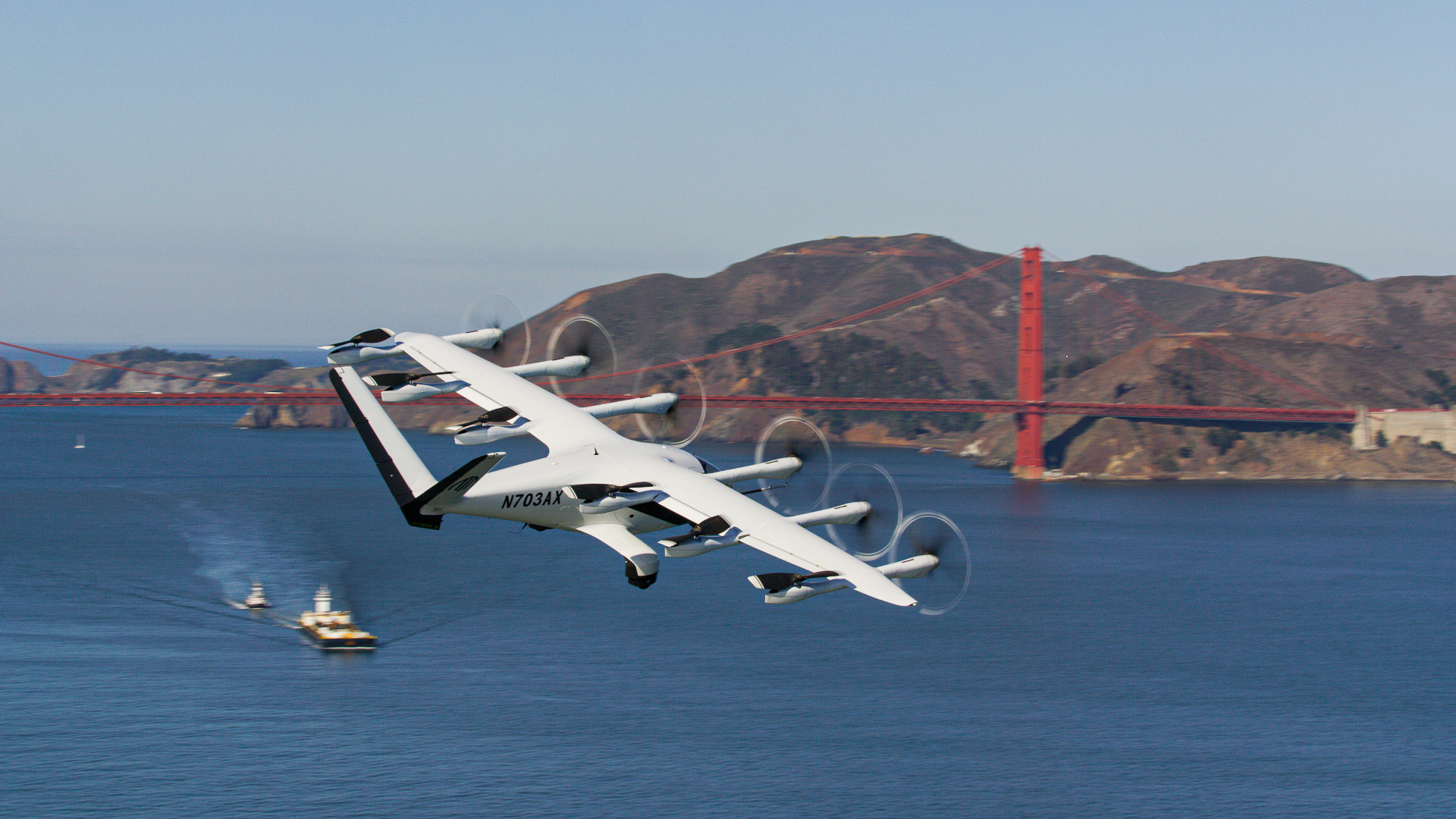
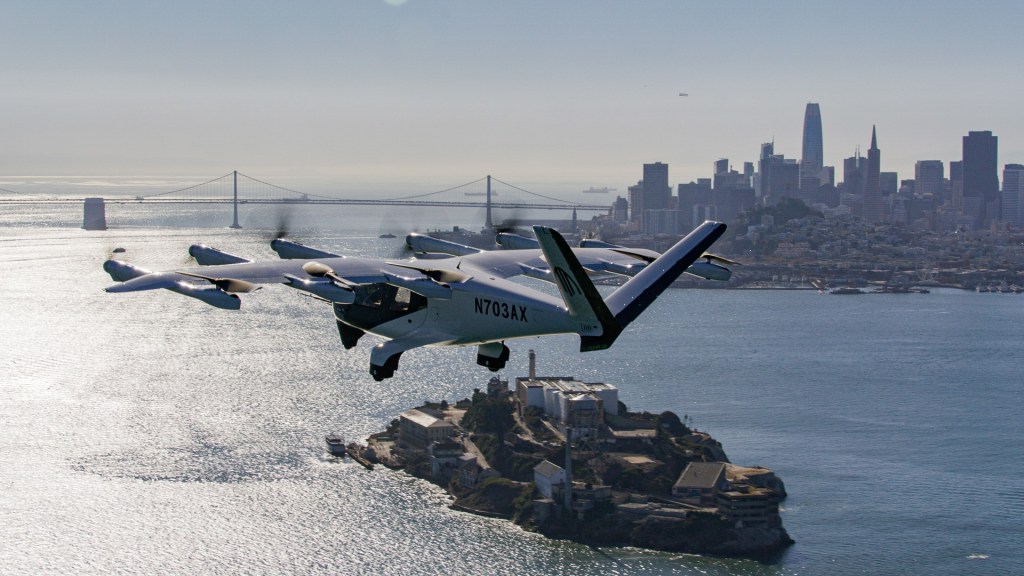
Archer’s Midnight prototype, N703AX, conducts an out-and-back flight over the San Francisco Bay. [Credit: Archer Aviation]
Electric vertical takeoff and landing air taxi manufacturer Archer Aviation on Thursday conducted demonstration flights over the San Francisco Bay as the company lays the groundwork for future commercial service in the region.
According to FlightAware, Archer’s aircraft registered N703AX made three flights over the bay, each lasting about 20 minutes. Archer said it demonstrated that a trip on its Midnight air taxi to San Francisco’s Marina District could take about 10 minutes versus more than one hour by a car in traffic. The prototype did not land in the Marina District, instead taking off and landing using the runway at Oakland International Airport (KOAK).
Archer has not yet showcased Midnight’s transition from vertical to forward flight, the defining capability of eVTOL models that will allow them to leverage fixed-wing efficiency while minimizing ground footprint to smaller, dedicated areas known as vertiports. Aviation International News reports that N703AX is a preproduction prototype that cannot transition between vertical and wingborne flight.
Archer said the Bay Area flights were part of a “week filled with piloted flights across Northern California,” during which the aircraft flew over 200 miles and reached top speeds of 131 mph. The manufacturer said it flew into seven cities over three days, capping off the first leg of its “No Roads” demonstration campaign.
The next leg of the tour will take Midnight to Los Angeles, where Archer is partnering to build a vertiport. LA is one of several locations where it is planning future commercial operations, with the goal of beginning on-demand passenger service during the 2028 Olympic Games.
“Flying Midnight across multiple cities in Northern California shows we can connect communities with no roads, no traffic, and no emissions in minutes instead of hours,” said founder and CEO Adam Goldstein in a news release. “That’s the future we’re working toward bringing to the Bay Area, Los Angeles and cities across the country.”
Archer’s Midnight is designed to turn hour-plus drives into quiet, zero-emission, all-electric 10-20 minute trips in locations such as Los Angeles and New York City. Though it has not yet demonstrated the transition from vertical to forward flight, its tilting rotors are intended to support both modes, allowing it to maintain runway independence and cruise at up to 150 mph. The air taxi is designed for a pilot to fly up to four passengers and charge in about 10 minutes.
Up Next for Archer
Archer’s No Roads campaign began in September, when Midnight flew round-trip journeys between the company’s California facilities in Salinas to Monterey and Hollister. The prototype also demonstrated piloted operations at the 2026 California International Airshow on September 22 in Salinas.
The manufacturer said the campaign advanced to progressively larger cities and more complex airspace over the past month, visiting Hollister, San Martin, San Jose, Mountain View, and Hayward before arriving in Oakland. There, the goal was to “showcase Midnight’s ability to operate seamlessly in complex urban airspace” near KOAK, San Francisco International (KSFO), and San Jose International (KSJC).
Archer’s Midnight soars past Alcatraz Island in the San Francisco Bay. [Credit: Archer Aviation]
Per FlightAware, N703AX journeyed from Oakland back to Salinas between Friday and Sunday. After Los Angeles, future tour legs are planned for Texas and Florida, where Archer will conduct activities under the FAA’s eVTOL Integration Pilot Program (eIPP). Manufacturers and operators that have launched eIPP operations are sharing data with the FAA in order to guide the regulator’s development of future operational rules for air taxis and other novel aircraft technology.
Archer’s announcement of the No Roads tour did not specify whether it will include VTOL operations. The company said in March that its latest test aircraft at the time was “on track” for piloted VTOL activities during the eIPP later this year.
The manufacturer’s chief rival, Joby Aviation, flew over the San Francisco Bay in March and shared a video depicting its prototype’s full transition from vertical to wingborne flight. Joby officially began eIPP operations in Texas in September and shared imagery showcasing vertical takeoffs.
Though both have secured FAA Part 135 certification, Archer and Joby have yet to obtain type certification for their respective eVTOL designs. Each aims to begin passenger flights in the coming months. Their first such flights may be noncommercial, conducted under the eIPP with FAA oversight.
Both companies have a marquee airline and manufacturing partner—United Airlines and Stellantis for Archer, and Delta Air Lines and Toyota for Joby.
Jack is a staff writer covering advanced air mobility, including everything from drones to unmanned aircraft systems to space travel—and a whole lot more. He spent close to two years reporting on drone delivery for FreightWaves, covering the biggest news and developments in the space and connecting with industry executives and experts. Jack is also a basketball aficionado, a frequent traveler and a lover of all things logistics.
When pilots start thinking about purchasing an airplane, often one of the first things that comes to mind is the prospect of taking wonderful airborne journeys with family and friends to distant destinations beyond the reasonable range of a road trip. While passengers are sure to appreciate the time-saving speed and efficiency of traveling in a light aircraft, most pilots know that comfort is what keeps them happy.
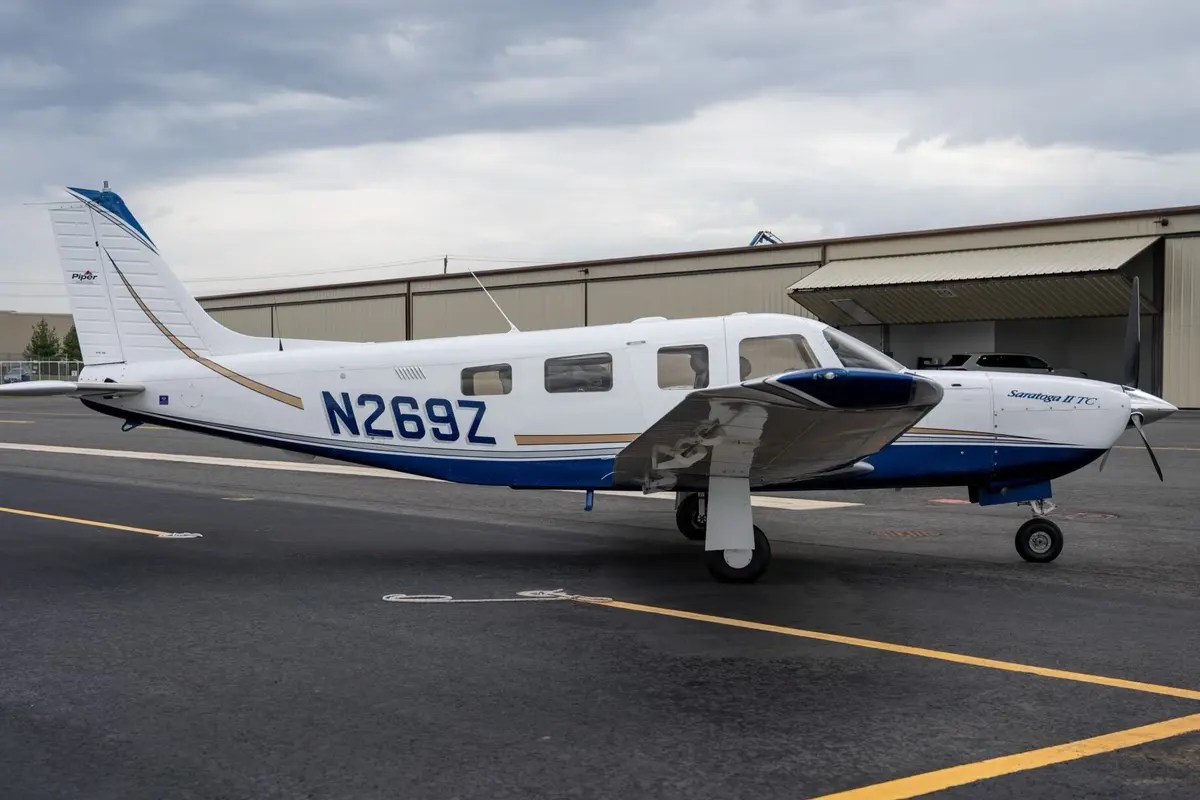
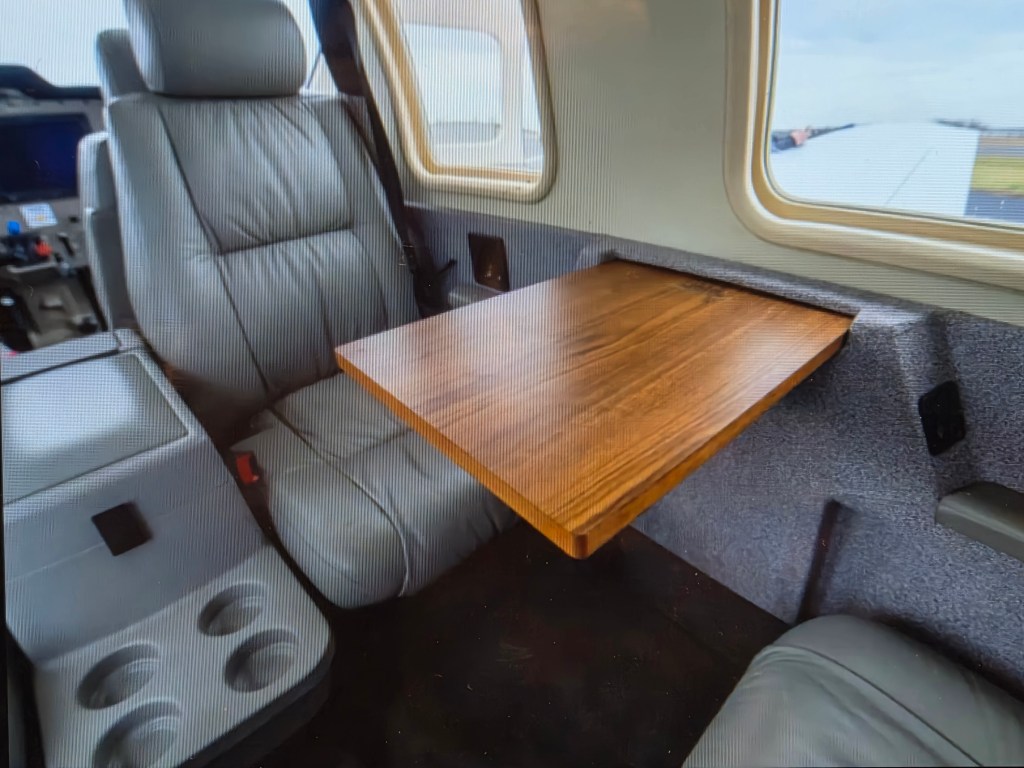
The Saratoga is known for its spacious interior. [Credit: Aerista]
The aircraft for sale today is the epitome of comfort. Piper Saratogas have long been known for their spacious cabins with club seating that provides a familiar, relaxed living-room feel that immediately makes everyone on board wonder how they ever tolerated airline economy class. Smooth, stable flight characteristics help everyone enjoy the voyage while focusing on the passing scenery.
As the pilot of this six-place, cross-country specialist, you might have to accept comparisons of your airplane to a large, luxury SUV. Try to remember that the folks in the cabin consider this a compliment. Then focus on impressing them with your best landing.
This 2006 Saratoga II HP has 1,610 hours on the airframe, 600 hours since overhaul on its Lycoming IO-540-AH1A engine, and 550 hours since new on its Hartzell three-blade aluminum propeller. The aircraft’s empty weight is 2,637 pounds.
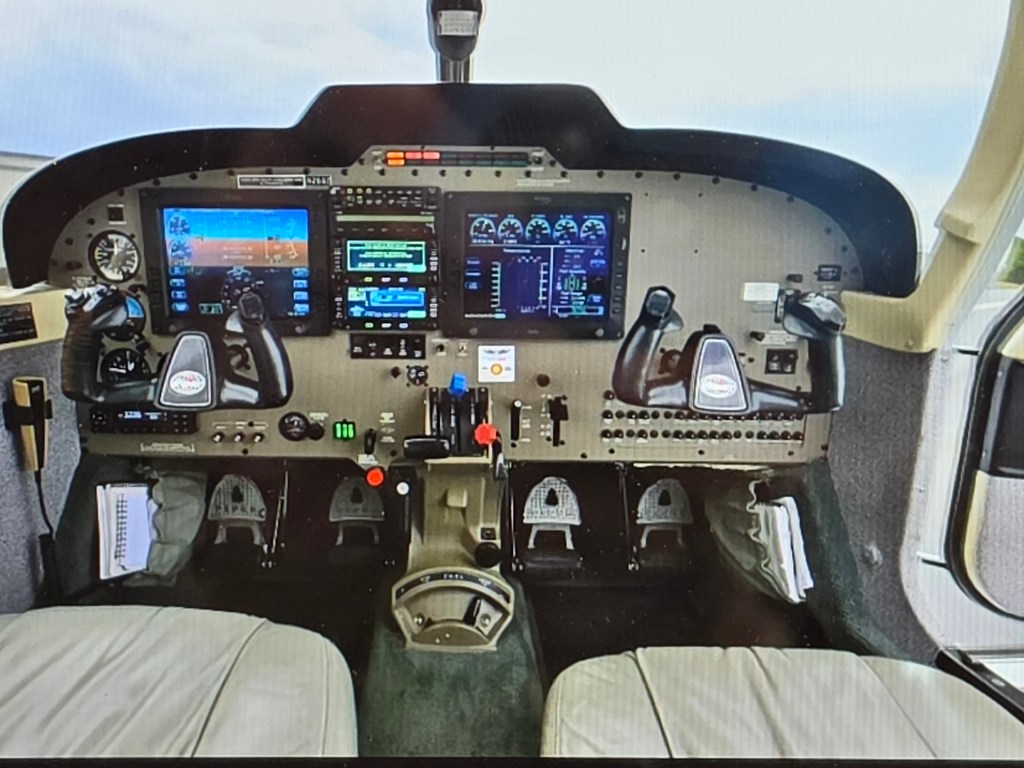
This late-model Saratoga has an up-to-date panel. [Credit: Aerista]
The panel features Avidyne Entegra EX5000 PFD and MFD, dual Avidyne IFD-440 navigators, Garmin GMA 340 audio panel, and GTX 345 transponder with ADS-B In and Out. Additional equipment includes a built-in oxygen system, TKS ice protection system, factory air conditioning, Whelen LED beacon, Sky-Tec starter and Reiff engine preheater,
Pilots looking for a powerful, capable and comfortable, six-place aircraft for family travel or business pursuits should consider this 2006 Piper Saratoga II HP, which is available for $394,900 on AircraftForSale.
If you’re interested in financing, you can do so with FLYING Finance. Use our airplane loan calculator to calculate your estimated monthly payments. Or, to speak with an aviation finance specialist, visit flyingfinance.com.
Jonathan Welsh is Lead Editor of Aviation Consumer and a private pilot who worked as a reporter, editor and columnist with the Wall Street Journal for 21 years, mostly covering the auto industry. His passion for aviation began in childhood with balsa-wood gliders his aunt would buy for him at the corner store. Follow Jonathan on Twitter @JonathanWelsh4
Hugh Milstein found that aviation is a disciplined craft where consistency and focus build true, lasting pilot
competence. [Credit: Hugh Milstein]
It’s after 3 a.m. in Los Angeles, and the city is quiet. I’m sitting under a single lamp in my office surrounded by maps, handwritten kneeboard notes, charts with soda stains, and pages folded and refolded from repetition. Three weeks ago, I passed my private pilot check ride, yet it still doesn’t feel real. People assume the moment your DPE shakes your hand and says “You passed” is the finish line, but at 3 a.m. you learn it’s not a finish line at all.
It’s a doorway.
I started flight training at 57 years old and earned my certificate at 60, discovering that the sky doesn’t care how old you are—only how prepared you are. Preparation, I learned, requires curiosity, patience, physical stamina, quiet confidence, humility, and, above all, respect for the process and the machine.
If you're not already a subscriber, what are you waiting for? Subscribe today to get the issue as soon as it is released in either Print or Digital formats.
Most people who hear that I began flight training at 57 raise their eyebrows, and some chuckle the way pilots sometimes do when they hear about late bloomers. Yet a surprising number lean in closer, as if they are quietly searching for permission to pursue something they once set aside. Many adults carry a dream they shelved somewhere along the path of responsibility—and for me that dream was aviation.
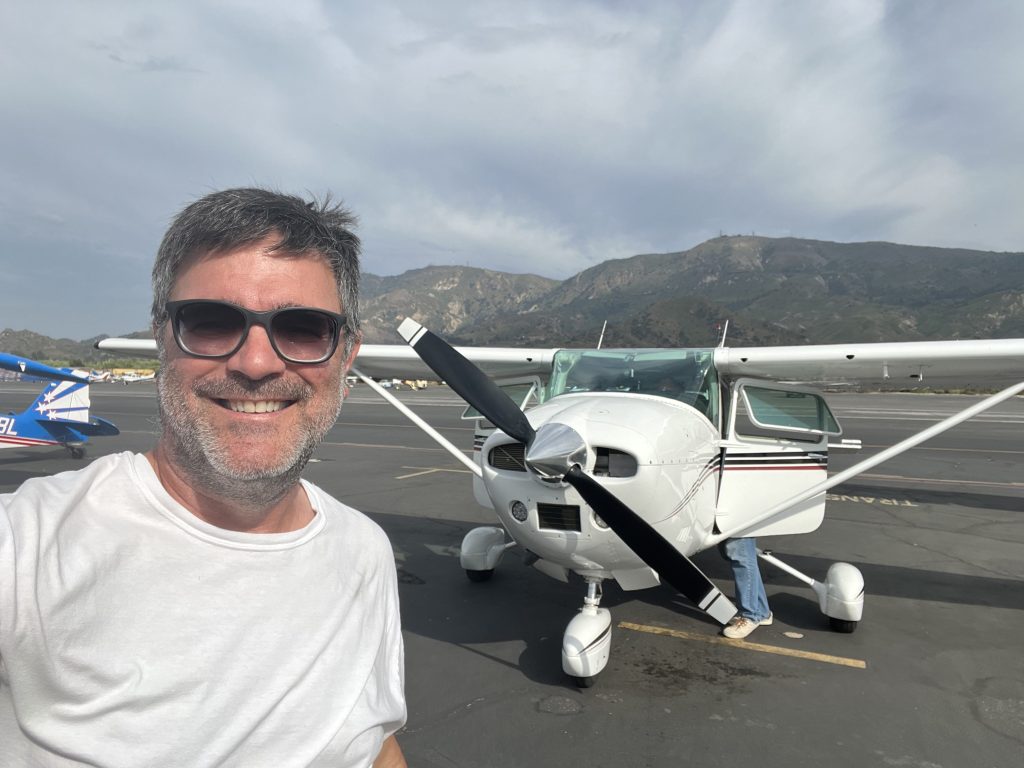
My training began in a Cessna 182P out of Zamperini Field (KTOA) in Torrance, California, a busy general aviation environment. I didn’t chase speed of completion—I chased competence. If I was going to put my friends and family in an airplane, I wasn’t going to rush the process or treat it like a casual hobby. Flying is a craft, a discipline, and a responsibility. Rushing through training doesn’t teach you to fly. It only teaches you to get lucky.
Southern California offers a master class in airspace management. The region is surrounded by the shelves and walls of Class B airspace around KLAX, intersected by Class C airports that require you to establish communication before entering, and dotted with Class D airports overlapping like puzzle pieces. Helicopter routes cross the basin, marine layers roll in from the Pacific, jet traffic descends through VFR corridors, and student pilots share frequencies with airline arrivals, news helicopters, and VIP TFRs.
Layered on top of all that complexity is the rhythm of SoCal radio communication, where timing, brevity, and clarity matter as much as the words themselves. Training here isn’t a novelty. It’s serious aerospace literacy, and learning to navigate this environment builds awareness and humility from the beginning.
My instructor, Gary Palmer, was calm, precise, and patient. Never rushed. Never rattled. The kind of CFI whose quiet tone tells you, “We’ve got time. Let’s do it right.” His saying was: “In this airspace, you don’t get to be casual. You get to be prepared.”
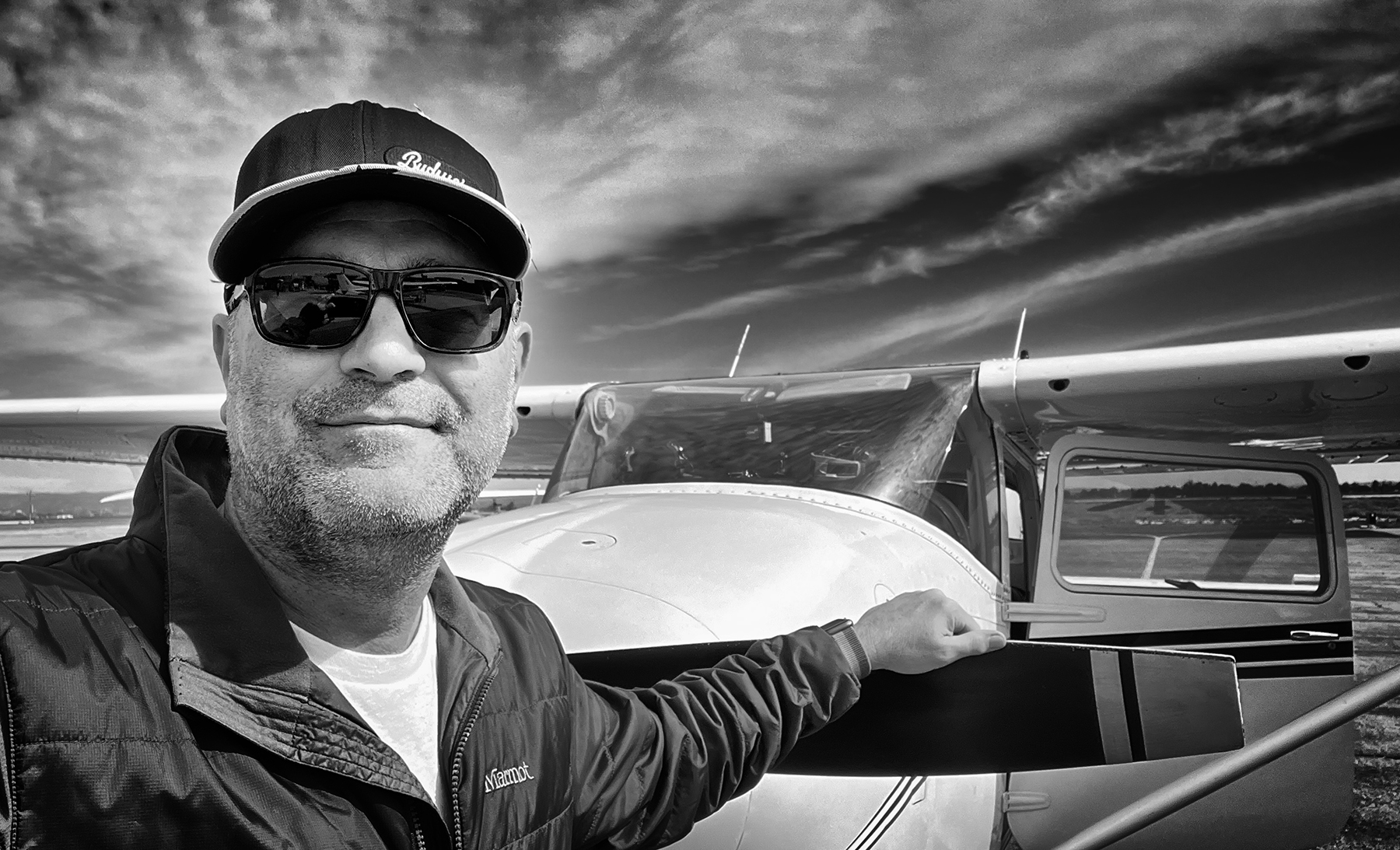
Hugh Milstein found that aviation is a disciplined craft where consistency and focus build true, lasting pilot competence. [Credit: Hugh Milstein]
Palmer taught me that safety is not an attitude—it’s a habit.
People often imagine flying as a seated activity, but operating a piston aircraft from a hangar involves more physical effort than most expect. Pulling out a Cessna 182 from its hangar by hand, lifting heavy fuel hoses above shoulder height to refuel high wings, wrestling hangar doors that feel older than some of the runways themselves, and climbing in and out of the cockpit under the heat of the California sun all demand energy and stamina.
After one particularly exhausting lesson, while pushing the airplane back into the hangar, I realized how different real aviation felt from anything simulated on a screen. The experience motivated me to carve out daily time to exercise.
I began power walking every day with music and small hand weights, building the physical endurance that training required. A habit that absolutely carried me through training and the check ride. I was more prepared physically and mentally with my body tuned up.
Moment Everything Changes
There are only a handful of moments in life when you know in advance that you’re about to experience something permanent. Your first solo flight is one of those.
The morning air was clear and cool, my nerves sharp and focused, and my heart pounding with a mixture of anticipation and disbelief. When my CFI stepped out of the aircraft and closed the door behind him, the airplane suddenly felt lighter, and the sky seemed larger than ever before.
Throttle forward. Engine roar. Nose up. And then—lift. Freedom. Disbelief. I laughed. Out loud. Alone. At 80 knots. It felt like being given the keys to a Ferrari in high school and told “Take it on the freeway.”
On downwind, tower told me to extend. I flew toward the Queen Mary, calm, listening. My side window suddenly popped open midflight—strike one. I closed it and carried on.
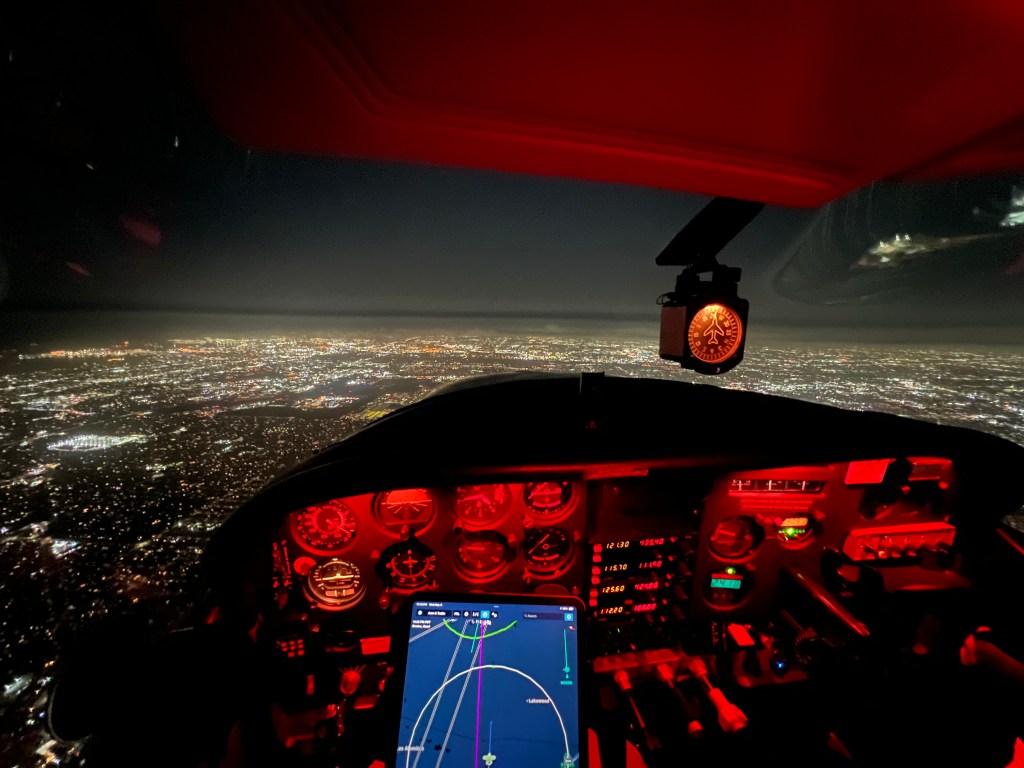
Hugh Milstein found that aviation is a disciplined craft where consistency and focus build true, lasting pilot competence. [Credit: Hugh Milstein]
Landing? No. 4 in the pattern. You’ll call my base. Um, OK, sure. Like the runway rose to meet me. Like the earth gave me permission to arrive. I taxied off and exhaled everything I’d been holding for months. The feeling was less like victory and more like being welcomed into a community I had long admired.
My “aha” moment wasn’t on solo day. It was weeks later, flying to Camarillo (KCMA), California, for the first time via the special flight rules corridor over KLAX. Camarillo tower gave a traffic advisory: “Jet passing below you at 11 o’clock.” My instincts screamed—below me? Don’t they know I’m a student? But the training voice won.
Eyes outside. Hands steady. Breath calm. Then…click. The unfamiliar runway came into view. The coordinated relationship between throttle, pitch, and rudder pedals felt effortless. Suddenly, I wasn’t manipulating controls. I was shaping flight.
When we landed, Palmer simply looked over and said, “You flew that,” which, in aviation language, meant everything.
Behind every smooth landing there’s a series of challenges that rarely appear in photographs or social media posts. Fatigue from work. Predawn drives in LA traffic. Budgeting aviation costs responsibly. Weather delays causing weeks lost. Not progressing as fast as you wanted. Comparing yourself to “40-hour” pilots online. Days where you fly worse than last week. Days where life hits you before the airport does.
Flying exposes you. Not your age, but your habits. These fluctuations are part of the learning process, revealing your resilience.
Two moments shaped my crisis mindset. The first was a presidential TFR. Suddenly during a lesson, a known TFR changed its start time, and we were minutes from violating restricted space. Palmer’s voice was calm as water: “We divert now.”
And we did. Without drama.
The second was an instance of lost comms and having to squawk 7600. I learned that hand-held radios should be battery tested and frequency set before every flight. I also figured out the signal does not reach as far as I thought it would.
Emergencies aren’t events. They’re evaluations.
On my student solo cross-country to San Diego, I called SoCal Approach for flight following.
ATC replied: “You’re doing a great thing getting flight following. We’ll keep you safe.” Then an airline pilot on frequency chimed in: “Exciting times!” That moment made me realize aviation isn’t solitary. It’s a conversation happening in the sky. It’s a community connected by radios and responsibility.
Check Ride
The week before my check ride I experienced stress like I hadn’t felt since college exams. To manage pressure, I booked a hotel next to the airport. Morning routine: Walk. Stretch. Breathe. Reset. The oral was long, detailed, and demanding, but I had all the materials I needed to “look it up” when needed. That helped.
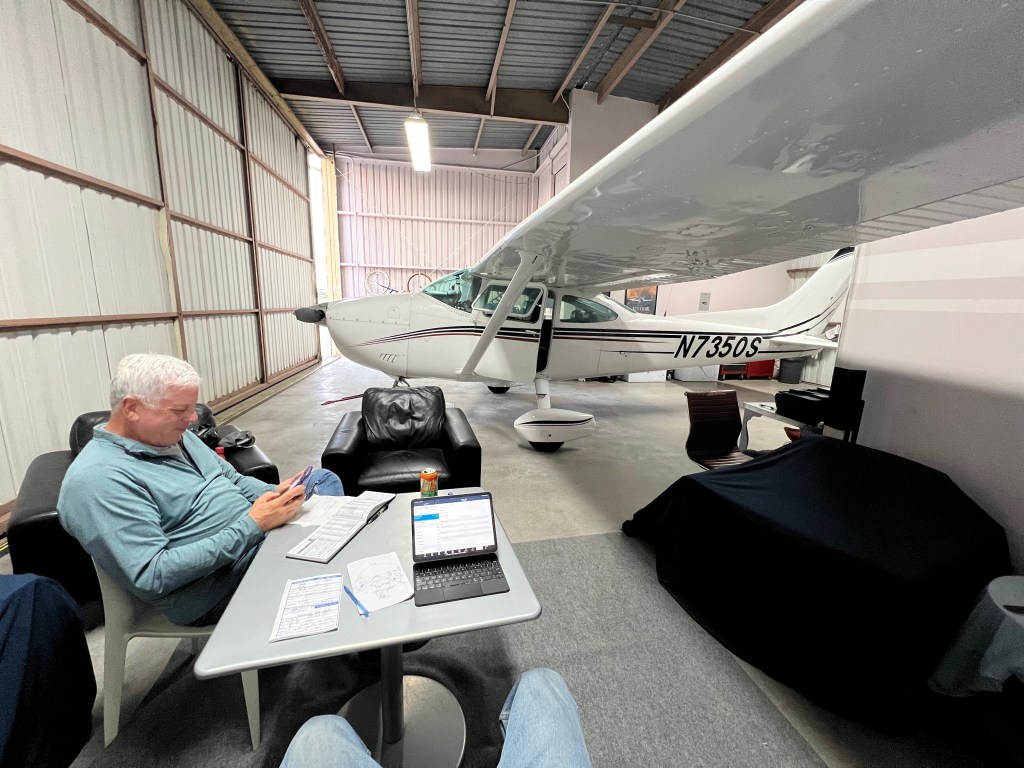
CFI Gary Palmer’s quiet tone conveys, ‘We’ve got time. Let’s do it right.’ [Credit: Hugh Milstein]
Then out to the airplane to find the marine layer had shut down my planned dead reckoning and pilotage route. I turned to the examiner and said, “I can’t go that way. It’s obscured. I’ll need a few minutes to replan.” He glanced at me from the right seat. “What might that look like?” That was the test—adapting with clarity, not panic. That moment didn’t test knowledge. It tested judgment.
Hours later, after flying through airspace I had never been through, and a short field landing back at my home airport, I taxied in and shut down. Silence. Then the handshake. “You passed.” I said nothing eloquent. Just three quiet “thank yous.” And my eyes…well, they weren’t dry.
Becoming a Beginner Again
Some days I felt 30 again. Some days I felt every bit of 60. But flying does something no gym, job, or meditation ever did: It sharpens life. You stay fit to fly. You sleep to fly. You hydrate to fly. You breathe to fly. Age tests your body. Aviation strengthens your mind.
Flying taught me calm—the Jedi-level kind. The type where your breath does more than your muscles. I discovered my brain has a “focus mode” I didn’t know existed until I needed it approaching Santa Barbara (KSBA) runway numbers during a night cross-country.
I hope other late-life pilots learn that you’re not late. You’re not behind. You’re exactly on time for your own runway. When you start, you’ll discover that your brain still learns. Your body still adapts. Your courage still answers the call. If you’re thinking about flying, start. Not someday, but now.
And when you do, I’ll be the voice on frequency saying, “Exciting times.”
Personal Operating Doctrine
» IMSAFE before every flight: Illness, Medication, Stress, Alcohol, Fatigue, Eating/Emotion. If one is off, I’m off. » PAVE in planning: Pilot, Aircraft, enVironment, External pressures. For the last one, money/time pressure is the stealth risk. Remove it up front. » Three-strikes rule: Three small anomalies equals one big decision to end the flight. » Flying twice weekly ideal: If life won’t allow it, protect at least one session and add a chair-flying slot midweek. » Kneeboard ticket every flight: Tach start/stop, oil, fuel by tank, total usable, projected endurance (set a clock countdown timer every flight), density altitude, winds, radios used, lessons learned. These become breadcrumbs—and memory is a slippery instrument. » Towered vs. nontowered builds complementary muscles: Radio precision at one, self-sequencing and spacing discipline at the other. Practice extended downwinds, short approaches, and go-arounds on purpose. Make “breaking off the approach” a victory, not a failure. » Lost comms: Brief it before taxi. Know 7600, light-gun signals, and your local patterns. Keep a charged handheld in your bag. Use it to get ATIS before flight, assure it’s working, and you can check battery level. Test it for real during a lesson with your CFI.
Health and Mindset for the Late-Blooming Pilot
» Power walk with your favorite music for 30 minutes every day. It turns stress into stamina. » Sleep as preflight. The night before counts more than you think. If life stacks stress, consider a later lesson. » Strength is practical. You feel the hangar doors, the towbar, the ladder. Light strength work pays dividends. » Don’t fly hungry. » Ask for scenario lessons. “Today, we’re diverting from a family flight” teaches 10 times more than another perfect pattern. » Reframe “slow.” You’re not slower—you’re more layered. The way you synthesize rules, weather, radio work, and judgment at 60 can be stronger than at 20. » Celebrate pauses. Breaks are part of endurance sports. This is an endurance sport.
Recommended Gear
The right equipment doesn’t make you a pilot, but it can make learning easier and safer.
Training is easier when you surround yourself with the right information and people.
» Boldmethod: Sign up for the mini quizzes to your inbox. » NAFI: Not just for flight instructors. Members get great discounts for ForeFlight and much more. https://nafimentor.org/ » Gleim FAA Knowledge Test Prep (book and online tests): I took an online written test every day for a month, and was ready for the FAA exam. https://aviation.gleim.com/shop/ppkt/ » King Schools PPL check ride video: Watch it at least 1,000 times and you’ll be ready. https://kingschools.com/online-private-pilot-practical-test-oral-exam-flight-test » Schiff monthly Zoom: Listening and participating in seminars every month gave me real connection and confidence. Highly recommend you take advantage of Brian Schiff’s decades of wisdom.
This feature first appeared in the August Issue 973 of the FLYING print edition.
Hugh Milstein is a Los Angeles-based media entrepreneur and private pilot. His interests include aviation, photography, and music, and he is committed to mentoring both emerging professionals and late-life learners.
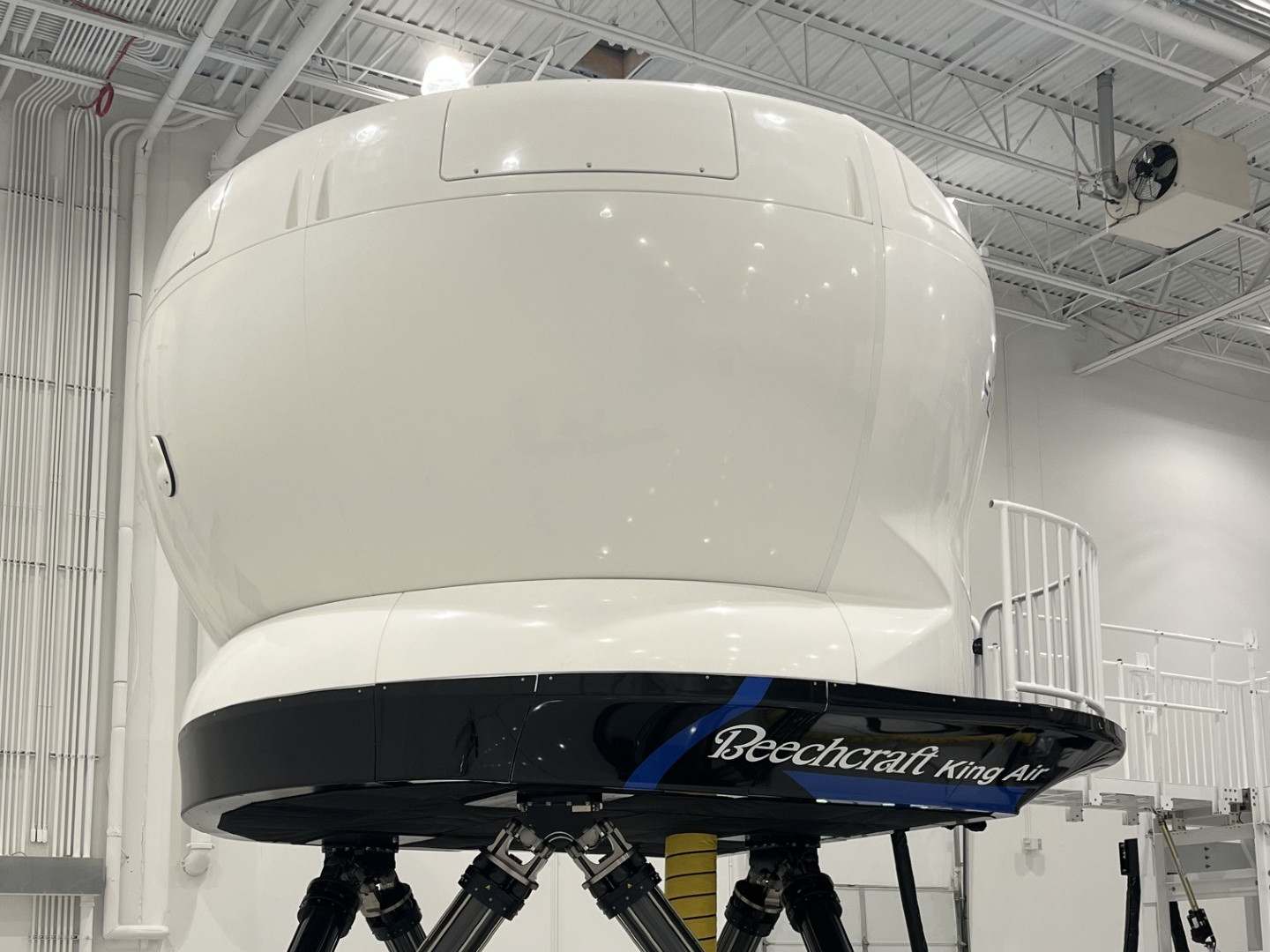
FlyRight plans to relocate a Beechcraft King Air simulator to Brazil starting in November. [Credit: FlyRight]
North Carolina-based FlyRight plans to relocate a Beechcraft King Air simulator to Brazil starting in November, the Part 142 flight training center said Monday.
The company will deliver its King Air C90A Level C full flight simulator to EPA Training Center, the largest regional aircraft training center in Latin America. It is scheduled to join EPA’s advanced training hub in Brazil, with initial training sessions planned for the second quarter of 2027 following transit, installation, testing, and certification.
FlyRight projected the simulator will secure formal Agência Nacional de Aviação Civil (ANAC) certification for pilot training by early next year. It said the relocation is intended to address South American demand for advanced turboprop simulation. The device will offer localized, motion-based initial and recurrent training for domestic and multinational corporate operators.
“Our goal is to facilitate access to quality training for the Brazilian market,” said Flávio Farias, CEO of EPA, in a news release. “With the King Air simulator, pilots and operators will have access to highly accurate equipment and instruction in Portuguese, right here in Brazil, without having to travel abroad. This means more safety, lower costs, and less time away from operations.”
Andy Bauer, vice president of sales and marketing for FlyRight, said the move will allow it to “optimize our [North Carolina] training capabilities while supporting the rapidly growing corporate and regional aviation sectors in Brazil with a premier, Level C simulation training tool.”
FlyRight is based at Concord-Padgett Regional Airport (KJQF) in Concord, North Carolina, a reliever airport for Charlotte-Douglas International (KCLT). It specializes in initial, recurrent, and custom professional pilot training using turboprop aircraft. Those include the King Air series, Cessna Caravan, and de Havilland Dash 8.
The 90 series is the smallest of the six basic King Air models Beechcraft has produced. The C90A, a variant of the C90, was introduced in 1984, and 235 were built before production ceased in 1992, according to aviation marketplace Globalair.
The original model 90 King Air was powered by Pratt & Whitney’s PT6A-6. The C90A instead uses the PT6A-21 to power its constant speed, reversible-pitch propellers. It introduced redesigned engine cowlings that reduced drag, boosted ram airflow to the engines, and gave it a modest speed increase, per the Aircraft Owners and Pilots Association.
The C90A improved on the C90 with an electrical landing gear system, rudder boost system for reduced pilot workload in single-engine operations, and bonded spar cap that uses shear fittings instead of bolts.
The type boasts a 384-gallon fuel capacity, 208-knot maximum operating speed, and 28,100-foot service ceiling at its normal category takeoff weight of 9,650 pounds. It has become a popular choice for military, government, charter, and private operators worldwide.
FlyRight said the twin-engine turboprop simulator features realistic flight dynamics, immersive visual systems capable of replicating complex operating scenarios, and full-motion capability that meets ANAC’s strict regulatory standards. It will soon join EPA’s simulators for the ATR 42/72 and Embraer ERJ-145/Legacy, EMB-120 Brasilia, and EMB-110 Bandeirante.
Jack is a staff writer covering advanced air mobility, including everything from drones to unmanned aircraft systems to space travel—and a whole lot more. He spent close to two years reporting on drone delivery for FreightWaves, covering the biggest news and developments in the space and connecting with industry executives and experts. Jack is also a basketball aficionado, a frequent traveler and a lover of all things logistics.
Defense Secretary Pete Hegseth said directed energy weapons and other technology will be used to counter drone threats. [Credit: U.S. Department of Transportation]
The federal government is restricting the use of drones along the entirety of the U.S.-Mexico border in an attempt to protect against “illicit cartel activity” and other threats.
According to the U.S. Transportation Department, a temporary flight restriction (TFR) took effect Friday and prohibits unauthorized uncrewed aircraft system (UAS) operations within 1 nm of the southern border, from the surface up to 400 feet. DOT said the TFR was coordinated jointly with the Department of Homeland Security and Department of Defense.
The FAA will publish a notice to airmen (NOTAM) linking to its UAS Data Delivery System, which contains national security-related UAS flight restrictions, as well as a domestic notice.
“For too long, cartels have taken advantage of gaps along our southern border,” said DOD Secretary Pete Hegseth in an announcement. “Equipped with cutting-edge technology—including directed energy weapons—our warfighters will shoot down any cartel drone that threatens America’s sovereignty.”
Per the domestic notice, the TFR will remain in effect through October 2027. It contains a graphic depicting the restrictions, which are described in NOTAMs ZLA 6/9954, ZAB 6/9955, and ZHU 6/9956. Operators should refer to the NOTAMs to confirm effective dates and times, altitudes, geographic boundaries, exceptions, and operating requirements.
To fly within the restricted airspace, UAS operators must request authorization from U.S. Customs and Border Protection at least 48 hours before operation. First responders or organizations responding to time-sensitive emergencies, such as natural disasters, can call CBP to see if they are eligible for expedited authorization.
Drones and Lasers at the Border
As drone activity rises, federal agencies are developing defenses against unauthorized drones operated by both domestic and foreign users. In June, officials said federal air marshals seized more than 300 drones during FIFA World Cup matches and fan events. Hundreds of millions of federal dollars have been allocated toward counter-UAS (C-UAS) initiatives.
Officials are equally concerned with unauthorized drone activity near the Southern border.
Hegseth mentioned that directed energy weapons would be used to take down drones in violation of the southern border TFR. The technology made headlines earlier this year, when airspace near El Paso, Texas, was twice shutdown during testing of an anti-drone laser. On one occasion, the device was used to shoot down what officials believed to be cartel drones, but they turned out to be party balloons.
In April, the FAA and Pentagon cleared the use of the laser for use along the U.S.-Mexico border, concluding it does not pose an “undue risk” to civilian aircraft.
A federal interagency task force in October announced four directed-energy systems that will be evaluated in a C-UAS pilot program. In May, the task force said testing would be conducted at Fort Huachuca in Arizona, Fort Bliss in Texas, Naval Base Kitsap in Washington state, Grand Forks Air Force Base in North Dakota, and Whiteman Air Force Base in Missouri.
The Army is overseeing its own effort called the Enduring-High Energy Laser (E-HEL) program and in September awarded Aerovironment a $464.8 million production contract for its Locust X3 system. At the Association of the U.S. Army’s (AUSA) annual meeting in Washington, Army officials told Military Times they aim to deploy the first E-HEL system by 2028.
In September, U.S. Northern Command said its Joint Task Force-Southern Border (JTF-SB) used kinetic and non-kinetic systems to take down more than 300 drones in 2026, including more than 100 in August alone. This month, Reuters reported that JTF-SB detected 378 drone incursions in the previous 30 days.
The Army acquired what it described as a “multipurpose high-energy laser” in September 2025.
Jack is a staff writer covering advanced air mobility, including everything from drones to unmanned aircraft systems to space travel—and a whole lot more. He spent close to two years reporting on drone delivery for FreightWaves, covering the biggest news and developments in the space and connecting with industry executives and experts. Jack is also a basketball aficionado, a frequent traveler and a lover of all things logistics.
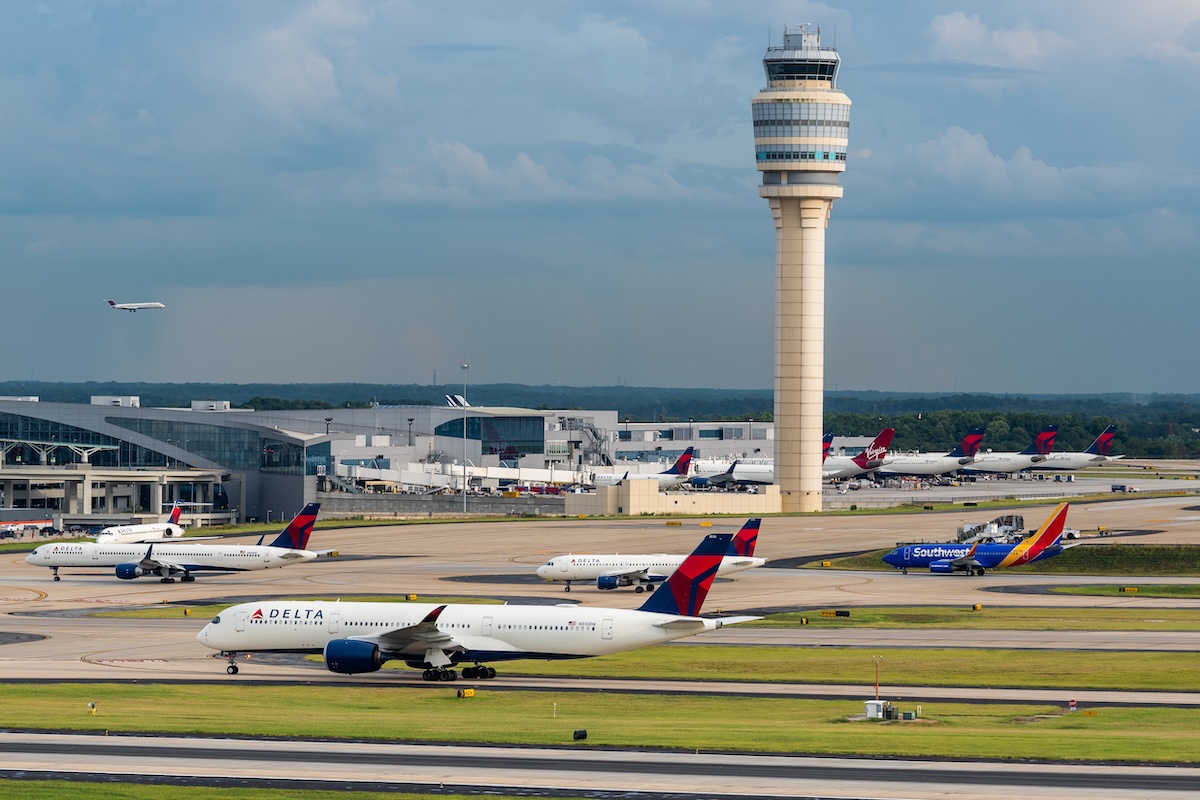
Air traffic control tower in Atlanta [Shutterstock]
FAA air traffic controllers will get a 2.8 percent raise under a new agreement worked out by the Trump administration and the National Air Traffic Controllers Association.
U.S. Transportation Secretary Sean Duffy said Friday that the increase is tied to workplace reforms, as required by an act of Congress.
The changes include a requirement for ATCs to “badge in” and “badge out” of facilities; the development of shift guidelines based on forecasted workload; and controller reassignments focused on where staffing needs are most severe. The shift guidelines will be created by local managers and union representatives.
DOT officials said the reforms will improve controller quality of life, maximize coverage, improve efficiency, and make better overall use of the FAA’s existing workforce.
“This increase reflects the vital role these dedicated professionals play in keeping our nation’s skies safe and efficient,” NATCA president Nick Daniels said in a news release. “Fair compensation and better working conditions are essential to sustaining a strong, experienced air traffic controller workforce.”
The DOT said the pay increase takes effect October 18, and is retroactive to the beginning of the year.
The issue of raises for ATCs had been contentious at times. Last month, U.S. lawmakers pushed FAA Administrator Bryan Bedford on why his agency had not implemented pay increases already approved by Congress. Bedford argued that he had sole discretion to implement the raise and wanted to work out a broader deal that would strengthen oversight and efficiency.
“Air traffic controllers perform critical work every day to keep the National Airspace System safe,” Bedford said in a statement Friday. “By improving how we track work, schedule shifts, and allocate personnel, we can make better use of our workforce and respond more effectively to operational demands. Our work with NATCA is helping us put practical changes in place that support our controllers and improve the way the system operates.”
Zach Vasile is a writer and editor covering news in all aspects of aviation. He has reported for and contributed to the Manchester Journal Inquirer, the Hartford Business Journal, the Charlotte Observer, and the Washington Examiner, with his area of focus being the intersection of business and government policy.
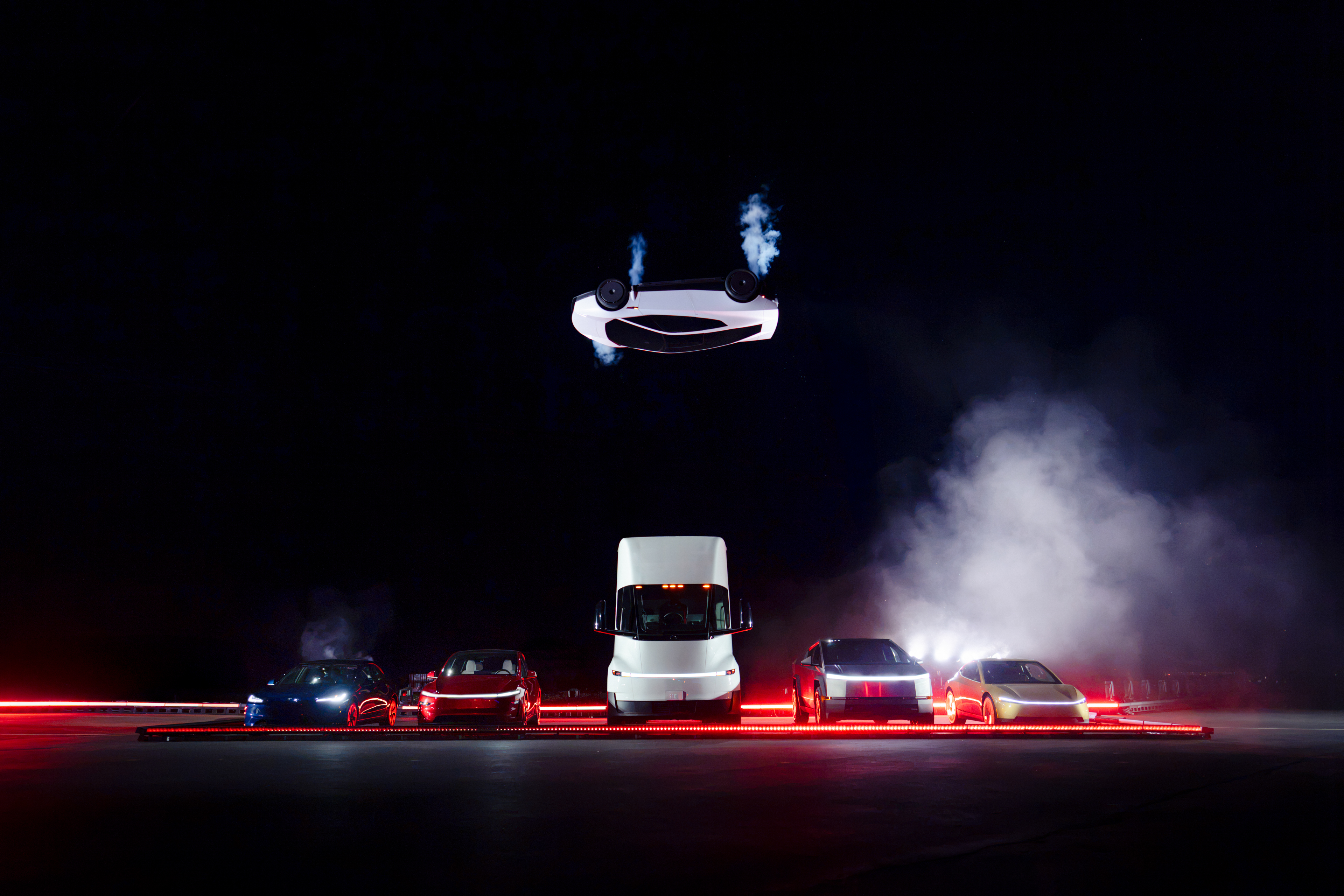
Tesla unveiled a new Roadster with aerial capabilities, with production scheduled for 2028. [Credit: Tesla]
Tesla on Thursday unveiled its long-awaited new Roadster—and it can fly.
At SpaceX’s engine test and development facility in McGregor, Texas, CEO Elon Musk revealed what he billed as a true flying car—a street-legal vehicle capable of lifting off and taking to the skies. During the event, Tesla demonstrated how the vehicle uses SpaceX thrusters to get off the ground and softly land.
Musk called the flying Roadster the “culmination of incredible work by Tesla and SpaceX engineers working closely together to make something that you haven’t seen in any movie, that’s better than any James Bond car.” He said production would begin in 2028.
The question is whether owners of the new Roadster will actually be able to fly it outside of highly controlled environments.
The FAA has issued certification criteria for a different class of vehicles called powered-lift aircraft, which include electric vertical takeoff and landing (eVTOL) air taxis under development by firms such as Joby Aviation, Archer Aviation, and Beta Technologies. These are not flying cars in the Jetsonian sense—rather, they are designed to lift off vertically like a helicopter from dedicated vertiports before transitioning to fixed-wings and whisking passengers across or between cities.
The FAA established the powered-lift category in 2024, making it the first new category of aircraft since helicopters. Manufacturers of eVTOL models have spent years developing vehicles that meet the agency’s certification guidance and initial pilot and operational requirements.
But the flying Roadster—which according to Musk will be an “actual car that’s on the roads”—could create a cascade of new problems for regulators. While the engineering is undeniably impressive, it is unclear whether the vehicle’s aerial capabilities will ever be street legal.
Flying Roadster Reveal
Before demonstrating the Roadster in flight, Musk cautioned that “success is not guaranteed.”
“It’ll probably work, but if it doesn’t work, we’re at a safe distance,” he said. “It is technically autonomous for this demo to make sure we don’t kill anyone.”
First, the Roadster drove up and down an inverted ramp at low speed, at one point stopping completely inverted. It then accelerated and departed the ramp upside down before its thrusters ignited, flipping the car upright and bringing it down gently.
Then came what Franz von Holzhausen, Tesla’s chief designer, called a “kickflip” maneuver. The Roadster accelerated toward a line of other Tesla vehicles and ignited its underbelly thrusters to take off. It completed something akin to an aileron roll while clearing the other vehicles.
Musk said a future demonstration may try to recreate Evel Knievel’s attempt to jump the Snake River Canyon in Idaho.
In addition to attitude control thrusters, the Roadster has four main thrusters in the rear diffuser area, which Musk said will allow it to “basically fly like a rocket” and perform maneuvers such as rolls. Lars Moravy, Tesla’s vice president of vehicle engineering, said the rear thrusters release compressed gas faster than the speed of sound, generating more than 80 kilonewtons of thrust.
Musk said the vehicle uses a rechargeable, “advanced, ultra-high-pressure air tank” that does not require special propellant. Per Moravy, it can hold up to 600 liters or 250 kilograms of compressed air, which is blasted through 10 nozzles.
SpaceX has used thrusters to position spacecraft for decades.
Making them work in a vehicle instead of a vacuum took all-new hardware & controls.
Every usable void in the car is packed with Carbon Fiber Overwrapped Pressure Vessels (COPVs)
According to Tesla, the Roadster was inspired by the venerable Lockheed SR-71 Blackbird and F-35 Lightning II. Von Holzhausen said it uses a full “steer-by-wire” system, with yokes, brakes, and throttle. Musk said the rear wing has variable pitch that can adjust downforce on the vehicle dynamically and automatically.
Moravy explained that the Roadster also has an underside fan suction system that can “pull up to two Gs,” allowing it to corner at high speeds or even stay upside down. Musk said it could “suck the chrome off a trailer hitch.”
“It can suck the car down at low speed to give us traction when we need it, and at high speed, we’ll open up the front and rear parts of the suction system to create even more flow underneath the car,” said Moravy.
Street Legal?
The Roadster demonstration was certainly eye-popping. But Musk himself said it is “not necessarily a safety optimized car” and conceded that he is “not sure it’s necessarily legal in all jurisdictions.”
The new Roadster’s flying abilities may be very limited. In order for drivers to become pilots and lift off from public roadways, Tesla would need to prove it meets federal motor vehicle safety standards as well as obtain FAA authorization. Owners would likely need some form of pilot certification as well.
State law would also come into play. Minnesota and New Hampshire are among the first to pass so-called “Jetson’s laws” that categorize roadable aircraft as motor vehicles, allowing them to both drive and fly. But other states have been more reluctant to approve such bills.
Tesla is not the only company developing what could be considered a true flying car.
Alef Aeronautics, which has proposed a Model A vehicle capable of lifting off from roadways and soaring over traffic, on Thursday shared video of its Model Zero—an ultralight prototype—flying over an older Tesla Roadster.
Alef’s Model Zero ultralight vehicle flies over a Tesla Roadster. [Credit: Alef Aeronautics]
Alef said the video captures the company’s thousandth logged flight. The developer received FAA special airworthiness certification to begin flight testing in 2023. Like Tesla, it is backed by venture capitalist Tim Draper.
“Having competition is a good thing, especially from such a major company as Tesla,” said Jim Dukhovny, CEO of Alef, in a news release. “It proves the market, establishes a separate flying car category, creates industry for lobbying specific regulations, brings investor focus, helps compare technology, and creates a benchmark to measure against.”
Unlike the Roadster’s compressed gas thrusters, Alef uses distributed electric propulsion and makes use of the surrounding air for lift. The company has flight testing agreements with two California airports and plans to begin evaluations with the Model Zero before advancing to the commercial Model A.
Outside of Tesla and Alef, no U.S. companies are pursuing true flying cars. Samson Sky and Aska are developing winged drive-and-fly machines, but their models are designed to take off from dedicated launch sites rather than the road.
Samson Sky in September secured $80 million to support production of its Switchblade, for which it has not yet produced test articles. Aska has not provided a development update for its A5 in about two years.
Other companies, including Pivotal, Doroni Aerospace, Jetson, and Air, are developing personal eVTOL aircraft that are not designed for driving. Jetson made its first U.S. customer delivery to Anduril founder Palmer Luckey in 2025, while the other manufacturers aim to begin deliveries in the near future.
Joby, Archer, Beta, and other eVTOL air taxi developers are demonstrating prototype aircraft under the FAA’s eVTOL Integration Pilot Program (eIPP), but their production aircraft are likely still a few years away from commercialization and routine passenger-carrying flights.
Jack is a staff writer covering advanced air mobility, including everything from drones to unmanned aircraft systems to space travel—and a whole lot more. He spent close to two years reporting on drone delivery for FreightWaves, covering the biggest news and developments in the space and connecting with industry executives and experts. Jack is also a basketball aficionado, a frequent traveler and a lover of all things logistics.
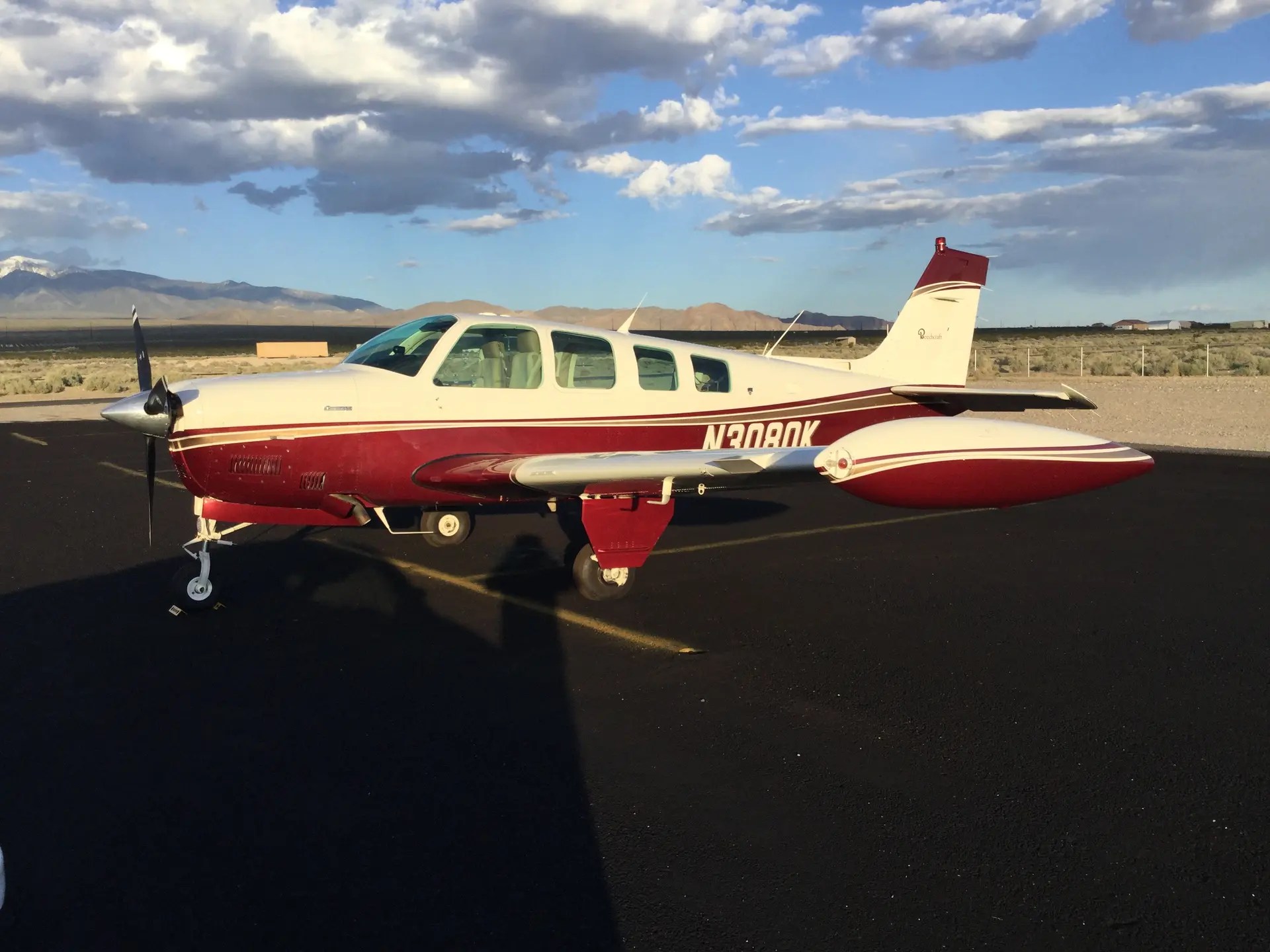
On several occasions when I was shopping for an airplane I heard other pilots say things like, “Everyone wants a Bonanza.” That might be an overstatement, but the long-running Beechcraft design certainly is a classic and ranks among those airplanes that pilots dream of owning.
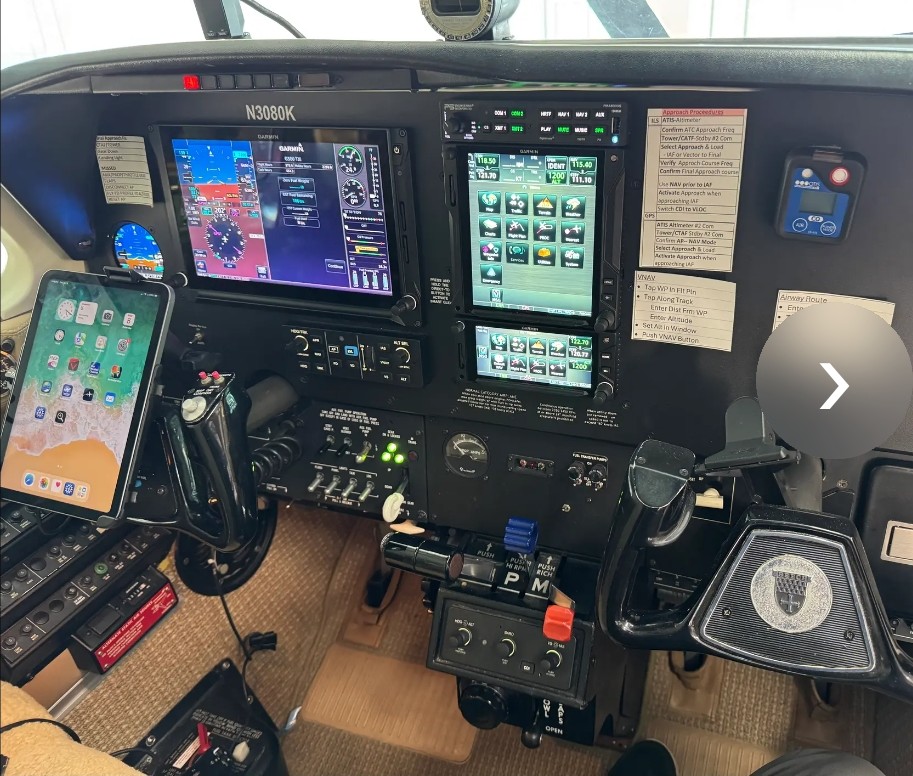
This Bonanza’s panel features major upgrades. [Credit: Ron Snuggs]
The aircraft for sale today arguably is the ultimate version of the Bonanza, with a stretched fuselage and six seats that give pilots more carrying capacity and flexibility in loading passengers and cargo. Interestingly, the A36 started out as a bare-bones utility aircraft built to compete with heavy haulers like the Cessna 206 and Piper PA-32 Cherokee Six, both of which often serve as flying pickup trucks. Customers soon started ordering them with better interior appointments and equipment suited to cross-country travel.
Before long the A36 was established at the top of the piston single food chain, where it has remained ever since. Even more modern, high-performance aircraft like the Cirrus SR22 cannot quite match the six-seat Bonanza’s cavernous cabin and double cargo doors.
Today’s example is ready for long-distance personal and business travel, with auxiliary fuel and turbo-normalizing for enhanced high-altitude capability. Passengers will appreciate the aircraft’s custom paint and interior while pilots can make the most of its substantially updated avionics.
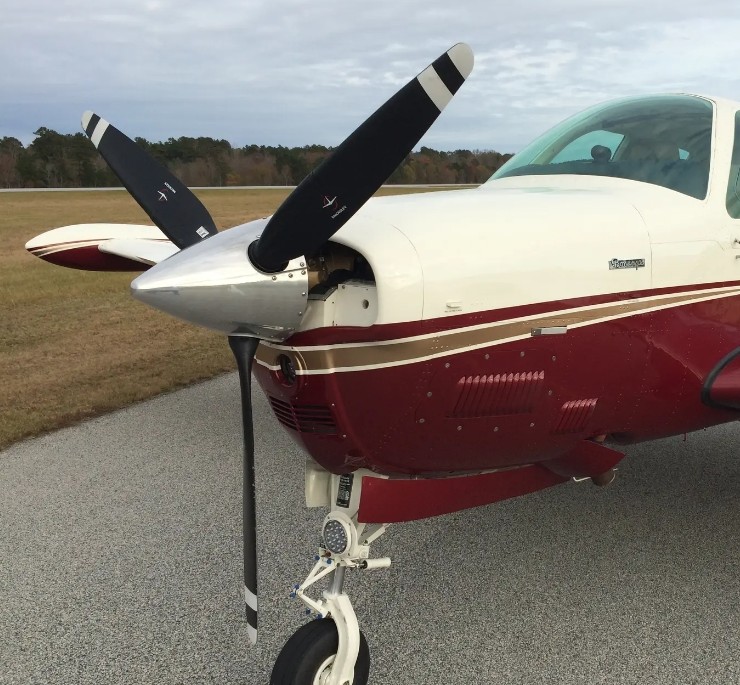
By 1987, Beechcraft was equipping the A36 with a 300 hp IO-550. [Credit: Ron Snuggs]
This 1987 Bonanza A36 has 4,430 hours on the airframe and 1,210 since overhaul on its 300 hp Continental IO-550-B. The aircraft is equipped with a Tornado Alley Whirlwind II turbo-normalizing system and GAMI fuel injectors and engine baffles.
The IFR panel features Garmin 10.6-inch G500TXi PFD/MFD, GTN 750 GPS/nav/com, GNC 355 GPS/nav/com, GMA 345 audio panel, GTX 345W transponder with ADS-B In and Out, SiriusXM weather and traffic, and GFC 500 autopilot.
Additional equipment includes Osborne 20-gallon tip tanks, B&C standby alternator, D’Shannon aileron and flap gap seals, LED external lighting, Rosen sun visors, and Jet Shades window shades.
Pilots looking for a spacious and capable cross-country traveling aircraft with pleasant handling and strong factory support should consider this 1987 Beechcraft Bonanza A36, which is available for $525,000 on AircraftForSale.
If you’re interested in financing, you can do so with FLYING Finance. Use our airplane loan calculator to calculate your estimated monthly payments. Or, to speak with an aviation finance specialist, visit flyingfinance.com.
Jonathan Welsh is Lead Editor of Aviation Consumer and a private pilot who worked as a reporter, editor and columnist with the Wall Street Journal for 21 years, mostly covering the auto industry. His passion for aviation began in childhood with balsa-wood gliders his aunt would buy for him at the corner store. Follow Jonathan on Twitter @JonathanWelsh4
U.S. Transportation Secretary Sean Duffy (left) and FAA Administrator Bryan Bedford introduce the SMART air traffic management system at a new center in Washington, D.C. [Credit: U.S. Department of Transportation]
The FAA is reportedly pursuing an unprecedented move to support its multibillion-dollar modernization of the nation’s aging air traffic control system.
According to Politico, which cited an internal FAA document, the agency has a term sheet for an equity stake in Air Space Intelligence (ASI) and is negotiating to acquire a warrant that would give it the right to buy the company’s stock. The agency in June awarded ASI a 12-year contract worth up to $875 million to develop the AI-powered Strategic Management of Airspace, Routes and Trajectories (SMART) air traffic management platform.
Officials have described SMART as a crucial pillar of the Transportation Department’s Brand New ATC System (BNATCS) project, which is also replacing or upgrading thousands of radios, radars, voice switches, facilities, and other ATC hardware and software. The DOT in September began rolling out the platform for airspace management in the Washington, D.C. area. It plans to deploy SMART nationwide by spring 2027, Transportation Secretary Sean Duffy said in August.
SMART’s initial deployment has been controversial. More than two dozen Democratic legislators this week urged the FAA to pause its use of the system until officials share more about how it works. The National Air Traffic Controllers Association (NATCA) said it was not “involved in the design, testing, or implementation” of the technology. The lawmakers said frontline aviation safety workers had either zero or very limited notice of SMART’s rollout.
Neither the FAA nor ASI immediately responded to FLYING’s request for comment. The agency told Politico it could not immediately provide comment.
FAA Seeks More Control of ATC Modernization
Politico reported that the FAA’s negotiation for a warrant for ASI stock is the first known instance of the agency pursuing an ownership stake in a private company.
In the U.S., the practice is historically rare and typically reserved for times of crisis. But it is becoming more routine under President Donald Trump’s administration.
The report comes a few weeks after the Government Accountability Office (GAO) alleged the agency’s ATC modernization effort may face cost overruns, schedule delays, and unmet goals. FAA Administrator Bryan Bedford disputed that characterization.
Bedford also revealed that the initial phase of BNATCS will cost about $16 billion. He and Duffy in September asked Congress for $30 billion—on top of the $12.5 billion lawmakers previously allocated toward BNATCS—to support further ATC and airport upgrades. In 2025, officials estimated the total cost of BNATCS at $31.5 billion.
Facing a rising budget and the time pressure of completing the first phase of ATC upgrades by the end of 2028, the FAA is apparently seeking greater control over one of the effort’s key contractors.
ASI was founded in 2018, and a spokesperson in April told FLYING that its Flyways AI platform manages more than 40 percent of all U.S. air traffic. Users include military and logistics customers and carriers such as Alaska Airlines.
Flyways is fed by more than 100 data links, including the FAA’s system wide information management (SWIM) platform, and is designed to predict airspace conditions eight-plus hours into the future.
SMART is a similarly predictive system, though officials have said it is being developed to create a picture of the airspace not just hours but days, weeks, or even months in advance. The New York Timesreported that it will initially manage only same-day delays for three D.C.-area airports.
According to the DOT, SMART synthesizes information from hundreds of data streams and uses it to make recommendations to controllers, which they can accept or decline. The data will centralize weather patterns, flight paths, traffic flow, controller staffing levels, and other information. Recommendations are reviewed by FAA staff before being delivered to controllers.
Though the agency has made significant progress on other portions of the BNATCS effort, Bedford in August said the program will “not be successful” unless SMART is rolled out in tandem.
Jack is a staff writer covering advanced air mobility, including everything from drones to unmanned aircraft systems to space travel—and a whole lot more. He spent close to two years reporting on drone delivery for FreightWaves, covering the biggest news and developments in the space and connecting with industry executives and experts. Jack is also a basketball aficionado, a frequent traveler and a lover of all things logistics.
Cirrus’ Duluth warehousing center will add 60,000 square feet of space as the manufacturer grows its global fleet of SR Series and Vision Jets. [Credit: Cirrus Aircraft]
Cirrus Aircraft on Thursday opened a new 60,000-square-foot warehousing center in Duluth, Minnesota, the manufacturer’s latest expansion as it looks to keep pace with the growth of its SR Series and Vision Jets.
Cirrus said the center will strengthen the company’s infrastructure and expand its operational capabilities and footprint, supporting parts storage, aircraft product development and innovation, and aftermarket services. It will consolidate multiple satellite warehouse locations into a centralized operation that will make receiving, storing, processing, and distributing parts more efficient, the manufacturer said.
In August, Cirrus expanded its manufacturing facility in Grand Forks, North Dakota—which produces components for the SR Series and Vision Jet—by 30,000 square feet. That site will also manufacture composites for the new, clean-sheet TRAC10 trainer, for which deliveries are planned in 2027.
Outside Duluth and Grand Forks, the manufacturer has locations in Greater Dallas; Greater Phoenix; Greater Orlando, Florida; Knoxville, Tennessee; and Benton Harbor, Michigan.
“As our fleet continues to grow around the world, we are investing in the infrastructure and capabilities needed to support our aircraft and owners throughout the ownership experience,” said Zean Nielsen, CEO of Cirrus, in a news release. “The Cirrus Warehousing Center gives our teams greater capacity and efficiency while supporting our production goals, continued innovation, and growing upgrades and accessories business.”
Cirrus Keeps Pace With Growth
Cirrus aims to grow its operational capabilities in tandem with its global fleet of SR Series and Vision Jets, including the new, Garmin Autoland-equipped G7+ and G3.
The manufacturer in 2025 delivered 691 SR Series aircraft and a record-breaking 106 Vision Jets, delivering more general aviation aircraft than any other firm. The SR Series became the best-selling high-performance, single-engine piston aircraft for 24 consecutive years, and the Vision Jet became the best-selling GA jet for eight years in a row.
For the first half of 2026, Cirrus reported higher deliveries and revenue. In August, it said its backlog topped 1,000 aircraft.
To date, worldwide flight time on Cirrus aircraft is over 19 million hours, the company said Thursday.
The manufacturer is well-known for its Cirrus Airframe Parachute System (CAPS), the first FAA-certified, whole-airframe parachute safety system included as standard equipment on an aircraft.
Jack is a staff writer covering advanced air mobility, including everything from drones to unmanned aircraft systems to space travel—and a whole lot more. He spent close to two years reporting on drone delivery for FreightWaves, covering the biggest news and developments in the space and connecting with industry executives and experts. Jack is also a basketball aficionado, a frequent traveler and a lover of all things logistics.
Sign-up for newsletters & special offers!
Get the latest stories & special offers delivered directly to your inbox.