
Register

Chart Wise: West Lafayette, Indiana (KLAF) VOR-A

Old-school approach and circling procedures must be navigated to reach Purdue University Airport.

Ramp at Purdue University Airport (KLAF) in West Lafayette, Indiana [Credit: Purdue University]

A trip to West Lafayette, Indiana, to visit Purdue University (see feature on page 44), or perhaps getting some flight training there while in college, might just find a pilot with a need to fly the VOR-A approach. Or it just might be that your CFI (or mean old DPE on your IFR practical test) is putting you through the paces and asking you to fly it. It’s an old-school kind of approach. So let’s dig into some of the things you might want to take note of when trying to land at Purdue University Airport (KLAF).

This Article First Appeared in FLYING Magazine

If you're not already a subscriber, what are you waiting for? Subscribe today to get the issue as soon as it is released in either Print or Digital formats.

Subscribe Now
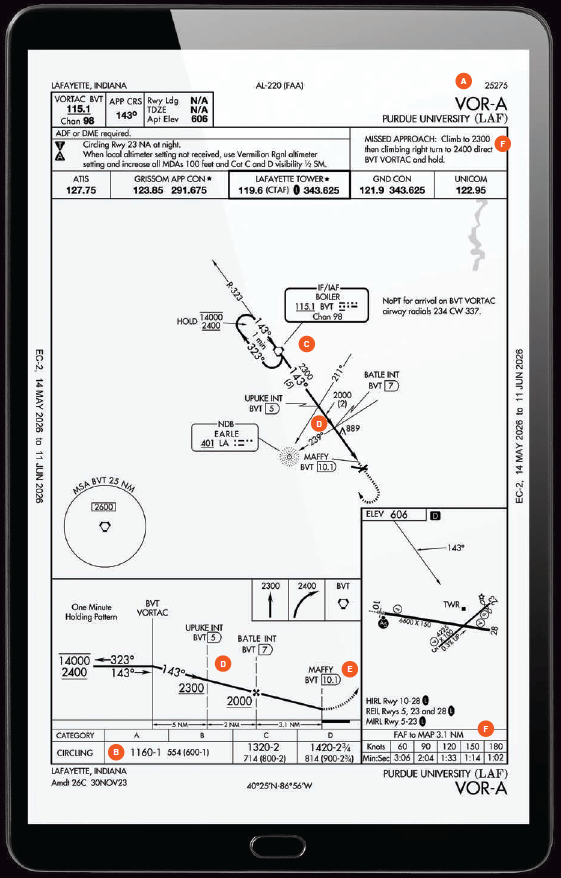
Purdue University Airport (KLAF) approach in Indiana [Credit: Jeppesen]

A. Not to ‘A’ Runway

The “A” (Alpha) indication on this approach means the approach is not to a specific runway unlike most approaches we fly. The intent of this approach is to get you to “the airport” and then let you transition to landing on a runway of your choice that would be best for the conditions. In this case, the pilot will be approaching the airport from the northwest and then, after breaking out, enter a pattern procedure to land on one of the runways. You just would not be able to land on Runway 23 at night, according to one note that says: “Circling Rwy 23 NA at night.”

B. Circling Minimums

The only minimums for this approach are for circling to a runway. The lowest of them, for aircraft slow enough to use approach category A or B are 1,160 feet msl (554 feet agl). If you are doing this, be sure to recognize that you will be flying a “pattern” at a lower altitude than the standard 1,000 feet agl. Keep your maneuvering close to the airport, and take care that your turns are not too steep. Don’t descend below those minimums until you are in a “position to land.”

C. Start at the VOR

The initial approach fix (IAF) for this approach is at the BVR (Boiler) VOR, where a hold is depicted to get you established onto the approach if ATC isn’t giving you vectors. A pilot might start here, execute a course reversal out to the northwest or even take a lap in the hold before they proceed inbound on the 143-degree radial toward the VOR toward the airport. 

D. BVT to UPUKE and then FAF at BATLE

After leaving the VOR inbound at 2,400 feet msl or above, the pilot can descend to 2,300 feet msl until they pass the UPUKE intersection, which is 5 DME from the VOR, and then down to 2,000 feet msl on the way to the BATLE intersection at 7 DME, which is the final approach fix. These intersections can also be identified using DME from the VOR, an IFR GPS system, or, if you happen to still have a functional ADF, you could even use a bearing from the EARLE NDB. Now we are really reaching back to old-school style on this approach, with intersections made from VOR radials and NDB bearings.

E. Missed at DME or Time

Figuring out when to go missed on this approach if the airport environment isn’t in sight offers a couple of options. An IFR GPS will cue up the missed approach point, but the pilot could also use 10.1 DME from the VOR or go with time as noted in the bottom right of the chart. The time would start from the FAF at BATLE. If the pilot was flying the approach at 90 knots ground speed, it would mean they would go missed after 2:04 had elapsed on the time, assuming they didn’t forget to start the timer when they crossed the final approach fix.

F. Misses Approach: Back to the VOR

The missed approach on this is a straight-ahead climb to 2,300 feet msl and then a right turn to 2,400 feet msl back to the BVT VOR. The good news is that it is the same hold you might have started with, so it should be familiar by this point if you had to go missed.


This column first appeared in the August Issue 973 of the FLYING print edition.

Jason Blair

Jason Blair is a flight instructor and an FAA designated pilot examiner, and an active author in the general aviation and flight training communities.

‘Aviation Start’ Episode 5 Maps Every Path Into Air Traffic Control

FAA center controller Marcus Miller breaks down CTI programs, the Academy washout rate, contract towers, and more.

‘Aviation Start’ podcast host Jamail Larkins interviews guest Marcus Miller. [Credit: FLYING]

The fifth episode of Aviation Start, FLYING’s career-focused video podcast hosted by Jamail Larkins, turns from the cockpit to the radar scope. Larkins’ guest is Marcus Miller, an air traffic controller at an FAA en route center who has built a following on social media as “PropHatCat,” explaining what controllers do and why.

The timing is deliberate.

“What a lot of people don’t realize is air traffic controllers are in a huge hiring surge right now, and is scheduled to happen for the next probably close to a decade,” Larkins said.

Miller, who noted that his opinions are his own and that he does not speak for the FAA or the National Air Traffic Controllers Association, came to the job by an unusual route.

He celebrated his fifth birthday at Waco Regional Airport (KACT) in Texas, caught the bug with Flight Simulator X in eighth grade, and started college pursuing a bachelor of fine arts in musical theater before pivoting to aviation.

Hours spent on VATSIM (Virtual Air Traffic Simulation Network), which lets flight simulator pilots talk to simulated air traffic controllers online, convinced him to pursue the real thing. He enrolled in the FAA’s Collegiate Training Initiative (CTI) program at LeTourneau University in Longview, Texas, and applied to the FAA every year for five years before he was hired.

Three Ways In

Miller and Larkins walked through the main paths into the FAA.

Military controllers transition directly. Off-the-street applicants need only be 18, hold a high school diploma, and have a year of work experience. CTI graduates skip the Air Traffic Basics course at the FAA Academy in Oklahoma City but still complete their tower, terminal, or en route training there.

The newest option, Enhanced CTI, allows accredited colleges to deliver that track-specific training on their own simulators, with an FAA evaluator signing off before graduates go straight to a facility.

“If you pass all of that, you don’t have to go to Oklahoma City,” Miller said.

Asked which path he would choose if he were starting over, Miller picked Enhanced CTI, in part because of what he saw at the academy.

“Whatever I went through back in 2019, it was maybe 50 percent, 60 percent,” he said of the washout rate. “It’s made to be difficult because you need to be able to show the FAA that you are teachable, that you are coachable.”

The academy compresses the material into about four months, he said, while an Enhanced CTI program spreads it over a two- or four-year degree. He added that he would still apply off the street at the same time, since candidates can pursue both.

For anyone headed to the academy, his advice was simple: “Just be teachable. Just be prepared to not know anything, because you’re going to be taught everything that you need to know.”

What the Job Pays, and What It’s Like

Controller pay starts around $70,000 and can reach the federal pay cap of about $228,000 at the busiest facilities, with full federal benefits, Larkins said, noting that the top figure exceeds a member of Congress’ salary.

Miller put that in context. Most new certified controllers at towers and TRACONs earn closer to $80,000, while the largest centers and approach controls pay in the $180,000-$190,000 range. Trainees are paid while at the academy.

The three tracks are not interchangeable.

“I like to think of it like doctors,” Miller said. “You have like a brain surgeon and a heart surgeon and then a foot surgeon. A brain surgeon is not going to go the next day and do foot surgery. They have to kind of retrain. All of them are there to keep the patient healthier, keep them safe, but they all have very specialized jobs. Same thing, center, TRACON, tower.”

Does the pressure of managing thousands of lives a shift ever ease?

“I don’t think it gets easier,” Miller said. “I think you just learn to manage it.”

What keeps him in the chair is the people on the airplanes.

“We think of the airplanes as just little radar blips, but there are people on those planes.”

Contract Towers and the Age Limit

Larkins also raised contract towers, which are FAA-funded but staffed by private companies and typically serve smaller airports. Miller explained that FAA controllers face mandatory retirement at 56, while contract towers have no such rule, so many retirees keep working there.

The path also runs the other direction. Schools such as Advanced ATC and the Community College of Beaver County in Pennsylvania offer control tower operator certificate programs. A graduate can be hired at a contract tower, build the 52 weeks of experience the FAA requires for its prior-experience hiring bid, and be hired directly into the agency without attending the FAA Academy.

That matters for anyone past the FAA’s age cutoff of 31 for new-hire controllers. Larkins noted that the limit does not necessarily apply to contract towers, and both men encouraged viewers to confirm the details for themselves.

For pilots, Miller closed with a reminder about the voice on the other end of the frequency. In seven years he has issued a possible pilot deviation exactly once.

“We’re human just like you,” he said, “and we want everybody to get from point A to point B safely.”

Episode 5 of Aviation Start is available now on FLYING’s YouTube channel and all major podcast platforms. Aspiring aviation professionals can get matched with eligible scholarships from a database of more than $20 million scholarships at aviationstart.org.

FLYING Staff

FLYING Magazine is a one-stop resource for everything aviation, including news, training, aircraft, gear, careers, photos, videos, and more.

Unsure If You’re Fit to Fly? FAA’s MedGuide Can Help

Version 1.0 contains only approved medications, but future variants will add conditional and unacceptable medications.

FAA medical certificate
FAA’s online MedGuide tool lists medications it considers acceptable for use while performing flight or safety-related duties. [Credit: FLYING Archive]

The FAA’s Office of Aerospace Medicine this month introduced an online tool that can tell pilots and Air Traffic Control Specialists which medications are considered acceptable for use while performing flight or safety-related duties, partially addressing a longstanding information gap.

The agency on its website says its MedGuide tool is not a stand-in for medical diagnosis or treatment and “should not be used as the sole basis in making aeromedical determinations, which must include an individualized assessment.” But it provides a reference for airman medical certification and ATCS clearance.

Version 1.0 of MedGuide contains only approved medications. Future iterations will add conditional and unacceptable medications.

Users can select generic or brand-name drugs and over-the-counter medications using a drop down menu or type them manually. The page then returns FAA frequency limits—typically as prescribed on the label—and wait times for the medication, depending on the user’s role.

For most drugs, that includes an initial wait time, or the observation period required after starting a new medication before returning to safety-related duties. This is typically 48 hours but can be longer or shorter depending on the drug.

Some medications have a different wait time after subsequent doses to mitigate aeromedically significant side effects. They may also have a discontinuation wait time, required to verify that the user’s condition is stable and there is no risk of rebound symptoms or withdrawal after stopping a medication.

MedGuide also allows users to select the underlying conditions for which they are being treated, which the FAA said is critical to determining safety of flight and can impact wait times.

“This tool, while still a work in progress, equips aviators to make safe, fit-for-flight decisions about medication use,” said Mark Larsen, director of safety and flight operations for the National Business Aviation Association (NBAA), in a news release. “Pilots are accustomed to clear, if-then directions, and MedGuide offers a more direct way to understand both prescription and over-the-counter medications, including any wait time after an initial or subsequent dose.”

Addressing Mental Health in Aviation

The NBAA is one of several organizations that has backed the Aviation Medication Transparency Act (AMTA) of 2026. The legislation would require the FAA to create a comprehensive list of medications safe for pilots, ATCS, and trainees, as well as indicate what period of time individuals holding an FAA medical certificate must have limited or no duties while taking certain medications.

The Aircraft Owners and Pilots Association (AOPA) maintains a list of what medications are appropriate for use as a general aviation pilot, but the FAA lacks such an index.

The Senate passed the AMTA in September, and it is pending House approval.

“MedGuide is a big step in the right direction, and the agency is well positioned relative to the proposed legislative requirements,” said Larsen. “NBAA will continue collaborating with the FAA and advocating for clear guidance paired with reasonable policies and practical timelines.”

NBAA and other groups also support the John A. Hauser Mental Health in Aviation Act (MHAA), which the Senate also passed in September.

That legislation would reduce barriers to seeking mental health treatment, accelerate the FAA’s medical approval process, increase funding to the Office of Aerospace Medicine, and implement other recommendations from the FAA’s Mental Health and Aviation Medical Clearances Aviation Rulemaking Committee.

The bill is named after Hauser, a University of North Dakota student who took his own life in an airplane crash in 2021 while training to become a commercial pilot. Pilots and other aviation professionals must disclose to the FAA any physical and psychological conditions as well as medications they are taking, but many do not for fear of career repercussions.

Jack Daleo

Jack is a staff writer covering advanced air mobility, including everything from drones to unmanned aircraft systems to space travel—and a whole lot more. He spent close to two years reporting on drone delivery for FreightWaves, covering the biggest news and developments in the space and connecting with industry executives and experts. Jack is also a basketball aficionado, a frequent traveler and a lover of all things logistics.

FAA Certifies Gogo Galileo HDX for Citation Longitude and Latitude

Textron Aviation business jets delivered starting in 2028 will be eligible for no-charge installation of the connectivity solution.

Textron Aviation Cessna Citation Longitude and Latitude flying side by side
Textron Aviation says it will be the first OEM to offer no-charge installation of Gogo’s Galileo HDX for factory-new business jets. [Credit: Textron Aviation]

Textron Aviation said Thursday that the FAA has certified Gogo’s Galileo HDX low-Earth orbit connectivity solution for factory-new Cessna Citation Longitude and Citation Latitude business jets.

Citation Longitude and Latitude models delivered starting in 2028 will be eligible for no-charge installation of the Galileo HDX system. Textron said it is the first OEM to offer the integration to customers free of charge. Customers who opt for the connectivity solution will also receive a preferred worldwide service rate, guaranteed for three years, the company said.

Christopher Moore, CEO of Gogo, said in a news release that customers will benefit from not only high-performance connectivity but also cybersecurity and data privacy protections, as well as round-the-clock customer support. Moore added that, if needed, Gogo technicians could arrive on the tarmac within 24 hours to resolve any issues.

The integration includes a fuselage-mounted antenna that Textron said will make the solution easier to install than alternatives on the market. Galileo HDX is designed to offer online access in just about any location globally.

“In order to stay productive wherever they fly, our customers rely on connectivity, and they’re looking for solutions that perform reliably around the world,” said Chris Hearne, senior vice president of engineering and programs for Textron Aviation.

The company is also adding SpaceX Starlink connectivity to certain jets via supplemental type certification. It announced Starlink’s availability for the Citation X and X+ in March 2025, for the Citation Longitude in October 2025, and for the Citation Ascend in April 2026. STCs for the Hawker 700, 800, and 900 series were announced in September.

In addition to better connectivity, Textron is improving the safety of future aircraft. The company’s three next-generation Citation light jets, the CJ4 Gen3, CJ3 Gen3, and M2 Gen3, will be its first to come factory-equipped with Garmin Autothrottle and Emergency Autoland. Autoland has seen just one recorded real-world activation, but it successfully passed that test.

Jack Daleo

Jack is a staff writer covering advanced air mobility, including everything from drones to unmanned aircraft systems to space travel—and a whole lot more. He spent close to two years reporting on drone delivery for FreightWaves, covering the biggest news and developments in the space and connecting with industry executives and experts. Jack is also a basketball aficionado, a frequent traveler and a lover of all things logistics.

FAA Reinstates Flight Deck Training for ATCs

Air traffic controllers will be able to apply for jumpseat access to gain firsthand experience on flight deck operations.

Pilot sitting in aircraft cockpit
Reinstatement of the Flight Deck Training program will give controllers jumpseat access to flights and a firsthand view of how their instructions impact flight crews. [Credit: Shutterstock]

Air traffic controllers will soon be able to apply for jumpseat access to commercial, general aviation, and military aircraft in order to improve their understanding of the interplay between ATC instructions and the flight deck.

The FAA on Wednesday announced the reinstatement of its Flight Deck Training (FDT) program, which it said was paused at the start of the COVID-19 pandemic in 2019.

The pandemic also prompted a brief closure of the agency’s Oklahoma City academy, where controllers receive initial training, and forced a two-year pause in on-the-job ATC training at FAA facilities. Those obstacles contributed to the current shortage of hundreds to thousands of controllers, depending on what metric is used.

The FDT program was previously revived in 2011 following its discontinuation due to security concerns after the 9/11 attacks.

“After listening to our frontline controllers, we’re excited to bring back the Flight Deck Training program,” said FAA Administrator Bryan Bedford in a news release. “Communication is key and this program will give controllers and pilots an up-close view of each other’s responsibilities and challenges.”

The agency said it worked closely with the National Air Traffic Controllers Association (NATCA) to reinstate FDT. The program allows controllers to apply for access on eligible flights to experience flight deck operations, including pilot workload and cockpit procedures, and how their instructions impact flight crews.

The FAA said it has been testing the program and that it could help controllers understand when they should refrain from issuing complex instructions, as well as how certain instructions, such as altering a landing runway, could impact pilot workload.

Nick Daniels, president of NATCA, said in a statement that he is “pleased to see this vital component of air traffic controller training reinstated.”

“There is no substitute for firsthand experience in the cockpit,” Daniels said. “The Flight Deck Training program gives participants a unique perspective on the challenges pilots face and how their decisions and actions interact with the air traffic control system, ultimately strengthening their understanding of the National Airspace System.”

The FAA said it plans to formally restart the program after Thanksgiving.

Support for ATCs

Controllers will voluntarily apply for access to flights electronically and identify a training objective, and the FAA will approve requests before sending them to airline partners. According to the agency, “all major U.S. airlines” will participate.

For security, the controllers will be vetted at the airport and again when they reach the aircraft. After the flight, they will submit a report describing what they learned.

According to NATCA, controllers may request to work credit hours to cover others who are participating in FDT. They would also be able to jumpseat flights in conjunction with leave accrued during their annual leave process, and previously approved leave could be exchanged for duty time or days off in order to participate.

The union said that additional guidance and participating airlines will be announced as soon as October 30. ATCs will be limited to two commercial or GA flights and one military flight per year. Their managers will consider staffing levels at their facility when evaluating requests.

The FAA earlier this month said it broke its controller hiring record in fiscal year 2026, onboarding more than 2,200 trainees. Still, Bedford testified in September that there were about 11,000 certified professional controllers (CPCs) deployed to 313 ATC facilities, meaning the agency remains shorthanded.

As a result, controllers have been forced to work demanding hours and take on increased workload when shortages arise.

The agency has taken steps to swell the ranks of controllers by expanding training capacity, partnering with universities, and rewarding trainees and new hires with incentives such as bonuses. At the same time, Bedford in September refused to commit to giving active controllers a 3.8 percent pay raise, which is provided for by legislation passed earlier this year. He contended that raises are not the only way to boost staffing and efficiency.

The FAA has also begun rolling out an AI-based system designed to process large swaths of data and make recommendations to controllers, which they can accept or decline. However, NATCA told FLYING it was not “involved in the design, testing, or implementation” of that technology. Federal legislators this week urged the FAA to pause its use until officials provide more details on how it works.

Jack Daleo

Jack is a staff writer covering advanced air mobility, including everything from drones to unmanned aircraft systems to space travel—and a whole lot more. He spent close to two years reporting on drone delivery for FreightWaves, covering the biggest news and developments in the space and connecting with industry executives and experts. Jack is also a basketball aficionado, a frequent traveler and a lover of all things logistics.

This 2001 Piper PA-34-220T Seneca V Is a Well-Kept ‘AircraftForSale’ Top Pick

Open-checkbook maintenance and state-of-the-art glass panel bolster six-seat multiengine cruiser.

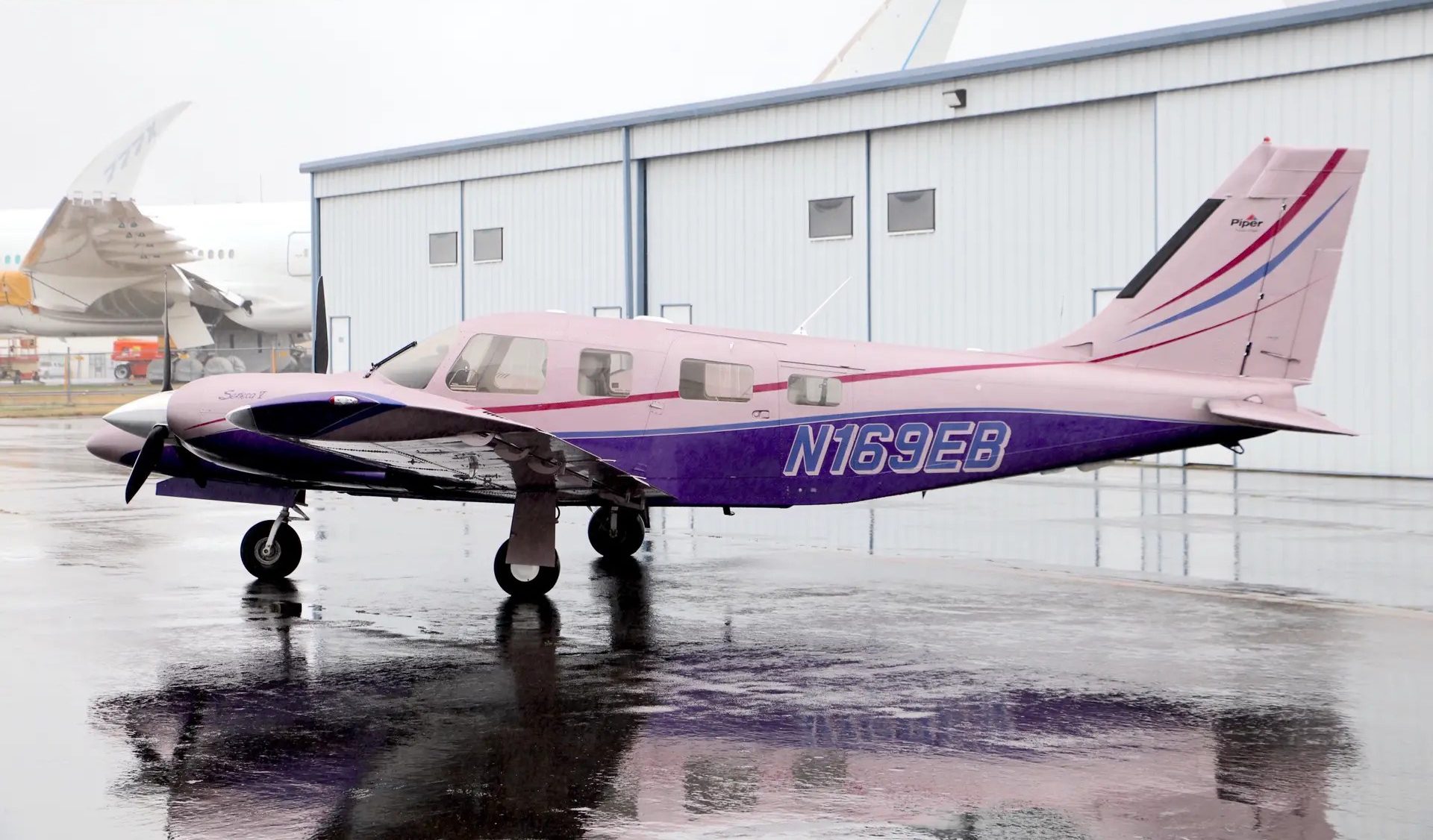
2001 Piper PA-34-220T Seneca V [Credit: Seitz Aviation]

Every day, the team at Aircraft For Sale chooses an airplane that catches our attention because it is unique, a good deal, or has other qualities we find interesting. You can read Aircraft For Sale: Today’s Top Pick at FLYINGMag.com daily.

Today’s Top Pick is a 2001 Piper PA-34-220T Seneca V.

Few light twins manage to strike the elusive sweet spot between docile multiengine handling, generous six-place cabin volume, and genuine all-weather utility quite like Piper’s flagship Seneca V. Engineered to take the stress out of flying over challenging terrain or through low ceilings, its counter-rotating powerplant setup eliminates the traditional engine worry while handing private pilots an ultra-stable, confidence-inspiring, cross-country platform.

Drawn from a history of disciplined stewardship in the Pacific Northwest, this airframe shows just 1,485 total flight hours on the clock. What sets this airframe apart for four-season dispatch reliability is its certified FIKI capability, featuring pneumatic deice boots across the wings and vertical fin, electric windshield heat plate, heated McCauley propellers, and heated pitot mast to shed freezing moisture when the weather deteriorates.

Step through the aft door and you are greeted by an executive passenger lounge deliberately equipped to make multihour hops feel effortless. The six-place cabin is climate-managed by dedicated air conditioning for sweltering summer ramps and an auxiliary cabin combustion heater for high-altitude winter cruises, complemented by a built-in oxygen system, five USB-C charging ports, and six-place Bose-powered LEMO jacks wired directly into the airframe.

Nestled inside clean nacelles out on the wings is a matched set of turbocharged Continental LTSIO-360-RB1B engines, each recording 1,485 hours since factory new. Both powerplants exhibit spotless oil analysis histories and healthy cylinder compressions (consistently measuring in the mid-70s), paired with automatic propeller synchrophasers, Tanis engine preheaters for cold-climate starts, and DDMP digital engine management display that delivers real-time diagnostic insight.

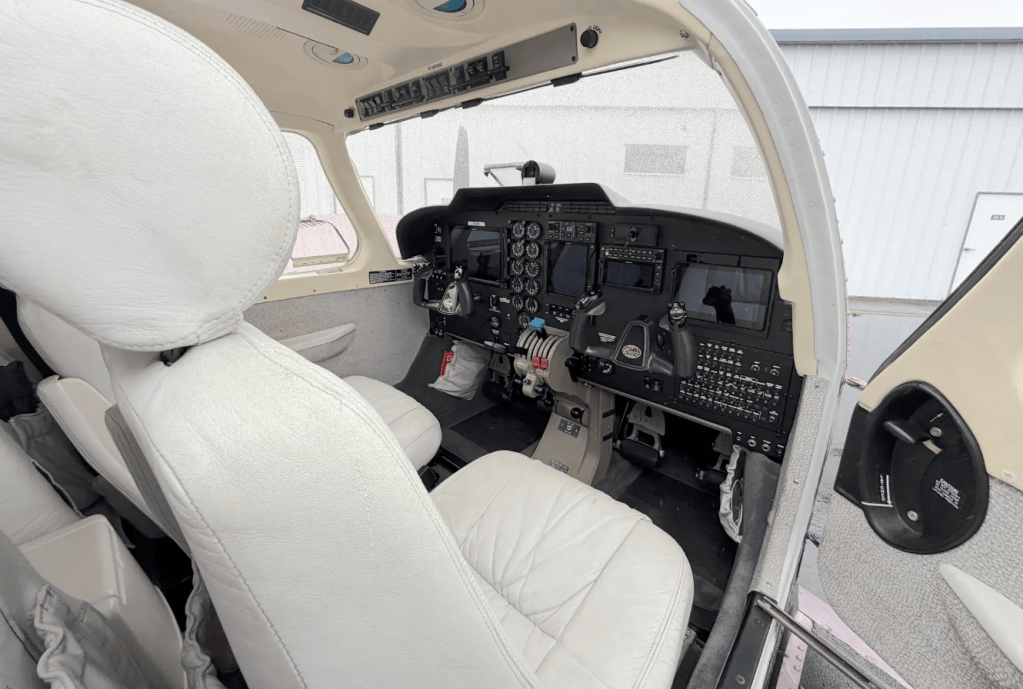
In 2023, the flight deck underwent an exhaustive, squawk-free avionics overhaul anchored by a 10-inch Garmin G500 TXi landscape primary display, dual touchscreen GTN 750Xi and GTN 650Xi navigators, panel-docked Garmin Aera 760, and GI 275 digital standby. Pilot workload is slashed via a three-axis Garmin GFC 500 digital autopilot equipped with yaw damper and Smart Glide safety logic, while active tactical threat detection comes courtesy of a BendixKing RDR2000 color weather radar and L3 WX-500 Stormscope.

Listed at $624,500, this turnkey Seneca V spares its next owner the six-figure expense and months of shop downtime required to engineer a modern glass retrofit from scratch. It stands ready to serve as a fast, highly capable family cruiser or corporate hauler.

If you’re exploring ownership options, FLYING Finance can help get you airborne. Use our airplane loan calculator to estimate your monthly payments, or connect with an aviation finance expert at flyingfinance.com.

FLYING Staff

FLYING Magazine is a one-stop resource for everything aviation, including news, training, aircraft, gear, careers, photos, videos, and more.

More Than 2,500 Aircraft Now Equipped With Garmin Autoland

Emergency system has seen only one recorded real-world activation but passed that test with flying colors.

person pushing Garmin Autoland button
Garmin Autoland can activate on its own or by anyone in the aircraft, including passengers, with a simple button push. [Credit: Garmin]

Integrated flight deck provider Garmin said Wednesday that its Autoland system is now equipped on more than 2,500 aircraft, marking a new milestone for the technology that was initially certified less than seven years ago in May 2020.

The Robert J. Collier Trophy-winning technology is the world’s first certified autonomous system designed to activate during an emergency to control and land an aircraft without human intervention.

Phil Straub, executive vice president and managing director for aviation at Garmin, said in a news release that the achievement “reflects the incredible adoption of a technology designed to provide pilots and passengers with added confidence when it matters most.”

First certified on the Piper M600 SLS, Garmin Autoland is now available on 15 models, including piston-powered aircraft and twin-engine jets.

It is certified for airframes including the Piper M700 Fury; Cirrus Vision Jet G2, G2+, and G3 and Cirrus SR20 G7+, SR22 G7+, and SR22T G7+; Daher TBM 940, TBM 960, and TBM 980; Beechcraft King Air 200, B200, 300, and 350; as well as the HondaJet Elite II and recently certified Embraer Phenom 300EV, its first twin-engine jet certifications.

In September, the system was certified for the Pilatus PC-12 Pro and Epic E1000 AX. In 2027, Garmin expects more certifications for Textron Aviation’s Beechcraft Denali and Cessna Citation M2 Gen3, CJ3 Gen3, and CJ4 Gen3, the first Citation models to feature the technology. The company also last month made all-Garmin avionics upgrades available to original CitationJet owners via retrofit.

Autoland is available through the G1000 NXi, G3000, and G3000 Prime flight decks. Of the 2,500-plus aircraft equipped with the technology, more than 250, including the King Air series, were retrofitted after delivery.

How Garmin Autoland Works

Autoland is designed to handle situations involving sudden pilot incapacitation, such as due to a medical emergency or loss of pressurization. The system can be activated by anyone in the aircraft, including passengers, with a simple button push, and it can be overridden and shut down by the pilot at any time.

When the button is pressed or the system activates on its own, it takes full control of the aircraft and begins analyzing all available weather, aircraft status, navigation, and other data. Factoring in runway length, wind, weather conditions, remaining fuel, and NOTAMs, it uses that data to choose the best place to land, then calculates a safe route.

While flying autonomously, Autoland avoids known hazards and communicates its intentions to passengers and ATC on appropriate radio frequencies. It takes command of flaps, landing gear, lighting, and other systems required for landing. Once the aircraft is on the ground, Autoland brings it to a stop on the runway, shuts the engine down, and directs the occupants to evacuate.

In the event of cabin depressurization at high altitude, Garmin’s Emergency Descent Mode activates first, and Autoland activates if the pilot does not interact with the flight deck after descending to a safer altitude. The system will also activate if Electronic Stability and Protection is turned on and senses pilot control inputs that repeatedly exceed given limits.

There is only one recorded real-world activation of the system. In December, the pilot of a King Air B200 reported a cabin pressurization issue to air traffic control shortly after takeoff, and the system activated automatically after the aircraft’s cabin altitude exceeded safe levels. The conscious crew allowed Autoland to take over. The aircraft landed safely and returned to service the following day.

Jack Daleo

Jack is a staff writer covering advanced air mobility, including everything from drones to unmanned aircraft systems to space travel—and a whole lot more. He spent close to two years reporting on drone delivery for FreightWaves, covering the biggest news and developments in the space and connecting with industry executives and experts. Jack is also a basketball aficionado, a frequent traveler and a lover of all things logistics.

How to Become an Airframe & Powerplant Technician

Path to a career as an A&P mechanic involves various training and testing requirements.

Getting your A&P just might be more accessible than you think. [Credit: Abbye Garcia/Rock Valley College]

There is a group of highly skilled professionals who work behind the scenes to ensure the safety of our aircraft. Airframe and powerplant technicians (A&Ps) are responsible for keeping aircraft in safe working condition.

The role of an A&P is a challenging one with diverse job opportunities. Although they will often have a specialization, A&Ps are certified to work on all parts of all types of aircraft, ranging from widebody commercial airliners to small two-seat helicopters.

A&Ps are also sometimes referred to as aircraft mechanics or aviation maintenance technicians (AMTs). They can work for a variety of employers, ranging from flying schools to airlines to aircraft maintenance contractors.

Prospective A&Ps need to obtain a combination of training and skills before they can be certified by the FAA. Here are the four main steps to becoming an airframe and powerplant technician:

Meet the Basic Eligibility Requirements

To be an A&P, you must be at least 18 years old and be able to read, write, speak, and understand English.

Although you can obtain the technical skills required to be an A&P through training, you should also ensure that you have soft skills that will help you succeed in the field of aviation maintenance. These include strong communication skills and attention to detail.

Gain Formal Training or Experience

The FAA requires prospective A&Ps to meet either a training or experience requirement in order to be certified. There are three ways to meet this requirement:

  • Completing the training requirement is the most common option, but also requires you to pay for the program. To meet this requirement, you will need to attend and graduate from an FAA-approved aviation maintenance technician school.
  • Those with experience in the military have the option of completing a Joint Service Aviation Maintenance Technician Certification Council training course instead.
  • Alternatively, you can complete 18 months of practical work experience with either airframes or powerplants, or 30 months of experience with both systems. Although this option may seem the most practical, entry-level apprenticeships can be hard to come by.

Pass the Required Tests

After meeting the training or experience requirement, a prospective A&P will need to complete the required FAA testing. First, there is a set of three knowledge tests. Once you pass these tests, there is an oral test and a practical test.

Get Certified by the FAA

After completing all the steps listed above, you can obtain your FAA certificate. The A&P certificate has no expiration date and does not require any medical testing.

The FAA certificate actually has two ratings—airframe and powerplant. Most mechanics will obtain both ratings, thereby earning the A&P designation.

FAQs

What is the salary for an airframe and powerplant technician?

According to the Bureau of Labor Statistics, the median salary for aircraft mechanics in 2025 was $80,180.

Are airframe and powerplant mechanics in high demand?

Yes, there is high demand for A&Ps across the United States and around the world. The Bureau of Labor Statistics anticipates 4 percent growth for aircraft and avionics mechanics through 2032 and aviation training company CAE projects a need for 138,000 AMTs by 2033.

How long does it take to become an airframe and powerplant technician?

The timing depends on which training or experience requirement you choose and how long it takes you to complete the testing. A&P school programs typically range in length from 14 to 24 months. 

Andrew Chen

Andrew is a lifelong lover of aviation and travel. He has flown all over the world and is fascinated by the workings of the air travel industry. As a private pilot and glider pilot who has worked with airlines, airports and other industry stakeholders, he is always excited to share his passion for aviation with others. In addition to being a writer, he also hosts Flying Smarter, an educational travel podcast that explores the complex world of air travel to help listeners become better-informed and savvier travelers.

FLYING Magazine Launches The FLYING Gift List

Editors will score entries in five categories to name the best gifts for pilots.

Check out the FLYING Gift List [Credit: FLYING Archive]

The FLYING Gift List for 2026 is now live.

With the holidays approaching, pilots are likely wondering what to buy, as are the loved ones shopping for them. With The FLYING Gift List, brands enter products, and our editors review and score every one, with the best highlighted on our website and emails next month.

Editors alone will score each entry on its usefulness to pilots, quality, value for the price, and its suitability as a gift.

The two highest-scoring products in each category win. The highest scoring product will be recognized as a Top Pick, and the second-highest scoring as a Standout.

If fewer than two entries meet the editorial bar, fewer winners will be named.

Winning products will get placement in the Gift List feature on FLYING’s website; a product feature in the FLYING Gift List email, which reaches over 50,000 subscribers; and a Top Pick or Standout badge with FLYING’s logo to display on an entrant’s website or social media channels. Optional promotion packages will be offered after winners are selected, and do not affect the judges’ decision-making.

The gift list categories are:

Best Headset and Audio: ANR and passive headsets, intercoms, and audio accessories

Best Avionics and Cockpit Tech: Portables, wearables, trackers, apps, and cockpit electronics

Best Pilot Gadget and Accessories: Bags, kneeboards, lights, tools, and everyday carry

Best Training and Education Product: Courses, books, simulators, and subscriptions

Best Gift Under $100: Any pilot-friendly gift priced under $100

Entries open October 14 and close November 6. Judging will take place between November 7 and 14, and winners will be announced November 16. The full guide and winners email will be published in late November.

The entry fee is $300 per product, or $250 each for two or more. The fees support the judging platform, program administration, and editorial review; they do not influence scoring, and an entry does not guarantee a win.

Brands can enter their products here.

FLYING Staff

FLYING Magazine is a one-stop resource for everything aviation, including news, training, aircraft, gear, careers, photos, videos, and more.

FAA Grounds Elixir Trainers

Agency issues airworthiness directive prohibiting further operation of two-seat airplanes pending approved modification and inspection procedures.

Elixir Aircraft model Elixir training airplane with FAA logo
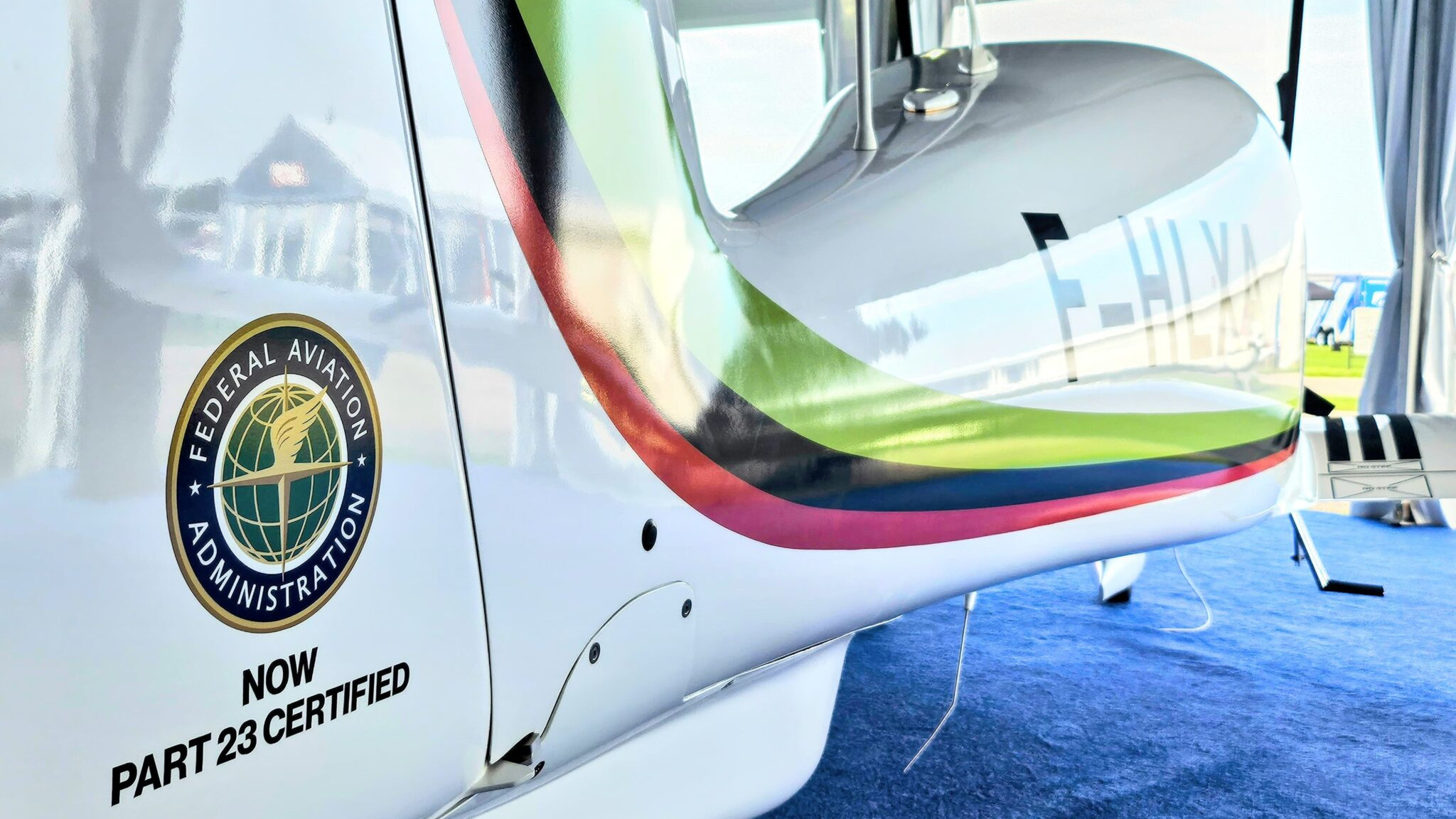
The FAA certified Elixir airplanes under Part 23 in July 2025. [Credit: Elixir Aircraft]

An FAA airworthiness directive grounding two-seat, single-engine Elixir trainers took effect Wednesday.

The agency issued the AD on Tuesday following a fatal accident during a production test flight involving the Elixir earlier this month. The airplane, marketed primarily for training, is manufactured in France by Elixir Aircraft.

To address an unsafe condition, which the FAA said could result in loss of continued safe flight and landing if unaddressed, the agency required immediate adoption of the AD without the traditional public comment period. Instead, members of the public can submit comments through November 27, after which the FAA may amend the final rule.

“The FAA has found that the risk to the flying public justifies forgoing notice and comment prior to adoption of this rule,” it said, “because the severity of the consequences of not knowing what caused the fatal accident necessitate prohibiting further flight until approved inspection or modification procedures are identified, the airplane is inspected, and any applicable corrective actions are performed.”

The directive halts operation of the Elixir until the aircraft have undergone FAA-approved inspection or modification procedures, which have not yet been established. The agency described the AD as an interim action and said it may consider further rulemaking.

The provision applies to all model Elixir airplanes, regardless of certification category, and prohibits special flight permits unless specifically approved under the directive’s alternative compliance procedures. The FAA estimated that the grounding will affect only three U.S.-registered aircraft.

The French manufacturer obtained FAA Part 23 certification in July 2025 and began U.S. deliveries this year, with initial customers including Cirrus Aviation. Cirrus’ website states that the next-generation Elixir aircraft it ordered are “currently being integrated into operations and will be available soon for student training and advanced instruction.”

The fatal Elixir accident, which killed two test pilots, occurred October 1 at Rochefort Airport (LFDN) in France. It involved model F-WGAZ, which according to media reports lost one of its flaps during a low-level circuit before the accident.

France’s Bureau of Enquiry and Analysis for Civil Aviation Safety and the European Union Aviation Safety Agency (EASA) are still investigating the cause of the accident. But the FAA said the unsafe condition is “likely to exist or develop on other products of the same type design.”

Elixir issued an Alert Service Bulletin to operators on October 2. EASA the same day issued an emergency AD temporarily suspending operations of the entire Elixir fleet as a precautionary measure.

Jack Daleo

Jack is a staff writer covering advanced air mobility, including everything from drones to unmanned aircraft systems to space travel—and a whole lot more. He spent close to two years reporting on drone delivery for FreightWaves, covering the biggest news and developments in the space and connecting with industry executives and experts. Jack is also a basketball aficionado, a frequent traveler and a lover of all things logistics.
Pilot in aircraft
Sign-up for newsletters & special offers!

Get the latest stories & special offers delivered directly to your inbox.

SUBSCRIBE