Register

Stick & Rudder

Low And Slow

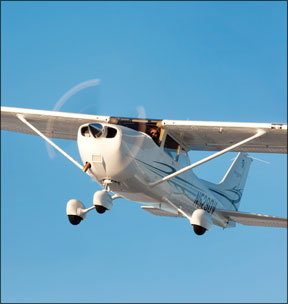
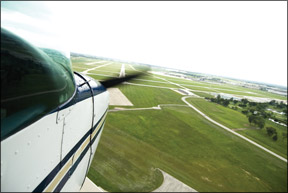
Pilots like to talk about speed and how fast they fly, often to the exclusion of other aircraft characteristics; its fun to go fast, no doubt. Witness how many aviators seek out the fastest flivver their finances can support. But the ability to power up to cruise, trim for speed, engage the autopilot and start fiddling with an iPod requires far less skill and hand-flying ability than working at the lower end of the airspeed dial. And we dont learn much at the top of the green. Demonstrating slow-flying skills takes up part of our training time; slow flying is an item in the FAAs Practical Test Standards for sport pilot certificates on up.
Read More »

What Goes Around Comes Around… Again

Sometimes the only answer to a situation is, “No, not this time.” Maybe it applies during a to-minima instrument approach where the ground never appears; maybe while attempting VFR flight toward weather deteriorating into IMC. Often, it should be the first part of the answer to a questionable landing-with the second part of the answer being, “Yes, Im going around.” The high-profile landing accident involving a Hawker Beechcraft Premier IA at EAA AirVenture 2010 in Oshkosh, Wis., served to elevate the topic. But venue aside, normal application of the requisite skills and judgment can work there, just as they do elsewhere.

Read More »

From Denial To Final, II

There you are, droning along in cruise. Suddenly, theres a vibration, then a power surge, then combustion ends…and youre flying a glider. For a moment you hesitate-no one is immune from at least a split-second of indecision, most of us much longer-and then you realize you have an engine failure. You maintain control, point the aircraft in the direction of a place to land, then confirm the failure. If you have time and altitude you can try to restart the engine, but if the failure is catastrophic youll quickly find theres nothing you can do to fix the engine from the pilots seat. You are committed to a glide and a power-off landing.

Read More »

Tips for Full-Circle Pilots

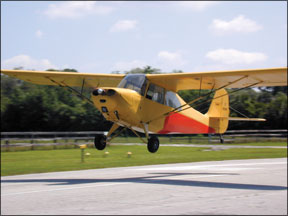
Its inevitable. Youll be standing on the ramp, clutching an avgas receipt rivaling Greeces national debt. Your chest throbs. You cant breathe, and ripping off your bolo tie, you scream, “Enough! I cant take this anymore!” Heart attack? Time to kiss 30 years of flying good-bye? Perhaps, but in this scenario, no. Instead, as you wander off toward your car, its first-love rekindled as you spot an old flame lounging in the grass across the field: a 1946 Aeronca Champ. And as your six-place Twin Turbo-Moneysucker is tugged off to its hangar, you stumble zombie-like toward the little taildragger and stammer to its owner, “I learned to fly in one of these….” She, then, takes your hand, guides you into the front seat and whispers, “Its time. Weve been waiting for you.” When she swings the prop by hand the 65-hp engine barks like a puppy on Christmas morning, and off you fly back to your aviation roots. Your flying life isnt over. Its merely come full circle, thanks to old airplanes that qualify as Light Sport Aircraft (LSA).

Read More »

Five Exercises For Better Crosswind Landings

Everybody talks about crosswind practice, but few pilots do anything about it. Crosswinds are the number one factor in weather-related accidents, and even far more in-motion aviation insurance claims. The answer to handling crosswinds is usually to…practice crosswinds. Theres no question that practice makes one (at least closer to) perfect. And, as is the case with most other maneuvers we attempt when flying aircraft, landing in crosswinds requires the artful combination of a number of individual skills. As with so many elements of learning to fly and maintaining proficiency, there are several of ways to develop and improve your crosswind skills. You dont necessarily have to practice them in an actual crosswind, but you do need to be ready to combine them on the day when things are strong and gusty, and not aligned with the runway. Here are five exercises you and your CFI can use to develop better crosswind landing skills.

Read More »

Asymmetry In Action

Symmetry. Balance. These concepts are universal to virtually all human philosophy and aesthetics. An aviation credo is that “if an airplane design looks good, it will fly good.” In most cases, “looking good” means having proportions-and symmetry-that please the eye. We strive for balance and symmetry in the way we fly as well. Pitch attitudes. Bank angles. Airspeeds. Rudder coordination. Almost everything we do is designed to make maneuvers steady and balanced. Some of the most challenging maneuvers on practical tests make us demonstrate symmetry, with airspeeds, altitudes and bank angles at one point of the maneuver equaling those at others, and balanced rudder input throughout. But there are times when we must violate the concept of symmetry to make the airplane perform. Most notably, this means something other than balanced rudder input.

Read More »

Flying The Ball

A close friend e-mailed recently to inquire about what happens to the turn coordinator/turn and bank instruments ball in certain flight attitudes. After giving him what I thought was the answer he needed, several more e-mails ensued, each one raising my frustration level-admittedly not a difficult thing to do. Finally, I picked up the phone and called, and Im glad I did, since his real question had very little to do with the ball. But his questions-and little bit of research I did to verify my understandings before responding-highlighted one thing: There probably are a large number of pilots out there who have forgotten exactly what the little ball does and how it does it. Theres also another number of pilots who never were taught these things correctly. Lets try to fix both problems. First, though, lets refresh our understanding of why and how an airplane turns.

Read More »

Five Airspeeds Youve Got To Nail

So much of operating personal aircraft is a numbers game: How many gallons of fuel are required, how many inches aft is the center of gravity and how many more minutes until we arrive? The automation available in todays avionics makes some of this childs play, but we still need to know how to do the basic computations, if for no other reason than the day our expensive panel soils the bed. The same is true for just basic stick and rudder skills, also. For example, there are several performance airspeeds that, when the need arises, youve got to be able to predictably attain. Some may be obvious, others perhaps not, and some reference speeds well address a little differently than you might have been taught. Unfortunately, recent NTSB accident histories show a growing trend away from proper airspeed control, so with that in mind, lets review five speeds youve got to nail.

Read More »

Deep Stall Aerodynamics

In October 22, 1963, a prototype of the British Aircraft Corporation One-Eleven (BAC 1-11) short-haul jet airliner, registration G-ASHG, crashed near the village of Chicklade in southwest England. The aircraft was evaluating stall characteristics at varying center of gravity locations when the flight crew found the flight controls unresponsive after entering a stable stall and the aircraft struck the ground at a wings level attitude with a high rate of descent and little forward speed. All aboard died in the crash. The 1-11 was one of the second-generation of jet airliners-others being the Douglas DC-9 and Boeing 727-featuring aft-mounted engines, swept wings and all-moving T-tail horizontal stabilizers. Post-crash investigation concluded the prototype 1-11 had experienced an unrecoverable deep stall in which the wake of the stalled wing covered the high-mounted horizontal stabilizer, thus blanking the elevator controls and preventing normal recovery techniques.

Read More »

Real-World Steep Turns

I spent a weekend recently helping prepare a pilot for his commercial pilot practical test. He is a long-time instrument pilot and highly experienced in his turbocharged Beech Bonanza. One of the hardest parts of his training was getting him to bank beyond a standard-rate turn-everything hed practiced for years involved making small control inputs, and he needed to regain comfort with the more dynamic maneuvering required for the test. As we practiced steep turns, getting closer and closer to halving the minimum practical test tolerances, the question came up: Besides demonstration of a “circus trick” in order to earn his commercial certificate, what is the purpose of performing steep turns? Its a good question many students and rated pilots ask, and one deserving a detailed response.

Read More »
Pilot in aircraft
Sign-up for newsletters & special offers!

Get the latest stories & special offers delivered directly to your inbox.

SUBSCRIBE