Register

Stick & Rudder

The Spin On Spins

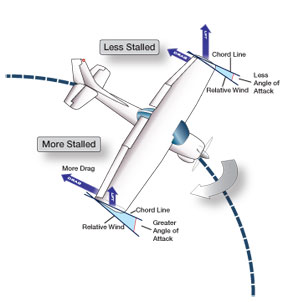
The FAA doesnt talk much about spins. Mostly, they want us to learn to avoid them. Clearly, avoiding an inadvertent spin is good, but it might help to know a bit more about them. Plus, the whole specter of Air France 447 crashing into the Atlantic at what French authorities indicate was a very high vertical speed and a nearly level attitude suggests that it might be nice to know a bit about flat spins in particular. Most of us have heard it before: Spin training used to be mandatory, but sometime after WWII it was decided most inadvertent stall/spin accidents occurred at an altitude low enough to make recovery unlikely and neednt be taught. So, the FAA dropped spin training from all but the CFI curriculum and instead began to emphasize spin avoidance. Now, the FAA is taking that one step further by de-emphasizing stall practice and recovery, and instead concentrating on teaching pilots to avoid stalls. With this progression, soon spins and even stalls may be solely the realm of the aerobat and the accident victim. Our goal, of course, is to minimize the latter, so a little education is in order. Well start with a brief discussion of the stall and then focus on the aerodynamics of spins and their recovery. Finally, well take a look at what makes a flat spin.
Read More »

Beyond The Burble

Were going to do what?” Okay; I dont usually get quite that reaction when I discuss full aerodynamic stalls during a preflight brief with my students receiving checkouts, or flight reviews in high-performance aircraft. But you can see it in their eyes. Many pilots havent practiced full stalls since their private pilot checkride, and a large number of my students in 300-horsepower retractable singles-and especially light twins-have never stalled the airplane they currently fly. No wonder theres trepidation about a maneuver some have not flown in many years. No wonder stalls continue to take lift, and life, away. To reduce the chance a stall might go unrecognized or uncorrected, lets go back to what we learned in our early training, and build upon that knowledge to deal comfortably with what occurs beyond the first stall burble.

Read More »

True Short Field Landings

The short-field approach and landing is something we all learned as student pilots. Commercial students get to show some additional expertise. However, both the private and even commercial requirements are a bit relaxed and dont really prepare us for that maximum performance, white-knuckle experience of putting the airplane down on that postage stamp some joker sadistically calls a runway. When we say “short-field approach and landing,” were really talking about two entirely different situations with different techniques. Obstacles at the approach end of the runway determine how we will make the approach-whether we can “drag it in” a few feet off the ground, or if we have to make a steep descent to clear the FAAs standard-issue 50-foot tree right at the runway threshold.

Read More »

Power-Off Approaches

Takeoffs, as a friend and CFI likes to inform her students, are optional. Landings, however, are mandatory. Within the soaring community, the line was “Get one free landing with every takeoff!” And therein is the most sobering aspect of facing a power-off landing: the reality the old stand-by go-around option we enjoy for other situations is eliminated. So while making all the usual efforts to restart an engine after it stops, the savvy pilot must simultaneously make a quick assessment of available options-and adjust to flying the aircraft as a glider. That means trimming for best glide while working the restart prospects and looking for the best suitable landing area available. And you must take these steps quickly: Altitude equals time to touchdown; the lower the failure altitude the less the time available, and the smaller is the radius of territory you have to consider. Gravity will prevail; your job is to make the arrival survivable, maybe even a great landing that leaves the airplane ready to fly again-once the engine problem is fixed, of course. Ultimately, an engine failure in a single-or, say, flameout of both engines after flying through a flock of birds-presents a situation demanding the best of your stick-and-rudder skills along with all your top judgment and experience.

Read More »

Beyond Standard Rate

From Day One of our flight training, maneuvers practice fills much of our hours of dual instruction: turns around a point and such, unusual attitudes and recovery from them, and that most-basic skill from putting together all the control elements, flying pattern work. In aircraft so equipped, most of us learn to use the turn gyro when practicing maneuvering flight, striving to master the standard-rate, two-minute turn depicted by our little friend. But as we learn later in actual flying, that training also instilled flexibility and the skill to adapt maneuvers to the conditions. Among the best of all flexibilities is the ability to maneuver beyond our standards-both beyond the standard-rate turn and past the point where turns become steep. At times it seems that too few of us practice to maintain competence at the higher demands of flight beyond 30 degrees of bank. Thankfully, with a bit of caution and common sense, steep turns are skills we can practice on our own or, even better, with the security and added safety of an instructor or safety pilot. The payoff can be a lifesaver. Steep-turn skill holds significant real-world application in everyday flying, whether for something as potentially dangerous as trying to escape from a dead-end canyon or the more routine need to complete a non-precision instrument approach by circling while remaining within sight of the runway. With a little regular practice, a pilot should be ready to safely, sanely fly steep turns up to and including the most demanding of such unusual maneuvers: the 60-degree bank, 360-degree turn, all while holding altitude within 50 feet, plus or minus, of our entry altitude. Acknowledging that such circumstances when we need that skill should be relatively rare only heightens the need to regularly hone your real-world steep-turns skills. And should we never actually need to, a great sense of self-satisfaction comes from bumping through ones own wake.

Read More »

Icing And Tailplane Stalls

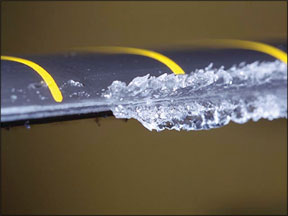
Even as the wreckage of Colgan Flight 3407 cooled in a Buffalo, N.Y., neighborhood in mid-February, the debate over flying turboprops into known icing was reigniting. Whether icing was the cause isnt known, and actually isnt relevant to the fact that this accident reminded everyone in the industry of an unresolved safety question: Are turboprops equipped with pneumatic boot de-icing systems really capable of handling all the icing they might be expected to encounter? And if they arent, how can pilots be trained to safely recover an airplane thats been iced up beyond the equipments capability or, worse, survive an icing encounter in an airplane with no ice protection? Another early question arising from this tragedy involves reports of what might be considered inappropriate control inputs as the Bombardier Q400 departed controlled flight. According to the NTSB, information retrieved from the flight data recorder indicates the stall-warning stick shaker and stick pusher activated soon after landing gear deployment and wing flap extension to 15 degrees down. At that time, the aircraft then pitched up 31 degrees, far in excess of a normal maneuver in a transport-category airplane. While its entirely possible the pitch up involved the autopilots automatic and simultaneous disengagement, its also possible the maneuver was commanded from the flight deck. Why would the crew pitch up so severely? One explanation involves the crews presumption the tail had stalled. In such an event, the appropriate response is to pitch up, not down as would be the case if the wing entered a stall. Generally, the only way a tailplane is going to stall in normal operations is if its leading edge somehow becomes contaminated, as would be the case if ice accumulated.

Read More »

Anatomy of a Crosswind Landing

It never fails. You reserve the airplane for an early morning departure on the family vacation. Then the kids and the packing and the delays add up, so you launch hours late, and arrive at beautiful Lake Runamuck as one of the kids becomes spectacularly ill, the other is screaming about the dead batteries in the GameBoy, the turbulence reaches its glorious maximum, the winds are 270 at 15 gusting to 20, and the 75-foot wide runway is oriented north and south. The last two pilots in the pattern were using Runway 18, so you figure youll follow the crowd. You remember the maximum demonstrated crosswind component for this airplane is 17 knots. You know its not a limitation, but you consider it was a professional test pilot who did the demonstration, so, as you havent really done any serious crosswind practice for at least a month-okay, okay! It was six months ago and it wasnt pretty-so, maybe, despite your ingrained determination to complete the mission, you should admit to yourself your ability to control the airplane and make a safe landing under these conditions is not a sure thing. As common sense kicks in, you leave the pattern, add a little power and climb about 500 feet, then pull the power back, lean the mixture and take a minute to decide what to do. You recheck the airport diagram and see there is an east-west grass runway. Its only 2000 feet long. Why didnt you consider it? Well, because no one else is using it, its not paved and the FBO where you rented the airplane says no grass runway operations. It seems to you that right now, in high summer, landing on a grass runway into the teeth of a 15-to-20 knot breeze is a heck of lot smarter than landing at a 90-degree angle to that same wind. So, you announce your intention to land on Runway 27, fly the pattern and make a normal landing. Your spouse comments on how nice it is to land on the grass. You taxi in, holding the ailerons carefully for the wind and tie down the airplane. As you are picking up the bags to walk into the FBO you hear a horrible squealing noise as one of those airplanes in the pattern for Runway 18 loses control on the rollout, scrapes a wingtip and describes a graceful curling path right into the airport fence. You run to the site and help the stunned pilot and passengers out of the airplane.

Read More »

Pitch And Power Exercises

Weve all struggled with it at some point. Maybe as a student you kept neglecting to add power when leveling off after a descent, or perhaps you couldnt quite grasp whether to pull back or push forward. Im currently helping a friend of mine teach a primary student to fly. Our student is really struggling to get a clear handle on how all this fits together. After I suggested some additional study and reading that didnt produce the desired “Aha!” moment, I came up with a few new ways to try to get the concepts across. Figuring it never hurts to review the basics, perhaps this might help you or someone you know gain a better understanding of the sometimes subtle effects that even small changes in power or pitch can have on altitude and airspeed. This better understanding may help a VFR pilot simply maintain better control of their aircraft. It might even help an old pro keep the needles glued to the center. Well look at examples of both.

Read More »

Takeoff Aborts

Takeoff and initial climb accidents are 10 times more deadly than landing accidents, according to the AOPA Air Safety Foundation (ASF) presentation “Mastering Takeoffs and Landings.” And, when you think about it, the ASFs numbers make sense. After all, during a takeoff, the airplane is as heavy as it will be for that flight, youre accelerating, not slowing as when landing, and you arent accustomed to the wind or the airplanes loading, among other factors. If in fact takeoffs are so potentially fatal, its worthwhile to discover how to detect when a takeoff or “first-stage” climbout is going bad and, if needed, how to safely abort it before joining the NTSB tally. What clues do we have to a takeoff anomaly, and how can we safely abort a takeoff when things arent going right? Im in favor of letting the student do everything possible on the first lesson, but the relative ease at which we launch into the air-at least compared to what it takes to learn to land-might make us complacent about critically observing our takeoffs. After all, when turned into the wind and the powers brought up, were thinking about the flight ahead, or perhaps focused on an initial heading or altitude restriction. It takes a lot of discipline to be thinking about the takeoff itself.

Read More »

Flying All The Angles

Are you a proactive or reactive pilot? From our early primary training days, weve learned to fly by the airspeed indicator and listen for the stall warning horn when we venture too close to the lower edge of the planes airspeed envelope. Or, we live with the monotone blare while practicing the stall series. But what does it really tell us? Like other traditional primary instruments, there is some level of lag in their indications, and the information we receive is delayed or incomplete. Enter the angle of attack (AOA) indicator. While ubiquitous in gliders, where lift is life, chances are good your primary trainer did not have such instrumentation on board, although your training covered the concept of angle of attack. Ah, stalls. During primary training, we memorize the aircrafts stall speeds, clean and dirty, in 1G flight. We are further admonished that the stall speed increases as the wing loading, as well as gross weight, increases. And then theres density altitude to consider. All these factors conspire to sabotage lift, and while the dissipation of lift has its place (such as right before touchdown), its better to be proactive in preserving lift than chasing its loss.

Read More »
Pilot in aircraft
Sign-up for newsletters & special offers!

Get the latest stories & special offers delivered directly to your inbox.

SUBSCRIBE