Register

Stick & Rudder

Aircraft Takeoffs and Landing on Shorter Runways

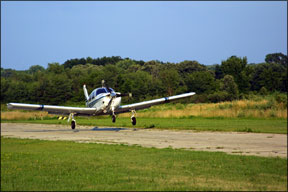
Early on in my flying career, taking off automatically meant, absolutely free, one mandatory dead-stick landing. Thats because I was flying hang gliders and developed an easy appreciation for fitting into small spaces. Later, after someone thought to put a small engine and propeller on one and dub the results an ultralight, my well-honed, dead-stick landing skills proved handy too frequently. Thankfully, the engines used on ultralights in those early days have improved greatly but-like a catchy tune you just cant shake after hearing it on the radio-I still think in terms of whether a nearby field is large enough for landing. Coincidentally and for the same reasons, short-field takeoff skills with an ultralight received equal attention. After all, once you “land out” in an ultralight and resolve whatever caused the engine to fail, you still need to get back to the car. Best of all, the better our short-field skills, the more options we had for operating, powerplant status aside. Once I moved up to flying larger, heavier, faster airplanes, those same instincts came with me, as did the comfort of knowing I had the ability to safely operate from fields that might make a knowledgeable passenger utter an audible, “Whoa….”
Read More »

How To Fly Twin Engine Aircraft At Single Engine Performance Levels

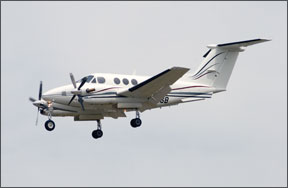
Twin-engine airplanes certified under FAR 23 do not have the same performance guaranteed for transport category airplanes certified under FAR 25. Especially, light twins weighing less than 6000 lbs and have VS0 equal to or less than 61 KCAS are not required to have any positive single-engine performance. Twins weighing more than 6000 lbs and/or having VS0 above 61 KCAS must demonstrate, in still air at 5000 ft, with the inoperative engine feathered, a climb gradient of 1.5 percent (if certified after February 1991), or a rate of climb of 0.027 V2S0-not exactly earth-shaking performance. We often hear that losing an engine in a light twin-engine airplane is far more dangerous than losing the only engine in a single-engine airplane. Melville Byington Jr. (1989 and 1993) of Embry-Riddle Aeronautical University conducted an experimental study of the bank angles required to obtain the zero sideslip flight, and consequently, the maximum performance in light twins. Based on the NTSB accident data, Byington concluded that 30 percent of twin-engine airplane accidents occur due to the loss of directional control (VMCA rollover), while 43 percent can be traced to insufficient performance with one engine inoperative (OEI). The remaining 26 percent or so are stall/spin accidents, which also carry the highest fatality rate. Evidently, more accidents happen due to the inadequate SE performance planning or understanding, than due to the control problems.

Read More »

Wind Gusts Effect on Airframes and Airspeeds

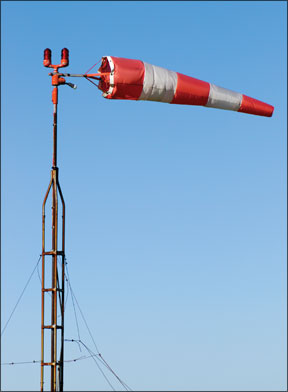
Comanche seven-three Papa, Wichita approach; winds two-zero-zero degrees at one-eight, gusts to 30.” “Approach, seven-three Pop; copy the winds…guess well keep up the pace a bit.” “Comanche Seven-Three Papa, Dorothy says, Welcome to Kansas.” When first sitting down to assemble this article, my initial thoughts turned to my logbook. Inside it are more than a few notations about such not-unusual days; the controllers welcome in this one made me chuckle. At almost the same instant, the sound of 30-knot gusts rattling the trees outside my office focused my attention on the days local conditions-an environment offering abundant signs that any flying means dealing with gusts. My familiarity with gusty conditions started developing during my primary training. A regular part of my time-building solo practice involved August afternoons hopping among five Wichita-area fields. Typically, those hot summer days and nights brought winds blowing hard, in the teens to low 20s, and usually gusty-as much as 20 knots above the mean. For much of that month gusty winds served up a significant challenge for a student pilot armed only with a Cherokee 140 and determination. Hey, its Kansas.

Read More »

Ten Tips For Recovering Bad Landings

Its probably a fair bet that every person who has flown an airplane more than about 20 hours has made at least five landings he or she not only considers personally embarrassing but remains convinced to this day could be measured on the Richter scale. So, lets be honest with ourselves from the very beginning: As active pilots, we are going to make ugly landings from time to time. Further, Murphys Law says we will probably make them when a lot of people are watching. Therefore, lets recognize that a little humility (and perhaps humiliation) is the price of acquiring and maintaining the skills necessary to cause a rapidly moving flying machine to return to the planet in a condition to be reused immediately. As a result, once we firmly accept that from time to time were going to make runway arrivals of the sort to make cement contractors rub their hands in financial glee, we are going to be less likely to try to force the airplane onto the ground due to embarrassment after we have bounced telephone pole high, and more likely to think rationally about the attitude, speed and altitude of the airplane and proceed to coolly evaluate whether to try to salvage the landing or go around.

Read More »

The Problem With Flight Instruction

Perhaps youve heard the riddle, “What do you call the person who graduates at the bottom of the class in medical school?” The answer: Doctor. The maxim being conveyed applies equally well to aviation: What do you call the pilot who has met the minimum standards set forth in FAR 61.183-187? Answer: Certificated Flight Instructor. Yet whether acting in the capacity of doctor or flight instructor, that individual is directly responsible for another persons well being. Others literally may live or die based directly on the doctors and the flight instructors knowledge and skills. The path to becoming a practicing doctor evolved to include a rigorous course of study and years of apprenticeship: college, med school, internship, residency, fellowship. The tradition in aviation, on the other hand, has been to treat flight instructing as the bullpen for corporate and airline flying. Still clinging to this model, many instructors teach largely for their own benefit and not the benefit of their students. Instructing, after all, is supposed to be a transient phase; building time, the primary goal; low pay and high turnover at flight schools, expected.

Read More »

The Problem With Flight Training

For a long time now, loss-of-control accidents in general aviation have been driven by relatively few but recurring causes pointing to fundamental problems in pilot training. These problems seem national in scope. The NTSBs findings in two recent crashes illustrate the point. One was the fatal stall/spin of an American Champion Decathlon in Oroville, Calif., in October 2005; the other the much-reported crash of a Cirrus SR20 into a Manhattan apartment building in October 2006. In both accidents-the Decathlon involving a high-time ATP, the Cirrus an 88-hour major league baseball player new to aviation-there were common threads. Both reveal systemic errors and omissions in our standard flight training. Methodology, in my estimation. These two accidents vividly show that our training is deficient in teaching stall/spin awareness, cockpit resource management and risk analysis. Why cant we figure this out?

Read More »

Aircraft Turn Dynamics

According to the AOPA Air Safety Foundations 2007 Nall Report, you have a 57.4 percent chance of dying if you lose control while maneuvering an airplane, up from 50.5 percent in the reports 2005 edition. Maneuvering describes a host of flight operations including aggressive turns from base to final, confined-area course reversals and retreats to the runway following an engine failure. In other words, turns. Why cant Johnny turn safely? One reason might be losing understanding of and appreciation for the dynamics of a turn, regardless of bank angle, airspeed or pitch. Lets take a look

Read More »

Brake Right

Transforming our elegant aerial machines into land vehicles is arguably the single most difficult aspect of flying. Many flight hours are spent practicing approaches and landings, occasionally followed by smooth deceleration to a safe, controlled stop. Brakes help make this possible, but if you ignore or abuse them they can bite back in a most spiteful way. The brakes in most general aviation airplanes involve relatively simple systems, but theyre not as robust as an automobiles. For one thing, most personal airplanes arent equipped with an anti-lock brake system. For another, automobile brake components are larger, heavier and more powerful. Yet, we often find ourselves in an airplane on or near the ground traveling at highway speeds. And, like so many tasks associated with aviation, theres also a right and wrong way to use an airplanes brakes. Lets start with how to inspect them.

Read More »

Gliding With Precision

From almost our very first flying lesson, pilots are taught what to do in the event a single-engine airplanes lone powerplant fails. As with too many concepts at that early stage of our training, we basically accept what were taught without many questions. Later, as we gain experience, we begin to think more about those early lessons and try to apply to them what our experience has taught us. In turn, many questions can arise. If your airplane ever becomes a glider, you would suddenly become very interested in its new aerodynamics. How promptly and accurately you can remember to make the most of the variables at your disposal would play a large part in determining where and how softly you land. Lets take a look at those variables and how they can affect your emergency glide.

Read More »

Letting Down Easy

Proper flight planning is extremely important and a vital component for your safety and the safety of your passengers. Just as we plan the takeoff, climb, cruise and landing phases of flight, we also should be thinking about and planning our letdown. Among the variables to consider are power settings to accommodate our approach profile, airspace or known ATC restrictions, aircraft operating limitations and any weather averse to a smooth, efficient descent. As our letdown continues, we monitor our progress, calculate for time and distance, adjust our plan by jockeying power, pitch and speed. The idea is to complete the flight with a textbook landing so we can score another victory for proper flight planning.

Read More »
Pilot in aircraft
Sign-up for newsletters & special offers!

Get the latest stories & special offers delivered directly to your inbox.

SUBSCRIBE