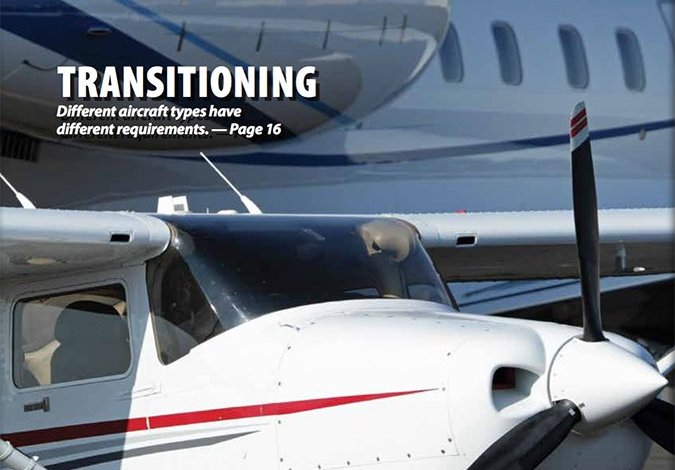
Risk Management

Download the Full July 2017 Issue PDF

First, its important to distinguish between fees an airport may levy and those of the FBO use of its facilities. Airports often levy their own fees but depend on the FBO to collect them. To pilots, this can be a distinction without a difference, and the FBO can come off as the bad guy. Meanwhile, pilots need to know before they land how much they should expect to pay for the privilege of using the airports and FBOs facilities, especially if its a single-FBO monopoly. They also should have the option of paying a minimal fee for minimal service. So, two things should happen, in my view.

Read More »

Situational Awareness?

Over the last couple of decades, theres been a growing realization within aviations training and safety arenas about situational awareness. The conversation generally involves ways to enhance situational awareness in the cockpit and often concentrates on technological solutions, like moving maps, or displaying real-time traffic and weather. The presumption is that greater situational awareness is better and that all of us have at least some measure of this characteristic.

Read More »

NTSB Reports: June 2017

While on the base leg for his private grass airstrip, the pilot noticed he was high, so he added flaps to increase his descent rate. On final, the airspeed was a little fast and during the landing, he flared the airplane a little high. After touchdown, the pilot applied the brakes, but the airplane did not respond, so he applied a little more brake. The airplane nosed over and came to rest inverted, sustaining substantial damage to both wings and the empennage. The pilot reported he should have performed a go-around instead of attempting to salvage the landing.

Read More »

Download The Full June 2017 PDF

Its that time of year again in North America: Summer is upon us and theres nothing we can do about itwithout a passport, even if we want- ed to. The good news is we no longer have to deal with freezing precipitation, cold, low clouds hugging a run- way for warmth or preheating our engines. More good news is that the number of reasons to hop in an air- plane and go somewhere will grow. Options will include small y-ins and pancake breakfasts to the large, name-brand events, and everything in between. There is other stuff going on with the change of seasons, which may or may not be good.

Read More »

NTSB Reports: May 2017

The pilot reported that when he raised the landing gear shortly after takeoff, he heard a loud crunch as the gear entered the wells. The pilot climbed the airplane to about 3000 feet and observed the landing gear circuit breaker was popped and the alternator was off. The pilot attempted to extend the landing gear normally several times, however, the circuit breaker popped each time and the gear remained retracted. The pilot also attempted to use the emergency gear extension, to no avail.

Read More »

Performance Margins

At one time or another, weve all passed an FAA knowledge test requiring us to calculate aircraft performance for various phases of flight, such as takeoff, cruise and landing. Even though weve been trained and tested on our ability to interpolate the answer down to the foot, mile, minute or gallon, these calculations alone dont ensure were always operating the aircraft prudently. For one thing, they dont account for poor technique, worn equipment or errors.

Read More »

Risk And Consequences

One of the first and most obvious choices we make when using a personal airplane is routing. We want to get from Point A to Point B, usually by the shortest, most direct route. So far, so good. What if that route increases the consequences of the risk in question, namely that our sole powerplant will fail at the worst possible time? Maybe change the route?

Read More »

IPC Scenarios

A lot of attention has been directed at the FAAs new airman certification standards (ACS), which prescribe how practical tests are conducted. Last year, the FAA implemented ACS for the private pilot-airplane certificate and instrument-airplane rating. A chief difference between the ACS and its predecessor practical test standards (PTS) is expanded integration of risk management principles. Another involves how slow flight is performed.

Read More »

New Advisory Circulars

Three Advisory Circulars newly issued by the FAA in December 2016 and January 2017 may provide much-needed guidance to operators seeking answers to a wide range of certification and operational questions. Two of the ACs revise existing guidance on Use of Flight Deck Displays of Digital Weather and Aeronautical Information (AC 00-63A) and Airworthiness Approval of Enhanced Vision System, Synthetic Vision System, Combined Vision System, and Enhanced Flight Vision System Equipment (AC 20-167A).

Read More »

When ATC Screws Up

On December 16, 2016, shortly after takeoff at 0119 local time, an EVA Air Boeing 777-300ER apparently came well within 1000 vertical feet of mountainous terrain after departing the Los Angeles (Calif.) International Airport (KLAX). While a formal investigation reportedly is underway at the FAA and the carrier, unofficial transcripts and aircraft tracking data make it clear this event was a very near thing. The publicly available information depicts confusion and uncertainty in the 777s cockpit. It also suggests non-standard phraseology on ATCs part may have contributed to the event. The sidebar on the opposite page explores it a bit more, based on unoffocial sources.

Read More »
Pilot in aircraft
Sign-up for newsletters & special offers!

Get the latest stories & special offers delivered directly to your inbox.

SUBSCRIBE