Risk Management

Risky When Real

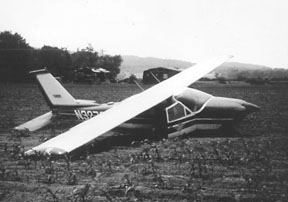
[IMGCAP(1)]I was driving down a country road when I had to blink to make certain I wasnt hallucinating. There was a Cessna 152 by the side of the road. It was undamaged, which was surprising because the road had a number of power lines running along it.

I stopped to see if the person standing next to the aircraft was okay. He said the flight instructor had pulled the mixture to simulate an engine failure when they were doing S turns along a road. The student had few options for an emergency landing area and chose the road. There was no time to try re-starting the engine.

The student said the flight instructor had walked down the road to try to find a better stretch of the road for…
Read More »

Repelling Terrain

There are large parts of this country where the terrain can impede your climb-out after takeoff. Sometimes it can even be a factor during en route climbs.

It takes just a quick glance through the NTSB database to find dozens of accidents in which the aircraft was unable to outclimb rising terrain. Those accidents reveal a number of common factors involved with this type of accident, in addition to the rising terrain. High density altitude carries much of the blame, to be sure, but so does restricted maneuvering area, adverse winds, heavy aircraft weights and relatively low power-to-weight ratios.

When most people think of rising terrain, they picture mountain peaks that rise nearly 1…

Read More »

Nowhere to Hide

[IMGCAP(1)]If the lure of exploration is strong, those magazine pictures of the backcountry airstrips, such as those in the Northern Rockies, are an irresistible lure. Vast areas in the United States are designated as wilderness area and are accessible only by horseback, hiking, drift boat – or airplanes.

Most wilderness areas contain a system of airstrips ranging from nice grass airstrips with plenty of width and length to strips that are barely wide enough for the landing gear of a STOL aircraft. This is a very challenging aviation environment that must be flown by the right pilot, with the right equipment, training, experience and weather.

The safety margins are very thin in thes…

Read More »

You Cant Fly There!

[IMGCAP(1)]In the interest of national security, flying light planes has become a confusing and dynamic business where the rules can change between the time you get your briefing and start your engine. In this brave new world, prepare to be wrong.

If thats too pessimistic a view, there is a bright side. The FAA has backed off enforcement actions when pilots can show theyre following the rules that existed an hour ago. And the number of airplanes forced to land by armed fighter jets has been small. So far, the trouble appears to be borne of changing rules, nervous politicians and a paranoid public.

But staying out of trouble has gotten decidedly more difficult.

Consider that in t…

Read More »

Water or Trees?

When faced with a controlled forced landing, water offers little danger. Surprisingly, the same is true of heading for the trees.

Read More »

Get Down Right Now

[IMGCAP(1)]Aviation training is often bashed for having a tombstone mentality. We tend to ignore certain shortcomings until an accident or incident instills new religion. Emergency descent training is a prime example of this.

Throughout my private, commercial and ATP courses, I dont remember getting instruction in emergency descents. Yet after the ValuJet, Swiss Air and FedEx accidents-each of which involved fire in flight-every checkride Ive had has included an emergency descent.

Whats the big deal with emergency descents? And is this skill worth your attention? Take one look at the burned wreckage of the FedEx DC-10 at Newburgh, New York in 1996 for your answer. That crew had…

Read More »

Airspace Blunders

[IMGCAP(1)]It was a typical pre-9/11 afternoon as we approached White Plains. New York Tracon handed us off to White Plains Tower and the controllers were issuing their usual rapid-fire instructions to the arriving mass of airline, regional, business and general aviation aircraft.

The frequency was so congested that most of the arriving aircraft were unable to read back the instructions. We had the TCAS turned down to a six-mile range and our heads were on swivels since the airspace was so busy. The TCAS screen was full of targets.

We were watching the business jet ahead of us turn onto final when suddenly it made an abrupt nose-up maneuver. The pilot cried over the frequency, What…

Read More »
Pilot in aircraft
Sign-up for newsletters & special offers!

Get the latest stories & special offers delivered directly to your inbox.

SUBSCRIBE