Risk Management

Minimizing The Risk Of Engine Failure

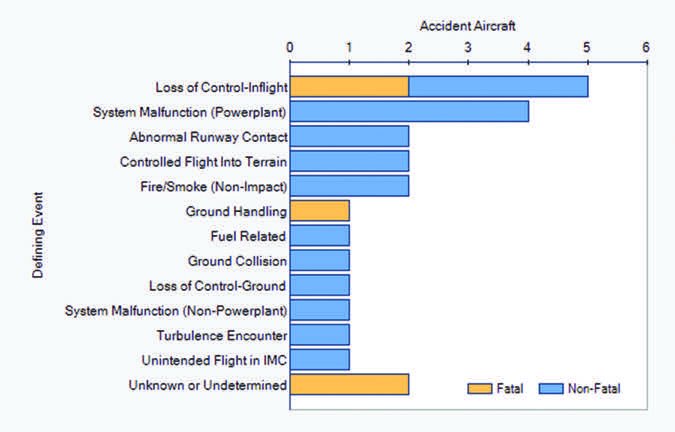
Almost from the beginning of our training, pilots are taught how to react to an engine failure. Before that, though, were also taught how to conduct a preflight inspection to ensure the engine (and the rest of the aircraft) is ready for what we are planning. Thats as it should be, since mechanical failures are a major component of overall accident causes, right after the pilot making a mistake. The good news is that the typical piston engine in a personal aircraft is much more reliable than it was a few years ago. The bad news is those reliability improvements often result in pilots giving little thought to piston engine aircraft reliability because failures have become so rare.


Read More »

Fuel Tank Frustrations

Right fuel tank cracked at top seam. Tank was replaced. Operator noticed a very loud oil canning sound from right wing after shutdown following a one-hour flight. Investigation revealed a partial blockage of the fuel tank vent, causing oil canning of fuel tank due to vacuum in fuel tank. Vent line was cleared and vented cap was replaced with new.

Read More »

How Will They Know?

Many years ago, I happened to overhear one pilot ask another, How did they find out? The question revolved around a situation resulting from an error in judgment concerning operation of an unairworthy (out-of-annual-inspection) aircraft. While there was no accident, a somewhat unusual event occurred that was traced to a mouse nest in the carburetor heater duct, which caused a rough-running engine. After a precautionary landing, mechanics discovered the problem and thought it was hilarious.

Read More »

Transitioning To Different Aircraft

Most pilots look forward to the challenge involved in qualifying to fly a new make or model aircraft. They anticipate the ritual involved in the checkout and are understandably proud when they receive a signoff from a flight instructor. That ritual may involve one flight and three touch-and-goes, or multiple flights and several instrument approaches, among other operations. Regardless, managing the risks of introducing yourself to a new aircraft is at the core of this…

Read More »

FAA Targets Incorrect Surface Landings

On July 7, 2017, an Airbus A320 operating as a scheduled Air Canada passenger flight and conducting a night visual approach to Runway 28R at the San Francisco International Airport overflew other airliners positioned on a taxiway and awaiting takeoff clearance. As we wrote in our October 2017 issue, Runway 28L was closed at the time; its lighting was turned off and a 20.5-ft-wide lighted flashing X (runway closure marker) was at its threshold. The Airbus lined up for its landing on parallel Taxiway C, which had four air carrier airplanes on it awaiting takeoff clearance-a Boeing 787, an Airbus A340, another Boeing 787 and a Boeing 737. Subsequent investigation reveals the Airbus crew advanced its thrust levers for a go-around when the airplane was about 85 feet above the taxiway; the minimum altitude recorded on the FDR once the go-around was initiated was 59 feet agl. The Boeing 787 is 55 feet 10 inches high.

Read More »

New To The Airplane

Even relatively simple airplanes, those with welded-down landing gear and a fixed-pitch propeller, can have complicated systems. Most of the time, everything works as intended by the manufacturer and all is well. On rare occasions, however, equipment failures occur. When that happens, its easy to say that excellent systems knowledge will save the day. The reality is somewhat different, and pilots often do not have the time or third hand with which to look up systems information in the airplanes documentation.

Read More »

NTSB Reports

August 1, 2017, Phoenix, Ariz.Grumman AA-1B TrainerAt about 1300 Mountain time, the airplane was substantially damaged when it impacted terrain shortly after takeoff. Both the flight instructor and student pilot sustained serious injuries. Visual conditions prevailed.According to witnesses, after the airplane lifted off and was in its initial climb to the west, the wings started to rock back and forth. The airplane began to descend, struck the airport’s western perimeter fence and collided with terrain before coming to rest on a road bordering the airport.

Read More »

Airports In The Dark

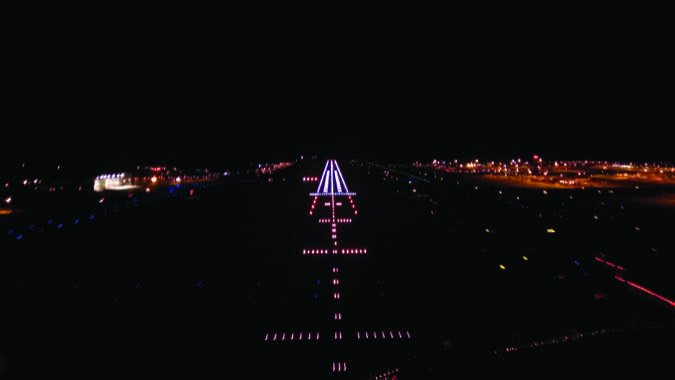
Over the years, Ive flown in and out of a specific airport on numerous occasions, day and night. Its a well-equipped facility, featuring a tower and a local approach control, along with scheduled service, multiple gates, two full-service FBOs and three runways. The nearby attractions are interesting when I want to stop, the food choices are excellent and the airport is a great choice for conducting practice approaches. Theres only one problem: I cant find it at night.

Read More »

Single-Pilot Jets

While most of us probably feel fortunate to be able to fly any kind of general aviation aircraft, most of us also have fantasies about owning and flying more expensive machines, including jets. A small number of us achieve that goal and obtain certification to operate small jets single-pilot. But the safety record of these operations is mixed. Some recent accidents point to gaps in the training and checking associated with single-pilot type ratings.

Read More »

Into The Flight Levels

It seems to be an arbitrary cutoff, 18,000 feet. However that height was originally chosen, its the altitude that defines, at least in U.S. airspace, what we call the flight levels. There are a number of rules that apply to all airplanes flying at and above FL180 but less obvious are some of the real-world considerations protecting you and your passengers as you climb above 18,000 feet-considerations that relate to very real hazards.

Read More »
Pilot in aircraft
Sign-up for newsletters & special offers!

Get the latest stories & special offers delivered directly to your inbox.

SUBSCRIBE