Instrument Flying

IFR Chart Choices

A long time has passed since Elroy Jeppesen first started drawing basic descriptions of ways to get into airports when the weather was down. Thankfully, aeronautical charting has evolved with technologies and operational needs. These days, the latest panel-mount avionics and handhelds coax us into the “paperless cockpit” realm, but a variety of factors havent eliminated dead-tree charts.The good news is we have a choice, even if its among only two basic publishers. Another piece of good news is we can put down one publishers chart and pick up the others without too much confusion. While there are qualitative differences between the two publishers, a major distinction is how they distribute updates. And despite a third-party company simplifying the process, theres still a price to pay when it comes to managing revisions.
Read More »

Five Reasons To Uncouple Your Approach

We admit it: The modern autopilot is a marvelous technological innovation, capable of smoothly flying even antique airplanes better than most of us on our best days. Especially when operating in the en route environment, its usually on, and doing its thing so we can concentrate on the scenery. Its also useful in other flight modes, of course, especially in the clag. Letting George do it frees our mental bandwidth for chart folding, communicating with ATC and planning the upcoming approach to minimums.

Read More »

Investing In WAAS

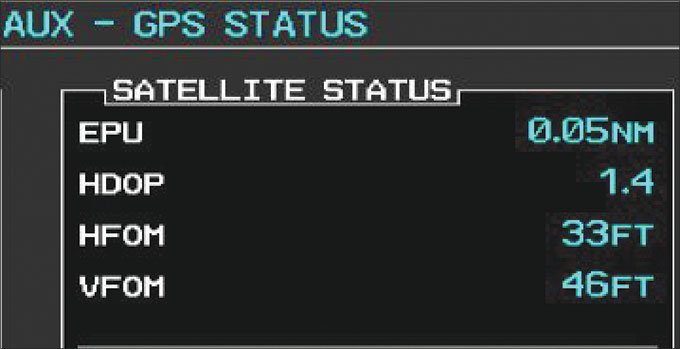
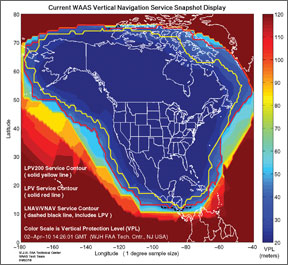
The FAAs Wide Area Augmentation System (WAAS) has been widely hyped as a boon to safety because it offers more precise approach guidance with vertical capability. While thats true on some approaches, it can also cost an aircraft owner a bundle of money. Worse, the market offers limited choices in equipment-Garmins GNS430/530W and G1000 are among the short list. There are plenty of reasons to buy WAAS, and for many new installations WAAS comes standard. Theres also ADS-B, which relies on a WAAS-enhanced GPS position. But is the safety enhancement worth the upgrade costs for the typical pilot? And what exactly are you getting out of the WAAS deal?

Read More »

When Its Too Bad For IFR, Go VFR

Having the instrument rating opens up a wide range of options for planning and completing flights our VFR-only brethren cant make. But the instrument ticket usually is not a piece of paper allowing go-anywhere, anytime capability, especially when used with most personal aircraft. Often, however, the same flight can be completed safely by staying VFR. More planning may be required, and youll likely be busier than if you went IFR, but safety isnt likely to be compromised. Here are some reasons you might want to stay VFR, and ways to do it safely.

Read More »

Reading Radar Right

One of the most misunderstood pieces of equipment in the modern cockpit is airborne weather radar. For most of us, its a luxury we cant afford: either sferic devices (Stormscope/Strikefinder) and/or datalinked Nexrad images serve as a pilots third-best tool for avoiding thunderstorms. We say “third-best” because the best thing ever used for this purpose remains the Mk. I, Mod. I human eyeball. The trick, of course, is the eyeball only can be used in visual conditions. By happy coincidence, thats the best place to be when contemplating flight in an area of thunderstorms. But visual circumnavigation of convective activity isnt always possible. Instead-and if youve got the room in the nose or a wing-mounted radome-an airborne radar installation remains your second-best solution. Yes, Nexrad is widely available and much less expensive, but it doesnt do the same job as the airborne equipment.

Read More »

How Rain May Affect Aircraft Performance

To my mind, only a couple of decent reasons exist to fly through rain: First, because your destination is out there in or beyond the precip-and its light rain and not far through it, at that; second, because youre too cheap or lazy to wash the plane normally. Otherwise, rain stands among those conditions to not take lightly-and on many fronts, to be taken as a condition to avoid as much as possible. When you think about it systematically, a lot goes on with the airplane when exposed to rain and-aside from the possibility of improved cooling on a hot day-its difficult to conjure up much to commend rain flying to anyone. But, we know youre going to fly in the rain; we do, too, but begrudgingly and guardedly-or avoid it if the datalink weather returns show orange or red. So instead of saying, “Dont do what we do, have done, and will probably do again,” we offer five strong reasons to make you think about whats happening to the aircraft when flown in rain.

Read More »

Top Three Aircraft Icing Myths Busted

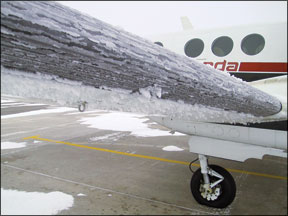
Many myths persist about the capability of airplanes to fly in ice, appearing to support techniques for ice avoidance or landing an ice-laden airplane that make ice accumulation acceptable. “Speed saves.” “More power is better than ice protection.” “Known icing certification makes flying in ice safe.” Like any myth these are rooted in truth, but they are not necessarily true themselves. With apologies to the Discovery Channel I present these icing myths, busted. Heres our first in-flight icing myth: “Keep your speed up and you can land with a load of ice.” Landing an ice-laden airplane can be tricky, even with clear approaches to the longest runway around. Performing a tight, circling approach at night in low visibility? We dont even want to think about it.

Read More »

Top Five Reasons To Cancel An IFR Flight

An overly long list of chores guaranteed a couple of things for flying from my home in Wichita, Kan., to Atlantic City, N.J., some years ago. First, the entire trip would be flown IMC and with instrument departures and arrivals at all three airports involved. Second, the timing of my departure meant not only was the first leg assured to be IMC and with ILS conditions, it was going to be mostly at night-with a night ILS. The questions running around in my head prompted me to undertake a higher-than-usual degree of preparation, starting by making a serious personal risk analysis. The questions didnt need 100-percent affirmative answers, but getting a negative response on more than one merited a longer look at the elements of the flight, in search of a way to turn one of the “no” responses into a “yes.” Three “no” responses would warrant a new decision on going, starting with “not going now.”

Read More »

Improper IFR

Even the casual student of why aircraft accidents happen knows that in a large percentage of them, weather is a factor. (Its about 15 percent.) Thats not to say weather caused the accident, just it was implicated as one link in the chain of events that led to the typical accident. When we think “weather,” icing, thunderstorms, low visibility and turbulence come to mind, as well they should. But the NTSBs accident files reveal a particular subset of accidents in which pilots operating in flyable if challenging IMC prang perfectly good airplanes into terrain and obstacles for no apparent reason. The agency throws these into a grab bag category it blandly calls “improper IFR.” This catchall describes a narrow range of sins, but most of them relate to vertical rather than horizontal transgressions. We read enough accident reports to confess a certain discouragement at the level of skill-or lack thereof-of the typical pilot in the U.S. But theres good news: The number of incidents of NTSB-reported improper IFR have declined markedly in recent years. The NTSB reported no accidents in this category between 2006 and 2009, but there were 47 between 1989 and 2005.

Read More »

Cant See Nuthin

The proverbial zero-zero takeoff can be a perennial topic of debate whenever instrument pilots get together. Although you may have practiced them during your instrument training, chances are youve never attempted one since. Perhaps youve been presented with the need, but didnt want to tackle it in real conditions. Perhaps youve been lucky and the need never arose. If you had to execute a zero-zero takeoff, what is a good technique? How would you go about it? And what about the flights necessity makes a zero-zero takeoff a good idea, regardless of how many youve flown? Of course, what exactly is a zero-zero takeoff, anyway? Why might we want to execute one? In real-world conditions, a ceiling of zero feet rarely exists; for practical purposes, theres usually a little “air” between the surface and overlying clouds. Thats one of the reasons the “ceiling obscured” terminology describing a low, indefinite ceiling on the old sequence reports was replaced with vertical visibility in the newer Metar format. Nil visibility is just as unlikely to occur. After all, when was the last time you really couldnt see the hand in front of your face? In fact, and even though it might be legal, we cant support attempting a takeoff in less than at least a few hundred feet of visibility. So, what were really talking about here are low-visibility takeoffs.

Read More »
Pilot in aircraft
Sign-up for newsletters & special offers!

Get the latest stories & special offers delivered directly to your inbox.

SUBSCRIBE