Instrument Flying

Dissecting The Hold

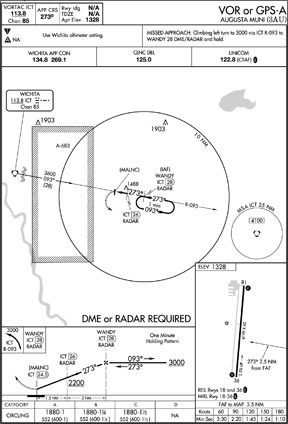
November 12345, cleared to Avsaf, hold east as published, expect further clearance at 1845.” Thats a typical clearance into a holding pattern for an IFR flight when ATC needs to “park” it somewhere until traffic or other conditions allow it to continue to its destination. A holding clearance usually isnt something a pilot or crew wants to hear, and they are much rarer in these times of flow control and ground delays, which are designed to minimize holding in the first place. But ATC still hands them out when needed, and FAR 61.57, Recent Flight Experience, requires regular practice in “holding procedures and tasks” to maintain currency. For the most part, holding can be relatively simple: Fly to the fix and turn right. But it also can get a bit complicated if the hold isnt published. And there are ways to avoid it entirely if youre willing to play ball with ATC and eliminate the reason for the hold. Lets explore.

Read More »

Deviation Avoidance

If youre like many of us, the back-and-forth radio chatter between pilots and controllers leaves you, at times, bewildered and wondering what, exactly, that voice on the radio intended. Especially for new pilots and those simply not accustomed to the phrases and terms used, listening to ATC can be confusing, and occasionally even confounding and frustrating. At its worst, the constant stream of aviation shorthand through our headsets carries with it the potential to cause major problems, both for the pilots for whom the missed instructions are intended as well as the rest of us sharing the airspace. When the clag prevails and we turn to our training, charts, plates and procedures to make our way through a safe departure and arrival, we can ill afford to deal with additional issues.

Read More »

Your Altimeter Lies

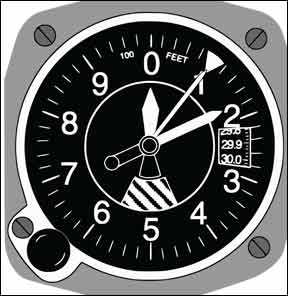
The instruments in our so-called “steam-gauge” panels are marvels of ingenuity. A collection of springs, tubing, gears, bellows, shafts and dials, their basic design predates most of the pilots staring at them. While they have, for the most part, been rendered obsolete by the latest microelectronics and air-data computers, they still work as advertised. Well, pretty much. The fact is our faithful mechanical instruments are regularly susceptible to certain errors. Too, they can fall victim to not-so-regular problems, mostly brought about through neglect or damage. The good news is many of these errors are predictable, if we take the time to understand how the instruments work and how the errors may manifest themselves.

Read More »

How CFIT Happens

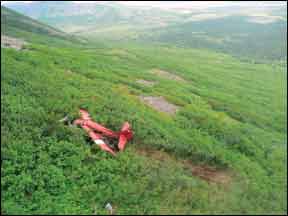
Controlled flight into terrain, CFIT, accidents afflict pilots of all skill levels-those with rookie-level experience and those with more than enough experience to know better than to fall into the traps leading to an abrupt, final, premature arrival. According to a review of NTSB records, more than 40 CFIT-related accidents occurred in the 10 years ending in 2010. And theyre unforgiving and deadly, with 39 of 43 incurring 112 fatalities. The senselessness of one such accident prompted a former NTSB staff member to suggest a review of the probable-cause report issued in an October 2009 crash. The former staffer felt the abbreviated report left a few questions unanswered; the NTSBs probable-cause cite in the final report read with characteristic candor, citing “the pilots decision to continue VFR flight into instrument meteorological weather conditions which resulted in controlled flight into terrain.”

Read More »

Is This Approach Legal?

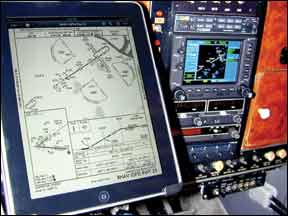
Any instrument-rated pilot should know, as a double-I we knew well would stress, “While youre flying straight and level is a good time to get set up for the approach.” Sage advice, but that was back in the days when pilots of most personal airplanes considered themselves fortunate to have a working DME. Moving maps hadnt been invented and the first GPS satellite had yet to be launched. As long as we had current plates-which was most of the time-and a record of a VOR check having been performed in the preceding 30 days, we were good to shoot almost any approach this side of a CAT IIIa ILS, including the then-feared-but-now-rare NDB procedure.

Read More »

Ducking Under

A crash occurring during an instrument approach almost always happens because the airplane descends below the published minimum altitude. Its easy for any pilot to say, “Id never do that,” and dismiss this brand of controlled flight into terrain (CFIT) as a non-hazard…at least for ourselves. True, evidence suggests that some “ducking under” decision height, decision altitude or the minimum descent altitude is intentional-the pilot knowingly flies “just a little bit lower” to try to find the runway in the murk. But ducking under is not always intentional-a conscientious pilot may be susceptible to ducking under in some circumstances. The question is, how can we avoid the traps?

Read More »

Partial-Panel Prep Tips

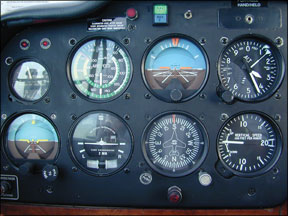
Instrument failure doesnt happen often. But when it appears in an accident report, its almost universally fatal. Instrument failure is part of the required syllabus for the IFR rating, and on the list of items to be included in an instrument proficiency check (IPC). While failures not resulting in an accident or incident arent reported, the record shows a casual, once-in-a-while demonstration of partial-panel skills doesnt prepare many pilots when an instrument actually fails in IMC. Here are 10 tips you can use in the course of every flight to prepare yourself for partial panel.

Read More »

Non-Radar IFR

November 12345, youre cleared from the Backwoods Airport to the Backwoods NDB, then hold as published. Climb and maintain 3000 feet, squawk 2012. Report airborne on frequency 125.1. Clearance void if not off by two-zero past the hour; time now zero-five past the hour. Expect further clearance at two-five past the hour.” Fly IFR from non-towered, out-of-the-way airport, and youll eventually get a short-range clearance like the one above. Its a clearance to a nearby fix with a time window (until the “void time”) allowing you to enter controlled airspace without conflicting with other IFR airplanes. Since ATC cant see you on radar yet and wont know exactly when youll enter controlled airspace from that non-towered field, theyll keep a small area clear for you until the void time

Read More »

(Oh) No Procedure Turn

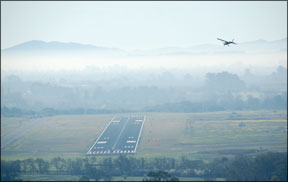
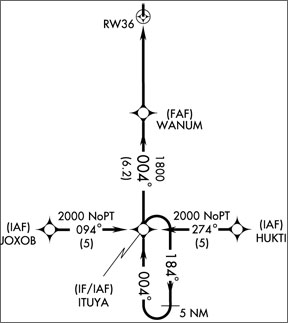
Where you are, smoking into your destination airport. Winds are calm, traffic is sparse, the ceiling is 1500 broken with good VFR underneath, youve got plenty of gas. But a close look at the approach plate creates confusion: Youre being vectored to a nearby fix, but its not at all clear how-or even whether-some kind of course reversal will be necessary. You certainly can slow down enough to easily nail the turn onto final, along with the approach, but something in the back of your mind says it wont be that simple. Suddenly, it dawns on you: Youre going to need to execute a procedure turn.

Read More »

NPAs: Stable Or Not?

Over the past few years the FAA has added new non-precision instrument approaches at a remarkable rate-thousands of procedures with names like LNAV and VNAV, and ILS-comparable LPV approaches-2208 LPV approaches alone. The common denominator among these relative newcomers to an instrument pilots nomenclature is their dependence on the wonders of GPS, in particular, Wide Area Augmentation System-based (WAAS) GPS. The primary benefit of a WAAS-enhanced approach is availability of a pseudo glideslope generated by the in-cockpit GPS navigator, bringing ILS-like vertical guidance where theres no ILS.

Read More »
Pilot in aircraft
Sign-up for newsletters & special offers!

Get the latest stories & special offers delivered directly to your inbox.

SUBSCRIBE