











The FAAs Wide Area Augmentation System (WAAS) has been widely hyped as a boon to safety because it offers more precise approach guidance with vertical capability. While thats true on some approaches, it can also cost an aircraft owner a bundle of money. Worse, the market offers limited choices in equipment-Garmins GNS430/530W and G1000 are among the short list. 288
Investing In WAAS
The FAAs Wide Area Augmentation System (WAAS) has been widely hyped as a boon to safety because it offers more precise approach guidance with vertical capability. While thats true on some approaches, it can also cost an aircraft owner a bundle of money. Worse, the market offers limited choices in equipment-Garmins GNS430/530W and G1000 are among the short list. There are plenty of reasons to buy WAAS, and for many new installations WAAS comes standard. Theres also ADS-B, which relies on a WAAS-enhanced GPS position. But is the safety enhancement worth the upgrade costs for the typical pilot? And what exactly are you getting out of the WAAS deal?

Key Takeaways:
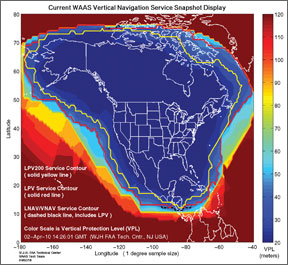
- WAAS significantly enhances GPS accuracy, enabling more precise instrument approaches with vertical guidance (LNAV+V, LPV) and offering stability comparable to or better than ILS.
- Upgrading to WAAS, particularly for existing avionics or older airframes, can be a very expensive endeavor due to equipment costs, extensive labor for installation/rewiring, and potential panel modifications.
- Despite the high cost and limited equipment choices, WAAS provides substantial safety and operational benefits for IFR pilots, is crucial for future avionics like ADS-B, and is becoming a standard expectation for modern aircraft.
Key takeaways sponsored by Aviator Pro | Start Your Training ->
See a mistake? Contact us.

