Features

The Forgotten Maneuver

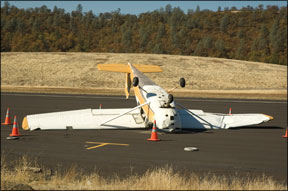
Go-arounds (sometimes called rejected landings) are something of a “forgotten maneuver” for most pilots. I think this is because the go-around is something were taught as a way to fly away from a botched landing. As we gain more experience and get better at landing, we find ourselves needing this escape route less frequently. The psychology of pilots is such that we try to “recover” from our mistakes, so we also tend to try to turn bad landings into good ones with a nudge of the throttle, a tap on the rudder pedal, or a twist of the controls instead of powering up and climbing away for another try. Instructors can fall into the same trap. Failing to see a reason for a go-around in their experienced students landings, they might not require demonstration of a go-around during a flight review or other recurrent training. If the pilot receiving instruction is instrument-rated, the CFI may consider flying a missed approach to be adequate to demonstrate go-around technique. I must admit for a time I was in that camp as well. When was the last time you practiced a go-around? With experience, ego and unenlightened instruction, it may have been a very long time. So what happens on the day something completely outside the span of your expert aircraft control requires you to call off the landing from a point very near (or even on) the ground?

Read More »

Improper IFR

Even the casual student of why aircraft accidents happen knows that in a large percentage of them, weather is a factor. (Its about 15 percent.) Thats not to say weather caused the accident, just it was implicated as one link in the chain of events that led to the typical accident. When we think “weather,” icing, thunderstorms, low visibility and turbulence come to mind, as well they should. But the NTSBs accident files reveal a particular subset of accidents in which pilots operating in flyable if challenging IMC prang perfectly good airplanes into terrain and obstacles for no apparent reason. The agency throws these into a grab bag category it blandly calls “improper IFR.” This catchall describes a narrow range of sins, but most of them relate to vertical rather than horizontal transgressions. We read enough accident reports to confess a certain discouragement at the level of skill-or lack thereof-of the typical pilot in the U.S. But theres good news: The number of incidents of NTSB-reported improper IFR have declined markedly in recent years. The NTSB reported no accidents in this category between 2006 and 2009, but there were 47 between 1989 and 2005.

Read More »

The Spin On Spins

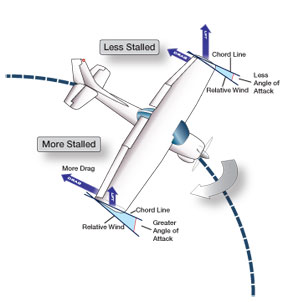
The FAA doesnt talk much about spins. Mostly, they want us to learn to avoid them. Clearly, avoiding an inadvertent spin is good, but it might help to know a bit more about them. Plus, the whole specter of Air France 447 crashing into the Atlantic at what French authorities indicate was a very high vertical speed and a nearly level attitude suggests that it might be nice to know a bit about flat spins in particular. Most of us have heard it before: Spin training used to be mandatory, but sometime after WWII it was decided most inadvertent stall/spin accidents occurred at an altitude low enough to make recovery unlikely and neednt be taught. So, the FAA dropped spin training from all but the CFI curriculum and instead began to emphasize spin avoidance. Now, the FAA is taking that one step further by de-emphasizing stall practice and recovery, and instead concentrating on teaching pilots to avoid stalls. With this progression, soon spins and even stalls may be solely the realm of the aerobat and the accident victim. Our goal, of course, is to minimize the latter, so a little education is in order. Well start with a brief discussion of the stall and then focus on the aerodynamics of spins and their recovery. Finally, well take a look at what makes a flat spin.

Read More »

Is It Airworthy?

The question comes up time and again in the FBOs pilot lounge and on aviation-related forums: Does a known fault make an airplane unairworthy? Time and again when faced with this question, I hear the response, “TOMATO FLAMES” for an aircraft in VFR-day conditions, a mnemonic referring to the items required under FAR 91.205 for day VFR. This is part of the answer, but it is neither the beginning nor the end of determining the airworthiness of an aircraft with a known fault. Instead of a simple, “one-size-fits-all” answer, exploring existing regulations, legal decisions and legal interpretations should guide a pilot or owner in determining whether or not an aircraft with known faults is airworthy. First, lets define “airworthy.” Somewhat surprisingly, “airworthy” isnt defined by the FAA, at least not in FAR Part 1, Definitions and Abbreviations. In 1994, Congress took it upon itself to describe an “airworthiness certificate” as something the FAA Administrator shall issue when he or she “finds that the aircraft conforms to its type certificate and, after inspection, is in condition for safe operation.” Very little additional guidance is available from the 350-plus pages of FAA Advisory Circular AC 8130.2F, Airworthiness Certification of Aircraft and Related Products. When attempting to define “airworthy,” the AC basically reaffirms what Congress said.

Read More »

Landing On Roads?

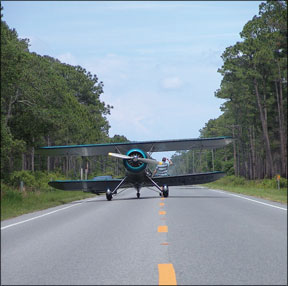
Off-airport landings are a perennial subject whenever pilots get together, and rightly so. Among the topics inevitably coming up will be whether or not to land on a paved road. After all, you probably took off from pavement; why not try to land on it, too, that too-quiet engine in front of or beside you notwithstanding? We last looked at this overall topic in our December 2006 issue. In that article, we basically concluded theres no free lunch: While a paved road may offer the smoothest, most-familiar surface, it also poses a set of problems others may not-like wires, cars, signs, utility poles and other things you may or may not see before hitting them. While you should be able to spot vehicular traffic and avoid it (presuming one or more drivers dont do something dumb, which isnt always a safe presumption), spotting wires, roadside signage and the odd telephone pole from the air isnt the easiest thing to do. If you dont believe us, try it the next time youre out committing aviation. Dont forget youll be a bit distracted and may not have much time dealing with a real emergency: troubleshooting, cinching belts, calming passengers and performing all the other tasks required after the airplane soils the bed.

Read More »

Is It Safe?

Anyone whos spent much time flying personal aircraft has been asked this question: Is it safe? As a rule, the answer is, “It depends.” Because safety is relative, sitting at home can be the safest course of action. But its usually not very rewarding, and sitting at home makes it much more difficult to travel in a personal aircraft. Beginning on page 24 of this issue, we look at a recent accident the NTSB attributed to low-level maneuvering. In critiquing that accident, we referred to the AOPA Air Safety Foundation (AOPA/ASF) and its most recent Nall Report, an annual in-depth look at GA accident trends. The data in those annual reports is very intriguing; so much so, we thought wed examine some of it more closely. We wanted to pose the question, “Is it safe to do X?” when X is some operation, maneuver or decision made by a GA pilot. While every operation and skill level is different, what we really wanted to do is highlight some of the areas in which GA pilots routinely bend metal, with the idea of using the 2007 Nall Report, the most recent available, and its findings to demonstrate why doing what youre about to do might not be a good idea.

Read More »

Showing Off

Each year, the AOPA Air Safety Foundation (AOPA/ASF) releases its excellent Nall Report, a review of a previous years accidents and causes, taken from NTSB data. And each year when perusing the report, we find pilot-related accidents-as opposed to mechanicals or unknown causes-to lead the pack by an overwhelming margin. In 2006, the last year for which the AOPA/ASF has crunched the NTSB data, pilot-related causes comprised 73.8 percent of all accidents and a whopping 79.1 percent of fatals. In fact, from 1999 through 2006, inclusive, maneuvering has accounted for approximately 25 percent of all accidents in the U.S. The annual numbers vary, but never dip below 20 percent and too-frequently arch above 25 percent. Breaking down the numbers, we find maneuvering accidents as a whole-which AOPA/ASF says “often involve questionable pilot judgment, such as decisions to engage in buzzing, low passes, or other high-risk activities”-outpaced all other fatal accident causes in 2006, including weather and those occurring during the descent/approach flight phases.

Read More »

Cant See Nuthin

The proverbial zero-zero takeoff can be a perennial topic of debate whenever instrument pilots get together. Although you may have practiced them during your instrument training, chances are youve never attempted one since. Perhaps youve been presented with the need, but didnt want to tackle it in real conditions. Perhaps youve been lucky and the need never arose. If you had to execute a zero-zero takeoff, what is a good technique? How would you go about it? And what about the flights necessity makes a zero-zero takeoff a good idea, regardless of how many youve flown? Of course, what exactly is a zero-zero takeoff, anyway? Why might we want to execute one? In real-world conditions, a ceiling of zero feet rarely exists; for practical purposes, theres usually a little “air” between the surface and overlying clouds. Thats one of the reasons the “ceiling obscured” terminology describing a low, indefinite ceiling on the old sequence reports was replaced with vertical visibility in the newer Metar format. Nil visibility is just as unlikely to occur. After all, when was the last time you really couldnt see the hand in front of your face? In fact, and even though it might be legal, we cant support attempting a takeoff in less than at least a few hundred feet of visibility. So, what were really talking about here are low-visibility takeoffs.

Read More »

EFIS Evaluated

Electronic flight displays-glass cockpits in the modern vernacular-were a novelty just six years ago. Then all at once, it seems, they were everywhere. Every new airplane is delivered equipped with some kind of glass and older airframes are seeing retrofits. Steam gauges are still in the majority, but theres enough glass out there to pose this question: Is it really better? More important, is glass actually more reliable and safer? Lacking a detailed blind study, a take-it-to-the-bank answer isnt possible and would, in any case, be subject to debate. So we did the next best thing. We joined with our sister publication, Aviation Consumer, and surveyed more than 300 owners and operators of various types of EFIS displays. Via an online survey published by our news service, www.avweb.com, we asked owners to evaluate the very idea of electronic displays compared to conventional iron gyros and analog pitot-static instruments. Is the glass easier to use? Do owners like the displays? Whats the maintenance like? And above all, do these sophisticated but relatively untried systems inspire the confidence necessary to charge off into the gray innards of hard IMC? Both of our magazines have received e-mails complaining about system failures, and more than one of these has claimed reliability is worse than the industry claims. If this were true, we reasoned, our survey would turn up a substantial number of complaints. It didnt. While owners did report glass failures and several pilots reported more than one failure, there was no widespread pattern related to poor reliability.

Read More »

Did The FAA Get This One Right?

In last months Editors Log, under the heading, “Unwritten Rules,” we discussed the tragic August 8, 2009, mid-air collision between a Piper PA-32R-300 and Eurocopter AS350 operating as a for-hire tour over the Hudson River off New York City. The Piper had just departed nearby Teterboro Airport while the helicopter had launched a few moments before from the West 30th Street Heliport. The two collided over the Hudson Rivers west bank; all nine aboard both aircraft perished. The collision engendered just the kind of hysteria to which those who pay attention to the mass medias coverage of general aviation have grown accustomed. Elected officials and average citizens alike marched forth to complain there were no rules concerning such operations, and non-scheduled flights should be (choose one or all) banned, subject to specific training and approvals or under new operating rules, including positive ATC direction.

Read More »
Pilot in aircraft
Sign-up for newsletters & special offers!

Get the latest stories & special offers delivered directly to your inbox.

SUBSCRIBE