Features

Top Three Aircraft Icing Myths Busted

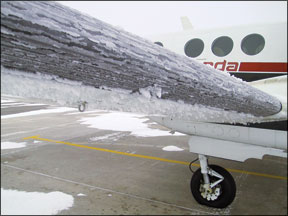
Many myths persist about the capability of airplanes to fly in ice, appearing to support techniques for ice avoidance or landing an ice-laden airplane that make ice accumulation acceptable. “Speed saves.” “More power is better than ice protection.” “Known icing certification makes flying in ice safe.” Like any myth these are rooted in truth, but they are not necessarily true themselves. With apologies to the Discovery Channel I present these icing myths, busted. Heres our first in-flight icing myth: “Keep your speed up and you can land with a load of ice.” Landing an ice-laden airplane can be tricky, even with clear approaches to the longest runway around. Performing a tight, circling approach at night in low visibility? We dont even want to think about it.
Read More »

Deep Stall Aerodynamics

In October 22, 1963, a prototype of the British Aircraft Corporation One-Eleven (BAC 1-11) short-haul jet airliner, registration G-ASHG, crashed near the village of Chicklade in southwest England. The aircraft was evaluating stall characteristics at varying center of gravity locations when the flight crew found the flight controls unresponsive after entering a stable stall and the aircraft struck the ground at a wings level attitude with a high rate of descent and little forward speed. All aboard died in the crash. The 1-11 was one of the second-generation of jet airliners-others being the Douglas DC-9 and Boeing 727-featuring aft-mounted engines, swept wings and all-moving T-tail horizontal stabilizers. Post-crash investigation concluded the prototype 1-11 had experienced an unrecoverable deep stall in which the wake of the stalled wing covered the high-mounted horizontal stabilizer, thus blanking the elevator controls and preventing normal recovery techniques.

Read More »

Real-World Steep Turns

I spent a weekend recently helping prepare a pilot for his commercial pilot practical test. He is a long-time instrument pilot and highly experienced in his turbocharged Beech Bonanza. One of the hardest parts of his training was getting him to bank beyond a standard-rate turn-everything hed practiced for years involved making small control inputs, and he needed to regain comfort with the more dynamic maneuvering required for the test. As we practiced steep turns, getting closer and closer to halving the minimum practical test tolerances, the question came up: Besides demonstration of a “circus trick” in order to earn his commercial certificate, what is the purpose of performing steep turns? Its a good question many students and rated pilots ask, and one deserving a detailed response.

Read More »

Cockpit Fatigue During Long Flights

Editors Note: Last month in this space, we promised to bring you a podcast-based discussion of landing on roads in an emergency. Unfortunately, due to illness, travel and conflicting schedules, weve been unable to complete that project. As this issues deadline approaches, were redoubling our efforts to schedule and record that discussion, which should be available by the time you read this. If you looked for that podcast only to come up short, please accept our sincerest apologies, as well as our thanks for your patience.

Read More »

Counting Gallons of Fuel

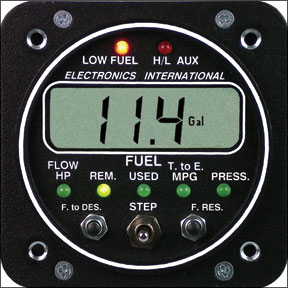
One reason fuel mismanagement mishaps still comprise a large share of annual accident data is pilots forgetting to manage their fuel or doing it poorly. Another could be the less-than-exact instrumentation found aboard most GA aircraft. The bad news is only you can fix the pilot problem. But there is good news: A fuel totalizer providing instantaneous fuel consumption data along with fuel remaining, endurance time and other useful information can eliminate shortcomings in the less-than-accurate fuel gauges installed in most personal aircraft. Even better news? When connected to a Loran or GPS, a totalizer and a navigator working together can supply distance-to-empty and reserve-at-destination information, along with your real-time mileage.

Read More »

Proper Plane Maintenance after Snow Storms

By the time this magazine hits your mailbox, winter will be full-on in most parts of North America. Even if you spend most or all of your time in a warmer climate, your weather will change, with cooler temperatures, more wind and the occasional low-lying clouds, with rain. In other parts of North America, youll likely experience the full range of winters offerings sooner or later this season. Good luck. Of course, winters colder temperatures and denser air mean enhanced aircraft performance, at least when compared to summers typical heat and humidity. But the season brings its own set of aircraft performance challenges, especially when it comes to precipitation. This time of year, moisture from the sky can come in many different forms, not all of it liquid. And an airplane doesnt have to be airborne to be affected; merely parking one outside in winter precipitation can have a major impact on flight operations.

Read More »

Night Flying Lessons

Night flying can be just as safe as flying in the daytime-but it isnt. Although accidents are more likely to occur during the daytime, according to the AOPA Air Safety Foundations 2007 Nall Report, accidents at night (and in IMC, for that matter) are more likely to be fatal. “Only 19.2 percent of daytime accidents resulted in fatalities, but over one-third (34.6 percent) of all night accidents were fatal.” Meanwhile, the same report states, “At night, nearly half of the accidents in VMC conditions were fatal (45.0 percent), compared to nearly three-fourths of night IMC accidents (74.1 percent). Night-flying accidents are generally thought of as being caused by inexperience-by students, or low-time pilots-but nighttime offers an equal opportunity for embarrassment, or worse. Experienced airmen are involved, too.

Read More »

Wing Icing and Datalink Weather

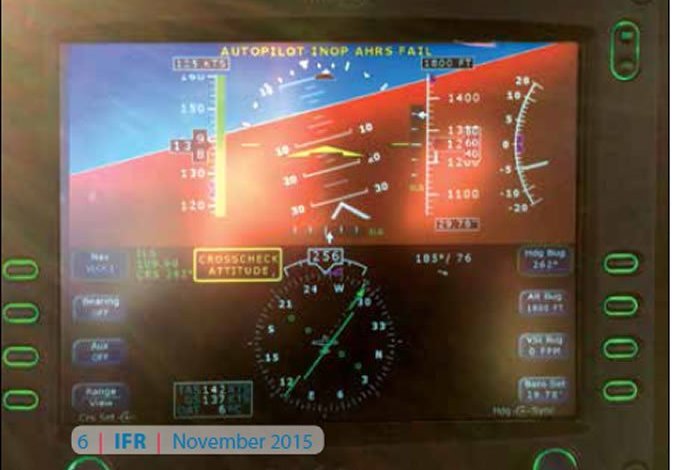
Risk-and the management thereof-is a diffuse concept, for it remains true that one mans risk is anothers Saturday afternoon recreation. But its also true that in order to place degrees of risk into categories remotely capable of being ranked requires as much information as it is possible to have. It applies to airplane systems, to stick and rudder skills and above all, to weather. Weather has always been the stickiest thorn in the FAAs concept of “all available information.” Even in the era of five-minute Nexrad loops and ever more sophisticated ice prediction products, theres occasionally a large disconnect between what is expected to happen and what is really happening. The advent of real-time weather data in the cockpit has reduced the surprise factor, but it hasnt eliminated it. And it cuts both ways-having lots of information thats just wrong can be worse than having no information, and it can lure you into a decision you might not have otherwise made.

Read More »

Reasons Behind Fatal Accidents

Some pilots are, by nature, worriers. They worry about fuel, about engine failures, about hazardous weather, about midair collisions. Bluntly, pilots worry about things that can kill them. But do they worry about the right things? In other words, does the risk framework that most of us construct in our personal aviation universe reflect the reality of the serious killers in aircraft accidents? Our guess is that it does not, unless pilots are out there really sweating about stalls, spins and controlled flight into terrain. And even if the pilot population is wide awake about these hazards, it could do a better job of avoiding them. Stalls and CFIT (controlled flight into terrain) pop up as the two biggies in fatal accidents in general aviation to a degree that, frankly, startles us.

Read More »

Top Five Reasons To Cancel An IFR Flight

An overly long list of chores guaranteed a couple of things for flying from my home in Wichita, Kan., to Atlantic City, N.J., some years ago. First, the entire trip would be flown IMC and with instrument departures and arrivals at all three airports involved. Second, the timing of my departure meant not only was the first leg assured to be IMC and with ILS conditions, it was going to be mostly at night-with a night ILS. The questions running around in my head prompted me to undertake a higher-than-usual degree of preparation, starting by making a serious personal risk analysis. The questions didnt need 100-percent affirmative answers, but getting a negative response on more than one merited a longer look at the elements of the flight, in search of a way to turn one of the “no” responses into a “yes.” Three “no” responses would warrant a new decision on going, starting with “not going now.”

Read More »
Pilot in aircraft
Sign-up for newsletters & special offers!

Get the latest stories & special offers delivered directly to your inbox.

SUBSCRIBE