Epic Flight Academy, founded in 1999, is the largest Part 141 flight school in the U.S. [Credit: Epic Flight Academy]
Epic Flight Academy, the largest Part 141 flight school in the U.S., is opening a new facility in Danbury, Connecticut, on October 17.
The school is located at Danbury Municipal Airport (KDXR), approximately 20 miles northwest of Bridgeport. The airport is a class D facility with two runways—08/26 and 17/35—and has multiple instrument approaches.
The airport was established in 1928 as a grass landing strip. By the 1930s it had a paved runway and welcomed some famous flying visitors, such as Amelia Earhart and Charles Lindbergh.
According to EFA officials, the school will hold a grand opening and ribbon-cutting ceremony on October 17 from 10 a.m. to 1 p.m. EDT.
In addition to flight instructors and school officials, members of the Greater Danbury Chamber of Commerce have been invited to tour the facility and be given the opportunity to test-fly the flight simulator and take an introductory flight in a new Cessna 172 Skyhawk.
“We appreciate the warm welcome in Danbury and the support we’ve received from airport leadership and the city,” said Epic Flight Academy founder and CEO Danny Perna in a news release. “Our Epic team has done a great job setting up the campus, and we’re already training our first flight students. We look forward to welcoming everyone who wants to learn more about Epic Flight Academy.”
Epic Flight Academy, founded in 1999, has locations from Florida to Utah, with facilities that provide both flight training and Part 147 aircraft mechanic training.
Meg Godlewski has been an aviation journalist for more than 24 years and a CFI for more than 20 years. If she is not flying or teaching aviation, she is writing about it. Meg is a founding member of the Pilot Proficiency Center at EAA AirVenture and excels at the application of simulation technology to flatten the learning curve. Follow Meg on Twitter @2Lewski.
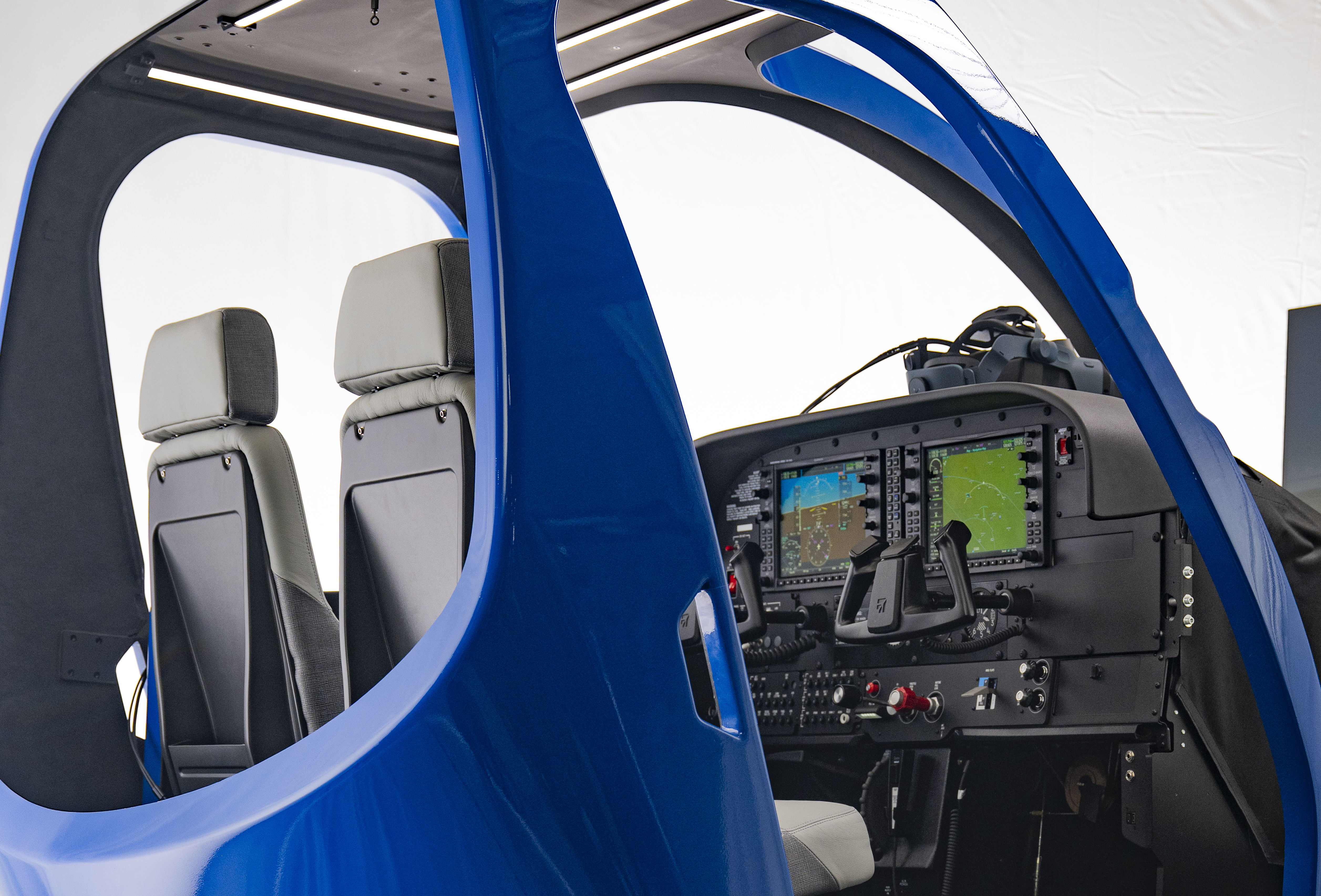
The Veris Virtual Reality FTD for the Cessna Skyhawk will make its trade show debut at NBAA-BACE in Las Vegas on October 20-22. [Credit: TRU Simulation + Training]
Attendees of October’s National Business Aviation Association Business Aviation Convention & Exhibition (NBAA-BACE) in Las Vegas will be able to see one of the most advanced flight training devices (FTDs) being developed.
Textron unit TRU Simulation + Training said live demonstrations of its Cessna 172 Skyhawk-configured Veris Virtual Reality FTD are planned for NBAA-BACE, marking the technology’s trade show debut and giving attendees a chance to experience it firsthand. Veris is designed for state-of-the-art simulation of rotorcraft and fixed-wing aircraft like the Skyhawk, one of the world’s most popular trainers.
The simulator is designed to offer immersive virtual reality environments for pilots using an image generation system powered by Unreal Engine, the same platform used to design popular video games such as Fortnite. The device can be loaded with custom airports and visual scenarios and allows users to interact with switches and avionics just as they would in a real aircraft.
TRU announced Veris in 2024, and it secured FAA qualification as a level 7 FTD for helicopters in September 2025. The company said Monday that the Skyhawk-configured Veris is not yet FAA-qualified. The device is also designed to meet EASA Level 3 FTD standards.
Once qualified, the Skyhawk Veris will be delivered to launch customer US Aviation Academy, which ordered five devices and secured options for 10 more at last year’s NBAA-BACE, and mark its introduction to the fixed-wing training market. The training provider offers professional pilot, aircraft maintenance, dispatcher, and remote pilot training using a fleet of more than 200 aircraft, with partners including major airlines and the U.S. Air Force. It will install Veris at its training facility in Denton, Texas.
“The Cessna Skyhawk Veris was designed with intentionality to support a realistic flight training experience, including a dual-seat configuration that allows instructors and students to train together on the device,” said Jerry Messaris, president and CEO of TRU, in a news release. “As demand for pilots continues to grow, solutions like Veris help training organizations expand access to high-quality instruction and prepare students for the next step in their aviation careers.”
Bell Training Academy was the launch customer for the rotorcraft-configured Veris. Its devices are configured for the Bell 505.
TRU has more than 240 qualified and supported devices for civil and military customers. In 2016, it delivered the world’s first Boeing 737 Max full flight simulator (FFS).
Veris Simulator for the Skyhawk
Veris combines FFS features in a physical cockpit structure with virtual reality technology, though students can complete certain training with or without a virtual reality headset.
The Skyhawk Veris’ fully configured cockpit is designed to precisely replicate the aircraft’s instrumentation and controls, including its Garmin G1000 NXi avionics. TRU said it will offer training credit for all licensing phases from private pilot through flight instructor.
The advantage of Veris, as TRU describes it, is comparable performance to a traditional FTD at a much lower price point, as well as less time between purchase and training readiness. Measuring 7.3 by 6.85 by 7.25 feet, it is compact enough to fit into just about any training facility.
The simulator’s image generator displays aircraft models—including accurate representations of switches, knobs, levers and instrument panels—environments, and landscapes. It can also simulate smoke, fire, and lighting conditions such as shadows and reflections.
Users can load the device with airports from around the world and request new ones. They can also customize a variety of scenes and scenarios including off-airport landings, search, rescue, and emergency operations, military and defense exercises, and night vision goggles.
A full-electric six degrees of freedom motion system provides accurate flight cues and vibrations. The device’s digital electric control loading system (CLS), the same used in TRU’s Level D FFS products, offers high-fidelity and realistic force-feel simulation.
According to Bell, the device enables training for “emergency procedures and complex scenarios supported by the OEM’s flight data package.”
For instructors, an operating station controlled using a pair of touchscreen displays allows them to see what pilots see. Optional features include a wireless tablet enabling instructor control of the station from anywhere around the simulator environment.
Further, an optional debrief system transfers video, audio, avionics data, and other information to a station outside the simulator for playback. A lesson plan system allows instructors to create predetermined sequences of activities and events for various training scenarios.
Correction: The U.S. Army’s Flight School Next program will not utilize the Bell 505 Veris Flight Training Device, as a previous version of this story stated. Bell Training Academy competed but was not selected for the program.
Jack is a staff writer covering advanced air mobility, including everything from drones to unmanned aircraft systems to space travel—and a whole lot more. He spent close to two years reporting on drone delivery for FreightWaves, covering the biggest news and developments in the space and connecting with industry executives and experts. Jack is also a basketball aficionado, a frequent traveler and a lover of all things logistics.
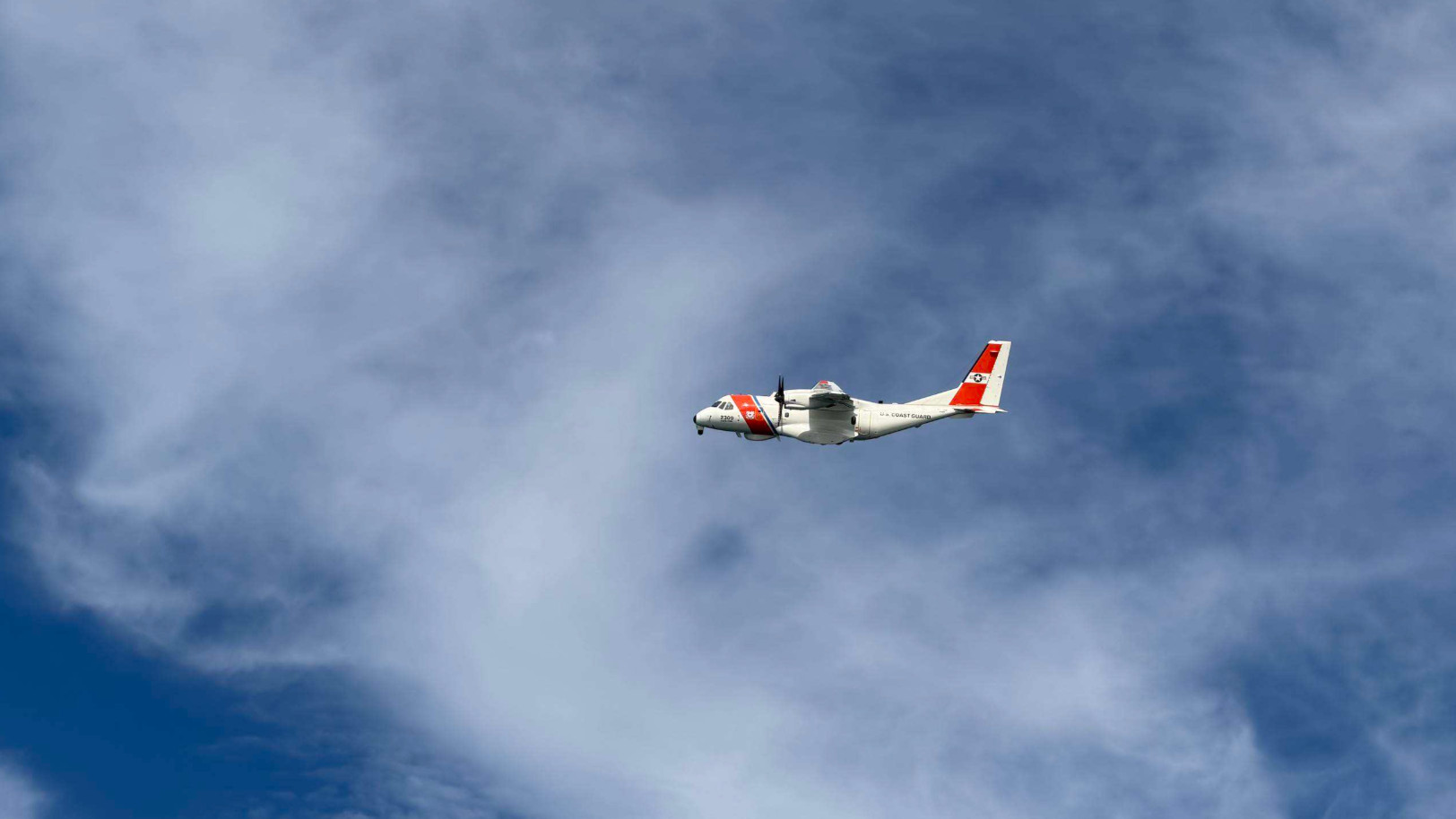
A Coast Guard HC-144 Ocean Sentry from Coast Guard Air Station Cape Cod searches for a missing G100 medical transport aircraft off the coast of Nantucket. [Credit: U.S. Coast Guard]
Six people are presumed dead after the U.S. Coast Guard on Sunday suspended its search for a Gulfstream G100 medical transport aircraft that went missing off the coast of Nantucket early Saturday morning.
Rear Admiral Matthew Lake, commander of the Coast Guard’s Northeast District, said in a statement that calling off the search was “not an easy decision.” The agency said it found a debris field confirmed to be from the aircraft off the coast of Nantucket and scoured 4,445 miles over approximately 66 hours, but it was unable to locate the four Canadians and two Bermudians traveling on the G100.
The aircraft, tail number C-GRJP and call sign Heartbeat 104, was flying from Bermuda to Boston, and the FAA at 2 a.m. EDT on Saturday told the Coast Guard that air traffic control lost contact with it. Canadian operator Latitude Air Ambulance said the airplane was carrying four of its crew, a patient, and a family escort.
Per data from FlightAware, the air ambulance departed Bermuda at 11:41 p.m. EDT Friday and was scheduled to land in Boston at 1:12 a.m. Saturday. Its recorded altitude dropped from 24,000 feet at 1:03 a.m. to 11,000 feet at 1:07 a.m. before flight data was lost.
A controller asked the crew whether it was declaring an emergency and “coming in blind,” according to audio obtained by NBC News.
Latitude said it accepted the Coast Guard’s decision to transition from active search to recovery efforts with “profound sadness” and thanked searchers for their efforts.
“We must now face the heartbreaking reality that the [aircraft’s six occupants]…are presumed to have died,” it said in a statement Sunday.
The Coast Guard said that a “future investigation into the cause of the incident will be coordinated by the appropriate investigative authorities.” Latitude said it would coordinate with the National Transportation Safety Board and Transportation Safety Board of Canada. It declined to speculate on the cause of the incident but said it may provide further information when it is confirmed by authorities.
“This is an unimaginable loss for our Latitude family and for everyone who loved the six people aboard Heartbeat 104,” said Peter Byl, president of Latitude. “Our focus now is on supporting their families, supporting our people, and assisting the authorities.”
What We Know
The Coast Guard began its search early Saturday morning and said later in the day that crews had located a debris field from the aircraft off the coast of Nantucket, and it was continuing to look for the six missing occupants.
The agency deployed an HC-144 Ocean Sentry, HC-130 Hercules, MH-60 Jayhawk, and lifeboat crews. Those assets were supported by an HC-130 and two HH-60 helicopters from the New York Air National Guard’s 106th Rescue Wing as well as the Boston-based Coast Guard cutter William Sparling.
During a news conference Sunday, before the search was suspended, Lake said crews had scoured some 2,840 square miles over about 53.5 hours.
“This is a large and demanding search area,” he said. “Our crews are employing fixed-wing aircraft, helicopters, boats, and cutters to search the area, and we’ll continue to evaluate all available information as our operation progresses.”
“We express our deepest condolences to the families and loved ones affected by the tragedy and our gratitude for our partner agencies who helped support search efforts,” Lake said in a statement later on Sunday.
Latitude provides specialized medical evacuation and patient transport services in Canada and internationally. It operates a Falcon 900B, pair of LearJet 35As, trio of Beech 1900-Ds, and four G100 medevac aircraft.
The company on its website describes the G100 as the longest-range dedicated medevac aircraft in North America. It can carry a patient stretcher, full ICU medical equipment and supplies, and up to two travel companions for the patient.
Latitude’s G100 flights are typically staffed by two pilots, a registered nurse, and a registered respiratory therapist. Teams meet patients directly at the hospital and provide care within the aircraft during flights.
The Coast Guard did not provide a probable cause for the aircraft’s disappearance but said an investigation would be forthcoming. According to NBC, Lake on Sunday said crews had not yet located the G100’s flight data recorder, which could help investigators piece together what occurred.
Jack is a staff writer covering advanced air mobility, including everything from drones to unmanned aircraft systems to space travel—and a whole lot more. He spent close to two years reporting on drone delivery for FreightWaves, covering the biggest news and developments in the space and connecting with industry executives and experts. Jack is also a basketball aficionado, a frequent traveler and a lover of all things logistics.
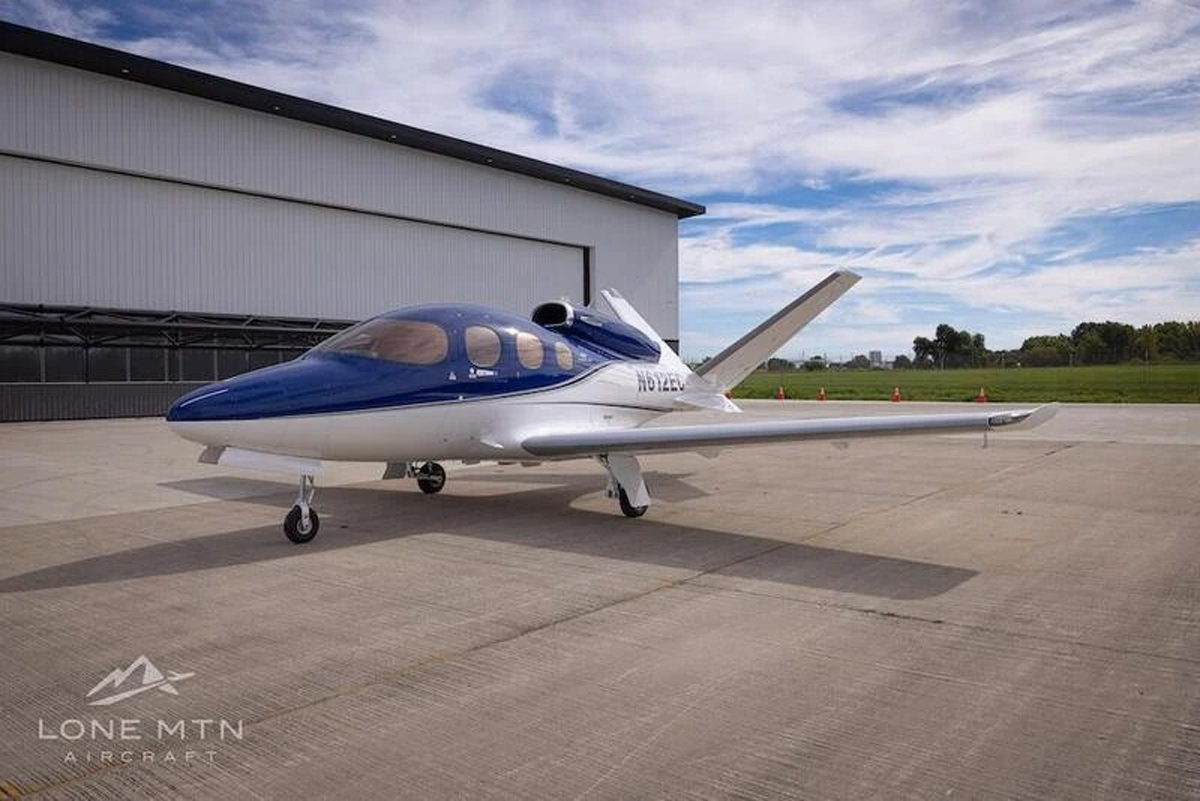
Designed from the ground up to make turbine performance approachable, the Cirrus SF50 G2 Vision Jet stands as the ultimate step-up platform for owner-operators. Combining single-engine efficiency with swift cruise speeds and upper-airway capability, it offers private pilots a seamless transition into jet-class speed and comfort without the operational complexity of a twin-engine flight deck.
Showing 1,300 flight hours since new, this 2020 model provides a 6,000-pound gross takeoff weight and a 2,344-pound useful load, with additional storage space provided by the Cargo X-Tend modification. The ramp presence is undeniably striking, highlighted by an Apex exterior paint scheme that features an elegant cobalt blue over a snow white finish.
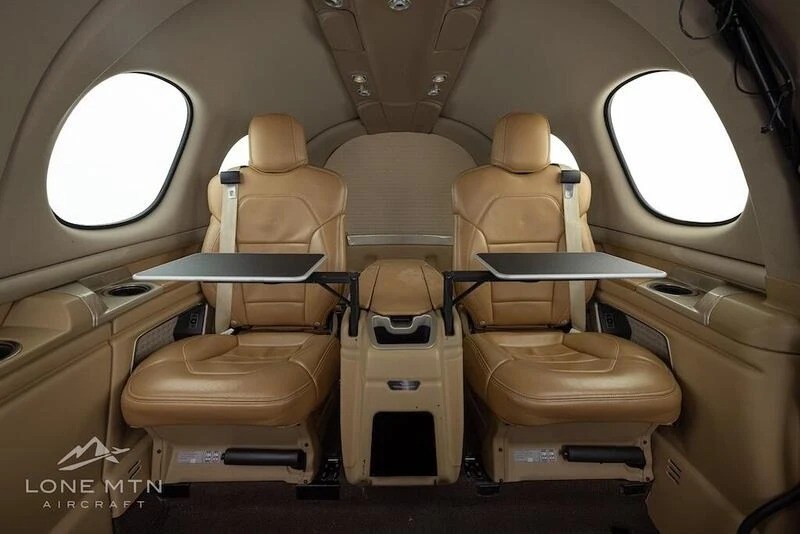
Settling into the passenger area uncovers a highly refined cabin environment designed around the mocha premium interior. Occupants are treated to a luxurious experience with executive seating, multizone climate controls, 22-inch entertainment display, and power stations with HDMI and USB connectivity, ensuring cross-country journeys are productive and relaxing.
Delivering reliable jet-A performance is a Williams International FJ33-5A engine that produces an impressive 1,846 pounds of thrust. Equipped with full FADEC control, autothrottle, and the hot and high Performance upgrade, the powerplant is fully enrolled in the TAP Blue program through Cirrus JetStream concierge, which covers the aircraft until June 2027 or 1,400 hours.
Looking at the state-of-the-art instrument panel showcases the highly advanced Cirrus Perspective Touch+ avionics suite by Garmin, running the updated G3 software. Pilots manage flights through three landscape touchscreen controllers and expansive 14-inch, high-resolution displays. Safety and situational awareness are enhanced by Synthetic Vision Technology, Enhanced Vision System (EVS) camera, Surface Watch, and the new Garmin GWX8000 Auto Radar.
Listed at $2,695,000, this Wisconsin-based jet represents a phenomenal opportunity to bypass waitlists and place a highly upgraded, turnkey SF50 in your hangar.
If you’re exploring ownership options, FLYING Finance can help get you airborne. Use our airplane loan calculator to estimate your monthly payments, or connect with an aviation finance expert at flyingfinance.com.
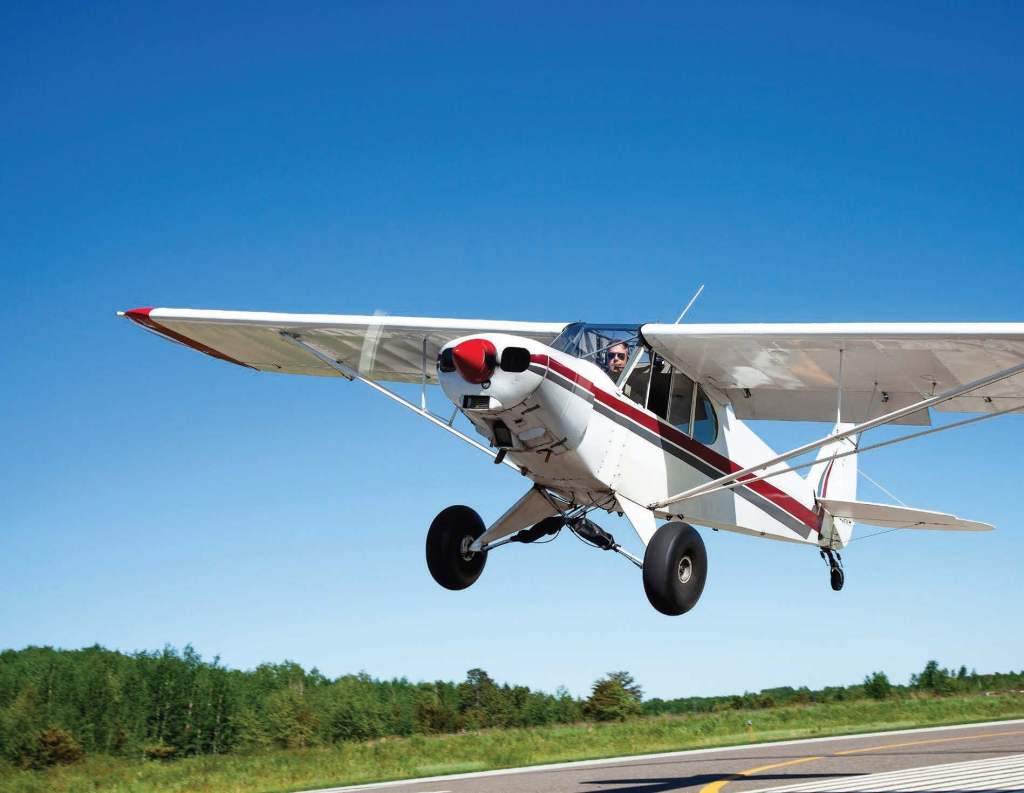
The Piper Cub remains a proven choice for developing essential stick-and-rudder skills. [Credit: Adobe Stock]
Of course, you want to fly tailwheel. Let’s be honest, the airplanes look cool—after all, the best piston-engine fighters in World War II had tailwheels, and they looked like they were doing a million miles per hour (conservative estimate) just parked on the ramp. And there’s the snob appeal—how many times can you hear that “you’re not a real pilot until you fly tailwheel” until you start to believe it?
The thing is, after giving tailwheel instruction for more than 50 years and watching scores of pilots go from “I’m not sure where this thing’s going!” to the gigantic, irrepressible grin generated by a steep slip over a tree line to a feather-light touchdown on a grass field on a summer evening, I’ve not met a pilot who didn’t think the hard work of going through a tailwheel checkout wasn’t worth it.
Getting Started
Not surprisingly, the FAA has something to say about flying tailwheels. FAR Part 61.31(i) sets out training requirements for a person to act as pilot in command (PIC) of a tailwheel airplane. As you might imagine, the pilot will have to demonstrate proficiency in normal and crosswind takeoffs and landings, wheel landings, and go-around procedures.
If you're not already a subscriber, what are you waiting for? Subscribe today to get the issue as soon as it is released in either Print or Digital formats.
There’s no check ride involved, as the pilot must demonstrate an acceptable level of proficiency to a flight instructor (who defines what is acceptable) and receive a logbook endorsement. The FAR came about because pilots were wrecking tailwheel airplanes at a much higher rate than nosewheel birds. Even with the training requirement, the accident rate on landing is still two to three times higher for tailwheel airplanes than for those with a nosewheel.
For planning purposes, budget for 10 hours of dual in the airplane, although you probably won’t need that much. It’s always nice to find that your budget was liberal. Some schools have flat-rate programs, although most will charge extra if you exceed a certain amount of training time.
The biggest challenges of learning to fly tailwheel aircraft may be finding a facility that gives dual instruction. It may take some homework as schools that do are rare.
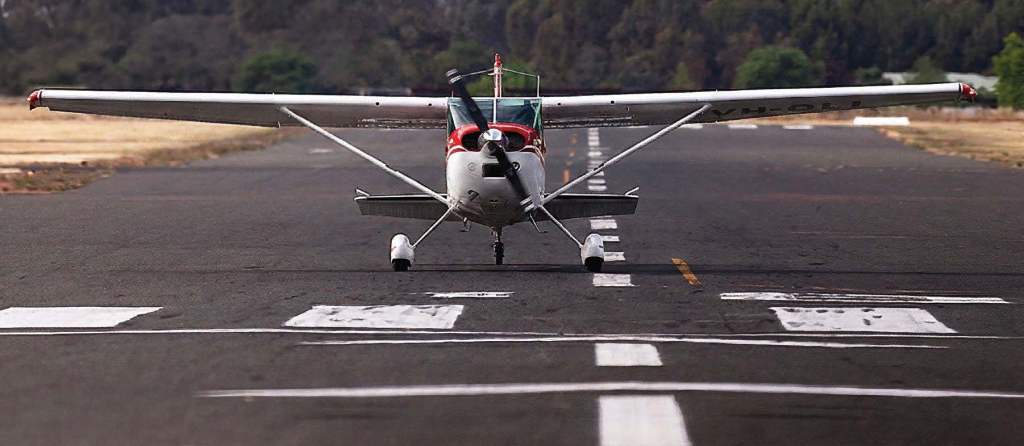
The odds are good that you will have to travel for training. If that’s the case, do some research. What kind of aircraft is used? I’m partial to Cubs, Super Cubs, Champs, and the Citabria/Decathlon series. They have predictable ground handling, generally good over-the-nose visibility (except for the Cub), and reasonable operating costs.
If you intend to go into a higher-performance tailwheel airplane or warbird, I recommend doing initial training with the more modest performers. Low-powered tailwheel airplanes require finesse to solve problems on takeoff and landing (instead of brute power), something I strongly recommend developing and will serve you well in the long run.
As with any type of flight training, doing it without interruption over the shortest time is the least-expensive method—you don’t spend so much time relearning after a layoff. Check out the flight school to make sure it can meet your training schedule.
Is there an airplane and instructor available for three to five days in a row, for two or three flights a day? Does it have a backup airplane if the trainer breaks? Can you stick with one instructor? Once you complete the training, can you rent the airplane and fly it solo? What training materials does it have for review prior to showing up?
Recalibrating Your Brain
Moving from a nosewheel to tailwheel involves much more than learning some new control movements. It means a fundamental and visceral recalibration of your flying brain when it comes to takeoffs and landings.
The full physical and aerodynamic meaning of pilot operations when in an aircraft where the center of gravity is behind the main landing gear must be understood at a gut level. In a nosewheel one makes a turn on the ground by pressing the desired rudder pedal and holding it until time to stop the turn. The rudders are then returned to neutral, and the airplane straightens out because the center of gravity is ahead of the main landing gear.
That’s absolutely not the case with a tailwheel airplane. Once you press a rudder to start a turn, the airplane is going to keep on turning until you apply the opposite rudder to stop it. That basic concept has to become part of a pilot’s soul. After all, think about how difficult it is to push a shopping cart backward.
Precision and finesse unlock the joy of tailwheel flight. [Credit: Adobe Stock]
Programming your pilot brain for tailwheel starts with training aids to review before taking dual. A great resource is Patty Wagstaff’s video tailwheel training course offered by Sporty’s Pilot Shop (sportys.com).
There are also several publications with tailwheel training materials, and I’ll shamelessly recommend the tailwheel sections in my own book: The Thinking Pilot’s Flight Manual Or, How to Survive Flying Little Airplanes and Have a Ball Doing It, Vol. 1.
I really like total immersion when it comes to tailwheel training—not only setting the rest of the world aside while you train but going to schools that offer some of the newer training devices, such as a tailwheel simulator, virtual reality, and Redbird’s Xwind simulator. They help reduce the time and cost.
What’s Involved in Training?
Wear comfortable, flexible shoes because you want to be able to feel the rudders and brakes. Training will start with some quality ground instruction about the aforementioned requirement that you stop every turn that you start. That will segue into explaining that you should decide what route you’re going to take any time you are moving on the ground and not tolerate any deviation whatsoever from that route.
If you’re taking off or landing and the route is to go straight down the center of the runway, it’s imperative that you not tolerate the nose wandering off that route by more than a degree. That’s because doing so means you’re not in control of the airplane and that it’s swerving—and once a swerve starts it’s going to get worse, especially when moving rapidly.
Inattention, letting the nose move, say, 5 degrees off where you want it to be before you do anything about it is an invitation to an ever-increasing swerve into a ground loop. That’s an out-of-control swerve that tightens up into the airplane spinning around until it hits something, tips up on a wingtip or the nose, or runs out of energy. Especially when the airplane has lots of kinetic energy—it’s rolling fast—a swerve will snowball rapidly.
The good news is that in almost every tailwheel airplane you have plenty of control authority to stop a swerve if you act without hesitation. I’ve watched it for half a century—nosewheel pilots tend to be complacent about the nose deviating a few degrees from the desired route when on the ground. That complacency isn’t tolerated by a tailwheel airplane—it will embarrass you in a hurry.
The next topic is learning deep down inside your flying brain that on approach to landing, extra speed is your enemy. You’re giving the airplane more energy, which is ammunition for it to wreck itself should a swerve start. That means flying on speed, 1.3 VSO plus no more than half the gust factor. The idea is to touch down with minimum energy for maximum control on rollout. Tailwheel landing accidents don’t happen when the airplane is on final. They happen after touchdown when the pilot fails to manage the residual energy and loses control after failing to stop a swerve when it starts.
Once you’ve been suitably advised to be hyperalert any time the wheels are in contact with the ground, and you’ve reviewed the systems of the airplane, it will be time to fly.
Taxiing and Flying
You will spend some time just taxiing to start to get a feel for the airplane. In general, if the engine is running, the stick is held fully aft when on the ground unless there’s a strong tailwind. The idea is to pin the tailwheel for maximum steering effectiveness.
You will also learn that aileron position when taxiing is much more important than in a nosewheel airplane due to the three-point attitude. When taxiing a tailwheel, the ailerons are your friends when properly positioned. On a calm day you can even make wide radius turns using full aileron opposite to the direction you wish to turn.
As a rule, if the wind is calm, it shouldn’t require any rudder deflection to taxi the airplane straight ahead. If it does, something is wrong, and it can bite you when the speed increases. If you must hold rudder while taxiing straight on a calm day, there’s a problem with the landing gear rigging, tire inflation, tailwheel mechanism, or tailwheel strut. Get it fixed before you fly.
You and your instructor will brief the takeoff, including elevator position, rate of throttle application, and keeping the nose straight. You will be surprised at how effective the rudder is once there’s airflow over the tail. You will probably be pleasantly surprised by how effective the controls are after your time flying nosewheel airplanes.
In flight in most tailwheels, you will discover that they’ve got a great deal of adverse aileron yaw and require significant work with your feet to coordinate turns. You will need rudder when rolling into and out of turns, and it will be frustrating at first. The comment that “it flies just like a Cub” is not a compliment. Cubs have no wing dihedral, lots of adverse aileron yaw, and not great control harmony. It takes some skill to fly one well. However, you’re about to develop that skill—which, after some hard work, is going to make you quite happy with your accomplishment.
Three-Point Landings
After getting used to the airplane in flight, it’s time to start the challenging part—landings.
You will start out with three-point landings. The idea is to touch down either on all three wheels simultaneously or with the tailwheel slightly before the mains—it’s OK because it’s built for it. The airplane may or may not be stalled during a three-point landing. It’s the landing that allows you to touch down with minimum energy and maximum control. The yoke/stick is full aft prior to touching the runway and stays there during rollout.
If there’s a crosswind, touchdown is with the tailwheel and upwind main gear, using the ailerons to hold the downwind wheel off the ground. It’s OK, the airplane will roll straight ahead. You will be using opposite rudder to prevent the airplane from weathervaning into the wind, plus the down aileron on the downwind side generates drag, which acts as additional rudder on that side, helping you keep the airplane straight during rollout. As you decelerate, you will increase aileron deflection until you hit the control stop.
Experience the irrepressible grin of a perfect tailwheel landing. [Credit: Adobe Stock]
That’s another part of learning to fly tailwheel. You will be putting at least one of the controls to the stop on every single landing— something you’ve rarely done in a nosewheel airplane. The airplanes you will be flying have very good aerodynamic controls, so it’s up to you to make use of them to make them go where you want them to go.
Wheel Landings
Learning to make wheel landings means learning some control inputs that are contrary to all that you’ve learned in nosewheel airplanes. The airplane comes down final on speed, as you’ve done for years. You then flare enough to break the descent and hold the main gear an inch off the runway. You then relax the backpressure slightly, allow the mains to start to roll, and then further relax the backpressure so that the angle of attack is reduced to hold the airplane on the mains.
As the airplane decelerates, forward pressure is applied to hold the pitch attitude until it slows to a speed you desire, and then the stick is brought smoothly aft to fly the tailwheel down to the runway and pin it for directional control. Generally, that’s done as soon as the speed is low enough that the airplane will not lift off when the tail is lowered. Keeping the tail high may invite a directional problem should there be a crosswind gust. In general, don’t apply the brakes until the tail is down and you have the stick fully aft.
If you bounce a wheel landing, it’s essential to avoid the desire to shove the stick forward and plant the mains on the ground. That way introduces the strong possibility of pilot induced oscillation (PIO) and hitting the prop and/or a noseover. If you bounce a wheel landing, you may have enough energy to flare again and make a tail-low wheel landing or three-point landing. If you bounce a wheel landing a second time, you’re no longer making a wheel landing. You’re making either a three-point landing or going around, otherwise your risk of PIO goes through the roof. No later than on downwind, decide which type of landing you’re going to make and, if it’s a wheel landing, what you’re going to do if you bounce it.
Anytime the airplane is landed and held on the main gear, it’s a wheel landing, even if the tailwheel is just an inch off the runway. Wheel landings are rarely made with the airplane in a level flight attitude. That’s a good indication that the airplane is going way too fast.
In general, landings in tailwheel airplanes occur with full flaps and the power at idle prior to touchdown. If you’re carrying power, you’re doing something wrong and touching down with more energy than needed, which can cause you grief during the rollout. The airplane has plenty of energy for the flare and landing, power off, with full flaps, out of an approach at 1.3 VSO. You just have to use the elevators to make the flare and touchdown take place before you run out of speed. That requires a degree of skill that should be mastered before trying crosswind landings.
Specialized Operations
Short and soft field landings will be covered during training and, depending on the specific airplane, may be similar or greatly different from what you’re used to in a nosewheel airplane.
It may sound silly, but land into the wind if at all possible. If a crosswind is howling, there may be a taxiway into the wind that’s safer to land on—it’s not illegal—or it may be best to find somewhere else. As your training progresses, you’ll have a chance to get into the favorite argument among tailwheel pilots—which is better, three-point or wheel landings? The answer is: It depends. It depends on the type of airplane, the comfort level of the pilot, and their recent experience.
First, the POH rules. It may have specifics for landings under varying conditions. Do what it says. When in doubt, do a three-point landing to minimize energy on touchdown. Some airplanes, notably the Luscombe Sedan, can’t be three-pointed because of restricted elevator travel. Some airplanes can be three-pointed, but it’s challenging, and you better have your A-plug game—notably the Globe Swift, Beech 18, and DC-3.
A wheel landing gives better visibility over the nose, something that may matter on the airplane you’re flying. Some pilots prefer them in crosswinds, although if a wheel landing in a crosswind is coupled with extra speed at touchdown, things can and do go badly wrong suddenly during rollout.
If a swerve starts to develop into a ground loop and the track of the center of gravity of the airplane gets enough to the side to be outside of the main landing gear, applying a brake to try to stop the turn will only make it worse. The airplane is going around. If that happens, hold the stick/yoke full aft and stay off the brakes. The airplane will come to a stop. If you’re on the brakes, it will almost certainly tip up onto a wingtip, or the nose or flip over. If there’s any good news about ground loops, it’s that if everyone is strapped in and wearing a shoulder harness, injuries are rare. Embarrassment, however, is not.
It’s going to be hard work at times, but the harder things to accomplish in life always give the greatest rewards when you master them. Besides, you’re going to greatly improve your stick-and-rudder skills and discover that tailwheel flying is so much fun that it’s probably illegal in certain jurisdictions.
TacAero: Tailwheel Training Specialists
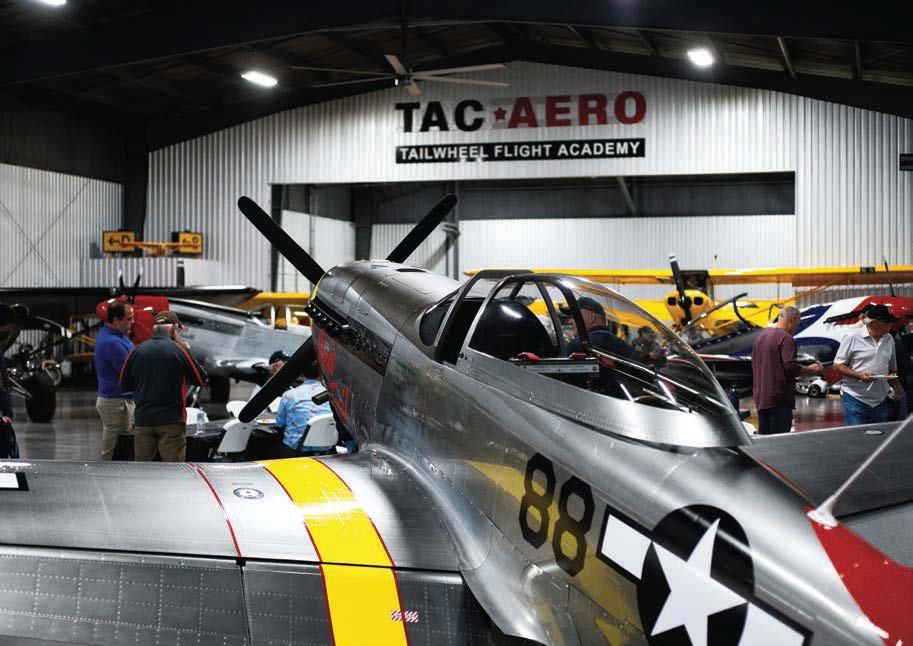
I traveled to the Gillespie County Airport (T82) in historic Fredericksburg, Texas, where ScaleWings has partnered with tailwheel training specialist organization TacAero. SW-51 Mustangs coming to the U.S. are shipped to TacAero, where they’re assembled, flight tested, receive FAA approval, and the buyer goes through transition training.
My initial reaction was that TacAero had a pretty good gig doing nationwide support for ScaleWings—and that it must be a pretty sharp company to have been selected as the partner for the manufacturer.
TacAero in Fredericksburg, Texas [Credit: Glenn Watson]
The moment I walked into TacAero’s pristine hangar I realized I had badly underestimated the company. Arranged around us I saw a brace of SW-51s, several models of CubCrafters Cubs, a GameBird GB1, a Piper Super Cub, and a WACO UPF-7. There was but one nosewheel aircraft, and that was only because it was a Super Cub on amphibious floats. It was obvious that TacAero is focused on teaching pilots to fly tailwheel aircraft and providing maintenance for new and vintage tailwheel airplanes.
Besides ScaleWings, TacAero partners with CubCrafters to provide full support to owners of the manufacturer’s extensive line of tailwheel airplanes, from initial transition training through annual recurrent training as well as maintenance.
I spent some time talking with TacAero director Ian Waghorn, who walked me through the training that the company provides. Waghorn, also a CFI, explained that it organizes training into complete courses rather than charging by the hour for instruction. The intent is to turn out pilots who well exceed any FAA requirements for such things as a tailwheel endorsement. Each course dedicates a specific airplane to the student for the duration of the course and intermingles one-on-one ground and flight training to proficiency. As it says on its website, TacAero seeks to create elite pilots with the skills and judgement to operate their aircraft safely.
The courses range from tailwheel training for the required endorsement to fly one as PIC through transition and recurrent training for buyers of CubCrafters and ScaleWings aircraft, aerobatic instruction, upset recovery training, spin training, vintage aircraft training, both initial and recurrent either in TacAero’s WACO or in a customer’s vintage bird. It also offers in-depth initial and advanced backcountry training. The one exception to its all-tailwheel, all-the-time training is for a floatplane rating in the Super Cub on amphibs. TacAero has such advanced training devices as a tailwheel simulator and virtual reality, both of which can reduce the time needed in the airplane.
In keeping with an underlying spirit of adventure, the company also offers aerial expeditions at times. Past expeditions have been to the backcountry in the Lower 48 and Alaska as well as island hopping in the Bahamas. TacAero’s website has information on upcoming expeditions.
Waghorn said TacAero’s instructors are highly experienced tailwheel pilots who like the passion the company and its customers bring to flying. I felt the passion and dedication in each of TacAero’s CFIs, including Ross Harwell, the CFI who flew with us in the SW-51 for a feature in FLYING’s February/Issue 967.
This feature first appeared in the August Issue 973 of the FLYING print edition.
Rick Durden has written for Aviation Consumer since 1994 and specializes in aviation law. He is an active CFII and holds an ATP with type ratings in the Douglas DC-3 and Cessna Citation. He is the author of The Thinking Pilot’s Flight Manual or, How to Survive Flying Little Airplanes and Have a Ball Doing It, Volumes 1 & 2.
Engine overhauls can take weeks or even months to complete, and all of that is time out of your calendar that you can’t fly. [Credit: Shutterstock]
Every hour aloft, your engine is building toward an invoice you haven’t paid yet. Fuel, insurance, and hangar rent show up predictably on a calendar.
The overhaul bill doesn’t show up until the day a mechanic pulls a cylinder, finds metal in the filter, or simply tells you the clock has run out. By then it’s not a line item. It can be a $30,000 to $65,000 surprise with your airplane grounded until you write the check.
With a reserve, funded hour by hour, you can mitigate the bulk of overhaul expenses. The owners who don’t get surprised are the ones treating the overhaul like a loan they’re paying down in advance.
Math Is Usually Simple
The Aircraft Owners and Pilots Association’s guidance on estimating direct operating costs boils the whole exercise down to one formula—overhaul cost divided by the engine’s time between overhauls (TBO) equals your per-hour reserve rate.
AOPA’s worked example is a Cessna 172 facing a $17,000 overhaul over a 2,000-hour TBO, and it pencils out to $8.50 an hour. Swap in a factory remanufactured engine at $27,000 with 900 hours left on the clock, and that jumps to $30 an hour.
Same airplane, wildly different reserve, depending entirely on what’s bolted to the firewall and how much life is left in it.
Run the same formula across the fleet and the spread gets wider.
Jake Naviation’s 2025 overhaul cost guide puts a Lycoming O-360 overhaul at $25,000 to $35,000, a Continental IO-520 at $38,000 to $55,000, and a turbocharged Lycoming TIO-540 as high as $65,000. Those figures translate to reserve rates of roughly $15 to $18 an hour for a 172, $20 to $30 for a Cirrus SR22, and $22 to $32 for a Bonanza. At 75 hours a year, that’s the difference between setting aside roughly $1,125 and $2,400 annually.
AOPA’s guidance adds 25 cents an hour for a fixed-pitch prop and $1 an hour for constant-speed. Items like that are small compared to the more major overhauls, but they can still be a headache if you’re not prepared.
Lycoming extended TBO to 2,600 hours this year across seven popular engine families—O-320, IO-320, O-360, IO-360, IO-390, O-540, and IO-540. The change added 400 hours before the overhaul clock runs out on fixed-wing applications. More hours between five-figure bills lowers the effective annual cost of ownership.
What it doesn’t do is erase the calendar.
Lenders and appraisers still apply a roughly 12-year limit regardless of hours flown, because metal fatigue and corrosion don’t care how many hours are on the tach. An owner who flies 50 hours a year is getting 2,600 hours of runway or 12 years, whichever comes first. The extended TBO helps active flyers more than it helps hangar queens, and in either case, it’s not a substitute for a funded reserve.
Budgeting and Financing an Overhaul
Engine condition doesn’t only determine what you’ll owe a shop someday. It determines what a bank will lend you today.
Appraisers price remaining engine time directly into the aircraft’s value, and lenders advance loan amounts against that appraised value, meaning a run-out engine shrinks your borrowing power even if the airframe and avionics are pristine. Most lenders also expect a minimum 15 percent down payment on post-1960 singles, with the understanding that many owners will refinance once the engine is overhauled and the aircraft’s value resets upward. An underfunded reserve means less leverage to finance the shortfall.
Turbine owners face a version of the same pressure, just formalized.
New aircraft typically get full coverage from hour one with no upfront cost. Aircraft already in service either pay a lump-sum buy-in for immediate full coverage or enter a pro-rata structure where coverage builds gradually.
Either way, lenders like seeing a reserve in place.
Fund Like You Mean It
The owners in the best position are calculating the per-hour number for their specific engine and TBO, moving that amount into a dedicated account every time they fly, and revisiting the figure whenever TBO guidance changes or the engine crosses into higher-wear territory.
Piston owners without the scale to justify a formal program can replicate the discipline with a simple separate savings account. Turbine owners should treat program enrollment as part of the financing conversation, not an afterthought after closing.
Either way, the reserve is a loan payment you’re making to your own future self. Skip it, and the bank or the mechanic collects the difference later, with interest.
Talk to our team of experts atFLYING Financetoday for any financing questions or concerns.
Matt Herr develops sponsored content for clients at Firecrown Media. He is a gearhead and motoring enthusiast with experience in tech, freight and manufacturing. He spends his free time hiking with his wife, son and German shepherds, or reading and writing hobby pieces.
FAA headquarters in Washington, D.C. [Credit: Shutterstock]
The FAA said it onboarded more air traffic controller trainees in fiscal year 2026 (FY26) than in any year in the agency’s history, though the number of certified professional controllers (CPCs) remained hundreds short of headcount targets as of August.
The agency set a goal of hiring 2,200 ATC trainees in FY26 and said Thursday that it onboarded 2,235. The influx was in part due to the FAA’s recruitment of gamers, which netted more than 12,000 applications in under 24 hours, the agency said.
Still, it will take years for those individuals to enter the field. The FAA said more than 1,300 trainees graduated from its academy in Oklahoma City in FY26, but they will need to complete facility-specific training, which can take years, before being fully certified to oversee airspace.
During a hearing in September, FAA Administrator Bryan Bedford testified that there were about 11,000 CPCs deployed to 313 ATC facilities, with 4,000 individuals in the training pipeline. The 11,000 figure, which was unchanged since April, is about 1,500 short of the FAA’s FY26 target of 12,563, set by a workforce blueprint released in May.
The National Air Traffic Controllers Association (NATCA) said it was left out of the calculation of that target, which is less than the FAA’s previous headcount goal of 14,633 CPCs.
An FAA blueprint calls for the agency to hire 2,300 new controller trainees in FY27 and 2,400 in FY28. The agency’s FY27 budget request includes about $95 million to support that effort.
“Meeting this year’s hiring goal is an important milestone, but it’s not the finish line,” Bedford said in a statement. “We are focused on continuing to bring the best and the brightest people into the profession, giving them the training and tools they need to succeed, and building a stronger, more resilient air traffic control workforce.”
The FAA said it saw the highest number of air traffic academy students in its history in June. That is due in part to an expansion of training capacity, as well as incentives such as bonuses that were introduced in 2025 and ’26. The agency also continues to expand partnerships with universities, certifying them to provide the same training that the Oklahoma City academy does.
It is also undertaking a multibillion-dollar modernization effort that is replacing antiquated ATC systems and installing upgraded hardware and software.
Still, Bedford in September refused to commit to giving active controllers a 3.8 percent pay raise, which is provided for by legislation passed earlier this year. The administrator said he has the “utmost respect” for controllers but that “Congress asked me to look for ways to improve staffing efficiency,” contending that raises are not the only way to do so.
Jack is a staff writer covering advanced air mobility, including everything from drones to unmanned aircraft systems to space travel—and a whole lot more. He spent close to two years reporting on drone delivery for FreightWaves, covering the biggest news and developments in the space and connecting with industry executives and experts. Jack is also a basketball aficionado, a frequent traveler and a lover of all things logistics.
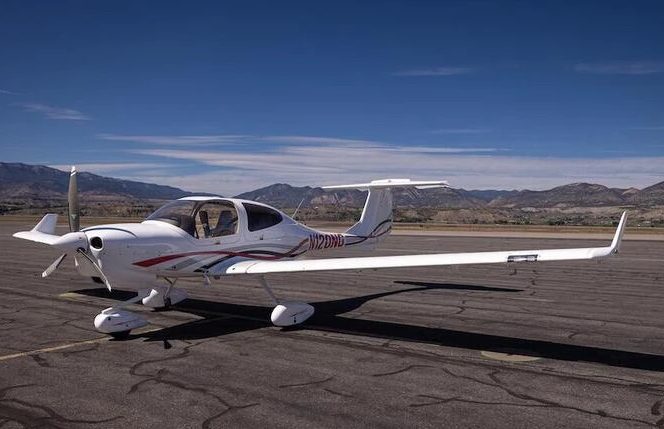
Diamond’s DA40 has undergone many evolutionary changes since making its first flight as a prototype in 1997.
During testing and over years of service, the design has been powered by Rotax, Continental, Lycoming, and Austro engines, though its focus on the training market has remained fairly steady over time. The exception is the NG model, which combines several aerodynamic improvements that improved cruise performance, with an engine that runs on jet-A fuel, which typically operates more economically.
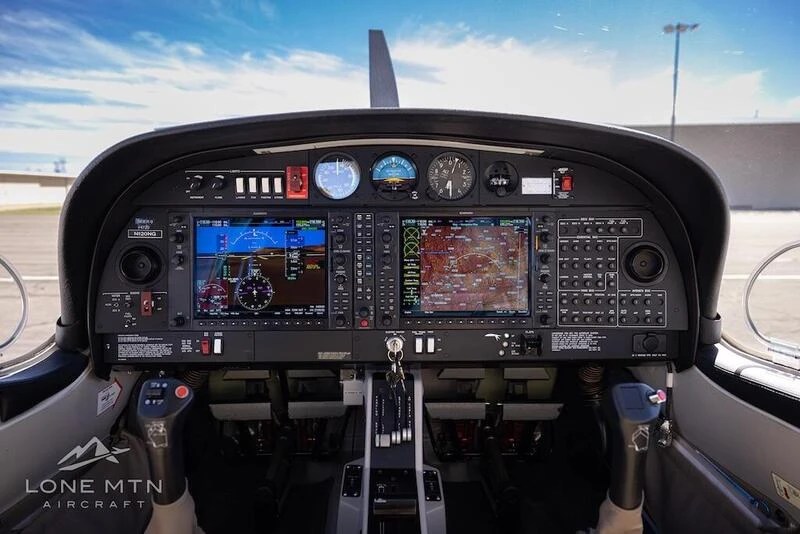
This DA40 NG has a Garmin G1000 flight deck. [Credit: Lone Mountain Aircraft]
While the aircraft for sale today is an ideal platform for training, it also has the performance, comfort, and economical operation that makes it attractive to private pilots.
This aerodynamically efficient composite design is known not only for extracting fairly high cross-country cruise speeds from an engine with modest power but also for forgiving handling that has helped it maintain a low rate of fatal accidents. Indeed, the aircraft is known for its reluctance to stall even with extreme control inputs.
This 2020 DA40 NG has 790 hours on the airframe, 435 hours since new on its 168 hp Austro Engine AE300, and 790 hours since new on its MT propeller. The aircraft has a 836-pound useful load and carries 39 gallons of jet-A fuel in long-range tanks.
The panel features a Garmin G1000 avionics suite with synthetic vision, dual WAAsGPS receivers, wireless Flight Stream 510 connectivity, Garmin digital audio panel, GTX 345R remote transponder with ADS-B In and Out, Avidyne TAS 600 traffic advisory system, Garmin GFC 700 autopilot, GDL69A SiriusXM datalink and audio, and electronic IFR, VFR, and approach charts.
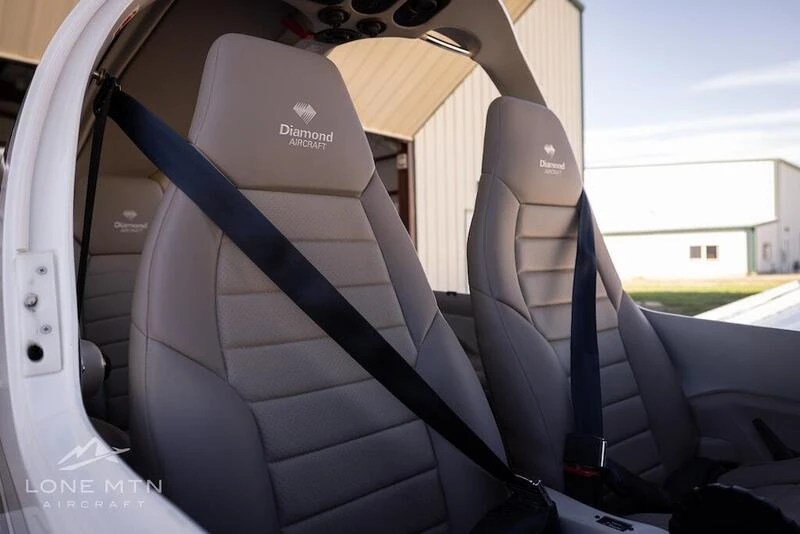
A neat, car-like interior is ideal for long flights. [Credit: Lone Mountain Aircraft]
Additional equipment includes Beringer wheels and brakes, LED lighting, AmSafe inflatable seat belts, electrically adjustable rudder pedals for pilot and copilot, Tanis engine preheating system, and lightweight canopy cover.
Pilots looking for a modern, versatile four-place aircraft that can be used for training, building time, or traveling with family and friends should consider this 2020 Diamond DA40 NG, which is available for $495,000 on AircraftForSale.
If you’re interested in financing, you can do so with FLYING Finance. Use our airplane loan calculator to calculate your estimated monthly payments. Or, to speak with an aviation finance specialist, visit flyingfinance.com.
Jonathan Welsh is Lead Editor of Aviation Consumer and a private pilot who worked as a reporter, editor and columnist with the Wall Street Journal for 21 years, mostly covering the auto industry. His passion for aviation began in childhood with balsa-wood gliders his aunt would buy for him at the corner store. Follow Jonathan on Twitter @JonathanWelsh4
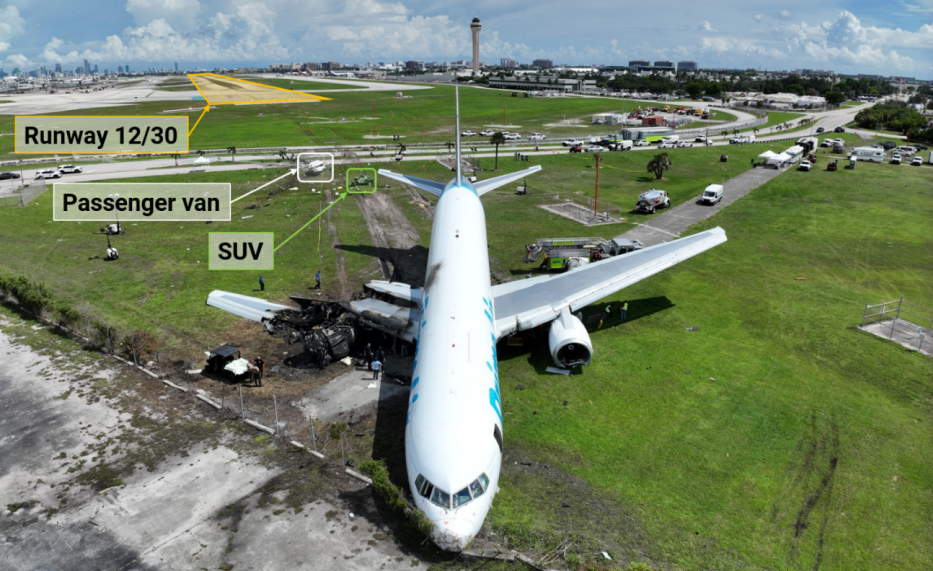
An aerial view of the Amazon Prime Air Boeing 767 cargo jet that overran Miami International Airport’s runway 30 in September [Credit: NTSB]
National Transportation Safety Board investigators Thursday clarified the sequence of events involving the Amazon Prime Air cargo jet that overran Miami International Airport’s (KMIA) Runway 30 in early September, killing five people. Initial findings reveal that the airplane had little room to come to a stop after touching down.
According to the NTSB’s investigation preliminary report, the aircraft—a Boeing 767-33A operated by Amazon contractor 21 Air—touched down about 3,750 feet beyond the displaced threshold at the approach end of Runway 30. The runway measures 9,360 feet, including the displaced threshold.
According to Boeing’s documentation, depending on its weight, a 767-300 freighter requires between about 4,200 and 5,500 feet of runway for landing when flaps are set to 30 degrees, the runway is dry, and the airport is near sea level, as Miami International is. The accident aircraft’s planned landing weight was 231,236 pounds, about 95,000 pounds below the 767-300’s maximum landing weight.
However, the weight-on-wheels parameter on the aircraft’s landing gear, which indicates whether the weight of the aircraft is resting on its wheels, did not switch to “ground” until the airplane had about 2,730 feet of runway remaining. The parameter oscillated between air and ground indications for about seven seconds after the jet’s left and right main landing gear touched down at a groundspeed of about 160 knots.
Despite one pilot requesting flaps be set to 30 degrees with about 41 seconds remaining on the cockpit voice recorder (CVR) data the NTSB reviewed, an examination of the wreckage revealed that slat track and flap support rod measurements were consistent with a 25-degree flaps setting. Automated callouts in the cockpit indicated the jet was descending too fast as it approached the runway, but the crew did not initiate a go-around attempt until there was less than 1,000 feet of runway remaining.
Speed brakes were not applied and thrust reversers did not deploy during the landing rollout, according to the NTSB’s analysis of the flight data recorder (FDR).
“FDR and other engineering data will be incorporated into an NTSB airplane performance study to refine this preliminary sequence of events and to analyze the physical state of the airplane during its approach and landing on Runway 30,” the NTSB said.
The preliminary report also indicated that KMIA’s Runway 30 lacks an engineered materials arresting system (EMAS). NTSB chair Jennifer Homendy in September said a “key part of our investigation” would be to determine whether EMAS could have prevented the accident and whether it should be installed universally.
The report also contains new information on the flight crew, aircraft damage, and actions taken by air traffic control (ATC).
Aircraft and Flight Crew
According to the NTSB, the accident aircraft was making its third flight of the day. It had accumulated a total time of about 110,077 flight hours and 24,505 flight cycles. The model was manufactured in June 1994 and originally delivered in passenger-carrying configuration before being converted to a freighter in 2016.
It was the second flight of the day for the accident flight crew, whose captain and first officer flew together for the first time on an outbound flight from Miami to San Juan, Puerto Rico, earlier in the day.
The captain on September 5, the day before the accident, made two flights between Miami and Colombia, returning to KMIA in the evening and retiring from duty until the following morning. The first officer had been off duty since September 4.
On the accident flight, the captain was the pilot flying and the first officer was the pilot monitoring. Their roles had been reversed on the outbound flight to Puerto Rico earlier in the day.
Per interviews with the NTSB, the captain was hired by 21 Air in April and had total flight experience of 7,267 hours, with 2,700 hours in the Boeing 737 but only 150 in the 767. The first officer was hired in February 2025 and had about 2,800 hours of flight experience, with 800 coming in the 767.
What Happened Before, During, and After the Accident
Controllers at KMIA’s combined ATC tower and terminal radar approach control (TRACON) facility cleared the Amazon cargo jet for landing on runway 30 when it was about 12 nm from the displaced threshold.
At the time of the accident, the airport’s Automated Surface Observing System (ASOS) reported wind from 190 degrees at 17 knots with gusts to 26 knots, visibility of 10 sm or greater, thunderstorms, scattered cumulonimbus clouds at 2,000 feet agl, and broken ceiling at 4,800 feet agl.
The local control south (LCS) controller was responsible for arrivals and departures on runways 9/27 and 12/30. But they did not issue information about the wind after granting runway clearance for the accident aircraft, despite the FAA requiring controllers to state wind direction and velocity when a tailwind component exists. The controller did provide wind information to another aircraft about 4 minutes prior, but the Amazon jet was not yet on the frequency.
The controller had about 11 years of ATC experience, was certified for the LCS position in 2019, and had been on position for about 17 minutes.
The 767 crossed the runway threshold at about 105 feet agl and groundspeed of 177 knots, per ADS-B and FDR data. Conditions at the time were VMC.
With about 930 feet of runway remaining, when groundspeed was 120 knots, brake pedals for wheel braking were released and the throttle resolver angle for both engines “increased to go-around thrust values,” the NTSB said. With about 415 feet remaining, wheel brakes were reapplied and throttle resolver angles reduced to idle values. An examination of the wreckage found the throttle levers in the idle position and fuel control switches in the cut-off position.
Ground speed was about 113 knots when the airplane crossed the departure end of the runway and about 100 knots when it impacted the localizer and Medium Intensity Approach Lighting System with Runway Alignment Indicator Lights (MALSR). The jet departed the paved surface and came to rest about 1,200 feet beyond it.
The FDR’s last recorded groundspeed was 65 knots, shortly after the aircraft broke through the airport’s perimeter fence and traversed a public road. It impacted a cleaning van before breaking the fence, killing five people and severely injuring two, and a Toyota SUV while crossing the road, severely injuring the sole occupant. Photos of the vehicles shared by the NTSB show severe damage to both.
After the airplane came to rest, the captain egressed out of door 1L, and the first officer egressed out of the right cockpit window. Both suffered minor injuries.
The NTSB found the jet’s nose landing gear displaced aft and underneath its belly. Left and right main landing gear assemblies were found in an “extended and locked landing configuration.” All brake wear pins showed remaining service life for the vehicle’s eight wheels.
The most substantial damage was to the right wing, which the NTSB said displayed “varying amounts of heat damage” due to a postcrash fire. A large section of the upper wing skin separated and was found about 158 feet away in a nearby parking lot. The damaged right engine was resting on the ground after partially separating from the wing pylon structure.
The NTSB’s investigation remains open, and the agency has not yet determined a probable cause.
Jack is a staff writer covering advanced air mobility, including everything from drones to unmanned aircraft systems to space travel—and a whole lot more. He spent close to two years reporting on drone delivery for FreightWaves, covering the biggest news and developments in the space and connecting with industry executives and experts. Jack is also a basketball aficionado, a frequent traveler and a lover of all things logistics.
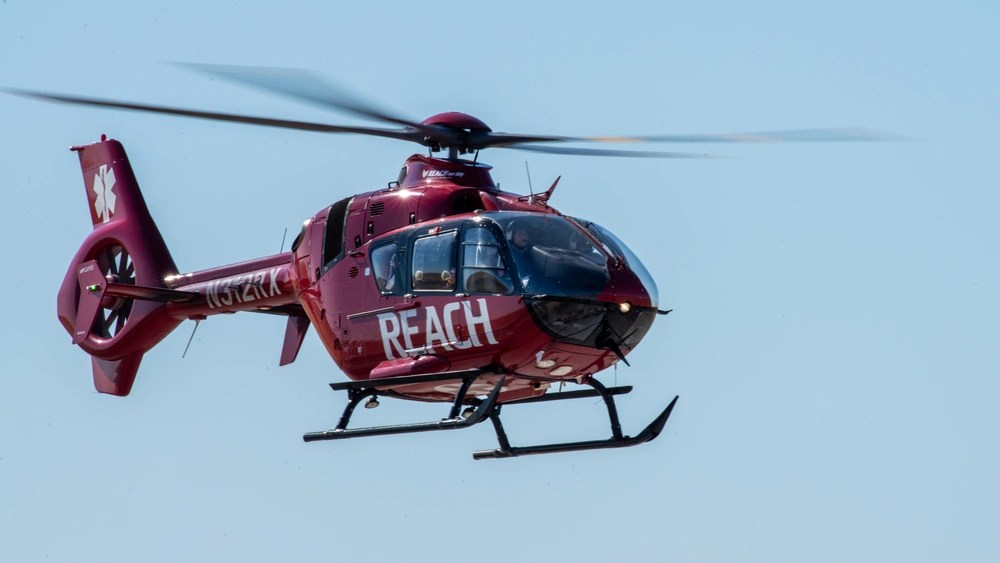
Reach Air Medical Services helicopter [Credit: U.S. Air Force/Kenneth Abbate]
Authorities have recovered the body of the patient aboard the medevac helicopter that crashed off Catalina Island on Wednesday night.
The patient, identified as 45-year-old Catalina Hernandez, a resident of the island, was being transported to a Los Angeles-area hospital after experiencing an allergic reaction.
The pilot and flight nurse were pulled from the water in cardiac arrest and treated at the scene but did not survive.
Hernandez’s 24-year-old son was also on board the helicopter. According to KTLA-TV, he was accompanying his mother to act as her translator. He survived the crash, as did a 49-year-old paramedic who sustained a broken leg, according to LA County Sheriff Robert Luna during a news conference Thursday.
The crash happened shortly after takeoff just before 8 p.m. PDT. The rotorcraft sank quickly in the dark water.
Rescue attempts launched immediately as Good Samaritans, teams from public safety, and the U.S. Coast Guard rushed to the scene using helicopters and boats to search for survivors.
On Thursday dive teams used a remotely operated vehicle to search the deep water. According to officials, specialized underwater cameras found the helicopter largely intact on the seabed 218 feet below the surface. The elder Hernandez’s body was still inside.
Officials from Reach Air Medical Services, operators of the helicopter, released a statement on the accident.
“Today, the entire Reach family is grieving,” Reach said. “This has been an incredibly difficult and emotional time for our organization, and our hearts are with everyone affected by this tragedy. Our crews dedicate themselves to helping people on what are often the worst days of their lives. They answer the call at all hours to provide critical care to patients and support for families in moments of crisis.
“While many questions remain, our commitment to the safety of our crews, patients, and communities remains unwavering. In the days ahead, our focus will remain on caring for our people, supporting their families and honoring the lives and service of those we have lost.”
The National Transportation Safety Board (NTSB) and FAA are investigating the accident.
Meg Godlewski has been an aviation journalist for more than 24 years and a CFI for more than 20 years. If she is not flying or teaching aviation, she is writing about it. Meg is a founding member of the Pilot Proficiency Center at EAA AirVenture and excels at the application of simulation technology to flatten the learning curve. Follow Meg on Twitter @2Lewski.
Sign-up for newsletters & special offers!
Get the latest stories & special offers delivered directly to your inbox.