Aviation Safety

August 11, 2009, Sanford, Fla., Beech C23 Sundowner

The airplane was substantially damaged during an attempted takeoff at about 0819 Eastern time. A student pilot was in the left seat and a private pilot was in the right seat; neither was injured. Both pilots declined to identify who was flying the airplane or the nature of the flight. Visual conditions prevailed. The airplane was observed performing touch and go landings. The airplane landed and was beginning another takeoff when the accident occurred. The two pilots told first responders that, after the initial loss of directional control, both of them simultaneously attempted to manipulate the controls to regain directional control.

Read More »

August 12, 2009, Eden Prairie, Minn., Beech E18S Twin Beech

At 1138 Central time, the airplane collided with terrain following loss of control while circling the departure airport. Both the commercial rated pilot and the student pilot passenger were fatally injured. The airplane was substantially damaged by impact forces and a post-impact fire. Visual conditions prevailed. Witnesses reported seeing the airplane depart and climb to an altitude of 500 feet agl or less. The airplane made left-hand turns until it was re-oriented in the direction of takeoff.

Read More »

August 1, 2009, Terrell, Texas, Piper PA-22

Thunderstorms were in the vicinity, but the pilot elected to continue the approach. During a turbulent encounter on short final, the airplane was turned 30 degrees to the right of runway heading and the nose was forced upward. The pilot regained control of the airplane and landed firmly on the runway surface. The airplane departed the left side of the runway, the left wing dug into the grass surface, cartwheeled and came to rest inverted. Witnesses observed the wind shift from a right quartering head wind to a right quartering tailwind while the airplane was on short final.

Read More »

August 1, 2009, Livermore Falls, Maine, Boeing A75N1 (Stearman)

At about 0845 Eastern time, the airplane was substantially damaged following a loss of engine power and forced landing. The private pilot and passenger were not injured. Visual conditions prevailed. An FAA inspector reported the engine lost power shortly after takeoff, and a forced landing was attempted at the airfields perimeter. During the landing, the airplane struck power lines before colliding with terrain. Structural damage to the wings resulted.

Read More »

EFIS Evaluated

Electronic flight displays-glass cockpits in the modern vernacular-were a novelty just six years ago. Then all at once, it seems, they were everywhere. Every new airplane is delivered equipped with some kind of glass and older airframes are seeing retrofits. Steam gauges are still in the majority, but theres enough glass out there to pose this question: Is it really better? More important, is glass actually more reliable and safer? Lacking a detailed blind study, a take-it-to-the-bank answer isnt possible and would, in any case, be subject to debate. So we did the next best thing. We joined with our sister publication, Aviation Consumer, and surveyed more than 300 owners and operators of various types of EFIS displays. Via an online survey published by our news service, www.avweb.com, we asked owners to evaluate the very idea of electronic displays compared to conventional iron gyros and analog pitot-static instruments. Is the glass easier to use? Do owners like the displays? Whats the maintenance like? And above all, do these sophisticated but relatively untried systems inspire the confidence necessary to charge off into the gray innards of hard IMC? Both of our magazines have received e-mails complaining about system failures, and more than one of these has claimed reliability is worse than the industry claims. If this were true, we reasoned, our survey would turn up a substantial number of complaints. It didnt. While owners did report glass failures and several pilots reported more than one failure, there was no widespread pattern related to poor reliability.

Read More »

Managing Stability

The balancing act aircraft designers must achieve amazes me. Examples include trading useful load for a strong airframe, cabin volume for reduced drag and high cruise speeds for low-speed handling. And whenever handling stands out as an issue, its generally balanced against whether the airplane also shines in its stability-how, for example, it stays in the attitude we establish and resists any temptation of responding to gusts. Or, when we purposely upset a trimmed attitude, how it naturally tries to return to that attitude. Sure, its likely to “hunt” its way back to trim, but hopefully for just a couple of cycles. The designers mastery always makes an airplanes nimbleness seem that much more impressive-especially if it goes where, how and when you ask, and seeks to stay put in between. Stability counts. But it counts differently for different machine types. Some, like the NASA X-29 research vehicle pictured above, are naturally unstable, and able to sustain controlled flight only through computer processing. In the now-retired X-29s case, computers continually adjusted the control surfaces up to 40 times each second. Others, like a jet transport, are optimized to resist any disturbance and can easily be flown with just two fingers. But any airplane can be made unstable, especially when we load it carelessly, or fly it beyond the regimes its designer intended. Where the average pilot should be concerned is in the many ways we can contribute to its loss of stability.


Read More »

Cant See Nuthin

The proverbial zero-zero takeoff can be a perennial topic of debate whenever instrument pilots get together. Although you may have practiced them during your instrument training, chances are youve never attempted one since. Perhaps youve been presented with the need, but didnt want to tackle it in real conditions. Perhaps youve been lucky and the need never arose. If you had to execute a zero-zero takeoff, what is a good technique? How would you go about it? And what about the flights necessity makes a zero-zero takeoff a good idea, regardless of how many youve flown? Of course, what exactly is a zero-zero takeoff, anyway? Why might we want to execute one? In real-world conditions, a ceiling of zero feet rarely exists; for practical purposes, theres usually a little “air” between the surface and overlying clouds. Thats one of the reasons the “ceiling obscured” terminology describing a low, indefinite ceiling on the old sequence reports was replaced with vertical visibility in the newer Metar format. Nil visibility is just as unlikely to occur. After all, when was the last time you really couldnt see the hand in front of your face? In fact, and even though it might be legal, we cant support attempting a takeoff in less than at least a few hundred feet of visibility. So, what were really talking about here are low-visibility takeoffs.

Read More »

Did The FAA Get This One Right?

In last months Editors Log, under the heading, “Unwritten Rules,” we discussed the tragic August 8, 2009, mid-air collision between a Piper PA-32R-300 and Eurocopter AS350 operating as a for-hire tour over the Hudson River off New York City. The Piper had just departed nearby Teterboro Airport while the helicopter had launched a few moments before from the West 30th Street Heliport. The two collided over the Hudson Rivers west bank; all nine aboard both aircraft perished. The collision engendered just the kind of hysteria to which those who pay attention to the mass medias coverage of general aviation have grown accustomed. Elected officials and average citizens alike marched forth to complain there were no rules concerning such operations, and non-scheduled flights should be (choose one or all) banned, subject to specific training and approvals or under new operating rules, including positive ATC direction.

Read More »

Flight Following

For some flights, filing and flying in the IFR system is the way to go. For others, its appropriate to turn off the radios and revel in being one with the machine, without external distractions. Somewhere between these two extremes exists VFR flight following, a neither-fish-nor-fowl compromise of obtaining ATC services on a workload-permitting basis but without as many rules. For many cross-country flights, its the right solution to the question, “Shouldnt you be talking to somebody?” Like so many other things in aviation, theres a right way and a wrong way to go about it. For example, using the mouth to ask for flight following before engaging the brain to efficiently make the request can guarantee a terse “unable.” And once you get your magic squawk code and radar contact is advised, you can relax-a little-satisfied ATC will keep most of the big stuff away from you. But flight following isnt a final solution to your navigation or see-and-avoid procedures.

Read More »

Dark Horizon

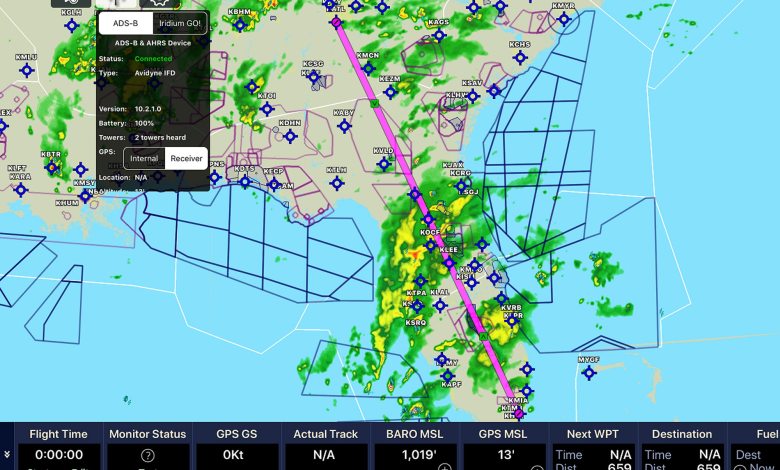
My most recent night flight involved a relatively short hop across the Florida peninsula. It was one of those humid, heavy summer nights when remnants of the days thunderstorms were still about, forcing FLIB and airliner alike to seek alternate routes and taxing controllers who just wanted a calm evening. Still, I had a few things going for me: Training, currency, experience and the occasional cluster of ground lights denoting a small town. I filed IFR at 8000 feet for this short hop, because I didnt want to try doing it at a level low enough to stay VFR-legal (there are way too many cellphone towers out there these days), and climbing high enough to get above the buildups wasnt practical. It was yet another case where having the instrument rating to spend maybe 90 seconds punching in and out of billowing clouds during a 45-minute flight meant all the operational difference in the world.This was one of those nights where the natural horizon wasnt all that apparent, due to the moist, summer haze over south Florida extending up to my altitude, plus the number and size of the buildups. Although I could see each buildup, and navigate around or through them, the natural horizon wasnt consistently visible.

Read More »
Pilot in aircraft
Sign-up for newsletters & special offers!

Get the latest stories & special offers delivered directly to your inbox.

SUBSCRIBE