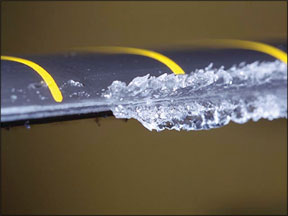
Even as the wreckage of Colgan Flight 3407 cooled in a Buffalo, N.Y., neighborhood in mid-February, the debate over flying turboprops into known icing was reigniting. Whether icing was the cause isnt known, and actually isnt relevant to the fact that this accident reminded everyone in the industry of an unresolved safety question: Are turboprops equipped with pneumatic boot de-icing systems really capable of handling all the icing they might be expected to encounter? And if they arent, how can pilots be trained to safely recover an airplane thats been iced up beyond the equipments capability or, worse, survive an icing encounter in an airplane with no ice protection? Another early question arising from this tragedy involves reports of what might be considered inappropriate control inputs as the Bombardier Q400 departed controlled flight. According to the NTSB, information retrieved from the flight data recorder indicates the stall-warning stick shaker and stick pusher activated soon after landing gear deployment and wing flap extension to 15 degrees down. At that time, the aircraft then pitched up 31 degrees, far in excess of a normal maneuver in a transport-category airplane. While its entirely possible the pitch up involved the autopilots automatic and simultaneous disengagement, its also possible the maneuver was commanded from the flight deck. Why would the crew pitch up so severely? One explanation involves the crews presumption the tail had stalled. In such an event, the appropriate response is to pitch up, not down as would be the case if the wing entered a stall. Generally, the only way a tailplane is going to stall in normal operations is if its leading edge somehow becomes contaminated, as would be the case if ice accumulated.