











The balancing act aircraft designers must achieve amazes me. Examples include trading useful load for a strong airframe, cabin volume for reduced drag and high cruise speeds for low-speed handling. And whenever handling stands out as an issue, its generally balanced against whether the airplane also shines in its stability-how, for example, it stays in the attitude we establish and resists any temptation of responding to gusts. Or, when we purposely upset a trimmed attitude, how it naturally tries to return to that attitude. Sure, its likely to “hunt” its way back to trim, but hopefully for just a couple of cycles. The designers 288
Managing Stability
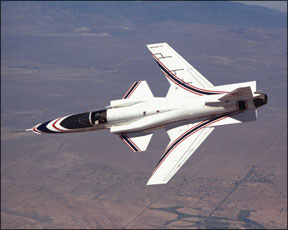
The balancing act aircraft designers must achieve amazes me. Examples include trading useful load for a strong airframe, cabin volume for reduced drag and high cruise speeds for low-speed handling. And whenever handling stands out as an issue, its generally balanced against whether the airplane also shines in its stability-how, for example, it stays in the attitude we establish and resists any temptation of responding to gusts. Or, when we purposely upset a trimmed attitude, how it naturally tries to return to that attitude. Sure, its likely to "hunt" its way back to trim, but hopefully for just a couple of cycles. The designers mastery always makes an airplanes nimbleness seem that much more impressive-especially if it goes where, how and when you ask, and seeks to stay put in between. Stability counts. But it counts differently for different machine types. Some, like the NASA X-29 research vehicle pictured above, are naturally unstable, and able to sustain controlled flight only through computer processing. In the now-retired X-29s case, computers continually adjusted the control surfaces up to 40 times each second. Others, like a jet transport, are optimized to resist any disturbance and can easily be flown with just two fingers. But any airplane can be made unstable, especially when we load it carelessly, or fly it beyond the regimes its designer intended. Where the average pilot should be concerned is in the many ways we can contribute to its loss of stability.

Key Takeaways:
- Aircraft design involves a critical balance between inherent stability (resistance to disturbances and tendency to return to trim) and handling/maneuverability, which is tailored to the aircraft's intended purpose.
- Designers use features like dihedral for roll, horizontal stabilizers for pitch, and vertical stabilizers for yaw to achieve desired stability.
- Even with designed-in stability, pilots can inadvertently compromise an aircraft's safe flight characteristics by mismanaging weight, center of gravity (CG), airframe ice, or airspeed.
- Pilots must be mindful of how loading, configuration, and operational choices can impact an aircraft's stability to prevent unsafe flight conditions.
Key takeaways sponsored by Aviator Pro | Start Your Training ->
See a mistake? Contact us.

