Aviation Safety

November 14, 2009, San Gabriel, Calif., Beech A36

At 1617 Pacific time, the airplane impacted a concrete wall and was destroyed by a post-crash fire. The solo pilot was killed. Visual conditions prevailed. According to local law enforcement, the airplane touched down on railroad tracks, bounced a couple of times and came to rest about 500 yards from the initial point of impact.

Read More »

November 7, 2009, Tucson, Ariz., Piper PA-32R-300

The airplane experienced a partial loss of engine power in cruise flight and the pilot made an emergency landing on a highway at 1553 Mountain time. The private pilot and passenger were not injured. The airplane sustained structural damage to the fuselage after departing the highway and impacting cacti prior to coming to rest upright. Visual conditions prevailed.

Read More »

November 9, 2009, Greer, S.C., Raytheon Aircraft Company B200

At about 1009 Eastern time, the airplane was substantially damaged following a loss of engine power and impact with terrain on final approach. The airline transport pilot and two passengers were seriously injured. Visual conditions prevailed. Following an engine ground run, the pilot and two passengers departed for a flight in the local traffic pattern. While airborne, ATC instructed the pilot to reduce speed to prevent overtaking a preceding aircraft.

Read More »

Pre-Heating You Engine Increases Flight Reliability

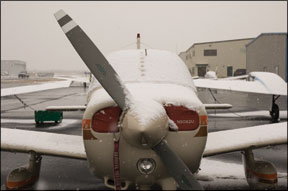
Its been several years now since I inflicted this on the poor thing, but somewhere out there is a Piper Archer II it once took me and a friend several tries to get started one cold, wintry day outside Washington, D.C. A lineguy came by, aimed a torpedo heater into the engine cooling inlets for a couple of minutes apiece, charged us a bunch of money and left. After a few more tries, wed managed to frost the plugs, so we decamped to the FBO for hot coffee. Thirty or so minutes later, we tried again and finally got a start. Based on what I know now-I knew very little about engine or aircraft pre-heating back then-none of what we did could have been good for that engine.

Read More »

Failure To Multitask?

Whenever Im around non-pilots and the subject of personal aviation comes up, the conversation inevitably turns to the skill set one needs to safely operate an aircraft. (Im sure this is nothing new and has happened to you.) My generic answer is something to the effect of if you can drive a stick-shift car, you can fly a fixed-wing airplane; the motor skill requirements are pretty much the same. Of course, thats not the end of it, especially if youve never driven a stick but have several thousand hours of flight time; in addition to the requisite motor skills, pilots also must be able to prioritize tasks, often performing one or more simultaneously. An example of the latter might involve maneuvering in a traffic pattern while conversing with ATC over the radio and changing the engines power setting, all at the same time. When the smoke clears, its not unlike downshifting, braking and turning a stick-shift car, all at the same time.

Read More »

Top Three Aircraft Icing Myths Busted

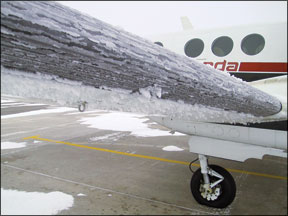
Many myths persist about the capability of airplanes to fly in ice, appearing to support techniques for ice avoidance or landing an ice-laden airplane that make ice accumulation acceptable. “Speed saves.” “More power is better than ice protection.” “Known icing certification makes flying in ice safe.” Like any myth these are rooted in truth, but they are not necessarily true themselves. With apologies to the Discovery Channel I present these icing myths, busted. Heres our first in-flight icing myth: “Keep your speed up and you can land with a load of ice.” Landing an ice-laden airplane can be tricky, even with clear approaches to the longest runway around. Performing a tight, circling approach at night in low visibility? We dont even want to think about it.

Read More »

Deep Stall Aerodynamics

In October 22, 1963, a prototype of the British Aircraft Corporation One-Eleven (BAC 1-11) short-haul jet airliner, registration G-ASHG, crashed near the village of Chicklade in southwest England. The aircraft was evaluating stall characteristics at varying center of gravity locations when the flight crew found the flight controls unresponsive after entering a stable stall and the aircraft struck the ground at a wings level attitude with a high rate of descent and little forward speed. All aboard died in the crash. The 1-11 was one of the second-generation of jet airliners-others being the Douglas DC-9 and Boeing 727-featuring aft-mounted engines, swept wings and all-moving T-tail horizontal stabilizers. Post-crash investigation concluded the prototype 1-11 had experienced an unrecoverable deep stall in which the wake of the stalled wing covered the high-mounted horizontal stabilizer, thus blanking the elevator controls and preventing normal recovery techniques.

Read More »

Just Out Of Annual

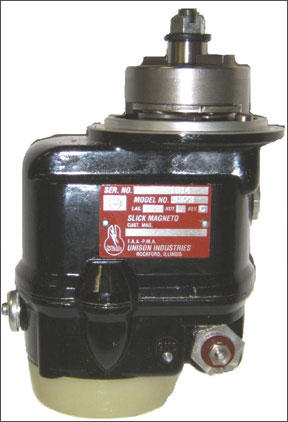
It was a beautiful October day. Clear sky, unlimited visibility, calm wind, smooth ride. My trusty 1960 Cessna 210 was humming along at 5500 feet, taking my pilot wife and me back home to Lebanon, Mo. (LBO). Suddenly, there was the deafening sound of silence from the front. The engine decided to stop without so much as a cough, sputter or warning. Funny how busy one can get in a few short seconds in a now-quiet cockpit. Boost pump on high, mixture full rich, switch tanks as my wife reached for the emergency checklist. We were about 20 miles from our destination. Maybe I could get the engine to start again, even for just a few more miles. My wife remained calm, although I could see the concern as she scanned the beautiful Ozarks hills and trees for an off-field landing spot.


Read More »

Wear And Tear

The right aileron was binding during aerobatic maneuvers. Investigation revealed the clearance between the aileron and the aileron bay rib was approximately 1/16 inch. Per American Champion, it should be inch. The inboard aileron bay rib appeared to have bowed due to fabric shrinkage, causing the interference. The aileron rib fabric was opened and the rib was relocated outboard 3/16 inch. Per the manufacturer, aileron balancing was not required. The aileron was reinstalled, with the clearance and operation satisfactory.

Read More »
Pilot in aircraft
Sign-up for newsletters & special offers!

Get the latest stories & special offers delivered directly to your inbox.

SUBSCRIBE