Aviation Safety

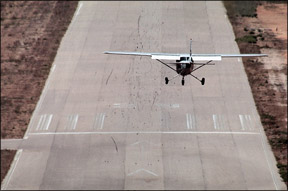
June 5, 2010, Islip, N.Y., Beech B19 Musketeer

The airplane was substantially damaged when it impacted the ground in an industrial area shortly after takeoff. The accident occurred at about 1505 Eastern time, shortly after takeoff. Day visual conditions prevailed. The flight instructor (CFI) and student pilot/owner suffered serious injuries.
Read More »

Mountain Wave

Learning to fly as I did in the relatively flat Eastern U.S., I never really had to deal much with windy, mountainous terrain until after I earned my instrument rating and started using a personal airplane for transportation. My most memorable encounter involved flogging a Skyhawk north out of Asheville, N.C., at 9000 feet. Improbably, I had a tailwind. All was well until passing Mt. Mitchell, the highest point in North Carolina. While I enjoyed the tailwind, I did not enjoy the mountain wave it generated. I soon found my relatively heavy 160-hp Skyhawk needed to be in a climb attitude with full power-which aint much-to maintain a descent rate of less than 300 fpm.

Read More »

IFR Chart Choices

A long time has passed since Elroy Jeppesen first started drawing basic descriptions of ways to get into airports when the weather was down. Thankfully, aeronautical charting has evolved with technologies and operational needs. These days, the latest panel-mount avionics and handhelds coax us into the “paperless cockpit” realm, but a variety of factors havent eliminated dead-tree charts.The good news is we have a choice, even if its among only two basic publishers. Another piece of good news is we can put down one publishers chart and pick up the others without too much confusion. While there are qualitative differences between the two publishers, a major distinction is how they distribute updates. And despite a third-party company simplifying the process, theres still a price to pay when it comes to managing revisions.

Read More »

Finessing Fuel

Few in-flight emotions evoke more sweat and discomfort than when youre unexpectedly low on go-juice and arent sure your remaining fuel is enough to keep the engine spinning until touchdown. If ever youve experienced the accompanying emotional swing, you already know that they stay with you. First comes disbelief-“I cant be that short….” Next comes the quiet surge of adrenaline-juiced anxiety between asking yourself the useless rhetorical question-“How did this happen?”-and when you turn to a useful one: “What do I do to survive this?” For the lucky, the final wave of emotions comes after the airplane is on the ground intact, on a real runway with the engine running…if, that is, youre really living well.

Read More »

Do We Really Need ELTs?

In June, the Federal Communications Commission (FCC) released a regulatory document stating, in part, “The manufacture, importation, sale or use of 121.5 MHz ELTs is prohibited.” Relax: At this writing, the ban has not gone into effect and cannot until at least early September. Although the FCCs action apparently caught many unawares, it was telegraphed as long ago as 2001. The ban comes on the heels of-and is partly justified by-the February 2009 cessation of satellite-based monitoring of 121.5 MHz emergency locator transmitters by the responsible international organization. The present lack of satellite-based monitoring shouldnt be anything new to pilots or operators.

Read More »

When To Flap

Since such an approach will be completed at a relatively long runway, the landing configuration should be set up at the final approach fix (FAF). I do not recommend changing this configuration on short final while close to the ground due to the possibility of a large pitch change. Of course, if the approach is a non-precision approach or if the precision approach ends up breaking out at 500-600 feet above the ground, go ahead and use full flaps as needed.

Read More »

May 1, 2010, Lakeland, Fla., Interstate S1A

At about 1852 Eastern time, the airplane collided with terrain and was substantially damaged. The sport pilot sustained serious injuries. Visual conditions prevailed. According to a witness, the airplane climbed to approximately 500 feet after takeoff. As the airplane was turning to the left, its nose “dived,” and the airplane descended rapidly.

Read More »

May 2, 2010, New Albany, Ind., Piper PA-46

The airplane sustained substantial damage on impact with terrain at about 2021 Eastern time. Instrument conditions prevailed. The private pilot and passenger were fatally injured. The flight was on an IFR flight plan en route to Louisville, Ky. Preliminary radar data show the airplanes speed decreased as it descended to an assigned altitude of 4000 feet and a heading of 050 degrees.

Read More »

May 2, 2010, Haysville, Kan., CGS Hawk

At about 1713 Central time, the ultralight aircraft was substantially damaged on impacting terrain. The private pilot was fatally injured. Visual conditions prevailed. One witness estimated the aircraft reached 300 to 400 feet above the ground after taking off.

Read More »
Pilot in aircraft
Sign-up for newsletters & special offers!

Get the latest stories & special offers delivered directly to your inbox.

SUBSCRIBE