Features

Choice of Action

Almost by definition, pilots generally are self-reliant, often preferring to depend on their own talent and experience instead of someone elses. At the end of the day, choosing to fly a personal airplane is, well, personal. Sharing with others our enjoyment of aviation often is a trait among pilots, of course, but the take charge, Type A personality seems more prevalent. In the early years of commercial aviation, the lone pilot shepherding his or her flock of passengers across the country took on mythical proportion. Later, professionalism crept in, replacing “seat of the pants” flying with hard data. Soon, multiple pilots were added to the flight deck, becoming a crew, despite what some of the more hardened pilots may have wanted.

Read More »

Letting Down Easy

Proper flight planning is extremely important and a vital component for your safety and the safety of your passengers. Just as we plan the takeoff, climb, cruise and landing phases of flight, we also should be thinking about and planning our letdown. Among the variables to consider are power settings to accommodate our approach profile, airspace or known ATC restrictions, aircraft operating limitations and any weather averse to a smooth, efficient descent. As our letdown continues, we monitor our progress, calculate for time and distance, adjust our plan by jockeying power, pitch and speed. The idea is to complete the flight with a textbook landing so we can score another victory for proper flight planning.

Read More »

IFR Into VMC

If youre Instrument-rated and current, you almost certainly own at least a modest complement of IFR charts and approach plates. Of course, the odds are you still make a number of flights under VFR and, if youre like me, you probably always have a couple of current Sectionals in your flight bag. But many Instrument-rated pilots from time to time find themselves so accustomed to the IFR “system” that the idea of going VFR and not talking to someone seated at a radar scope gives them the shakes. Also, flying a full VFR traffic pattern has been known to induce severe trauma in even the most jaded IFR pilots.

Read More »

Why It Went Wrong

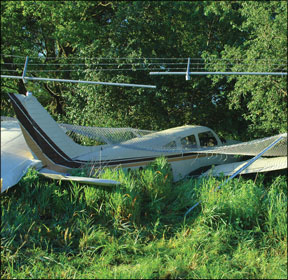
Mishaps happen for a number of reasons, but all too often theres a “what were they thinking?” element to an NTSB accident report. In the calm, clear skies of retrospect-or a motionless easy chair-its easy to condemn a bad decision and move on. But its not usually a single bad decision that causes tragedy. Pilots dont take off intentionally choosing to put themselves in a no-win situation; they dont mean to kill themselves, their families and friends.

Read More »

The New ADIZ

Some airspace designs are badly done. Some have “badness” thrust upon them. The Washington Air Defense Identification Zone (ADIZ), cobbled together by Notam in early 2003 as a “temporary” measure in preparation for the invasion of Iraq, managed to incorporate both extremes. Along with a “zero-tolerance” approach to even the most cursory and innocent violation, the Washington ADIZ became an operational burden, cartographic nightmare and growth industry for enforcement, all at the same time.

Read More »

Can I Land On That?

You are a skilled, proficient and responsible pilot. You do everything in your power to avoid dangerous situations but there are a few unavoidable moments during each flight where, if the unthinkable happened, youd be left with few options. Flying is, after all, an exercise in risk management, not risk elimination.Imagine that youre departing from Mega City Municipal. With a healthy climb rate established, you tuck away the landing gear, set climb power and prepare to enter the soup. Just as the airport fence slides underneath the belly, your sole engine shivers and goes silent. Youre only 500 feet above the ground, so turning back to the runway is not a reasonable option. You look out the window and all you see is a patchwork of gray and black boxes. Can you land on that stuff?

Read More »

Night Vision

Theres no question flying after the sun goes down is different. Many of the things we take for granted in the daylight-the scenery, the speed sensation, better terrain avoidance to name but three-simply arent available. The same airports we fly to and from in the daytime look…different. Ramps bathed partly in darkness and partly in yellowish or bluish glows appear cleaner, perhaps, more antiseptic. The runways and taxiways, too, take on a different appearance, hidden between rows of blue and white jewels.

Read More »

Flight Landing Alternates Made Easy

Flight under instrument flight rules (IFR) is largely procedural. Theres little room or tolerance for zany spontaneity so, if you love surprises, look elsewhere. But although we fly by the book, when the plot thickens, we do in fact have options (although theyre more like regulatory provisions) for choosing a different ending. Usually, the thickening agent affecting our best-laid plans is weather-related. Before we can exercise that freedom of choice, however, IFR pilots must fulfill certain obligations. Some of these rules are similar to those for VFR flight, such as how much fuel we should have on board. Some, however, go literally a step beyond, such as the requirement for specifying an alternate destination (as well as hopefully having some rough plan for getting there). The idea of even thinking of an alternate airport may be foreign for some newly anointed VFR pilots, but in the IFR world, its a well-known commodity.

Read More »

The Other Grounding

Those of us flying aircraft with reciprocating engines should be performing what is commonly referred to as a mag check, or magneto check, prior to every flight. During the engine run-up, we turn the ignition key to the Left position to disengage or ground the right magneto, noting the rpm change, before turning the key back to Both. We then repeat this process by turning the key to Right to ground the left magneto. In addition to noting the rpm drop, if any, we also should be examining other instrument indications-fuel flow, if so equipped-and especially, the EGT values presented on a multi-probe engine monitor if one is installed.

Read More »
Pilot in aircraft
Sign-up for newsletters & special offers!

Get the latest stories & special offers delivered directly to your inbox.

SUBSCRIBE