
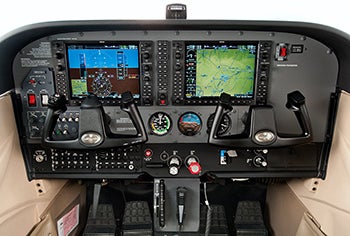


It’s been just over a decade since the FAA commissioned WAAS for general aviation use. So these days I am so used to having WAAS that I don’t think twice about it, particularly when flying behind a Garmin G1000 panel. But if you are purchasing or renting an airplane that is a few years old, it is worth looking into whether the airplane is WAAS-equipped or not.
On a recent IFR flight, I was surprised to find that the LPV approach I wanted to fly into Camarillo, California (CMA) — the RNAV (GPS) Z RWY 26 approach — was unavailable in the G1000 system I was flying. With hundreds of hours of G1000 time in new airplanes in my previous job as a Cessna sales demonstration pilot, I had never seen this before. I didn’t realize that the 172 I had rented was delivered by Cessna in 2005, about one year before Garmin introduced WAAS into its highly popular glass panel. So while the G1000 appeared very familiar to me, it was missing an important component that limited its use. As you are probably aware, WAAS is needed to provide vertical guidance for instrument approaches such as LPVs. So because the system I flew behind was not WAAS equipped, the LPV approach I wanted to fly was unavailable.