











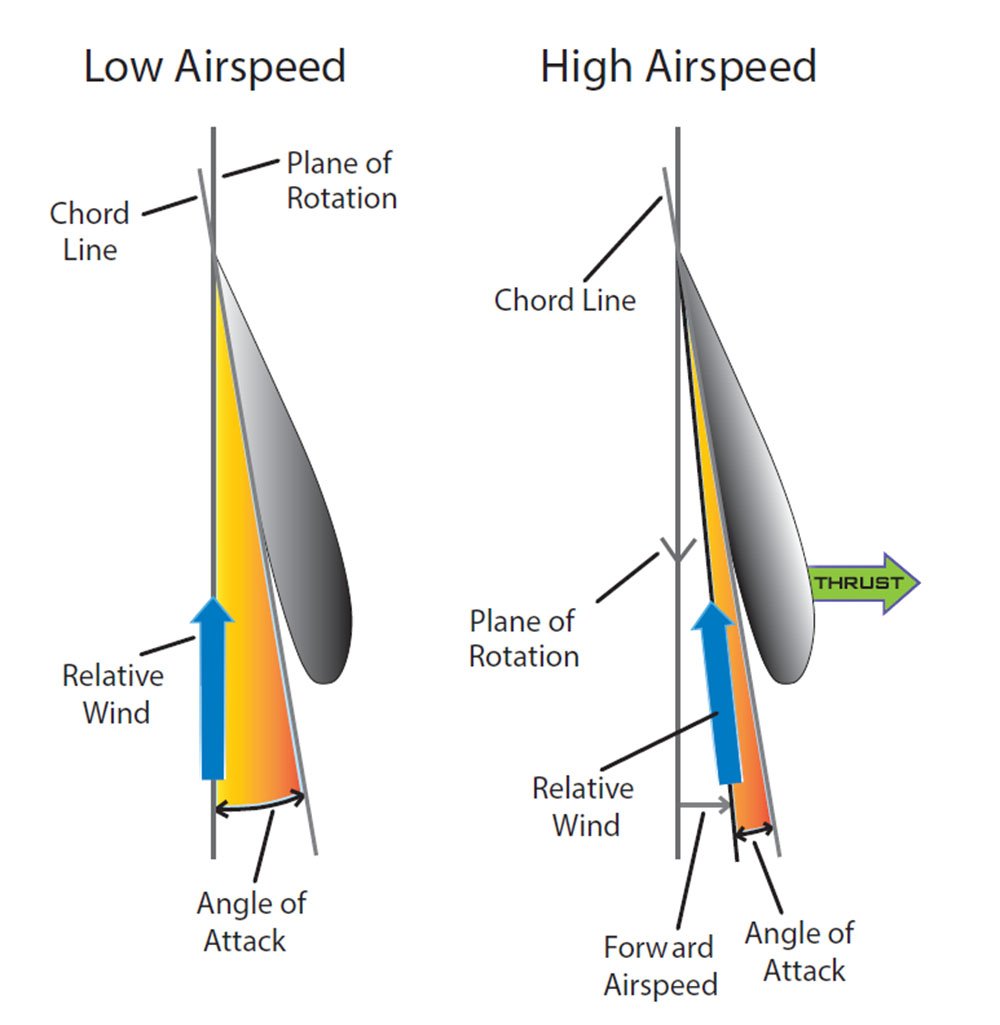


For some, the concept of how a constant-speed propeller maintains the desired rpm can be a difficult one to grasp. What the FAA’s Airplane Flying Handbook (FAA-H-8083-3B) has to say may help:
“When an airplane is nosed up into a climb from level flight, the engine will tend to slow down. Since the governor is sensitive to small changes in engine rpm, it will decrease the blade angle just enough to keep the engine speed from falling off. If the airplane is nosed down into a dive, the governor will increase the blade angle enough to prevent the engine from overspeeding. This allows the engine to maintain a constant rpm, and thus maintain the power output. Changes in airspeed and power can be obtained by changing rpm at a constant manifold pressure; by changing the manifold pressure at a constant rpm; or by changing both rpm and manifold pressure. Thus the constant-speed propeller makes it possible to obtain an infinite number of power settings.”

