












DIY Oil Changes

With some basic tools, plus a couple of special ones, you can change your engine’s oil, saving some money and shop time. 

Gemini Sparkle

Key Takeaways:

  • Private pilots are legally permitted by the FAA (FAR 43.3 and 43.7) to perform preventive maintenance, including oil and oil filter changes, on their owned or operated aircraft and approve them for return to service.
  • The process requires specific preparation, such as warming the oil, securing a suitable workspace and tools, acquiring new oil and filters, and having a plan for proper disposal of leaded used oil.
  • Key steps involve draining the warm oil, carefully removing and inspecting the old filter, installing a new manufacturer-recommended filter with correct lubrication and safety wire, refilling with fresh oil, and thoroughly documenting the maintenance in the aircraft logbook.
See a mistake? Contact us.

There’s no question owning and operating a personal airplane costs money. Fuel, insurance, annual inspections, storage and training all cost money. So does regular maintenance, like an oil change. Turns out there are many things an owner/operator can do without needing a certificated mechanic. Things like changing tires, cleaning spark plugs and refilling hydraulic reservoirs. You can replace seatbelts, refinish the interior and exterior, plus other stuff. Oil changes, too, though it’s not as clearly stated as other tasks.

The FAA, in FAR 43.3, allows a pilot to “perform preventive maintenance on any aircraft owned or operated by that pilot” as long as it’s not used under FAR Parts 121, 129 or 135. Meanwhile, FAR 43.7 allows “a person holding at least a private pilot certificate” to “approve an aircraft for return to service after performing preventive maintenance.”


Finally, Appendix A of Part 43 defines preventive maintenance actions, i.e., those a private pilot can perform to their own aircraft and approve for return to service. It turns out that “drain and refill an engine’s lubricating oil” isn’t on the list. Items that are on the list include lubricating, changing oil filters and screens, and replenishing hydraulic fluid. But changing an engine’s oil isn’t on the list.

An FAA publication, Maintenance Aspects Of Owning Your Own Aircraft, FAA-P-8740-15, includes the following as tasks an owner (with at least a private pilot certificate) may perform: “Check engine oil for quantity and condition. Change oil and oil filter; check screens.” As former Light Plane Maintenance magazine editor Kim Santerre wrote several years ago, “The writing is a bit convoluted on the specific type of filter, e.g., spin-on vs. screen, but no one will be cited for changing their own oil.”

Pictured are some of the tools and supplies I use to change my engine oil. At top left is a tube of silicone grease for coating the oil filter’s gasket before installation. The blue canister is a spool of 0.032-inch safety wire used to secure the filter. The pair of wire cutters is for snipping away the old safety wire. Middle left is an old pair of safety-wire pliers; to its right is a pair of hemostats for helping thread the new safety wire through its lug on the accessory case. The wrench at bottom is used to remove the old filter and install the new one.

Before You Start

With the legalities out of the way, you’ll need a few more things. A place to work is very high on the list, as are the proper tools. Oil changes can be done at the tiedown, but a hangar always is better. You’ll need a receptacle to catch the used oil, as well as fresh oil to replenish what you drain, plus a fresh filter. And you also need some means of disposing of the used oil. Keep in mind used oil from a typical piston aircraft engine has some level of lead in it, from burning leaded fuel, and might be considered hazmat where you are. Many airports have storage tanks dedicated to the purpose. Ask around. 

Something else you may need is some guidance. If you’ve never done this before, it’s a good idea to get someone who has walk you  through the process. Every airplane and engine can be different, and this certainly is not the Briggs  & Stratton on your lawn mower. Again depending on the aircraft, having someone else around can be invaluable when you need to remove and later replace all or part of an engine cowling, something else the FAA allows pilots to do as preventive maintenance.

You also need some tools. The image above shows what I use. Not shown are a couple of hoses: one to slip over the quick-drain’s hose nipple, which easily fits inside the larger hose I run through the cowl-flap opening and to the old five-gallon gas can I’ve dedicated to used motor oil. How big a container do you need? Well, duh; how much oil is in your engine? And if you’re flying a twin, the math should be easy.

Warm Oil Drains Better

One thing I always do before an oil change is fly the airplane. Maybe an hour or so, maybe only a couple of landings. This is for several reasons, but the main one is that warm oil drains better, and the whole idea of changing engine oil is to replace it with clean oil. Oil doesn’t lose its lubricity in an engine but it does get dirty, with combustion byproducts and environmental materials—dust—finding its way into the crankcase.

Getting to the oil drain and the filter/screen is next. Again, each airplane is different, and if you’ve not done this before, find someone who has. Pay them to show you if you have to. On my Debonair, removing the right chin-mounted “gill panel” opens up access to the quick-drain and enables running a hose through the cowl-flap assembly to the old gas can. Accessing the top of the engine to change the filter and add fresh oil is as easy as opening the hinged pilot-side cowling. Not all aircraft engines are as accessible.

Helping the engine drain its old oil also applies to the filter. I use a large flat-blade screwdriver and a mallet to poke a hole in the top of the filter before removing it. It’s easy in this application, since the filter sits upright, with its threaded base at the bottom. Poking the hole lets in air at the top, facilitating the oil in the filter to drain out the bottom.

Once all the various hoses and containers are in place, the actual draining of the oil should be anticlimactic. One thing that might trip up some people doing this work on some airplanes is the need to contain the mess. For example and as I mentioned, my oil filter mounts with its base down, meaning oil will drain out of it. Other filters are mounted with their base at the top, or even sideways. This makes trying to keep things clean and neat rather problematic. Stuffing rags or paper towels around the filter as you remove it may be the only thing you can do to minimize clean-up work. If you can get easy access to a filter mounted at its top, you might be able to use my screwdriver/mallet combination and poke a hole in the bottom. Have a bucket ready if you do.

Reinstalling

Once the filter is removed and the oil is draining, take a break. I usually give my Deb an hour or so before calling that portion of the task complete. Next thing is to close the quick drain to ensure the fresh oil you’re about to add doesn’t leak out. Remove any hoses or clamps you used to drain the old oil. Once the drain is secured—some are not as simple as an approved quick-drain—next to go back on is fresh filter and its safety wire. For my Deb’s engine/filter, it’s recommended that I use a silicone lubricant/sealant, Dow Corning #4. A very thin film on the filter gasket is all that’s needed. (A single tube used only on filters will last a lifetime.) A thin film of fresh oil may be recommended in some instances. Safety-wiring is something you may want someone to show you, although there are lots of online resources demonstrating how to do it. But this is a do-not-overlook step, as engine vibration can and will untwist a filter from its threaded mount. That can be really bad.

The filter should be the one recommended by the manufacturer. There are two basic filter types: those with an internal bypass spring and those without. Generally, Continental engines use filters with bypasses while Lycomings mount the bypass in the engine. Regardless, use a good-quality filter.

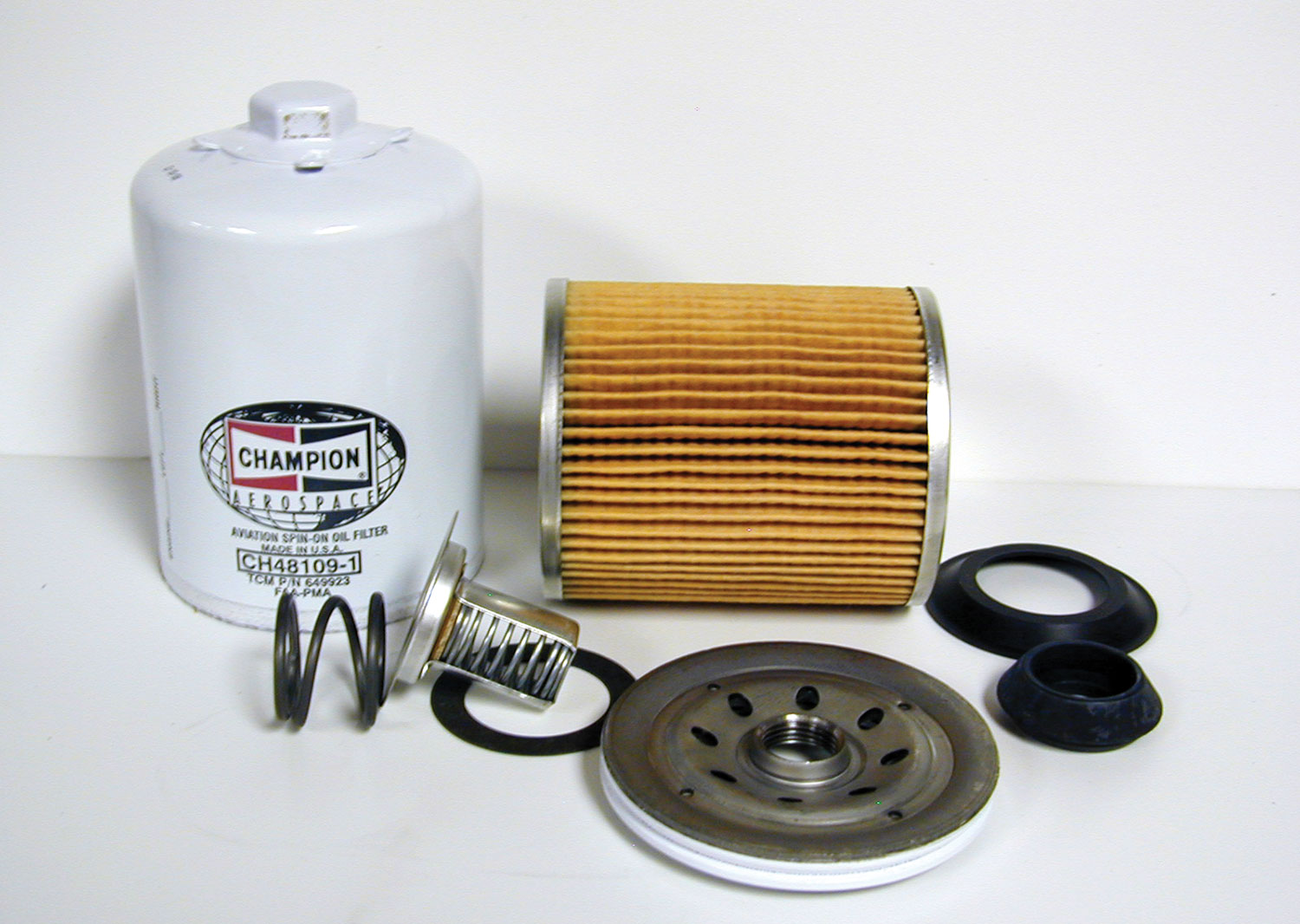
We’ve cut open filters from the major manufacturers and there are internal differences, mainly involving quality of materials. The image at right shows all of the components of a new filter we sacrificed. Always follow engine/filter manufacturer instructions when installing a new filter, including torque values. Don’t forget to write the date, engine hours and aircraft registration on the filter with something like a Sharpie.

Odds And Ends

If you send your engine oil off to be analyzed—and you should—try to sample the oil that’s first out of the drain, rather than last, since any metallic material in the oil is likely to be at the bottom of the sump rather than the top. You also may want to inspect your filter yourself, rather than send it out. The image at the top of page 16 shows what the pleated filter media of one of my used filters looks like when removed.

To get the media out of the filter, you’ll want to use an oil filter cutter to do it cleanly and prevent any contamination. A pair of latex or similar gloves will keep your hands cleaner, and an old bread knife or other serrated blade makes cutting the rather tough filter media out of its mounting much easier. If you spot metal in your filter media, it might not be that big a deal, especially with a brand-new engine. That can’t be said for an engine that’s been in service a while and hasn’t made much metal before. You can use a small magnet to see of the metal is ferrous, but getting the filter media analyzed—along with the oil—will tell you much more.

The final task is the paperwork. As noted at the top of this article, a private pilot or better can create and sign a logbook entry detailing the oil change and filter replacement.

Congrats! You just saved yourself some money and shop time.

Ready to Sell Your Aircraft?

List your airplane on AircraftForSale.com and reach qualified buyers.

List Your Aircraft
AircraftForSale Logo | FLYING Logo
Pilot in aircraft
Sign-up for newsletters & special offers!

Get the latest stories & special offers delivered directly to your inbox.

SUBSCRIBE