














NASA Calls On Students to Fix Aviation Maintenance

Space agency’s 2026 Gateways to Blue Skies competition focuses on maintenance solutions for passenger and cargo operations.

aircraft maintenance NASA
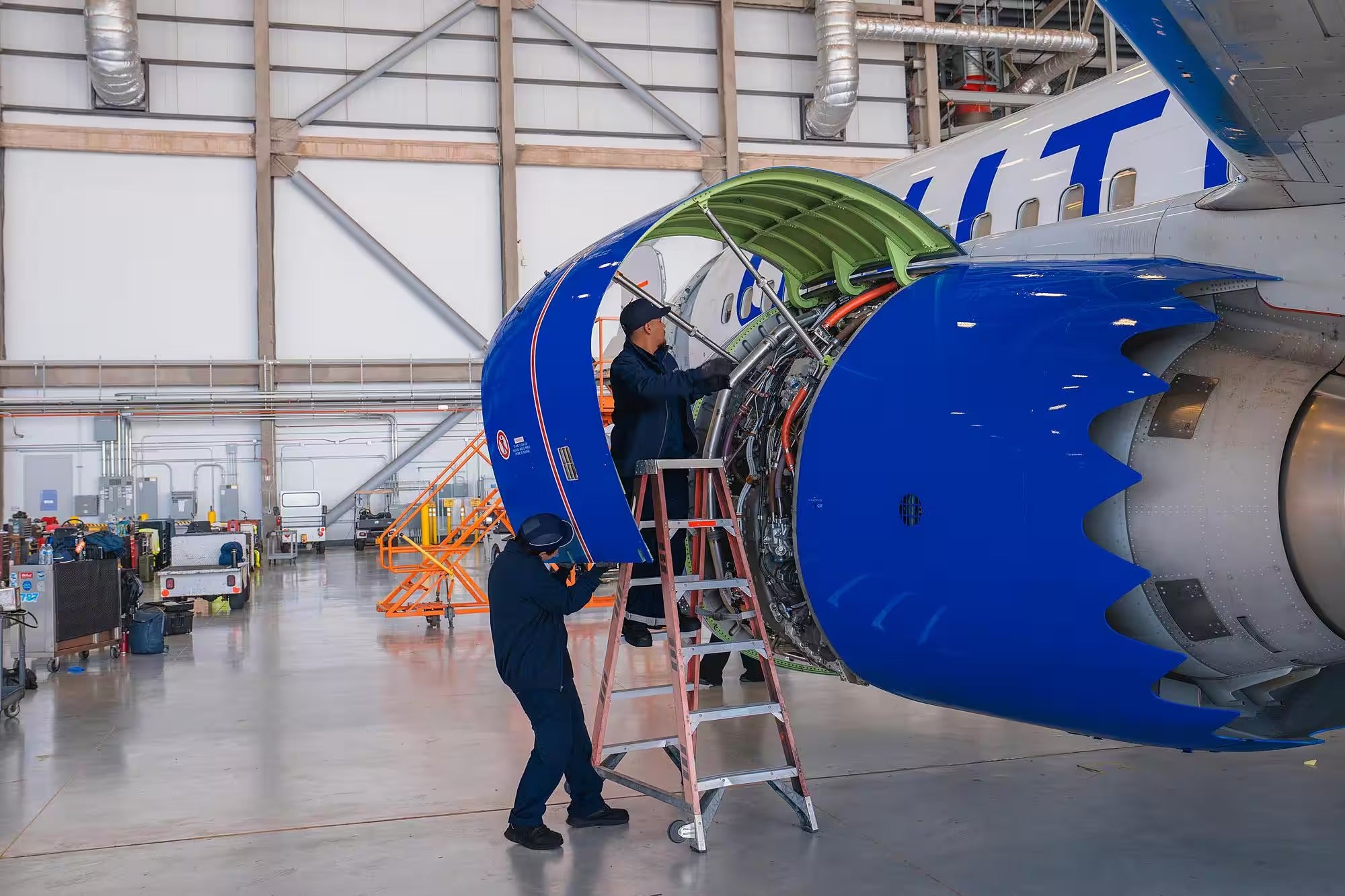
NASA calls on students to devise cutting-edge aviation maintenance solutions that could improve efficiency, safety, and cost. [Courtesy: United Airlines]
Gemini Sparkle

Key Takeaways:

  • NASA has announced its 2026 "Gateways to Blue Skies" competition, themed "RepAir: Advancing Aviation Maintenance," for U.S. college students.
  • Teams are invited to propose innovative technological solutions (e.g., automation, AI, robotics) to improve the efficiency, safety, or cost-effectiveness of commercial aviation maintenance.
  • Winning team members will receive internships with NASA's Aeronautics Research Mission Directorate and a share of $72,000 in prize money.
See a mistake? Contact us.

U.S. college students have the opportunity to score NASA internships by sharing ideas for aviation maintenance technologies.

The space agency on Friday announced the theme for its 2026 Gateways to Blue Skies competition—“RepAir: Advancing Aviation Maintenance” for commercial passenger and cargo operations. Teams of collegiate students are invited to submit proposals that incorporate automation, robotics, artificial intelligence, machine learning, and other technologies. Their objective is to devise a solution that could improve maintenance efficiency, safety, or costs and be implemented within the next decade.


Winning team members will be offered internships with NASA’s Aeronautics Research Mission Directorate (ARMD) at Langley Research Center, Glenn Research Center, Ames Research Center, or Armstrong Flight Research Center in spring or summer 2027. Also up for grabs is $72,000 in prize money.

“The commercial aviation industry is a crucial component of the U.S. economy, playing a vital role in transporting people, intermediate/final goods, and driving demand for various goods and services nationwide,” NASA wrote in the competition guidelines. “However, the industry faces numerous challenges.”

Charting the Future

The 2026 competition will be the fifth iteration of Gateways to Blue Skies, which is conducted by NASA’s University Innovation program within the ARMD. Each year, the space agency asks students to develop new technologies based around a specific theme. A South Dakota State University team won last year’s agriculture-themed contest, for example, with a concept for a drone that could test soil and extract leaves from plants.

Per NASA, among the biggest challenges facing the industry today are rising operational costs as demand for air travel, air cargo, and e-commerce grows. For example, Boeing’s commercial market outlook for the next two decades, released in June, sees passenger air traffic and aircraft demand “outstripping supply for years to come.” Last year, it said, marked the first time the global airline industry returned to pre-COVID-19 traffic levels.

“Operators will need new airplanes to replace older, less-efficient jets and to grow their fleets to support travel demand,” the analysis reads. “We expect it will take at least until the end of this decade for airplane supply to catch up with market demand, at which point commercial aviation will align with its pre-pandemic growth trajectory.”

Maintenance—which has its own unique challenges, like aging aircraft and components and a growing shortage of maintenance technicians—will take center stage in the 2026 competition. ARMD researchers are looking for students to come up with ways of improving maintenance capabilities, efficiency, costs, and safety.

“To address these challenges, the industry needs to swiftly innovate and implement more efficient and resilient aircraft maintenance practices, including the adoption of new technologies,” NASA said.

Student teams are encouraged to think outside the box and devise systems that are not yet considered mainstream. Ideas could focus on a range of maintenance processes, from routine inspections and scheduled maintenance to on-demand repairs and component overhauls. NASA even provided a few examples, such as advanced monitoring, diagnostics, or predictive maintenance systems; 3D printing; lifecycle management; and automated regulatory compliance checks.

Teams will comprise a maximum of six part- or full-time students from accredited, U.S.-based institutions, two of whom must be U.S. citizens or lawful permanent residents. They must also include at least one faculty advisor, but NASA expects the students to take the lead.

Teams have until November 4 to submit a nonbinding notice of intent (NOI) to participate, which will grant access to Q&A sessions with competition judges. In Phase 1, they will submit a proposal that includes a concept of operations and path to deployment by 2035, as well as a two-minute video, by February 16. Up to eight teams will be selected as Phase 2 finalists and receive $9,000 each.

Phase 2 teams will submit a final paper that expands on the proposal, as well as an infographic. The contest will culminate with in-person presentations at NASA’s Langley Research Center in Virginia in May. Submissions will be judged by a panel of NASA and industry experts.

One grand prize winning team will secure what is a dream for many—the opportunity to begin a career at the world’s preeminent space agency. Internships will be limited to U.S. citizens, among other requirements. Other awards will be determined by the panel. Last year, for example, it awarded a second place prize and highlighted the best technical paper.

NASA Calls on Students

In addition to the Blue Skies competition, NASA’s University Innovation project supports student-led research through the University Leadership Initiative (ULI). In March, it selected three teams led by the Florida Institute of Technology, University of Colorado at Boulder, and Embry-Riddle Aeronautical University to tackle pressing challenges in autonomous flight.

The space agency also awards grants worth up to $80,000 through its University Student Research Challenge. In May, teams from Texas A&M University and North Carolina State University—a finalist in the 2024 Blue Skies competition—won funding to study drone hurricane response and traffic management systems.

NASA, alongside private sector partners such as Boeing and RTX, is also backing a three-year competition called GoAERO that calls on students and other participants to design and build self-flying emergency response aircraft. It awarded funding to 14 university-based GoAERO teams in February. The winner of the competition will receive $1 million.

Like this story? We think you’ll also like the Future of FLYING newsletter sent every Thursday afternoon. Sign up now.

Jack Daleo

Jack is a staff writer covering advanced air mobility, including everything from drones to unmanned aircraft systems to space travel—and a whole lot more. He spent close to two years reporting on drone delivery for FreightWaves, covering the biggest news and developments in the space and connecting with industry executives and experts. Jack is also a basketball aficionado, a frequent traveler and a lover of all things logistics.
Pilot in aircraft
Sign-up for newsletters & special offers!

Get the latest stories & special offers delivered directly to your inbox.

SUBSCRIBE
