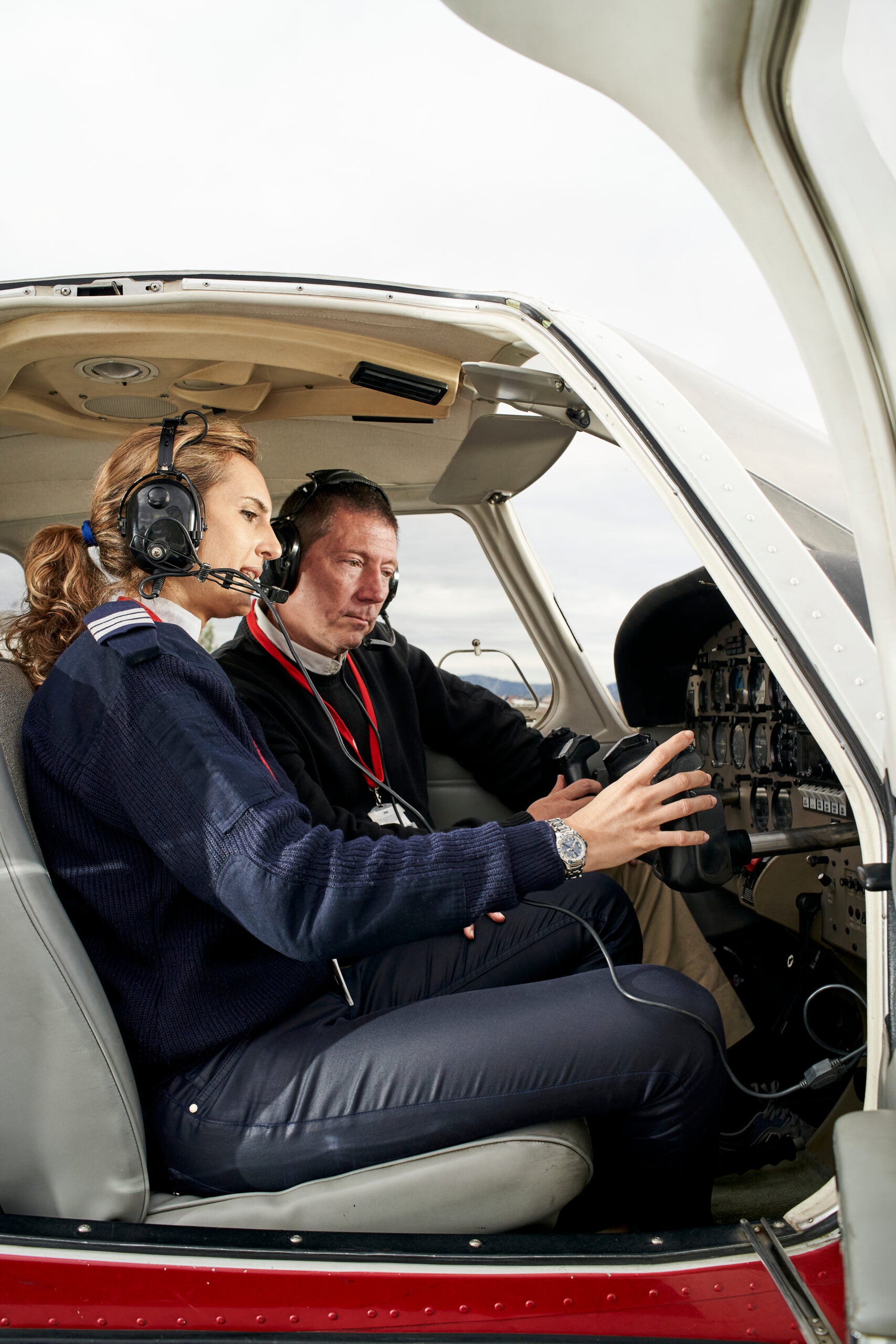
When you begin your flight training, you don’t know what you don’t know.
You walk into a flight school filled with dreams and ambition, and if you are lucky, the time and a healthy bank account. You may have ideas on how to expedite your training—such as flying five hours a day, five days a week with the idea you’ll be a private pilot in two months.
Could it happen? Sure, if all the pieces line up, such as an available instructor, a healthy airplane, the weather, your health, your aptitude, finding a place to take the knowledge test, your finances, and an available DPE when you are ready for your check ride. While technically it’s possible, it may be impractical to commit to a hard date for completion, as there are so many variables.
- READ MORE: Experience by the Numbers Makes a Difference
For an experienced CFI, the first red flag is the length of the flight lessons.
The usual length at the beginning of training is approximately 1.0 to 1.3 hours because learner fatigue sets in and learning stops. There is a lot coming at you physically and intellectually, and you need time to absorb it.
When you get further into the training—the dual cross-country phase, for example—longer lessons are the norm. That’s not to say the CFI won’t get something out of the longer primary lesson—it’s a paycheck and logs those coveted hours.
But training is supposed to be for the benefit of the learner, not the CFI.
Sometimes the flight school will urge the learner to accelerate their training by doing both the private pilot and instrument ground schools at the same time. To be successful in instrument ground school, you need to have passed private pilot ground school or, at the very least, have more than a student pilot’s level of knowledge.
It might be possible, but I submit it is improbable, based on the experience of one learner in an instrument ground school.
The learner was paired up with a self-described time builder who had been paired up with me to learn how to teach ground school. The time builder talked the learner into taking both private pilot and instrument ground schools at the same time. It was absolutely ambitious, but unfortunately the learner became nothing but frustrated.
In the grand scheme, it was a foolish move, as after the learner passed ground school and earned the endorsement for the knowledge test, they had 60 days to take it and pass it. That starts the clock running on their flight training—24 calendar months to take the check ride or they have to take the knowledge test again.
Given the learner’s circumstances, working a full-time job running his own business, he didn’t have the time for flight training for the private pilot certificate and instrument rating.
Too Much Airplane
Another common push is the fledgling aviator who wants to do all their training in a turboprop, jet, or multiengine aircraft. This often happens when the customer has been doing “research” and learns they will need X number of multiengine hours to qualify for a job at an airline where they will be flying either a turboprop or jet.
While there is no FAA rule that states you must do your primary training in a single-engine piston aircraft, that’s the way most schools do it, because a multiengine aircraft can be a lot to handle for the ab initio client. You may have heard the admonishment: “Two engines, twice as much to deal with, leading to twice the chance to get behind the airplane.”
- READ MORE: How to Stay Ahead of the Airplane
A particular client was adamant, saying he didn’t want to waste time in a single-engine aircraft. The flight school desk clerk paged the two instructors who held multiengine instructor certificates. The instructors were very helpful, showing the client the aircraft and telling him what his training would be like, how many hours he could expect, etc. It was going well until the would-be student asked how many hours of instruction he would need before he soloed.
“250 hours,” said the front desk clerk.
You could almost hear the sound of the brakes being slammed. The clerk handed the MEIs a rental rate sheet that indicated the experience required for solo rental of the Seneca was at least a private pilot certificate, a multiengine rating, 250 hours total time, of which at least 10 were in the Seneca, and a two-hour checkout in the airplane with one of the school’s MEIs.
This started a debate on if it was legal to solo someone in a multiengine aircraft. According to cFAR 61.87, it is. Just like for single-engine solo privileges, the learner must pass an aeronautical knowledge test to demonstrate their grasp of Parts 61 and 91, know the airspace rules and procedures for the airport where the solo flight will be performed, and know the flight characteristics and operational limitations for the make and model of the aircraft to be flown.
Subparagraph (e) covers the maneuvers and procedures for pre-solo flight training in a multiengine airplane. They include:
- Proper flight preparation procedures, including preflight planning and preparation, powerplant operation, and aircraft systems
- Taxiing or surface operations, including runups
- Takeoffs and landings, including normal and crosswind
- Straight and level flight and turns in both directions
- Climbs and climbing turns
- Airport traffic patterns, including entry and departure procedures
- Collision avoidance, wind shear avoidance, and wake turbulence avoidance
- Descents, with and without turns, using high- and low-drag configurations
- Flight at various airspeeds from cruise to slow flight
- Stall entries from various flight attitudes and power combinations with recovery initiated at the first indication of a stall, and recovery from a full stall
- Emergency procedures and equipment malfunctions
- Ground reference maneuvers
- Approaches to landing area with simulated engine malfunctions
- Go-arounds
The only difference between this list and those for a single-engine solo is that the single-engine solo requires slips to a landing. They are not required for multiengine solo flight.
In this particular case, the flight school owner stepped in, saying the experience requirements for multiengine rental were set in stone due to liability and insurance coverage.
The student signed up for lessons in a Cessna 172, but when the school ran out of aircraft, as often happens on busy summer days, the learner and his instructor did a lesson in the Seneca. In essence, he was doing both the private single engine and multiengine at the same time. He had the money, and no one was going to get in his way, so the instructors did their best to work with him.
Unfortunately, he didn’t finish either ticket. The last time his name came up in conversation, I learned he had purchased a Piper Seminole and was looking for someone to fly it with.
According to the instructor he had been flying with, the client had the dream and the money, but not the drive. There are just some things that money can’t buy.