












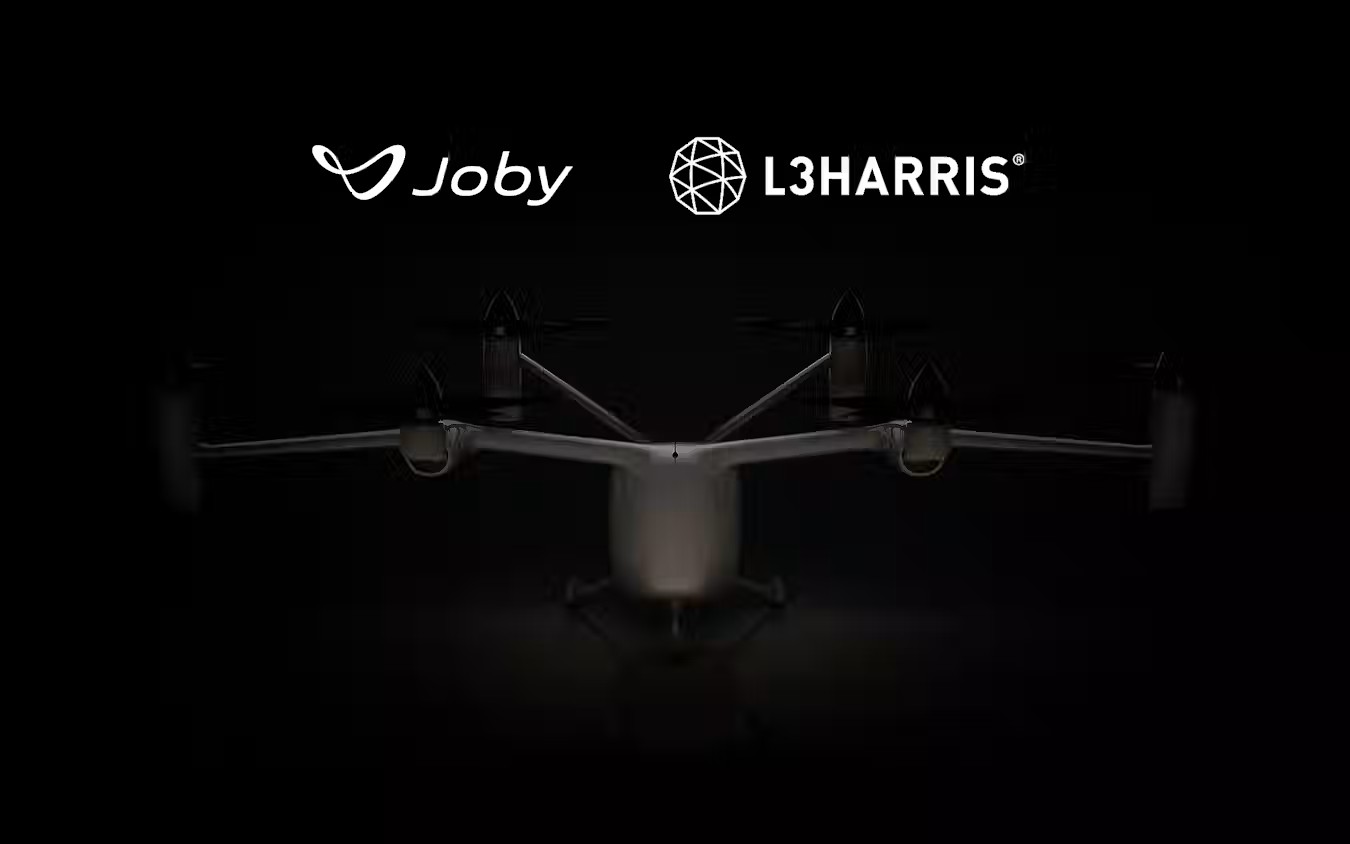


Electric vertical takeoff and landing (eVTOL) air taxi developer Joby Aviation and defense titan L3Harris are joining forces on a new, gas turbine hybrid, optionally piloted VTOL model.
According to Jon Rambeau, president of integrated mission systems for L3Harris, the autonomous variant—a modified S4 air taxi for which Joby said it is “actively developing” a hybrid powertrain—could enable “long-range, crewed-uncrewed teaming” for a range of low-altitude defense missions. Flight testing is planned for as early as this fall, with operational demonstrations on tap for 2026.

“We have worked closely with the Department of Defense over the past decade to give them a front row seat to the development of our dual-purpose technologies, and we’re now ready to demonstrate and deploy it,” said JoeBen Bevirt, founder and CEO of Joby, in a statement.
The company said it will develop and build the new aircraft, with L3Harris assisting with the integration of sensors, effectors, and communication systems. The defense contractor will also share expertise on collaborative autonomy, which entails crewed and uncrewed aircraft working in unison.
Joby’s Defense Play
Joby has already shown the range benefits of hybrid propulsion that is planned for the new variant. In June 2024, it completed a 462 nm flight with a hydrogen-electric demonstrator under its $131 million U.S. Air Force contract.
The company later demonstrated aircraft-level autonomy during the Air Force’s Agile Flag 24-3 exercise at Mojave Air and Space Port (KMHV) in California in August. Earlier that year, it acquired the autonomy division of Xwing, another Air Force collaborator.
The military has shown a penchant for these commercial autonomy systems, working with firms such as Merlin Labs and Reliable Robotics to test and refine them. It is also exploring optionally piloted capabilities for the UH-60 Black Hawk with Skyryse and Sikorsky.
The Joby-L3Harris concept combines these coveted features—a pitch that could be attractive as the Defense Department ramps up autonomy efforts.
The variant will be built off Joby’s S4—a piloted, four-passenger eVTOL air taxi with a range of about 130 nm on a single charge. It is powered by six electric motors designed to reduce noise and enable cruise speeds of about 200 mph (174 knots). Joby aims to launch a U.S. aerial ridesharing service with Delta Air Lines and Uber as soon as next year in cities such as New York.
The company so far has churned out six production prototype aircraft from its manufacturing facility in California, where it soon plans to double its production rate. Two have been delivered to Edwards Air Force Base (KEDW) in California for evaluation, with two more scheduled for delivery to MacDill Air Force Base (KMCF) in Florida this year.
Joby was the first eVTOL manufacturer to earn military airworthiness from the Air Force in 2020, but it is not the first to announce a defense variant.
Competitor Archer Aviation in December partnered with Anduril to pitch the DOD on its own hybrid-powered VTOL variant. It later secured a $300 million raise to support the effort.
Beta Technologies, a manufacturer of both eVTOL and electric conventional takeoff and landing (CTOL) variants, was the first to put Army pilots in the cockpit of an airworthy electric model. Officers from several branches of the military—including two out of three operational Air Force major commands—have since flown it.
The firm last year completed four deployments, including simulated cargo delivery and casualty evacuation in Michigan, under an Air Force partnership. It is developing the autonomous, hybrid MV250 for military logistics as well as a hybrid propulsion system for the Army.
Like this story? We think you’ll also like the Future of FLYING newsletter sent every Thursday afternoon. Sign up now.

