












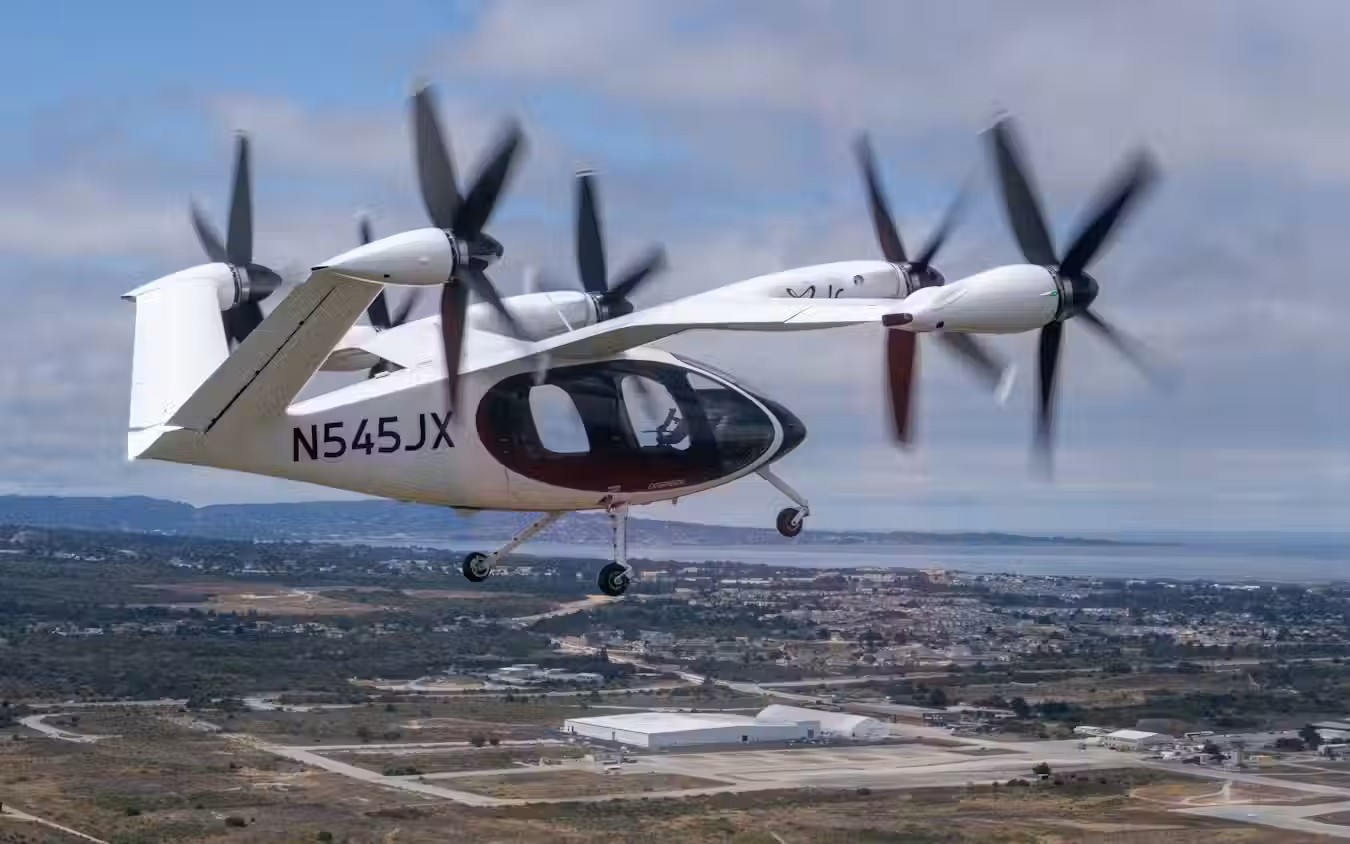


Electric vertical takeoff and landing (eVTOL) air taxi developer Joby Aviation this week took a key step toward its envisioned electric aerial ridesharing service.
After expanding its pilot production facility in Marina, California, to about 435,000 square feet, Joby on Tuesday said it expects to double its air taxi production rate to 24 per year. Ramping up in Marina—the epicenter of its manufacturing efforts and a critical test site for the air taxi—will allow Joby to expand its test fleet, which comprises five eVTOL air taxis plus one liquid hydrogen-powered demonstrator. Collectively, they have flown more than 40,000 miles.

Joby has already begun type inspection authorization (TIA) of the air taxi’s key structures with FAA inspectors ahead of a planned 2026 rollout. It is also conducting testing with the U.S. Air Force at Edwards Air Force Base (KEDW) in California and has committed to delivering a pair of air taxis to MacDill Air Force Base (KMCF) in Florida by year’s end.
Air Taxi Ramp-Up
Joby aims to begin passenger-carrying flights in the United Arab Emirates by early next year, followed by the launch of an aerial ridesharing service in U.S. cities like New York and Los Angeles with partners Delta Air Lines and Uber.
The company has already conducted a few groundbreaking tests at Marina, including simultaneous flight of two aircraft and a piloted transition from hover to wingborne flight—the first for a full-scale, tiltrotor eVTOL prototype. Still on the docket are full-aircraft TIA evaluations with the FAA. But expanding the test fleet could accelerate that process.
Once fully operational, the expanded Marina site is expected to churn out new aircraft every other week. It recently produced Joby’s sixth test aircraft, which earned airworthiness certification within one week and is already flying, the company said. The facility also houses pilot training simulators, maintenance services, and conforming components. Joby believes it will help the firm secure initial FAA production certification, allowing it to ramp up further.
The expansion is expected to create about 690 full-time jobs and is backed by a nearly $10 million grant from the state of California.
Marina—along with facilities in Santa Cruz and San Carlos, California, specializing in system architecture and propulsion—has been Joby’s bedrock production site. But it has even bigger plans for Ohio, where the company last year acquired a 140-acre-site at Dayton International Airport (KDAY).
Recent renovations to the Dayton facility will allow Joby to manufacture and test air taxi components that will be shipped to Marina, it said. Equipment installation is also underway, with plans to begin manufacturing of titanium and aluminum parts this year.
If all goes to plan, Joby expects the facility to eventually encompass 2 million square feet and produce 500 air taxis annually. According to the firm, the site “demonstrates the capabilities required for FAA production certification.”
Joby still has work to do to achieve type certification, but its localized facilities could help. The company designs, builds, and tests its aircraft in the U.S., and it stands to benefit from a recent executive order that bolsters domestic production. Design, manufacturing, pilot training, operations, and more are handled in-house.
Also aiding Joby is the backing of Toyota, its partner and largest investor. Once it finalizes the second of two $250 million investment tranches, the automaker will have poured nearly $900 million into the aircraft developer.
The relationship is not just financial. Toyota’s most recent cash injection includes the potential for it to secure air taxi manufacturing and operating privileges in Japan, where the partners last year conducted an exhibition flight. According to Joby, Toyota engineers are “deeply integrated” across its design, manufacturing, and quality teams, helping the company streamline production. The partners further have a long-term agreement for the supply of powertrain and actuator components.
Joby competitor Archer Aviation has a similar manufacturing arrangement with automaker Stellantis, which is partially funding construction of a scaled production site in Georgia. Archer is targeting an annual production rate of 650 Midnight air taxis.
Like this story? We think you’ll also like the Future of FLYING newsletter sent every Thursday afternoon. Sign up now.

