Air Force, Reliable Team on Flexible Autonomy Architecture

Partners will collaborate on design standards to put commercial autonomy systems in the hands of the military.

Reliable Robotics U.S. Air Force autonomy contract
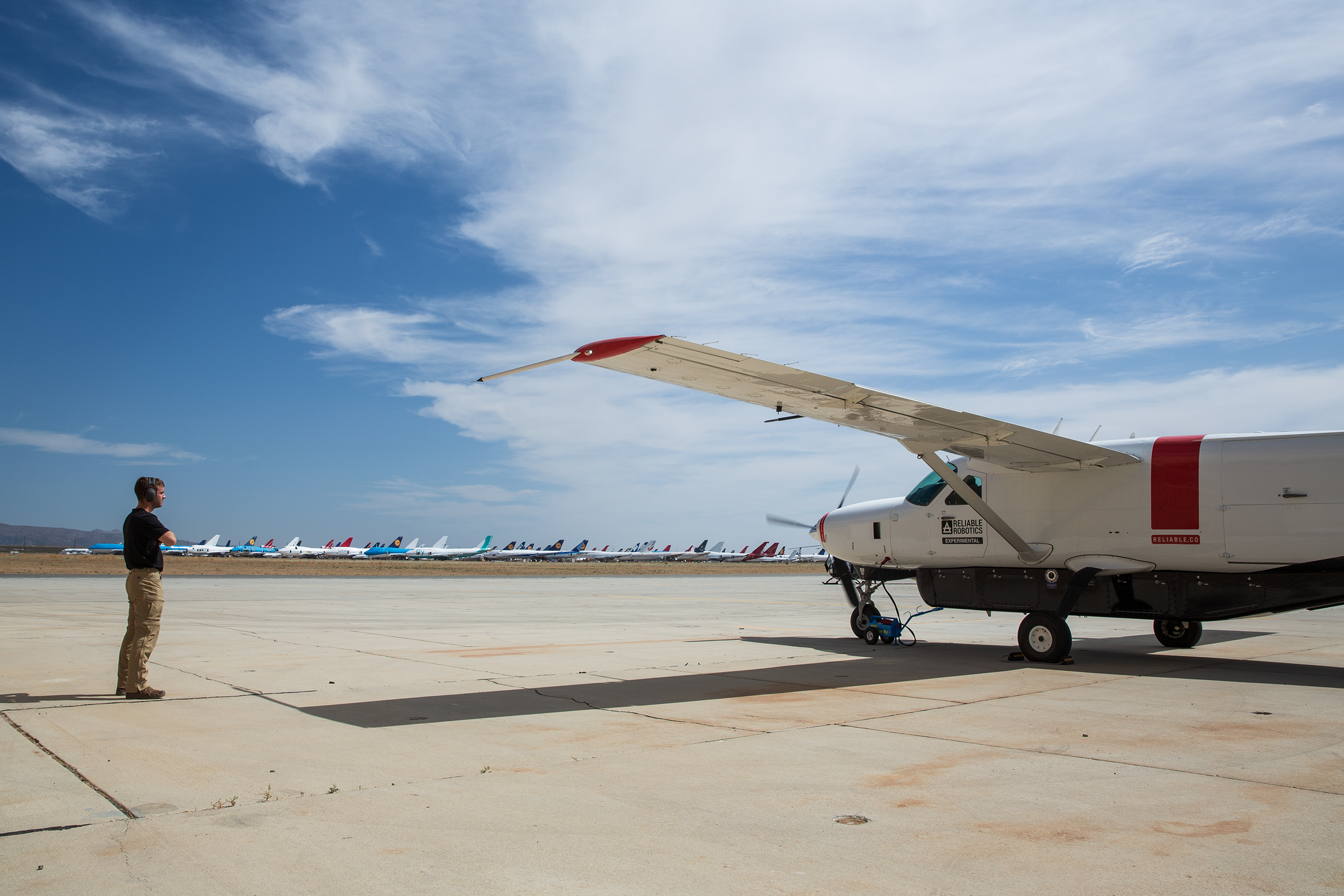
The Air Force in 2024 evaluated Reliable’s autonomy-equipped Cessna 208B Grand Caravan during a series of exercises. [Courtesy: Reliable Robotics]
Gemini Sparkle

Key Takeaways:

  • The U.S. Air Force is expanding its partnership with Reliable Robotics to integrate commercial aircraft autonomy systems, aiming to enhance combat capabilities and reduce risk to human pilots.
  • Reliable Robotics will guide the development of an "Autonomy Government Reference Architecture" (A-GRA) to ensure interoperability and "plug and play" integration of commercial technologies across various Air Force platforms and missions.
  • Reliable's Remotely Operated Aircraft System (ROAS) automates flight phases to prevent pilot error and is simultaneously pursuing FAA certification for commercial use, with the Air Force already evaluating retrofitted aircraft like the Cessna 208B Caravan.
See a mistake? Contact us.

The U.S. Air Force is looking to commercial providers to help bolster its aircraft autonomy systems.

Reliable Robotics—which owns a multiyear deal to retrofit Air Force airlift and aerial refueling aircraft with its platform-agnostic autonomy system—on Tuesday announced the partners are deepening their relationship with a collaborative research and development agreement (CRADA).

Under the CRADA, Reliable will guide the development of an architecture for autonomy systems that are interoperable across multiple platforms and missions. The idea is to add commercial, certifiable technologies to the Air Force’s pool of systems.

Reliable’s remotely operated aircraft system (ROAS) is aircraft-agnostic and designed to prevent accidents due to pilot error or impairment, such as controlled flight into terrain (CFIT) and loss of control in flight (LOC-I).

ROAS uses hardware and software to automate control surfaces and engine controls across all phases of flight. Detect-and-avoid and precision navigation systems help the aircraft understand where it is and where it’s going, while voice and data links enable remote communication. A remote supervisor or onboard safety pilot can step in if necessary.

“Autonomous collaborative platforms will expand the aircraft fleet and enhance combat capabilities while reducing costs and risk to human pilots,” Robert Rose, CEO of Reliable, said in a statement.

The military has explored autonomous collaborative platforms (ACP) since at least 2021. Per the Air Force, these aircraft use human-machine teaming to “provide affordable, runway-flexible capabilities that can operate semiautonomously in high-risk environments.” They can also serve as “force multipliers” in contested environments. The Air Force earlier in July conducted the first demonstration of ACPs in an air combat training scenario.

Autonomy Architecture

According to Reliable, ACPs will be central to the branch’s agile combat employment (ACE) strategy, which calls for platforms that can be rapidly adapted and moved. The Defense Department’s recent budget request calls for additional funding for autonomous systems. Support for self-flying aircraft extends all the way to the White House, which in June released an executive order intended to bolster domestic drone production.

The federal push coincides with a crop of private sector companies developing autonomy tech, including Reliable and fellow Air Force partners Merlin Labs and Xwing. But the Air Force needs a way to ensure that commercial systems are compatible with its platforms.

That’s where the autonomy government reference architecture (A-GRA) comes in. Per the Center for Strategic and International Studies (CSIS), A-GRA is a government source that “guide[s] the system design, development, production, and sustainment processes” for autonomy. Essentially, it gives the industry standards and interfaces to build software that is compatible with existing Air Force platforms and interoperable across missions.

Updating aircraft software is typically a lengthy process due to rigorous flightworthiness testing. With A-GRA, though, the government can specify which portions of the software are flight-certified and largely unchanged. That allows commercial developers to “plug and play” new systems without jeopardizing an aircraft’s FAA certification.

Reliable will share its expertise to ensure that its “recent advancements in low-cost, high-reliability commercial autonomy” are added to the architecture, giving its system a simpler path to integration. If the partners are successful, military pilots would be able to fly autonomously using both civilian and military air traffic control systems.

“Reliable is uniquely positioned to build capabilities allowing the warfighter to perform airspace-agnostic operations at levels of assurance equivalent to civilian aircraft,” Rose said.

Simultaneously, Reliable is working with the FAA to enable commercial integration of its ROAS. The regulator in 2024 accepted testing criteria for its advanced aircraft navigation and autopilot systems, which the company claims is an industry first. In 2023, it greenlit Reliable’s uncrewed flight of an ROAS-equipped Cessna 208B Caravan.

The Caravan, a loan from potential launch customer FedEx, is the company’s primary testbed. The Air Force has already gotten its hands on the retrofitted aircraft for evaluations.

Reliable has also submitted a blueprint to retrofit the military’s KC-135 Stratotankers and said the ROAS could find its way onto other models, such as the Cessna 408 SkyCourier. The system supports cargo aircraft with 3,000-plus-pound payloads.

Like this story? We think you’ll also like the Future of FLYING newsletter sent every Thursday afternoon. Sign up now.

Jack Daleo

Jack is a staff writer covering advanced air mobility, including everything from drones to unmanned aircraft systems to space travel—and a whole lot more. He spent close to two years reporting on drone delivery for FreightWaves, covering the biggest news and developments in the space and connecting with industry executives and experts. Jack is also a basketball aficionado, a frequent traveler and a lover of all things logistics.


Ready to Sell Your Aircraft?

List your airplane on AircraftForSale.com and reach qualified buyers.

List Your Aircraft
AircraftForSale Logo | FLYING Logo
Pilot in aircraft
Sign-up for newsletters & special offers!

Get the latest stories & special offers delivered directly to your inbox.

SUBSCRIBE